
期权策略

Search documents
能源化工期权策略早报:能源化工期权-20250923
Wu Kuang Qi Huo· 2025-09-23 02:00
Group 1: Report Summary - The report is an energy and chemical options strategy morning report, covering energy (crude oil, LPG), polyolefins (PP, PVC, etc.), polyesters (PX, PTA, etc.), alkali chemicals (caustic soda, soda ash), and other energy and chemical products [3]. - The recommended strategy is to construct an option portfolio strategy mainly as a seller, along with spot hedging or covered strategies to enhance returns [3]. Group 2: Underlying Futures Market Overview - Crude oil (SC2511) latest price is 478, down 7, a decline of 1.38%, with a trading volume of 9.61 million lots and an open interest of 3.53 million lots [4]. - LPG (PG2511) latest price is 4,259, down 34, a decline of 0.79%, with a trading volume of 9.06 million lots and an open interest of 8.12 million lots [4]. - Other varieties such as methanol, ethylene glycol, etc., also have corresponding price, trading volume, and open - interest data [4]. Group 3: Option Factors - Volume and Open Interest PCR - For crude oil options, the volume PCR is 0.83, down 0.11, and the open - interest PCR is 0.88, down 0.15 [5]. - For LPG options, the volume PCR is 1.83, up 0.62, and the open - interest PCR is 0.79, down 0.03 [5]. Group 4: Option Factors - Pressure and Support Levels - The pressure level for crude oil is 570 and the support level is 480 [6]. - The pressure level for LPG is 4,500 and the support level is 4,200 [6]. Group 5: Option Factors - Implied Volatility - The at - the - money implied volatility of crude oil options is 30.57%, and the weighted implied volatility is 33.81%, up 0.83 [7]. - The at - the - money implied volatility of LPG options is 17.815%, and the weighted implied volatility is 19.67%, down 0.13 [7]. Group 6: Option Strategies and Recommendations Energy - related Options (Crude Oil) - Fundamental analysis: OPEC plans to discuss early release of 1.6 million barrels per day of production cuts, and Russia has production cut plans from July to December and supports extending the gasoline export ban until November [8]. - Market analysis: Crude oil has shown a bearish market trend since July, with weak fluctuations in September [8]. - Option factor research: Implied volatility fluctuates around the mean, open - interest PCR above 1.00 indicates a sideways market, and the pressure and support levels are 570 and 480 respectively [8]. - Option strategy recommendations: Directional strategy: None; Volatility strategy: Construct a short - biased call + put option combination strategy; Spot long - hedging strategy: Construct a long collar strategy [8]. Energy - related Options (LPG) - Fundamental analysis: PDH plant maintenance is stable, but profit decline may lead to a decrease in capacity utilization [9][10]. - Market analysis: LPG has shown an oversold rebound market trend with pressure above [10]. - Option factor research: Implied volatility has dropped significantly to around the mean, open - interest PCR around 0.80 indicates a sideways market, and the pressure and support levels are 4,500 and 4,200 respectively [10]. - Option strategy recommendations: Directional strategy: None; Volatility strategy: Construct a neutral - biased call + put option combination strategy; Spot long - hedging strategy: Construct a long collar strategy [10]. Alcohol - related Options (Methanol) - Fundamental analysis: Port inventory is at a new high, and enterprise inventory and orders have changed [10]. - Market analysis: Methanol has shown a weak market trend with pressure above [10]. - Option factor research: Implied volatility has dropped and fluctuates below the mean, open - interest PCR around 0.80 indicates a weak sideways market, and the pressure and support levels are 2,400 and 2,250 respectively [10]. - Option strategy recommendations: Directional strategy: Construct a bearish put spread strategy; Volatility strategy: Construct a short - biased call + put option combination strategy; Spot long - hedging strategy: Construct a long collar strategy [10]. Alcohol - related Options (Ethylene Glycol) - Fundamental analysis: Port inventory is expected to fluctuate at a low level in the short term and may enter a stocking cycle later [11]. - Market analysis: Ethylene glycol has shown a weak market trend with pressure above [11]. - Option factor research: Implied volatility fluctuates below the mean, open - interest PCR around 0.60 indicates strong bearish power, and the pressure and support levels are 4,500 and 4,250 respectively [11]. - Option strategy recommendations: Directional strategy: Construct a bearish put spread strategy; Volatility strategy: Construct a short - volatility strategy; Spot long - hedging strategy: Hold spot long + buy put option + sell out - of - the - money call option [11]. Polyolefin - related Options - Fundamental analysis: PE and PP inventory levels have changed, with PP having higher inventory pressure [12]. - Market analysis: Polypropylene has shown a weak market trend with pressure above [12]. - Option factor research: Implied volatility has dropped to below the mean, open - interest PCR around 0.80 indicates a weakening trend, and the pressure and support levels are 7,400 and 6,700 respectively [12]. - Option strategy recommendations: Directional strategy: None; Volatility strategy: None; Spot long - hedging strategy: Hold spot long + buy at - the - money put option + sell out - of - the - money call option [12]. Rubber - related Options - Fundamental analysis: Affected by the rubber tapping season in Southeast Asia and increased overseas supply expectations, the global rubber futures market has continued to decline [13]. - Market analysis: Rubber has shown a weak sideways market trend with support below and pressure above [13]. - Option factor research: Implied volatility has risen sharply and then dropped to around the mean, open - interest PCR below 0.60, and the pressure and support levels are 17,000 and 14,000 respectively [13]. - Option strategy recommendations: Directional strategy: None; Volatility strategy: Construct a neutral - biased call + put option combination strategy; Spot hedging strategy: None [13]. Polyester - related Options (PTA) - Fundamental analysis: PTA social inventory has increased slightly, and it is expected to maintain a de - stocking pattern [13]. - Market analysis: PTA has shown a weak bearish market trend with pressure above [13]. - Option factor research: Implied volatility fluctuates at a relatively high level above the mean, open - interest PCR around 0.70 indicates a sideways market, and the pressure and support levels are 5,000 and 4,400 respectively [13]. - Option strategy recommendations: Directional strategy: None; Volatility strategy: Construct a short - biased call + put option combination strategy; Spot hedging strategy: None [13]. Alkali - related Options (Caustic Soda) - Fundamental analysis: Caustic soda plant inventory has increased [14]. - Market analysis: Caustic soda has shown a downward - trending market with pressure above [14]. - Option factor research: Implied volatility fluctuates at a relatively high level, open - interest PCR below 0.90 indicates a weak sideways market, and the pressure and support levels are 3,000 and 2,440 respectively [14]. - Option strategy recommendations: Directional strategy: None; Volatility strategy: None; Spot collar hedging strategy: Hold spot long + buy put option + sell out - of - the - money call option [14]. Alkali - related Options (Soda Ash) - Fundamental analysis: Soda ash plant inventory has decreased, and inventory available days have shortened [14]. - Market analysis: Soda ash has shown a low - level sideways market trend with support below [14]. - Option factor research: Implied volatility fluctuates at a relatively high historical level, open - interest PCR below 0.60 indicates strong bearish pressure, and the pressure and support levels are 1,300 and 1,200 respectively [14]. - Option strategy recommendations: Directional strategy: None; Volatility strategy: Construct a short - volatility combination strategy; Spot long - hedging strategy: Construct a long collar strategy [14]. Urea - related Options - Fundamental analysis: Urea enterprise inventory is at a high level, and domestic demand is weak [15]. - Market analysis: Urea has shown a weak sideways market trend at a low level [15]. - Option factor research: Implied volatility fluctuates slightly around the historical mean, open - interest PCR below 0.60 indicates strong bearish pressure, and the pressure and support levels are 1,800 and 1,620 respectively [15]. - Option strategy recommendations: Directional strategy: None; Volatility strategy: Construct a short - biased call + put option combination strategy; Spot hedging strategy: Hold spot long + buy at - the - money put option + sell out - of - the - money call option [15].
金融期权策略早报:金融期权-20250923
Wu Kuang Qi Huo· 2025-09-23 01:36
1. Report Industry Investment Rating - No relevant content provided 2. Core Views of the Report - The stock market, including the Shanghai Composite Index, large - cap blue - chip stocks, small and medium - cap stocks, and ChiNext stocks, shows a market trend of rising, falling back, rebounding, and then oscillating at a high level [3]. - The implied volatility of financial options gradually rises and fluctuates at a relatively high mean level [3]. - For ETF options, it is suitable to construct a bullish buyer strategy and a bull spread strategy of call options; for index options, it is suitable to construct a bullish seller strategy, a bull spread strategy of call options, and an arbitrage strategy of synthetic long futures with options and short futures [3]. 3. Summary According to Related Catalogs 3.1 Financial Market Important Index Overview - The Shanghai Composite Index closed at 3,828.58, up 8.49 points or 0.22%, with a trading volume of 941.8 billion yuan and a decrease of 74.5 billion yuan [3]. - The Shenzhen Component Index closed at 13,157.97, up 87.11 points or 0.67%, with a trading volume of 1,179.7 billion yuan and a decrease of 127.8 billion yuan [3]. - The Shanghai 50 Index closed at 2,922.18, up 12.44 points or 0.43%, with a trading volume of 156.4 billion yuan and a decrease of 6.9 billion yuan [3]. - The CSI 300 Index closed at 4,522.61, up 20.69 points or 0.46%, with a trading volume of 563.1 billion yuan and a decrease of 40.7 billion yuan [3]. - The CSI 500 Index closed at 7,225.13, up 54.78 points or 0.76%, with a trading volume of 421.9 billion yuan and a decrease of 28.7 billion yuan [3]. - The CSI 1000 Index closed at 7,489.48, up 51.29 points or 0.69%, with a trading volume of 440.5 billion yuan and a decrease of 42.7 billion yuan [3]. 3.2 Option - underlying ETF Market Overview - The Shanghai 50 ETF closed at 3.054, up 0.009 or 0.30%, with a trading volume of 6.331 million shares and a decrease of 0.7 billion yuan in trading volume [4]. - The Shanghai 300 ETF closed at 4.619, up 0.015 or 0.33%, with a trading volume of 6.2928 million shares and a decrease of 4.73 billion yuan in trading volume [4]. - The Shanghai 500 ETF closed at 7.318, up 0.057 or 0.79%, with a trading volume of 2.3562 million shares and a decrease of 3.66 billion yuan in trading volume [4]. - The Huaxia Science and Technology Innovation 50 ETF closed at 1.479, up 0.048 or 3.35%, with a trading volume of 42.4991 million shares and a decrease of 1.58 billion yuan in trading volume [4]. - The E Fund Science and Technology Innovation 50 ETF closed at 1.447, up 0.049 or 3.51%, with a trading volume of 12.6646 million shares and a decrease of 1.15 billion yuan in trading volume [4]. - The Shenzhen 300 ETF closed at 4.764, up 0.017 or 0.36%, with a trading volume of 1.3823 million shares and a decrease of 1.02 billion yuan in trading volume [4]. - The Shenzhen 500 ETF closed at 2.923, up 0.020 or 0.69%, with a trading volume of 0.9841 million shares and an increase of 0.06 billion yuan in trading volume [4]. - The Shenzhen 100 ETF closed at 3.494, up 0.019 or 0.55%, with a trading volume of 0.733 million shares and a decrease of 0.25 billion yuan in trading volume [4]. - The ChiNext ETF closed at 3.082, up 0.020 or 0.65%, with a trading volume of 13.8208 million shares and a decrease of 10.39 billion yuan in trading volume [4]. 3.3 Option Factor - Volume and Position PCR - For the Shanghai 50 ETF option, the trading volume was 1.1104 million contracts, down 436,400 contracts; the open interest was 1.8507 million contracts, down 224,300 contracts; the volume PCR was 0.73, down 0.41; the position PCR was 0.70, down 0.06 [6]. - For the Shanghai 300 ETF option, the trading volume was 0.9962 million contracts, down 844,100 contracts; the open interest was 1.4693 million contracts, down 271,700 contracts; the volume PCR was 0.88, down 0.65; the position PCR was 1.10, down 0.05 [6]. - For the Shanghai 500 ETF option, the trading volume was 1.6188 million contracts, down 859,900 contracts; the open interest was 1.3395 million contracts, down 228,100 contracts; the volume PCR was 1.05, down 0.35; the position PCR was 1.35, up 0.02 [6]. - For the Huaxia Science and Technology Innovation 50 ETF option, the trading volume was 2.4825 million contracts, down 287,500 contracts; the open interest was 2.4466 million contracts, down 226,800 contracts; the volume PCR was 0.75, down 0.43; the position PCR was 1.15, up 0.04 [6]. - For the E Fund Science and Technology Innovation 50 ETF option, the trading volume was 0.4856 million contracts, down 39,000 contracts; the open interest was 0.6715 million contracts, down 63,700 contracts; the volume PCR was 0.68, down 0.15; the position PCR was 1.00, up 0.05 [6]. - For the Shenzhen 300 ETF option, the trading volume was 0.2057 million contracts, down 39,400 contracts; the open interest was 0.363 million contracts, down 2,100 contracts; the volume PCR was 0.90, up 0.17; the position PCR was 1.01, up 0.01 [6]. - For the Shenzhen 500 ETF option, the trading volume was 0.3285 million contracts, down 88,500 contracts; the open interest was 0.4385 million contracts, down 6,800 contracts; the volume PCR was 1.53, up 0.10; the position PCR was 0.93, up 0.03 [6]. - For the Shenzhen 100 ETF option, the trading volume was 0.142 million contracts, down 19,100 contracts; the open interest was 0.1772 million contracts, up 1,400 contracts; the volume PCR was 2.97, down 1.13; the position PCR was 1.36, down 0.07 [6]. - For the ChiNext ETF option, the trading volume was 2.0114 million contracts, down 135,000 contracts; the open interest was 2.1809 million contracts, up 18,700 contracts; the volume PCR was 1.00, up 0.10; the position PCR was 1.37, up 0.03 [6]. - For the Shanghai 50 index option, the trading volume was 31,100 contracts, down 31,000 contracts; the open interest was 62,000 contracts, up 6,400 contracts; the volume PCR was 0.47, down 0.21; the position PCR was 0.59, down 0.02 [6]. - For the CSI 300 index option, the trading volume was 85,500 contracts, down 103,200 contracts; the open interest was 151,100 contracts, up 14,000 contracts; the volume PCR was 0.65, unchanged; the position PCR was 0.75, up 0.01 [6]. - For the CSI 1000 index option, the trading volume was 197,900 contracts, down 265,000 contracts; the open interest was 235,800 contracts, up 14,200 contracts; the volume PCR was 0.81, down 0.04; the position PCR was 0.93, down 0.01 [6]. 3.4 Option Factor - Pressure and Support Points - The pressure point of the Shanghai 50 ETF is 3.10, and the support point is 3.00 [8]. - The pressure point of the Shanghai 300 ETF is 4.60, and the support point is 4.60 [8]. - The pressure point of the Shanghai 500 ETF is 7.50, and the support point is 7.00 [8]. - The pressure point of the Huaxia Science and Technology Innovation 50 ETF is 1.65, and the support point is 1.40 [8]. - The pressure point of the E Fund Science and Technology Innovation 50 ETF is 1.60, and the support point is 1.35 [8]. - The pressure point of the Shenzhen 300 ETF is 4.80, and the support point is 4.70 [8]. - The pressure point of the Shenzhen 500 ETF is 3.00, and the support point is 2.85 [8]. - The pressure point of the Shenzhen 100 ETF is 3.60, and the support point is 3.30 [8]. - The pressure point of the ChiNext ETF is 3.10, and the support point is 3.00 [8]. - The pressure point of the Shanghai 50 index is 3,000, and the support point is 2,850 [8]. - The pressure point of the CSI 300 index is 4,600, and the support point is 4,500 [8]. - The pressure point of the CSI 1000 index is 7,500, and the support point is 7,400 [8]. 3.5 Option Factor - Implied Volatility - For the Shanghai 50 ETF option, the at - the - money implied volatility was 19.40%, the weighted implied volatility was 21.26%, down 0.16 percentage points, the annual average was 16.03%, the call implied volatility was 21.56%, the put implied volatility was 20.80%, the 20 - day historical volatility was 18.81%, and the difference between implied and historical volatility was 2.45% [11]. - For the Shanghai 300 ETF option, the at - the - money implied volatility was 18.91%, the weighted implied volatility was 20.11%, down 0.18 percentage points, the annual average was 16.46%, the call implied volatility was 20.25%, the put implied volatility was 19.94%, the 20 - day historical volatility was 18.44%, and the difference between implied and historical volatility was 1.67% [11]. - For the Shanghai 500 ETF option, the at - the - money implied volatility was 22.97%, the weighted implied volatility was 24.17%, down 2.17 percentage points, the annual average was 20.17%, the call implied volatility was 24.17%, the put implied volatility was 24.16%, the 20 - day historical volatility was 22.80%, and the difference between implied and historical volatility was 1.36% [11]. - For the Huaxia Science and Technology Innovation 50 ETF option, the at - the - money implied volatility was 48.62%, the weighted implied volatility was 47.36%, down 2.11 percentage points, the annual average was 31.30%, the call implied volatility was 46.50%, the put implied volatility was 48.73%, the 20 - day historical volatility was 43.11%, and the difference between implied and historical volatility was 4.25% [11]. - For the E Fund Science and Technology Innovation 50 ETF option, the at - the - money implied volatility was 45.61%, the weighted implied volatility was 48.02%, down 3.02 percentage points, the annual average was 32.11%, the call implied volatility was 46.24%, the put implied volatility was 50.92%, the 20 - day historical volatility was 44.65%, and the difference between implied and historical volatility was 3.37% [11]. - For the Shenzhen 300 ETF option, the at - the - money implied volatility was 19.87%, the weighted implied volatility was 23.85%, up 1.72 percentage points, the annual average was 18.09%, the call implied volatility was 21.13%, the put implied volatility was 27.03%, the 20 - day historical volatility was 20.94%, and the difference between implied and historical volatility was 2.91% [11]. - For the Shenzhen 500 ETF option, the at - the - money implied volatility was 23.66%, the weighted implied volatility was 31.95%, down 10.80 percentage points, the annual average was 21.53%, the call implied volatility was 25.16%, the put implied volatility was 38.83%, the 20 - day historical volatility was 24.52%, and the difference between implied and historical volatility was 7.43% [11]. - For the Shenzhen 100 ETF option, the at - the - money implied volatility was 25.85%, the weighted implied volatility was 64.35%, down 19.79 percentage points, the annual average was 23.80%, the call implied volatility was 27.99%, the put implied volatility was 88.09%, the 20 - day historical volatility was 26.84%, and the difference between implied and historical volatility was 37.51% [11]. - For the ChiNext ETF option, the at - the - money implied volatility was 38.90%, the weighted implied volatility was 45.45%, up 3.80 percentage points, the annual average was 27.47%, the call implied volatility was 39.62%, the put implied volatility was 51.56%, the 20 - day historical volatility was 36.83%, and the difference between implied and historical volatility was 8.62% [11]. - For the Shanghai 50 index option, the at - the - money implied volatility was 19.64%, the weighted implied volatility was 21.87%, down 0.63 percentage points, the annual average was 17.40%, the call implied volatility was 22.20%, the put implied volatility was 21.12%, the 20 - day historical volatility was 19.23%, and the difference between implied and historical volatility was 2.64% [11]. - For the CSI 300 index option, the at - the - money implied volatility was 20.66%, the weighted implied volatility was 21.91%, down 0.51 percentage points, the annual average was 17.13%, the call implied volatility was 21.81%, the put implied volatility was 22.06%, the 20 - day historical volatility was 18.52%, and the difference between implied and historical volatility was 3.39% [11]. - For the CSI 1000 index option, the at - the - money implied volatility was
能源化工期权策略早报:能源化工期权-20250922
Wu Kuang Qi Huo· 2025-09-22 03:46
1. Report Industry Investment Rating - Not available in the provided content 2. Core Viewpoints - Energy chemical options cover various categories including energy, polyolefins, polyesters, alkali chemicals, and others [3]. - The strategy suggests constructing option - combination strategies mainly as sellers, along with spot hedging or covered strategies to enhance returns [3]. 3. Summary by Related Catalogs 3.1. Futures Market Overview - Different energy - chemical option underlying futures have different price, trading volume, and open - interest changes. For example, crude oil (SC2511) closed at 484, down 8 (-1.55%), with a trading volume of 10.89 million lots and an open interest of 3.38 million lots [4]. 3.2. Option Factors - Volume and Open - Interest PCR - PCR indicators for different options vary. For instance, the volume PCR of crude oil options is 0.94, down 0.07, and the open - interest PCR is 1.03, down 0.13 [5]. 3.3. Option Factors - Pressure and Support Levels - Each option has its pressure and support levels. For example, the pressure level of crude oil options is 570, and the support level is 480 [6]. 3.4. Option Factors - Implied Volatility - Implied volatility of different options shows different trends. For example, the flat - strike implied volatility of crude oil options is 30.21%, and the weighted implied volatility is 32.98%, up 0.27% [7]. 3.5. Strategy and Recommendations 3.5.1. Energy - Class Options (Crude Oil) - Fundamental analysis: OPEC may discuss early release of 1.6 million barrels per day of production cuts, and Russia has its own production - cut plan [8]. - Market analysis: Crude oil has been in a weak and range - bound pattern since July, with short - term weakness in August and September [8]. - Option factor research: Implied volatility fluctuates around the mean, open - interest PCR is above 1.00, indicating a range - bound market, and the pressure and support levels are 570 and 480 respectively [8]. - Strategy recommendations: Directional strategy: None; Volatility strategy: Construct a short - biased call + put option combination strategy; Spot long - hedging strategy: Construct a long collar strategy [8]. 3.5.2. Energy - Class Options (LPG) - Fundamental analysis: PDH device maintenance is stable, but profit decline may lead to a decrease in capacity utilization [10]. - Market analysis: LPG has shown an oversold rebound pattern with pressure above [10]. - Option factor research: Implied volatility has dropped significantly to around the mean, open - interest PCR is around 0.80, indicating a range - bound market, and the pressure and support levels are 4800 and 4700 respectively [10]. - Strategy recommendations: Directional strategy: None; Volatility strategy: Construct a neutral - biased call + put option combination strategy; Spot long - hedging strategy: Construct a long collar strategy [10]. 3.5.3. Alcohol - Class Options (Methanol) - Fundamental analysis: Port inventory has reached a new high, and enterprise inventory and orders have changed [10]. - Market analysis: Methanol has shown a weak pattern with pressure above [10]. - Option factor research: Implied volatility has declined and fluctuates below the mean, open - interest PCR is around 0.80, indicating a weak - range - bound market, and the pressure and support levels are 2400 and 2250 respectively [10]. - Strategy recommendations: Directional strategy: Construct a bear - spread strategy with put options; Volatility strategy: Construct a short - biased call + put option combination strategy; Spot long - hedging strategy: Construct a long collar strategy [10]. 3.5.4. Alcohol - Class Options (Ethylene Glycol) - Fundamental analysis: Port inventory is expected to be in a low - level shock and then enter a stock - building cycle [11]. - Market analysis: Ethylene glycol has shown a weak pattern with pressure above [11]. - Option factor research: Implied volatility fluctuates below the mean, open - interest PCR is around 0.60, indicating strong short - side power, and the pressure and support levels are 4500 and 4250 respectively [11]. - Strategy recommendations: Directional strategy: Construct a bear - spread strategy with put options; Volatility strategy: Construct a short - volatility strategy; Spot long - hedging strategy: Hold spot long + buy put options + sell out - of - the - money call options [11]. 3.5.5. Polyolefin - Class Options - Fundamental analysis: Polyolefin inventory has different changes in production enterprises, traders, and ports, with PP having higher inventory pressure than PE [12]. - Market analysis: Polypropylene has shown a weak pattern with pressure above [12]. - Option factor research: Implied volatility has declined to below the mean, open - interest PCR is around 0.80, indicating a weak trend, and the pressure and support levels are 7400 and 6700 respectively [12]. - Strategy recommendations: Directional strategy: None; Volatility strategy: None; Spot long - hedging strategy: Hold spot long + buy at - the - money put options + sell out - of - the - money call options [12]. 3.5.6. Rubber Options - Fundamental analysis: Affected by the rubber - tapping season in Southeast Asia and increased overseas supply expectations, the global rubber futures market has declined [13]. - Market analysis: Rubber has shown a weak - range - bound pattern with support below and pressure above [13]. - Option factor research: Implied volatility has risen sharply and then dropped to around the mean, open - interest PCR is below 0.60, and the pressure and support levels are 17000 and 15750 respectively [13]. - Strategy recommendations: Directional strategy: None; Volatility strategy: Construct a neutral - biased call + put option combination strategy; Spot hedging strategy: None [13]. 3.5.7. Polyester - Class Options - Fundamental analysis: PTA inventory has increased slightly, but it is expected to maintain a de - stocking pattern due to high downstream load and more maintenance in September [14]. - Market analysis: PTA has shown a weak - bearish pattern with pressure above [14]. - Option factor research: Implied volatility fluctuates at a relatively high level, open - interest PCR is around 0.70, indicating a range - bound market, and the pressure and support levels are 5000 and 4400 respectively [14]. - Strategy recommendations: Directional strategy: None; Volatility strategy: Construct a short - biased call + put option combination strategy; Spot hedging strategy: None [14]. 3.5.8. Alkali - Class Options (Caustic Soda) - Fundamental analysis: Caustic soda factory inventory has increased [15]. - Market analysis: Caustic soda has shown a downward - trending pattern with pressure above [15]. - Option factor research: Implied volatility fluctuates at a high level, open - interest PCR is below 0.90, indicating a weak - range - bound market, and the pressure and support levels are 3000 and 2440 respectively [15]. - Strategy recommendations: Directional strategy: None; Volatility strategy: None; Spot collar hedging strategy: Hold spot long + buy put options + sell out - of - the - money call options [15]. 3.5.9. Alkali - Class Options (Soda Ash) - Fundamental analysis: Soda ash factory inventory has decreased [15]. - Market analysis: Soda ash has shown a low - level range - bound pattern with support below [15]. - Option factor research: Implied volatility fluctuates at a relatively high historical level, open - interest PCR is below 0.60, indicating strong short - side pressure, and the pressure and support levels are 1300 and 1200 respectively [15]. - Strategy recommendations: Directional strategy: Not specified; Volatility strategy: Construct a short - volatility combination strategy; Spot long - hedging strategy: Construct a long collar strategy [15]. 3.5.10. Urea Options - Fundamental analysis: Urea enterprise inventory has increased, and domestic demand is still weak [16]. - Market analysis: Urea has shown a low - level weak - range - bound pattern [16]. - Option factor research: Implied volatility fluctuates around the historical mean, open - interest PCR is below 0.60, indicating strong short - side pressure, and the pressure and support levels are 1800 and 1620 respectively [16]. - Strategy recommendations: Directional strategy: None; Volatility strategy: Construct a short - biased call + put option combination strategy; Spot hedging strategy: Hold spot long + buy at - the - money put options + sell out - of - the - money call options [16].
农产品期权策略早报:农产品期权-20250922
Wu Kuang Qi Huo· 2025-09-22 02:56
1. Report Industry Investment Rating - Not provided in the content 2. Core Viewpoints of the Report - The agricultural products options market shows diverse trends, with oilseeds and oils, agricultural by - products, soft commodities, and grains each having their own market conditions. Strategies mainly focus on constructing option combination strategies based on sellers and spot hedging or covered strategies to enhance returns [2] 3. Summary by Related Catalogs 3.1 Market Overview of Underlying Futures - Different agricultural product options have various price changes, trading volumes, and open interest changes. For example, the latest price of soybean No.1 (A2511) is 3,901, down 5 with a decline of 0.13%, and its trading volume is 10.47 million lots, down 0.52 million lots [3] 3.2 Option Factors - Volume and Open Interest PCR - The volume and open - interest PCR of different options are used to describe the strength of the option underlying market and the turning point of the underlying market. For instance, the volume PCR of soybean No.1 is 0.39, down 0.18, and the open - interest PCR is 0.43, with no change [4] 3.3 Option Factors - Pressure and Support Levels - From the perspective of the maximum open interest of call and put options, the pressure and support levels of different option underlyings are determined. For example, the pressure level of soybean No.1 is 4000, and the support level is 3900 [5] 3.4 Option Factors - Implied Volatility - The implied volatility of different options is calculated, including at - the - money implied volatility and weighted implied volatility. For example, the at - the - money implied volatility of soybean No.1 is 10.17%, and the weighted implied volatility is 13.00%, up 0.81% [6] 3.5 Strategies and Recommendations 3.5.1 Oilseeds and Oils Options - **Soybean No.1 and No.2**: The fundamental situation of soybeans shows the arrival volume of domestic oil mills. The market of soybean No.1 is in a weak shock. Option strategies include constructing a neutral call + put option combination strategy and a long collar strategy for spot hedging [7] - **Soybean Meal and Rapeseed Meal**: The trading volume of soybean meal has decreased. The market of soybean meal is in a weak shock with pressure. Option strategies include constructing a bear spread strategy for call options and a long collar strategy for spot hedging [9] - **Palm Oil, Soybean Oil, and Rapeseed Oil**: The total inventory of domestic oils is higher than last year. The market of palm oil is in a high - level shock. Option strategies include constructing a long - biased call + put option combination strategy and a long collar strategy for spot hedging [10] - **Peanuts**: The import volume of peanuts has decreased, and the market is in a weak shock. Option strategies include constructing a bear spread strategy for call options and a long collar strategy for spot hedging [11] 3.5.2 Agricultural By - products Options - **Pigs**: The pig market is in a supply - exceeding - demand situation, and the price is in a weak shock. Option strategies include constructing a short - biased call + put option combination strategy and a covered call strategy for spot hedging [11] - **Eggs**: The inventory of laying hens is expected to increase. The egg market is in a weak bearish trend. Option strategies include constructing a bear spread strategy for call options and a short - biased call + put option combination strategy [12] - **Apples**: The cold - storage inventory of apples has decreased. The apple market is in a warming - up upward trend. Option strategies include constructing a long - biased call + put option combination strategy [12] - **Jujubes**: The physical inventory of jujubes has decreased. The jujube market is in a large - amplitude shock. Option strategies include constructing a short - biased strangle option combination strategy and a covered call strategy for spot hedging [13] 3.5.3 Soft Commodities Options - **Sugar**: The sugar production in Brazil has increased, and the import volume in China has also increased. The sugar market is in a weak bearish trend. Option strategies include constructing a short - biased call + put option combination strategy and a long collar strategy for spot hedging [13] - **Cotton**: The开机 rate of spinning and weaving factories and the commercial inventory of cotton have changed. The cotton market is in a short - term weak trend. Option strategies include constructing a long - biased call + put option combination strategy and a covered call strategy for spot hedging [14] 3.5.4 Grains Options - **Corn and Starch**: The auction volume and成交 rate of corn have certain characteristics, and the corn market is in a weak shock. Option strategies include constructing a short - biased call + put option combination strategy [14]
金属期权策略早报:金属期权-20250919
Wu Kuang Qi Huo· 2025-09-19 02:09
1. Report Industry Investment Rating - Not provided in the document 2. Core Views of the Report - For non - ferrous metals, construct a neutral volatility strategy for sellers when the market is range - bound, and a short - volatility strategy for black metals with large fluctuations. For precious metals, build a spot hedging strategy as they break upward [2]. 3. Summary by Related Catalogs 3.1 Futures Market Overview - Various metal futures have different price movements, trading volumes, and open interest changes. For example, copper (CU2511) closed at 79,660, down 0.15% with a trading volume of 8.93 million lots and an open interest of 17.26 million lots [3]. 3.2 Option Factors - Volume and Open Interest PCR - Volume PCR and open interest PCR are used to describe the strength of the option underlying market and the turning point of the market respectively. For instance, the volume PCR of copper is 0.64 with a change of 0.08, and the open interest PCR is 0.71 with a change of - 0.01 [4]. 3.3 Option Factors - Pressure and Support Levels - From the perspective of the maximum open interest of call and put options, the pressure and support levels of each metal option are determined. For example, the pressure point of copper is 82,000 and the support point is 79,000 [5]. 3.4 Option Factors - Implied Volatility - Implied volatility data such as at - the - money implied volatility, weighted implied volatility, and their changes, historical average, call and put implied volatility, and historical volatility are provided for each metal option. For example, the at - the - money implied volatility of copper is 13.02% [6]. 3.5 Option Strategies and Recommendations 3.5.1 Non - ferrous Metals - **Copper**: Build a short - volatility seller option portfolio strategy and a spot long - hedging strategy [7]. - **Aluminum/Alumina**: Construct a short - neutral call + put option combination strategy and a spot collar strategy [9]. - **Zinc/Lead**: Build a short - neutral call + put option combination strategy and a spot collar strategy [9]. - **Nickel**: Construct a short - bearish call + put option combination strategy and a spot covered call strategy [10]. - **Tin**: Build a short - volatility strategy and a spot collar strategy [10]. - **Lithium Carbonate**: Construct a short - bearish call + put option combination strategy and a spot long - hedging strategy [11]. 3.5.2 Precious Metals - **Gold/Silver**: Build a long - biased short - volatility option seller portfolio strategy and a spot hedging strategy [12]. 3.5.3 Black Metals - **Rebar**: Construct a short - bearish call + put option combination strategy and a spot long - covered call strategy [14]. - **Iron Ore**: Build a short - neutral call + put option combination strategy and a spot long - collar strategy [14]. - **Ferroalloys**: Build a short - volatility strategy [15]. - **Industrial Silicon/Polysilicon**: Construct a short - volatility call + put option combination strategy and a spot hedging strategy [15]. - **Glass**: Build a short - volatility call + put option combination strategy and a spot long - collar strategy [16].
能源化工期权策略早报:能源化工期权-20250919
Wu Kuang Qi Huo· 2025-09-19 02:03
Group 1: Report Overview - The report is an early morning strategy report on energy and chemical options dated September 19, 2025 [2] - It covers various categories of energy and chemical options, including energy, polyolefins, polyesters, alkali chemicals, and others [3] - The recommended strategy is to construct option portfolio strategies mainly as sellers, along with spot hedging or covered strategies to enhance returns [3] Group 2: Underlying Futures Market Overview - Information on the latest price, change, percentage change, trading volume, volume change, open interest, and open interest change of multiple underlying contracts such as crude oil, liquefied gas, and methanol is provided [4] Group 3: Option Factor - Volume and Open Interest PCR - Data on the trading volume, volume change, open interest, open interest change, volume PCR, volume PCR change, open interest PCR, and open interest PCR change of different option varieties are presented [5] - The volume PCR and open interest PCR are used to describe the strength of the underlying option market and the turning point of the underlying market respectively [5] Group 4: Option Factor - Pressure and Support Levels - The pressure points, pressure point offsets, support points, support point offsets, maximum call option open interest, and maximum put option open interest of various option varieties are shown [6] - These are determined based on the strike prices with the maximum open interest of call and put options [6] Group 5: Option Factor - Implied Volatility - Data on the at - the - money implied volatility, weighted implied volatility, weighted implied volatility change, annual average implied volatility, call option implied volatility, put option implied volatility, 20 - day historical volatility, and the difference between implied and historical volatility of different option varieties are provided [7] - The at - the - money implied volatility is the arithmetic average of call and put at - the - money option implied volatilities, and the weighted implied volatility uses volume - weighted average [7] Group 6: Strategy and Recommendations for Different Options Energy - related Options Crude Oil - Fundamental data shows changes in European ARA weekly gasoline, diesel, fuel oil, and naphtha inventories [8] - The market has been weak and bearish since July, with the option implied volatility around the average, and the open interest PCR indicating a sideways market [8] - Recommended strategies include constructing a short - biased call + put option combination for volatility, and a long collar strategy for spot hedging [8] Liquefied Gas - Factory and port inventories have changed, and the market has shown a pattern of over - sold rebound [10] - The option implied volatility has dropped to near the average, and the open interest PCR indicates a sideways market [10] - Recommended strategies include constructing a neutral - biased call + put option combination for volatility, and a long collar strategy for spot hedging [10] Alcohol - related Options Methanol - The port has high inventory, and the market has been weak with some rebound recently [10] - The option implied volatility is below the average, and the open interest PCR indicates a weak sideways market [10] - Recommended strategies include a bear spread strategy for direction, a short - biased call + put option combination for volatility, and a long collar strategy for spot hedging [10] Ethylene Glycol - Terminal loads are stable, and the port has inventory accumulation. The market has been weak [11] - The option implied volatility is below the average, and the open interest PCR indicates strong bearish pressure [11] - Recommended strategies include a bear spread strategy for direction, a short volatility strategy, and a long collar strategy for spot hedging [11] Polyolefin - related Options Polypropylene - Inventory changes and downstream开工率 have changed. The market has been weak [11] - The option implied volatility is below the average, and the open interest PCR indicates a weakening market [11] - Recommended strategies include a long collar strategy for spot hedging [11] Rubber - related Options Rubber - Social inventories have decreased. The market has shown a pattern of weak sideways movement [12] - The option implied volatility has fluctuated around the average, and the open interest PCR is below 0.6 [12] - Recommended strategies include constructing a neutral - biased call + put option combination for volatility [12] Polyester - related Options PTA - Downstream loads have increased, and inventory has decreased. The market has been weak and bearish [13] - The option implied volatility is at a relatively high level, and the open interest PCR indicates a sideways market [13] - Recommended strategies include constructing a short - biased call + put option combination for volatility [13] Alkali - related Options Caustic Soda - Factory inventories have decreased. The market has shown a pattern of downward movement with pressure [14] - The option implied volatility is at a high level, and the open interest PCR indicates a weak sideways market [14] - Recommended strategies include a long collar strategy for spot hedging [14] Soda Ash - Factory and delivery warehouse inventories have changed. The market has shown a pattern of low - level sideways movement [14] - The option implied volatility is at a relatively high historical level, and the open interest PCR indicates strong bearish pressure [14] - Recommended strategies include a short volatility combination strategy for volatility, and a long collar strategy for spot hedging [14] Other Options Urea - Enterprise inventories have increased slightly. The market has been in a low - level weak sideways pattern [15] - The option implied volatility is around the historical average, and the open interest PCR indicates strong bearish pressure [15] - Recommended strategies include constructing a short - biased call + put option combination for volatility, and a long collar strategy for spot hedging [15] Group 7: Option Charts - Charts for various option varieties, including price trends, trading volume and open interest, open interest PCR, turnover PCR, implied volatility, historical volatility cones, and pressure and support levels, are provided [16][35][54]
农产品期权策略早报:农产品期权-20250919
Wu Kuang Qi Huo· 2025-09-19 01:56
1. Report Industry Investment Rating - Not provided in the content 2. Core Viewpoints of the Report - The agricultural product options market shows different trends across various sectors. Oilseeds and oils are weakly volatile, while agricultural by - products, soft commodities, and grains maintain their respective oscillating patterns. It is recommended to construct option combination strategies mainly based on sellers, along with spot hedging or covered strategies to enhance returns [2]. 3. Summary by Relevant Catalogs 3.1 Futures Market Overview - Different agricultural product futures show diverse price changes. For example, the latest price of soybean No.1 (A2511) is 3,898, with a rise of 6 and a rise - fall rate of 0.15%; the latest price of soybean No.2 (B2511) is 3,670, with no change [3]. 3.2 Option Factors - Volume and Open Interest PCR - The volume and open - interest PCR of different options vary. For instance, the volume PCR of soybean No.1 is 0.57 with a change of 0.01, and the open - interest PCR is 0.43 with a change of 0.01 [4]. 3.3 Option Factors - Pressure and Support Levels - Each option has its corresponding pressure and support levels. For example, the pressure point of soybean No.1 is 3,950 and the support point is 3,900 [5]. 3.4 Option Factors - Implied Volatility - The implied volatility of different options also shows differences. For example, the at - the - money implied volatility of soybean No.1 is 9.91%, and the weighted implied volatility is 12.19% with a change of - 0.98% [6]. 3.5 Strategy and Recommendations 3.5.1 Oilseeds and Oils Options - **Soybean No.1 and No.2**: The fundamental situation of US soybeans has a neutral - to - negative impact. The option strategy includes constructing a selling option combination strategy and a long collar strategy for spot hedging [7]. - **Soybean Meal and Rapeseed Meal**: The daily提货量 of soybean meal has increased, and the basis has decreased. The option strategies include a bear spread strategy for direction and a selling option combination strategy for volatility, as well as a long collar strategy for spot hedging [9]. - **Palm Oil, Soybean Oil, and Rapeseed Oil**: The palm oil inventory in Malaysia is expected to increase. The option strategies include a selling option combination strategy and a long collar strategy for spot hedging [10]. - **Peanuts**: The price of peanuts shows a weak consolidation pattern. The option strategies include a bear spread strategy and a long collar strategy for spot hedging [11]. 3.5.2 Agricultural By - products Options - **Pigs**: The supply pressure of pigs is large. The option strategies include a selling option combination strategy and a covered call strategy for spot [11]. - **Eggs**: The inventory of laying hens is expected to increase. The option strategies include a bear spread strategy and a selling option combination strategy, but no spot hedging strategy [12]. - **Apples**: The consumption market of apples is warming up. The option strategies include a selling option combination strategy, but no spot hedging strategy [12]. - **Jujubes**: The inventory of jujubes has decreased slightly. The option strategies include a wide - straddle selling strategy and a covered call strategy for spot hedging [13]. 3.5.3 Soft Commodities Options - **Sugar**: The low inventory of domestic sugar supports the price, but the sales volume is lower than expected. The option strategies include a selling option combination strategy and a long collar strategy for spot hedging [13]. - **Cotton**: The开机率 of spinning and weaving mills has changed, and the commercial inventory has decreased. The option strategies include a selling option combination strategy and a covered call strategy for spot [14]. 3.5.4 Grains Options - **Corn and Starch**: The corn yield is expected to increase. The option strategies include a selling option combination strategy, but no spot hedging strategy [14].
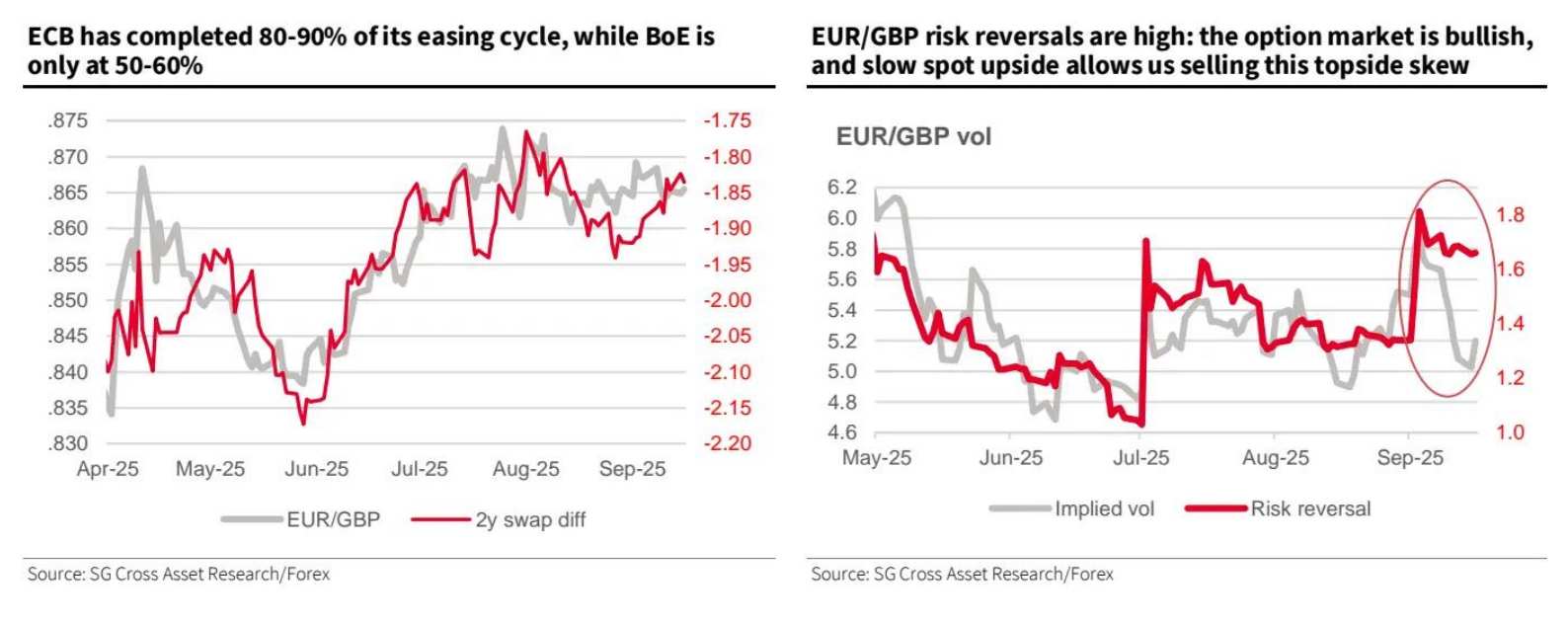
法兴银行:英镑成欧洲“最脆弱货币”,推荐三种期权策略做多欧元/英镑
智通财经网· 2025-09-18 03:52
Group 1 - The core viewpoint is that the British pound is facing multiple adverse factors, leading to expectations of further depreciation [1] - The UK is experiencing a combination of unfavorable fiscal and monetary policies, with a tightening budget expected in November followed by interest rate cuts [1] - High inflation is causing the Bank of England to slow its rate-cutting pace, with only 50%-60% of its rate cycle completed compared to 80%-90% by the European Central Bank [1] Group 2 - Market expectations for a rate cut by the Bank of England in November are close to 50% [1] - The euro is projected to rise to 1.25 against the dollar next year, while the pound is viewed as the weakest European currency [1] - The EUR/GBP exchange rate is expected to gradually rise to 0.90, aligning with short-term interest rate differentials [1] Group 3 - On the trading strategy front, Société Générale suggests utilizing structural opportunities in the options market due to high bullish skew in EUR/GBP [4] - Specific strategies include buying a 3-month EUR/GBP call spread (strike prices 0.8720/0.8860, zero cost) and a 2-month call option (strike price 0.88, knock-out price 0.9050) [4] - The 3-month digital call option (strike price 0.90) has an indicative quote of 12.5% [4] Group 4 - Positions in the first two strategies are recommended to be held until expiration, while the digital call option may be closed early to recover time value [8] - Investors using the call spread strategy face unlimited risk if EUR/GBP exceeds 0.90, as the nominal amount of the short strike exceeds that of the long strike [8] - The knock-out call option will become void if EUR/GBP reaches 0.9050, while the risk of the digital call option is limited to the initial premium [8]


金属期权策略早报-20250918
Wu Kuang Qi Huo· 2025-09-18 03:36
Report Industry Investment Rating No relevant content provided. Core Views of the Report - The metals sector is divided into non - ferrous metals, precious metals, and black metals. Different strategies are recommended for each sector and specific metal varieties based on their fundamentals, market trends, and option factors [2][8]. - For non - ferrous metals in a range - bound oscillation, a neutral volatility selling strategy can be constructed; for black metals with large - amplitude fluctuations, a short - volatility combination strategy is suitable; for precious metals with upward breakthroughs, a spot hedging strategy is recommended [2]. Summary by Related Catalogs 1. Futures Market Overview - The report provides the latest prices, price changes, trading volumes, and open interest changes of various metal futures contracts, including copper, aluminum, zinc, etc. For example, the latest price of copper futures contract CU2510 is 79,880, with a decrease of 840 (- 1.04%) [3]. 2. Option Factors - Volume and Open Interest PCR - Volume and open interest PCR are used to describe the strength of the option underlying market and the turning point of the market. For instance, the volume PCR of copper options is 0.57 with a change of 0.16, and the open interest PCR is 0.72 with a change of - 0.03 [4]. 3. Option Factors - Pressure and Support Levels - Pressure and support levels of each metal option are analyzed from the perspective of the strike prices with the largest open interest of call and put options. For example, the pressure point of copper options is 82,000 and the support point is 78,000 [5]. 4. Option Factors - Implied Volatility - Implied volatility data of various metal options are presented, including at - the - money implied volatility, weighted implied volatility, and its changes. For example, the at - the - money implied volatility of copper options is 13.60%, and the weighted implied volatility is 19.34% with an increase of 1.40% [6]. 5. Option Strategies and Recommendations Non - Ferrous Metals - **Copper Options**: Based on the analysis of fundamentals, market trends, and option factors, strategies such as a short - volatility selling option combination strategy and a spot collar strategy are recommended [7]. - **Aluminum/Alumina Options**: Strategies include a neutral call + put option selling combination strategy and a spot collar strategy [9]. - **Zinc/Lead Options**: A neutral call + put option selling combination strategy and a spot collar strategy are suggested [9]. - **Nickel Options**: A short - biased call + put option selling combination strategy and a spot covered call strategy are recommended [10]. - **Tin Options**: A short - volatility strategy and a spot collar strategy are proposed [10]. - **Lithium Carbonate Options**: A short - biased call + put option selling combination strategy and a spot collar strategy are recommended [11]. Precious Metals - **Gold/Silver Options**: A long - biased short - volatility option selling combination strategy and a spot hedging strategy are suggested [12]. Black Metals - **Rebar Options**: A short - biased call + put option selling combination strategy and a spot covered call strategy are recommended [13]. - **Iron Ore Options**: A neutral call + put option selling combination strategy and a spot collar strategy are suggested [13]. - **Ferroalloy Options**: A short - volatility strategy is recommended for manganese silicon options, and for industrial silicon/polysilicon options, a short - volatility call + put option selling combination strategy and a spot collar strategy are proposed [14]. - **Glass Options**: A short - volatility call + put option selling combination strategy and a spot collar strategy are recommended [15].
农产品期权策略早报-20250918
Wu Kuang Qi Huo· 2025-09-18 02:53
1. Report Industry Investment Rating No relevant content provided. 2. Core View of the Report - The agricultural product options market shows a mixed trend, with oilseeds and oils, and some agricultural by - products in a weak and volatile state, while soft commodities like sugar and cotton also present different degrees of weak fluctuations [2]. - It is recommended to construct option portfolio strategies mainly based on sellers, as well as spot hedging or covered strategies to enhance returns [2]. 3. Summary by Relevant Catalogs 3.1 Futures Market Overview - Various agricultural product futures show different price changes, trading volumes, and open interest changes. For example, the price of soybean No.1 (A2511) decreased by 0.49% to 3,895, with a trading volume of 12.17 million lots and an open interest of 22.65 million lots [3]. 3.2 Option Factors 3.2.1 Volume - to - Open - Interest PCR - Different option varieties have different volume - to - open - interest PCR values and their changes. For instance, the volume PCR of soybean No.1 is 0.55 with a change of 0.13, and the open - interest PCR is 0.42 with a change of 0.01 [4]. 3.2.2 Pressure and Support Levels - Each option variety has corresponding pressure and support levels. For example, the pressure level of soybean No.1 is 3,950 and the support level is 3,900 [5]. 3.2.3 Implied Volatility - The implied volatility of different option varieties also varies. For example, the at - the - money implied volatility of soybean No.1 is 10.555%, and the weighted implied volatility is 13.17% with a change of - 0.34% [6]. 3.3 Strategy and Recommendations 3.3.1 Oilseeds and Oils Options - **Soybean No.1 and No.2**: The fundamentals of US soybeans have a neutral - to - negative impact. The implied volatility of soybean No.1 options remains at a relatively high level compared to historical averages. Directional strategies are not recommended, while a volatility strategy of selling a neutral call + put option combination is suggested, along with a spot long - hedging strategy of a long collar [7]. - **Soybean Meal and Rapeseed Meal**: For soybean meal, the daily提货 volume increased slightly, the basis decreased week - on - week, and the inventory increased week - on - week but decreased year - on - year. A bear - spread strategy for put options and a volatility strategy of selling a bearish call + put option combination are recommended, along with a long collar strategy for spot hedging [9]. - **Palm Oil, Soybean Oil, and Rapeseed Oil**: The palm oil inventory in Malaysia reached a 20 - month high. A volatility strategy of selling a bullish call + put option combination and a long collar strategy for spot hedging are recommended for palm oil [10]. - **Peanuts**: The price of peanuts showed a weak consolidation pattern. A bear - spread strategy for put options and a long collar strategy for spot hedging are recommended [11]. 3.3.2 Agricultural By - products Options - **Pigs**: The supply pressure in September is large, and the market is in a weak consolidation state. A volatility strategy of selling a bearish call + put option combination and a covered call strategy for spot are recommended [11]. - **Eggs**: The inventory of laying hens is expected to increase. A bear - spread strategy for put options and a volatility strategy of selling a bearish call + put option combination are recommended [12]. - **Apples**: The consumption market of apples is gradually warming up. A volatility strategy of selling a bullish call + put option combination is recommended [12]. - **Jujubes**: The inventory of jujubes decreased slightly. A volatility strategy of selling a bearish strangle option combination and a covered call strategy for spot hedging are recommended [13]. 3.3.3 Soft Commodities Options - **Sugar**: The low inventory of domestic sugar supports the price, but the sales volume in August was lower than expected. A volatility strategy of selling a bearish call + put option combination and a long collar strategy for spot hedging are recommended [13]. - **Cotton**: The开机率 of spinning and weaving factories and the commercial inventory of cotton have different changes. A volatility strategy of selling a bullish call + put option combination and a covered call strategy for spot are recommended [14]. 3.3.4 Cereal Options - **Corn and Starch**: The corn production is expected to increase. A volatility strategy of selling a bearish call + put option combination is recommended for corn [14].