数据安全

Search documents
数据安全、破解大模型“幻觉”!蚂蚁密算获世界互联网大会杰出贡献奖
Xin Lang Ke Ji· 2025-11-07 06:55
Core Insights - Ant Group's subsidiary, Ant Misan, received the "Outstanding Contribution Award (Growth Potential Category)" at the 2025 World Internet Conference for its innovative privacy-preserving computing technology [1][3] - The technology enables low-cost, trustworthy data circulation at scale, currently serving over 10 million users [1][3] Technology Overview - Ant Misan's computing technology is based on cryptography, trusted hardware, and system security, allowing data to be "usable but invisible" during processing [3] - The cost of data processing is reduced to within 1.5 times that of plaintext distributed computing, laying the foundation for large-scale applications [3] Application and Impact - The technology has been implemented in various scenarios, including the "Medical Insurance + Commercial Insurance" settlement center in Beijing and the "Instant Loan for Farmers" project [3] - In the auto insurance project, 75% of new energy vehicle owners experienced an average premium reduction of 8% [3] Future Directions - Ant Group's Vice President and Chief Technology Security Officer, Wei Tao, emphasized the challenges of high-sensitivity data integration in the AI era, advocating for a new paradigm of "data-model integration" [3] - The company is addressing reliability issues in large model applications with the launch of High-Order Programs (HOP) and has introduced the first trusted data space in the industry [3] - Ant Misan is promoting a comprehensive transformation of its "chip, system, and platform" to achieve a low-cost transition to privacy-preserving intelligent computing [3]


A股收评:低开高走!创业板指涨超1%,电网设备、海南板块走高
Ge Long Hui· 2025-11-05 07:08
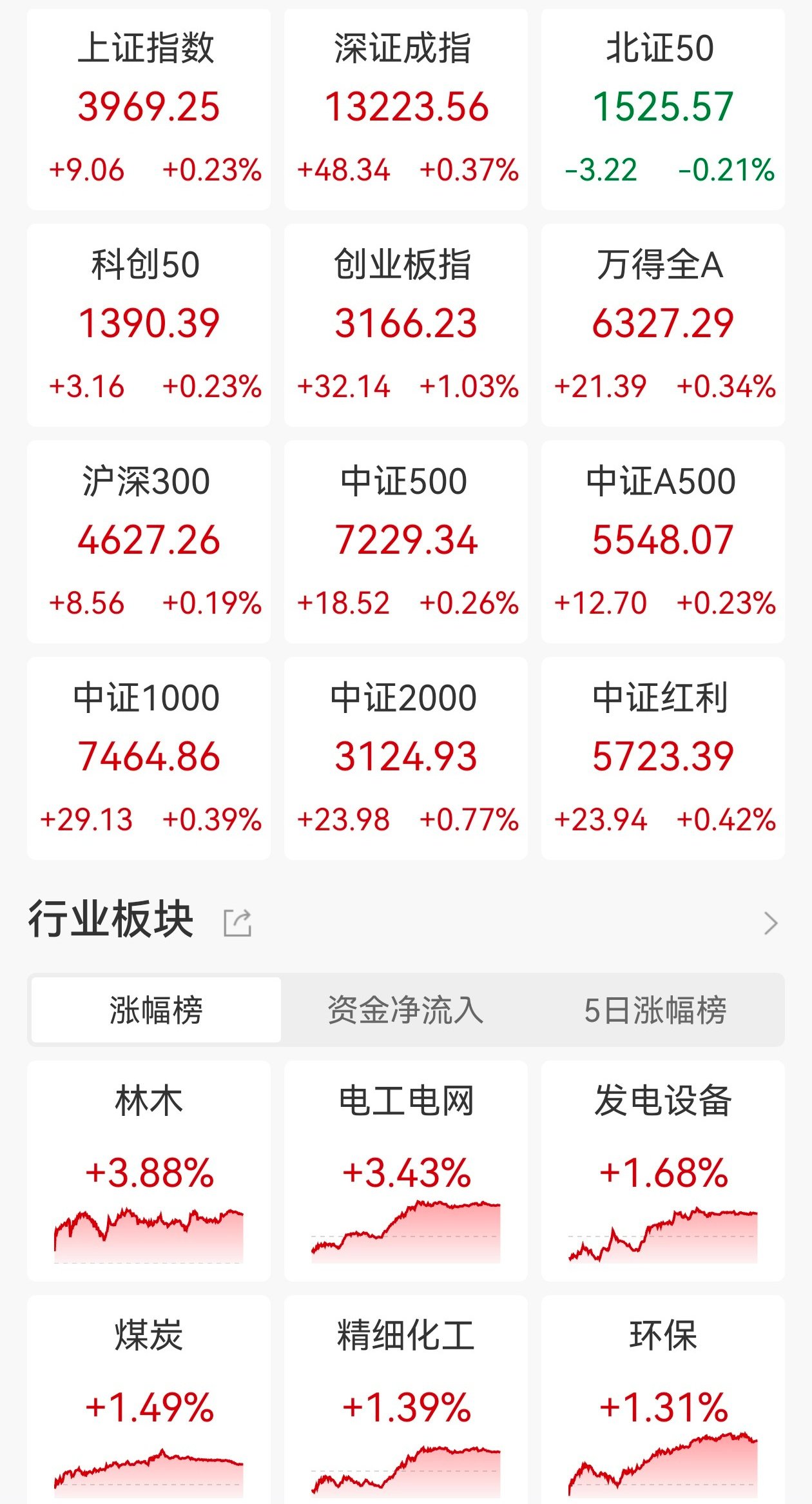
Market Overview - The Asia-Pacific stock markets experienced a collective decline influenced by the "Black Tuesday" in the US stock market, but the A-shares showed an independent trend with all three major indices closing higher. The Shanghai Composite Index rose by 0.23% to 3969 points, the Shenzhen Component Index increased by 0.37%, and the ChiNext Index gained 1.03% [1]. Trading Volume and Market Activity - The total market turnover reached 1.89 trillion yuan, a decrease of 441 billion yuan compared to the previous trading day, with nearly 3400 stocks rising [1]. Sector Performance - The Hainan sector was notably active, with stocks like Haima Automobile and Haixia Shares hitting the daily limit. The State Grid completed fixed asset investments exceeding 420 billion yuan, leading to gains in the electric grid equipment, ultra-high voltage, and smart grid sectors, with stocks such as Jinguan Electric and TBEA also hitting the daily limit [1]. - The titanium dioxide sector saw a surge, with Vanadium Titanium Shares hitting the daily limit. The photovoltaic equipment sector also performed well, with Aters hitting a 20% increase limit. Other sectors with significant gains included duty-free concepts, high-speed charging, energy storage, and wind power equipment [1]. Declining Sectors - The recombinant protein sector declined, with Sanofi falling over 8%. The quantum technology sector also saw a drop, with Keda Guokai decreasing by over 7%. Other sectors that experienced significant declines included Kimi concept, data security, digital currency, and CRO [1]. Top Gainers - The top gainers included sectors such as forestry, power generation equipment, and electrical grid, with respective increases of 3.88%, 1.68%, and 3.43% [2].

研判2025!中国商业大数据服务行业进入壁垒、市场政策、产业链、市场规模、竞争格局及发展趋势分析:未来增长潜力巨大[图]
Chan Ye Xin Xi Wang· 2025-11-05 01:41
Core Insights - The commercial big data service industry in China is experiencing significant growth, with a projected market size of 60.5 billion yuan in 2024, representing a year-on-year increase of 20.76% [1][6] - The industry is divided into general commercial big data services, accounting for approximately 29%, and specialized commercial big data services, which make up about 71% of the market [1][6] Overview - Commercial big data services involve the use of vast structured and unstructured data to provide insights, decision support, business optimization, and risk management for enterprises [2] - The core value lies in transforming data into actionable business strategies, enhancing operational efficiency, identifying market opportunities, and strengthening core competitiveness across various business processes [2] Industry Entry Barriers - The commercial big data service industry has high technical requirements, including data analysis, processing, resource integration, and algorithm development [4] - Companies must invest significant time, effort, and capital to develop core technical capabilities and keep pace with rapid technological advancements to avoid market obsolescence [4] Market Policies - The industry is recognized as a strategic emerging industry in China, supported by various government policies aimed at fostering its development [5] - Key policies include the "Digital China Construction Overall Layout Plan" and the "Three-Year Action Plan for Data Elements (2024-2026)" among others, creating a favorable policy environment for the industry [5] Industry Chain - The upstream of the commercial big data service industry includes data sources, technology sources, and servers, while the midstream consists of service providers, and the downstream encompasses application markets across various sectors [5] Competitive Landscape - The industry is segmented into general and specialized commercial big data services, with companies like Anshuo Information and Yuxin Technology focusing on customized analysis for specific industries [8] - General commercial big data service providers, such as Qichacha and Tianyancha, offer standardized products and services that cater to a wide range of client needs [9] Company Analysis - Anshuo Information specializes in credit risk management and has generated 380 million yuan in revenue in the first half of 2025, with 71.09% from credit management systems [10] - Hehe Information focuses on AI and big data technology, achieving 843 million yuan in revenue in the first half of 2025, with a significant portion from B-end services [11] Future Trends - The integration of AI and machine learning with big data services is expected to enhance data processing efficiency and decision-making capabilities [11] - Data security and privacy protection will become critical as the importance of data increases, leading companies to adopt advanced technologies for secure data collaboration [11]

数据不出门 分析快如风——本地部署的Datayes AMS 2.0来了
Datayes· 2025-11-03 11:13
Core Viewpoint - The article introduces the upgraded version of Datayes AMS 2.0, emphasizing its ability to enhance data security and analysis efficiency for post-investment management without compromising on compliance requirements [3][8]. Group 1: Overview of Datayes AMS - Datayes AMS serves as a comprehensive SaaS platform that integrates investment research and management throughout the investment cycle, from market data integration to performance analysis [5]. - The platform is designed to meet the needs of various roles within investment institutions, supported by a high-standard research team to create a performance risk analysis system tailored for the Chinese market [5]. Group 2: Key Upgrades in Datayes AMS 2.0 - The new version enhances four core dimensions: compliance, efficiency, analysis, and customization, allowing institutions to manage post-investment processes without making trade-offs [8]. - The 2.0 version features a local client that isolates sensitive data from the cloud, ensuring that all data handling occurs on local servers, thus eliminating leakage risks [13]. - Data management is streamlined with two methods: manual uploads for precise control and automatic email integration for real-time data updates, reducing operational burdens [15]. Group 3: Performance Analysis Features - The upgraded version addresses four major pain points: incomplete data visibility, unclear trends, difficulty in risk prediction, and lack of basis for asset allocation [20]. - It offers multi-dimensional performance analysis, allowing users to dissect returns and net value trends while comparing against benchmarks [20]. - The system supports customized development, enabling institutions to tailor reports and templates to fit their specific business scenarios [19]. Group 4: User Engagement and Accessibility - Institutions can choose between a lightweight local version for data compliance or a comprehensive online SaaS version for broader research capabilities [33]. - The article encourages potential users to apply for trials of Datayes AMS 2.0, highlighting ongoing developments for additional features [33].

IT外包行业深度洗牌:印度模式受挫,AI与价值创造成新引擎。
Sou Hu Cai Jing· 2025-11-03 03:06
Core Insights - The global IT outsourcing industry is undergoing a profound structural transformation, moving away from traditional labor cost advantages towards innovation, compliance, and strategic collaboration as new growth drivers [1][3][5] Group 1: Global Market Dynamics - The Indian outsourcing model, once a benchmark, is facing unprecedented challenges due to tightened U.S. visa policies and rising costs associated with H-1B visa applications, which are squeezing profit margins and forcing companies to consider local hiring alternatives [1] - Rapid advancements in artificial intelligence (AI) pose a fundamental risk of industry substitution, as AI offers faster, cheaper, and more precise solutions, gradually eroding traditional outsourcing markets such as call centers and basic code development [1] - Potential trade protectionism, including proposed high tariffs on IT outsourcing services in the U.S., further constrains the survival space for traditional outsourcing models represented by India [1] Group 2: Chinese Market Trends - The Chinese IT outsourcing market is exhibiting clear differentiation and upgrading trends, with technical capability and compliance becoming essential criteria for service provider selection [3] - Compliance certifications such as ISO27001, GDPR, and others are viewed as critical indicators for reducing data breach risks and are necessary for entering partnerships [3] - Cost control remains a significant consideration for enterprises, with outsourcing potentially saving nearly half the costs compared to building an in-house IT team, leading to a preference for flexible pricing models [3] Group 3: Evolution of Collaboration Models - Outsourcing strategies are shifting from transactional relationships to strategic partnerships, with project-based outsourcing suitable for short-term needs and long-term operational outsourcing preferred in sectors like finance and healthcare [5] - Companies are advised to be cautious of vague service scopes and low compensation limits in contracts, emphasizing the need for service transparency and real-time monitoring of key performance indicators [5] Group 4: Future Outlook - AI technology is set to reshape the value chain of IT outsourcing, with significant investments from tech giants like Microsoft and Google driving automation in operations [7] - Traditional labor-based outsourcing firms risk losing market share as AI-driven solutions reduce fault diagnosis times dramatically, enhancing efficiency [7] - The industry is transitioning from a focus on cost reduction to value creation, with companies needing to balance short-term costs with long-term effectiveness through careful selection of compliant service providers and embracing technological innovations [7]

隐私保护再获认可!“全球Robotaxi第一股”文远知行通国际审核
Jin Tou Wang· 2025-11-03 01:29
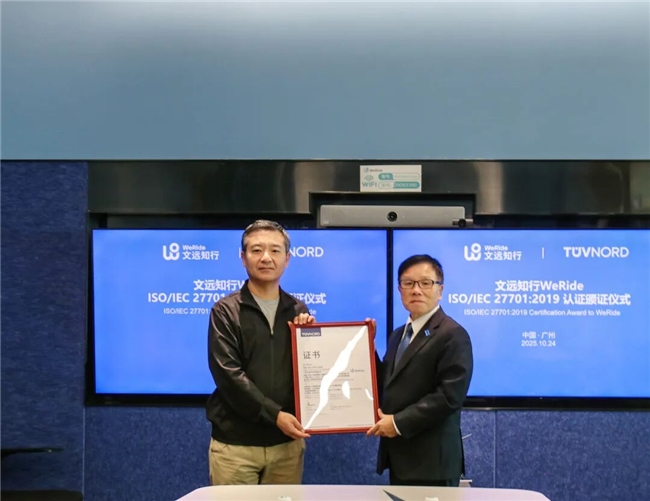
Core Insights - The core focus of the news is on the importance of user privacy and data security in the rapidly evolving autonomous driving technology sector, highlighted by the achievement of the ISO/IEC 27701:2019 certification by the company WeRide, marking a significant milestone in privacy management within the industry [1][3]. Group 1: Certification and Standards - WeRide has successfully obtained the ISO/IEC 27701:2019 privacy information management system certification from TÜV NORD, establishing itself as a leader in privacy management within the autonomous driving sector [1]. - ISO/IEC 27701:2019 is recognized as the world's first international standard for privacy information management, providing systematic management guidelines for controllers and processors of personally identifiable information (PII) [3]. Group 2: Commitment to Privacy Protection - WeRide's commitment to privacy protection has been a gradual process, having previously achieved the ISO/IEC 27001:2022 information security management system certification in December 2024, laying a solid foundation for privacy protection [5]. - The company has implemented various measures to enhance privacy protection, including advanced encryption technologies, strict access control mechanisms, and scientific data de-identification methods to mitigate risks associated with sensitive information exposure [5]. Group 3: Future Outlook - As autonomous driving technology continues to evolve and business scenarios expand, the importance of privacy protection will become increasingly prominent, with WeRide aiming to enhance its information security and privacy protection systems further [7]. - The company intends to leverage this certification as a new starting point to strengthen data governance capabilities and contribute to the improvement of industry privacy protection standards and the healthy development of the smart mobility ecosystem [7].

豪特节能递表港交所 为中国第五大中立运营商数据中心能源管理解决方案公司
Zhi Tong Cai Jing· 2025-11-02 12:01
Core Viewpoint - Guangzhou Haote Energy Conservation and Environmental Protection Technology Co., Ltd. has submitted its listing application to the Hong Kong Stock Exchange, with GF Securities and Shenwan Hongyuan Hong Kong as joint sponsors [1] Company Overview - Haote Energy Conservation is a leading energy management solutions provider in China, focusing on the data center segment. The company offers a full lifecycle service system for energy management solutions, including consulting, design, equipment selection, project integration, and system maintenance [4] - The company's solutions are widely applied in data centers (including AI computing power data centers and edge data centers), smart industrial parks, smart factories, and multi-purpose commercial complexes, covering a broad range of scenarios [4] - According to Frost & Sullivan, by 2024, Haote Energy Conservation is the fifth largest neutral operator data center energy management solutions provider in China and the ninth largest overall in the data center energy management solutions market [4] Market Dynamics - The market for neutral operator data center energy management solutions in China has been expanding significantly, with the market size projected to grow from RMB 11.2 billion in 2020 to RMB 25.7 billion in 2024, representing a compound annual growth rate (CAGR) of 23.1%. The market is expected to reach RMB 83.9 billion by 2029 [5] - Key drivers of this growth include increased demand for AI computing, ongoing digital transformation, energy efficiency improvements, data security and regulatory trends, and the transition to low-carbon and green energy [5] - The data center energy management solutions market in China is relatively fragmented, with over 100 participants expected by 2024. The top ten companies hold a market share of 57.9% [5] Financial Performance - For the six months ending June 30, 2022, 2023, 2024, and 2025, the company reported revenues of approximately RMB 793 million, RMB 858 million, RMB 1.018 billion, and RMB 754 million, respectively. The total profit and comprehensive income for the same periods were approximately RMB 39.1 million, RMB 70.2 million, RMB 75.9 million, and RMB 50.5 million [7][8] - The company has shown a consistent increase in revenue, with a notable rise in profit margins over the years, indicating a positive financial trajectory [7][8]
绿盟科技:前三季度营收12.80亿元 亏损收窄
Zhong Zheng Wang· 2025-10-30 03:10
Core Viewpoint - Green Alliance Technology reported a slight increase in revenue for the first three quarters of 2025, with a focus on AI security, data security, and practical defense, while also improving its gross margin and reducing net losses compared to the previous year [1] Financial Performance - The company's revenue for the first three quarters reached 1.28 billion yuan, showing a minor increase compared to the same period last year [1] - The net profit attributable to shareholders was -196 million yuan, reflecting a year-on-year reduction in losses by 39.85% [1] - The gross margin stood at 60.37%, which has improved both year-on-year and quarter-on-quarter [1] - In Q3 alone, the revenue was 479 million yuan, representing a year-on-year growth of 1.22% [1] - The net profit for Q3 was -24.6 million yuan, with a year-on-year reduction in losses of 65.54% [1] - The net cash flow from operating activities for the first nine months was 69.67 million yuan, indicating sustained positive cash flow [1] Strategic Focus - The company is concentrating on "digital" and "intelligent" as core directions, emphasizing AI security, data security, and practical defense [1] - Green Alliance Technology is committed to deepening innovation and implementation, enhancing its product matrix, accumulating benchmark cases, and accelerating the rollout of major projects [1] - The company is exploring new forms of security capabilities in the intelligent era [1]

绿盟科技发布2025三季报:收入微增,亏损大幅收窄,现金流持续为正
Cai Fu Zai Xian· 2025-10-29 11:05
Core Insights - Green Alliance Technology released its Q3 2025 report, emphasizing its strategic focus on "3+3+X+Y" to enhance capabilities in AI security, data security, and practical defense [1] Financial Performance - For the first three quarters of 2025, the company reported revenue of 1.28 billion yuan, showing a slight increase compared to the same period last year [1] - The net profit attributable to shareholders was -196 million yuan, a year-on-year reduction in losses by 39.85% [1] - The gross margin stood at 60.37%, reflecting improvements both year-on-year and quarter-on-quarter [1] - In Q3 2025, the company achieved revenue of 479 million yuan, a year-on-year growth of 1.22% [1] - The net profit attributable to shareholders for Q3 was -24.6 million yuan, marking a year-on-year reduction in losses by 65.54% [1] - The net cash flow from operating activities for the first nine months of 2025 was 69.67 million yuan, indicating sustained positive cash flow [1] Strategic Focus - The company is committed to exploring new technologies and fields, driven by customer needs and technology to guide product development and market expansion [1] - Green Alliance Technology adheres to an open and collaborative philosophy, aiming to make security a foundational element of digital intelligence development [1]
Varonis(VRNS) - 2025 Q3 - Earnings Call Transcript
2025-10-28 21:30
Financial Data and Key Metrics Changes - The company reported an 18% year-over-year increase in Annual Recurring Revenue (ARR), reaching $718.6 million [4][19] - Total revenues for Q3 were $161.6 million, reflecting a 9% year-over-year growth [19] - SaaS revenues accounted for $125.8 million, while term license subscription revenues were $24.8 million, and maintenance and services revenues were $10.9 million [19] - Gross profit for Q3 was $128.3 million, resulting in a gross margin of 79.4%, down from 85% in Q3 2024 [19] - Net income for Q3 was $8.4 million, or $0.06 per diluted share, compared to $13.8 million, or $0.10 per diluted share in Q3 2024 [20] Business Line Data and Key Metrics Changes - The SaaS business now represents 76% of total company ARR, indicating a successful transition to SaaS completed ahead of schedule [4][16] - The on-premises subscription business has underperformed, particularly in the federal sector, leading to a reduction in team size and a more conservative outlook for renewals [5][16] Market Data and Key Metrics Changes - The company experienced weaker-than-expected renewals in both federal and non-federal on-premises subscription businesses during the final weeks of Q3 [5][17] - The federal business has historically contributed around 5% of total ARR, and recent renewals in this segment have faced challenges [78] Company Strategy and Development Direction - The company plans to end-of-life its self-hosted solution by December 31, 2026, to focus entirely on its SaaS offerings [5][16] - Investments in partnerships, particularly with Microsoft, and acquisitions like Cyro and SlashNext are expected to enhance the company's product offerings and market position [10][54] - The company aims to capitalize on the growing demand for data security solutions, especially in the context of AI and cloud environments [10][11] Management's Comments on Operating Environment and Future Outlook - Management expressed disappointment with the on-prem business performance but remains optimistic about the strong demand for the SaaS platform [15][23] - The company is taking steps to manage expenses, including a 5% reduction in headcount, to reallocate resources effectively [6][23] - Future guidance has been adjusted to reflect conservatism due to recent performance issues, particularly in the on-premises segment [17][23] Other Important Information - The company generated $111.6 million of free cash flow year-to-date, up from $88.6 million in the same period last year [19] - A $115 million share repurchase program has been authorized by the board, supported by a strong balance sheet with over $1 billion in liquidity [23] Q&A Session Summary Question: What led to the decision to reduce the federal team? - The company lacks empirical evidence to justify continued investment in the federal sector due to ongoing underperformance, prompting a reevaluation of strategy [26] Question: What were the reasons for the lower on-prem renewals? - There was no single theme identified; issues included account management and a lack of comprehensive engagement with on-prem customers [28][44] Question: How does the company plan to address the non-renewal of on-prem customers? - The company is focusing on improving account management and ensuring that customers understand the value of transitioning to SaaS [28][44] Question: What is the expected contribution from recent acquisitions? - The company anticipates that acquisitions like SlashNext and Cyro will enhance its product offerings and contribute positively to growth [54] Question: Is there a risk of alienating customers with the push to migrate to SaaS? - The company believes that moving to SaaS is essential for operational efficiency and customer value, despite potential concerns from some customers [58][60]