人民币汇率

Search documents
人民币,还会涨吗?机构最新研判!
券商中国· 2026-01-12 06:10
近期,人民币汇率整体呈现稳中趋强态势,美元兑人民币持续运行于7.0关口下方。 2026年,人民币汇率走势如何?多家机构人士表示,人民币汇率呈现稳中趋强态势,是内外因素共振、市场预 期催化的多重合力结果。人民币汇率未来大概率将呈现双向波动格局。 内外共振推动升值 从内部层面看,中国宏观叙事的积极转向、针对外部冲击的未雨绸缪、经济实现5%左右的稳定增长,以及中 美经贸磋商取得阶段性进展,共同重塑了市场对中国资产的信心,为汇率提供了基本面与情绪面的支撑。 这样的观点得到大多数机构的认可。兴业证券宏观团队在接受证券时报·券商中国记者采访时表示,年末以 来,中国人民币汇率呈现稳中趋强态势,是内外因素共振、市场预期催化的多重合力结果。 内部因素而言, 外需韧性与结汇高峰是近期人民币升值的重要拉力。2025年虽然面临关税冲击,但中国外需 呈现超预期韧性,前11个月出口累计同比增长5.4%,贸易顺差持续扩大,为外汇市场提供充足流动性支撑。 叠加岁末年初企业结售汇需求助推资金回流,进一步增强人民币升值动能。 本轮人民币升值并非单一因素驱动。中银证券全球首席经济学家管涛分析,2025年人民币走出逆势升值行情是 内外因素共同作用的 ...


管涛:人民币汇率、贸易顺差与中国经济再平衡
Xin Lang Cai Jing· 2026-01-12 02:47
Core Viewpoint - The depreciation of the real effective exchange rate and the expansion of trade surplus are currently seen as important reasons for a bullish outlook on the RMB. However, historical trends and comparisons with the JPY/USD exchange rate suggest these reasons may not hold true. The RMB's appreciation should not be used as a policy tool for economic rebalancing, as it contradicts the principle of macro policy consistency and may trigger panic among private sectors [2][3][35]. Group 1: Exchange Rate Trends - Since late November 2025, both onshore and offshore RMB exchange rates have shown a rapid appreciation, with the midpoint and trading prices rising to around 7.0, marking a cumulative increase of nearly 2% for the midpoint and over 4% for trading prices [2][35]. - The real effective exchange rate (REER) of the RMB has declined significantly, dropping 16.7% since March 2022, while the JPY has seen a similar decline of 17.1% during the same period [4][37]. - The recent trends in the JPY/USD exchange rate have not aligned with expectations based on the declining REER and narrowing interest rate differentials, indicating that multiple factors influence exchange rates [8][42]. Group 2: Trade Surplus and RMB Valuation - In the first 11 months of 2025, China's trade surplus reached $1,075.9 billion, an increase of 21.4% compared to the previous year, despite a decline in exports to the US [12][43]. - Historical data shows no simple linear relationship between trade surplus and RMB exchange rate movements, with instances where trade surplus increased while the RMB depreciated [16][47]. - The expansion of trade surplus is not a reliable predictor of RMB appreciation, as evidenced by various years where trade surplus growth coincided with RMB depreciation [16][48]. Group 3: Historical Context of RMB Policy - Following the 2008 global financial crisis, China implemented policies aimed at reducing trade surplus and promoting balance, resulting in a significant appreciation of the RMB due to structural adjustments and increased domestic demand [19][51]. - The relationship between the RMB's real effective exchange rate and China's external balance has shifted from a strong negative correlation (2008-2013) to a weak positive correlation (2014-2024), indicating a change in the effectiveness of leverage in driving investment [27][58]. - The RMB's depreciation in recent years reflects ongoing trade tensions and economic cycles, with the Chinese government emphasizing stability in the exchange rate to prevent rapid depreciation [29][60].
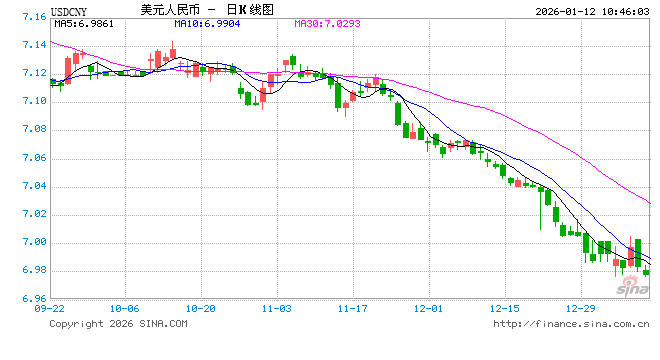
人民币汇率中间价调升20基点报7.0108
Sou Hu Cai Jing· 2026-01-12 02:33
摩根士丹利中国首席经济学家邢自强认为,短期内人民币具备一定升值基础,尤其是在美元走弱、季节 性结汇等因素推动下,不排除阶段性触及6.8附近水平。但从全年甚至中期来看,汇率仍可能回归基本 面中枢,围绕7左右波动。 同日,在岸人民币、离岸人民币对美元汇率小幅升值。截至当日9时50分,在岸人民币对美元报 6.9761,日内升值幅度为0.02%;离岸人民币对美元报6.9719,日内升值幅度为0.06%。 北京商报讯(记者 廖蒙)1月12日,中国人民银行授权中国外汇交易中心公布,当日银行间外汇市场人 民币汇率中间价为1美元对人民币7.0108元,相较前一交易日中间价7.0128元调升20基点。 ...
1月12日人民币兑美元中间价上调20个基点
Sou Hu Cai Jing· 2026-01-12 02:21
中国人民银行授权中国外汇交易中心公布,2026年1月12日银行间外汇市场人民币汇率中间价为:1美元 对人民币7.0108元,1欧元对人民币8.1400元,100日元对人民币4.4267元,1港元对人民币0.89959元,1 英镑对人民币9.3699元,1澳大利亚元对人民币4.6759元,1新西兰元对人民币4.0056元,1新加坡元对人 民币5.4345元,1瑞士法郎对人民币8.7260元,1加拿大元对人民币5.0241元,人民币1元对1.1455澳门 元,人民币1元对0.58191马来西亚林吉特,人民币1元对11.3121俄罗斯卢布,人民币1元对2.3566南非兰 特,人民币1元对208.80韩元,人民币1元对0.52546阿联酋迪拉姆,人民币1元对0.53645沙特里亚尔,人 民币1元对47.4051匈牙利福林,人民币1元对0.51777波兰兹罗提,人民币1元对0.9185丹麦克朗,人民币 1元对1.3172瑞典克朗,人民币1元对1.4427挪威克朗,人民币1元对6.16980土耳其里拉,人民币1元对 2.5680墨西哥比索,人民币1元对4.4868泰铢。 1月12日,人民币兑美元中间价上调20个基点,报7 ...
人民币市场汇价(1月12日)
Sou Hu Cai Jing· 2026-01-12 01:47
100美元 701.08人民币 100欧元 814.0人民币 100日元 4.4267人民币 100港元 89.959人民币 100英镑 936.99人民币 100澳元 467.59人民币 100新西兰元 400.56人民币 100新加坡元 543.45人民币 100瑞士法郎 872.6人民币 100加元 502.41人民币 100人民币114.55澳门元 100人民币58.191马来西亚林吉特 100人民币1131.21俄罗斯卢布 100人民币235.66南非兰特 100人民币20880韩元 100人民币52.546阿联酋迪拉姆 100人民币53.645沙特里亚尔 100人民币4740.51匈牙利福林 100人民币51.777波兰兹罗提 100人民币91.85丹麦克朗 100人民币131.72瑞典克朗 100人民币144.27挪威克朗 100人民币616.98土耳其里拉 100人民币256.8墨西哥比索 100人民币448.68泰铢(完) 1月12日人民币汇率中间价如下: 新华社北京1月12日电 中国外汇交易中心1月12日受权公布人民币对美元、欧元、日元、港元、英镑、 澳元、新西兰元、新加坡元、瑞士法郎、加 ...
人民币对美元中间价报7.0108 上调20个基点
Zhong Guo Jing Ji Wang· 2026-01-12 01:47
Group 1 - The central parity rate of the Chinese yuan against the US dollar is reported at 7.0108, which is an increase of 20 basis points from the previous trading day [1] - The People's Bank of China authorized the announcement of various exchange rates, including 1 euro to 8.1400 yuan and 100 Japanese yen to 4.4267 yuan [2] - The exchange rates for several currencies against the yuan were provided, including 1 British pound to 9.3699 yuan and 1 Australian dollar to 4.6759 yuan [2]
证券时报2025年四季度经济学家问卷调查显示:经济预期进一步改善 看好2026年A股表现
Zheng Quan Shi Bao Wang· 2026-01-11 23:32
Group 1 - The survey conducted by Securities Times indicates an improvement in economic expectations for China, with "stability" being a frequently mentioned term among economists [1][2] - Over 70% of surveyed economists believe that China's economic growth in the past year met expectations, with 21% stating it exceeded them [2][3] - The "Securities Times Economic Expectation Heat Index" has risen for three consecutive quarters, reflecting a sustained improvement in economic outlook [2] Group 2 - Economists expect the international economic and trade situation to remain stable, with 61% believing its impact on China's economy will be manageable [3] - The primary focus for economic work in the coming year is to expand domestic demand, with 75% of respondents anticipating stabilization or improvement in price levels [3][6] - The majority of respondents (96%) rated the stock market's outlook positively for the first half of 2026, indicating strong confidence in market performance [4] Group 3 - The report suggests that the fiscal deficit rate may have room for increase, with over 60% of respondents expecting it to remain above 4% [6] - Economists recommend implementing more policies to stabilize the real estate market, including the establishment of a national housing acquisition fund and lowering mortgage rates [7] - The overall sentiment is that despite global economic slowdowns, China's growth advantages remain, providing potential for income growth and industrial upgrades [7]
首席经济学家热议汇率: 人民币短期温和升值
Sou Hu Cai Jing· 2026-01-11 16:35
Core Viewpoint - The short-term outlook for the RMB shows potential for appreciation, particularly influenced by a weakening USD and seasonal settlement factors, with a possibility of reaching around 6.8. However, the mid-term perspective suggests a return to fundamental levels, fluctuating around 7 [1][2]. Group 1: USD and RMB Short-term and Mid-term Trends - The USD is currently under pressure due to high debt and deficit levels in the U.S., which may lead to depreciation, particularly against currencies like the Euro [2]. - Experts believe that while the USD index is in a phase of adjustment, it is not expected to decline unilaterally; the RMB has short-term appreciation potential but cannot resolve structural economic issues through significant appreciation [1][2]. - There is a consensus that if the U.S. experiences three interest rate cuts in 2026, the RMB could reach 6.8 this year, indicating a trend of RMB appreciation in the context of a weakening USD [2]. Group 2: Long-term Outlook for the International Monetary System - Experts agree that the international monetary system is undergoing structural changes, moving towards a more decentralized and multipolar currency landscape, rather than a sudden decline of the USD [4]. - The importance of assets outside traditional fiat currencies, such as gold and commodities, is increasing due to rising fiscal pressures and debt levels across major economies [4]. - The RMB's international status is closely tied to improvements in domestic economic fundamentals and asset returns, with its use in international trade settlements expected to rise, especially as China is a major buyer of commodities [5][6]. Group 3: Challenges and Opportunities for RMB Internationalization - The key bottleneck for RMB internationalization lies in its financing functions rather than trade settlements, suggesting that enhancing offshore RMB markets and cross-border financing mechanisms could improve its stability and attractiveness [6]. - The long-term vision for the international monetary system may evolve into a tri-polar structure with the USD, Euro, and RMB coexisting, although the USD will likely maintain its status as the primary reserve and payment currency for an extended period [5][6].
美元走向如何重构货币秩序?经济学家热议汇率与货币体系演变
Di Yi Cai Jing· 2026-01-11 13:07
Core Viewpoint - The discussion at the "2026 China Chief Economist Forum" highlighted the evolving dynamics of the dollar and the yuan amidst increasing global economic uncertainty, with a focus on the potential structural changes in the international monetary system [1] Group 1: Dollar Outlook - Experts believe that the dollar remains resilient but faces a gradual decline in its long-term dominance [1] - The current pressures on dollar credibility are significant, indicating a potential shift in its role in the global economy [1] Group 2: Yuan Prospects - The yuan is expected to appreciate moderately under controlled conditions, reflecting a cautious optimism about its future [1] - The discussions suggest that the yuan's rise could contribute to a more diversified international monetary landscape [1] Group 3: Global Monetary System - The future international monetary system may evolve towards a more multipolar structure, reducing reliance on a single currency [1] - This potential shift indicates a broader trend in the global economy, where multiple currencies could play more significant roles [1]
管涛:众口一词的人民币升值“真相”︱汇海观涛
Di Yi Cai Jing· 2026-01-11 12:53
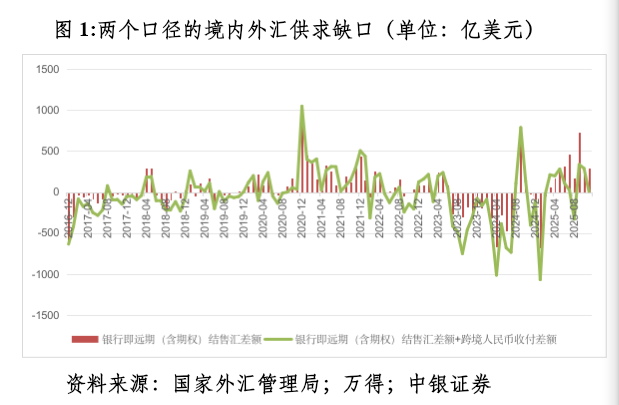
Group 1 - The article discusses the recent strengthening of the RMB against the USD, which has been characterized by a reversal of the previous trend of depreciation over the past three years, particularly since November 2024 [1] - Foreign investment banks have suggested that the RMB is structurally undervalued, predicting that RMB appreciation will be a high-confidence trade in 2026, while domestic voices echo that RMB revaluation will lead to a reassessment of Chinese assets [1][2] - However, the article argues that these significant judgments lack data, facts, or theoretical support, indicating skepticism about the sustainability of the RMB's appreciation [1] Group 2 - From July 2023 to February 2025, the RMB exchange rate faced overall pressure, with a notable shift to a surplus in bank foreign exchange settlements starting in March 2025, accumulating a surplus of $273.3 billion by November [2] - In November, the bank's foreign exchange settlement surplus was $29.7 billion, which was significantly lower than the surpluses recorded in September and October [2] - The article highlights that the improvement in the foreign exchange situation is not due to an increase in market settlement willingness but rather a decrease in the motivation to purchase foreign currency [4] Group 3 - The RMB broke the 7 mark in December 2025, with the domestic trading price showing a consistent strength against the central parity and offshore RMB rates [5] - The article compares the current situation to December 2020, when the RMB was also appreciating, noting that the average transaction volume in the interbank market decreased by 14.3% in December 2025 compared to the previous month [5] - The article emphasizes that the relationship between the actual effective exchange rate (REER) and the nominal exchange rate is complex, with REER depreciation not necessarily indicating that the nominal exchange rate is undervalued [7] Group 4 - The article notes that while China has a growing trade surplus, it also faces deficits in service trade and investment income, leading to a mixed picture in the current account balance [12] - In contrast, Japan has a trade deficit but benefits from significant investment income, resulting in a stronger current account position compared to China [12] - The article suggests that the equilibrium exchange rate is influenced by both external and internal factors, with the RMB potentially being undervalued due to trade surpluses but overvalued due to domestic economic conditions [14] Group 5 - The article discusses the complexities of the relationship between exchange rates and asset prices, arguing that a strong RMB does not automatically lead to a revaluation of Chinese assets [18] - Historical data shows that during years of RMB appreciation, a lower percentage of non-financial companies reported net exchange gains compared to years of depreciation [20] - The shift from net external debt to net external assets for Chinese companies may lead to net exchange losses if the RMB appreciates significantly, impacting corporate profitability [23]