人工智能全球治理

Search documents
12位顶尖科学家本月底齐聚上海!世界人工智能大会还有这些看点
Di Yi Cai Jing· 2025-07-10 04:58
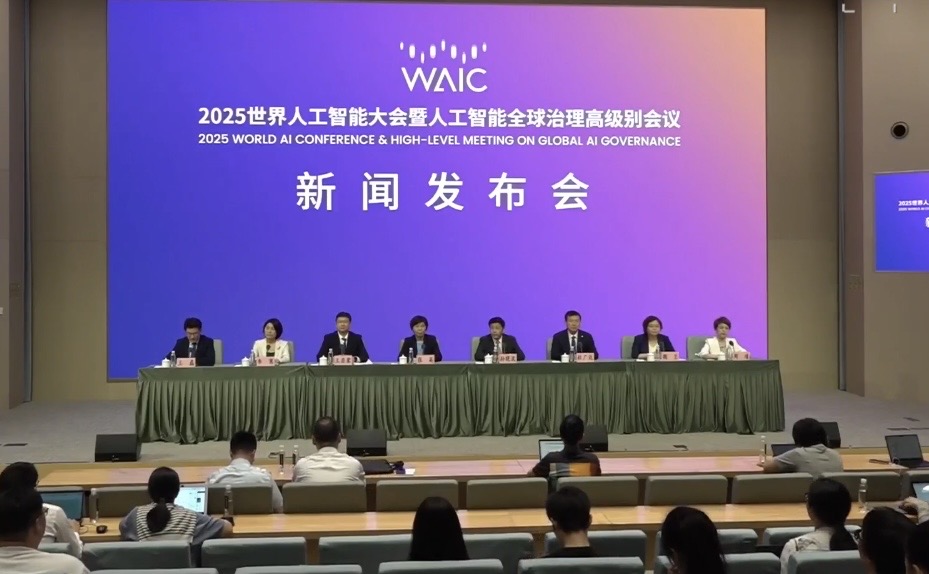
Group 1 - China has entered the leading track in the global artificial intelligence (AI) field, forming a relatively complete AI industry system and actively working to provide more AI public products to countries worldwide [1][3] - The 2025 World Artificial Intelligence Conference (WAIC) will be held in Shanghai from July 26-28, focusing on global AI governance issues and promoting equitable opportunities, rights, and rules for developing countries in AI development [1][3] - From 2014 to 2023, China accounted for 70% of the 54,000 global patent applications for generative AI, with 38,000 applications [3] Group 2 - As of April 2025, China's AI patent applications will exceed 1.57 million, representing nearly 40% of the global total, maintaining the world's leading position [3] - In the first half of this year, China's AI terminal shipment volume accounted for 42% of the global total, with a projected annual increase of 20% for AI smartphones, AIPC, and AI tablets [3][4] - Chinese AI models like DeepSeek and Tongyi Qianwen demonstrate strong performance and cost-effectiveness, showcasing high-quality solutions to lower the barriers for global AI technology usage [4] Group 3 - The WAIC conference will feature over 1,200 guests from more than 30 countries, including 12 international award winners and over 80 academicians [5] - The exhibition area for this year's WAIC will exceed 70,000 square meters, with over 800 companies showcasing more than 3,000 cutting-edge exhibits, including 40 large models and 50 AI terminal products [5] - Major companies like Siemens and Schneider will present new products focusing on "AI + manufacturing," while AI robotics firms such as Tesla and Yushutech will also participate [5]

李强会见联合国秘书长古特雷斯
证监会发布· 2025-07-09 01:26
Core Viewpoint - The meeting between Chinese Premier Li Qiang and UN Secretary-General António Guterres emphasizes the importance of multilateralism and the UN's role in addressing global challenges, particularly in the context of increasing instability and uncertainty in the world [1][2]. Group 1 - The UN has made significant contributions to world peace and development over its 80 years, and there is a need for it to play a more active role in the face of rising global uncertainties [1] - China is committed to deepening communication and cooperation with the UN to promote a more just and reasonable international order [1][2] - The Chinese government advocates for prioritizing development in the international agenda, focusing on poverty alleviation, education, employment, and capacity building [2] Group 2 - China supports the UN's unique role in political solutions to global tensions and aims to enhance global development cooperation [2] - The Chinese government emphasizes the need to address governance gaps in emerging fields such as artificial intelligence and cyberspace [2] - The UN Secretary-General acknowledges China's contributions to multilateralism and the political resolution of global issues, highlighting the alignment of China's initiatives with UN goals [2]
李强总理出席金砖国家领导人第十七次会晤 外交部介绍有关情况
news flash· 2025-07-08 07:50
Group 1 - The meeting highlighted the significance of BRICS cooperation in the context of rising unilateralism and protectionism, emphasizing the need for equal respect and collaboration among member states [1] - Premier Li Qiang pointed out the accelerated evolution of global changes and the serious impact on international rules and order, advocating for BRICS to be a leading force in global governance reform [1] - The BRICS nations are encouraged to maintain independence, promote economic growth, and enhance cultural exchanges while opposing unilateralism and protectionism [1] Group 2 - The Rio de Janeiro Declaration was adopted, along with statements on global governance of artificial intelligence and a climate finance framework [2] - China expressed its commitment to uphold the "BRICS spirit" and work with partners to promote common values and interests, aiming for a more just and efficient global governance [2]
金砖国家领导人第十七次会晤里约热内卢宣言(摘要)
Xin Hua She· 2025-07-07 12:50
Group 1: Core Principles and Cooperation - The BRICS spirit emphasizes mutual respect, equality, unity, democracy, openness, inclusiveness, deepening cooperation, and consensus [1] - The expansion of BRICS includes new member countries such as Indonesia and partner countries like Belarus, Bolivia, Kazakhstan, Cuba, Nigeria, Malaysia, Thailand, Vietnam, Uganda, and Uzbekistan [1] - Initiatives like the BRICS Leaders' Climate Fund Framework Declaration and the statement on global governance of artificial intelligence highlight the commitment to addressing urgent global issues [1] Group 2: Multilateralism and Global Governance Reform - There is a commitment to reforming global governance to create a more just, fair, and effective international system, emphasizing the importance of multilateralism and adherence to international law [2] - The BRICS nations recognize the potential of a multipolar world to provide opportunities for emerging markets and developing countries [2] - The need for comprehensive reform of the United Nations Security Council to enhance representation and effectiveness is reiterated [3] Group 3: Economic and Financial Cooperation - The International Monetary Fund (IMF) must maintain sufficient resources and agility, with a focus on increasing the representation of emerging markets and developing economies [4] - Concerns are raised about the rise of trade restrictions and their negative impact on global trade and economic development [5] - The New Development Bank is recognized for its strategic role in supporting development and modernization in the Global South [8] Group 4: Climate Change and Sustainable Development - There is a strong commitment to multilateralism in addressing climate change, with calls for developed countries to provide timely and affordable climate financing to developing nations [11] - Opposition to unilateral and discriminatory trade measures under the guise of environmental concerns is emphasized [11] - The importance of achieving a just and inclusive energy transition is highlighted, with a focus on sustainable development goals [11] Group 5: Human, Social, and Cultural Development - The BRICS nations reaffirm their commitment to promoting democracy, human rights, and fundamental freedoms [13] - There is an emphasis on enhancing women's rights and leadership across various fields [13] - Collaboration in health initiatives, including vaccine research and the application of artificial intelligence in health systems, is supported [13]
高举全球人工智能公平普惠发展的旗帜(和音)
Ren Min Ri Bao· 2025-05-06 22:02
Core Viewpoint - China is a strong advocate and pragmatic actor in promoting the fair and inclusive development of artificial intelligence (AI), emphasizing the need for global cooperation to bridge the digital divide and enhance AI governance [1][2][3]. Group 1: International Cooperation and Initiatives - China and Zambia co-hosted an international cooperation meeting on AI capacity building at the United Nations, attended by representatives from over 70 countries and international organizations [1]. - The "Friends of AI Capacity Building International Cooperation Group" was established to respond to the needs of developing countries and has become a significant force in global AI governance [2]. - China proposed the "AI Capacity Building Inclusive Plan" in September 2024, outlining key cooperation areas such as infrastructure, industry empowerment, talent cultivation, data construction, and security governance [3]. Group 2: Addressing the Digital Divide - According to the International Telecommunication Union, 2.6 billion people worldwide will still lack internet access by 2024, representing about one-third of the global population, highlighting the risk of an expanding digital divide [1]. - The global community is urged to focus on equitable AI development to ensure that developing countries can share in the benefits of AI technology [2]. - China's initiatives aim to strengthen the technological capabilities of global southern countries, contributing to bridging the global intelligence gap [3]. Group 3: Commitment to Fair AI Development - President Xi Jinping's "Global AI Governance Initiative" emphasizes equal rights, opportunities, and rules for all countries in AI development and governance [2]. - China is committed to enhancing the representation and voice of developing countries in global AI governance, ensuring that AI serves the common good rather than becoming a tool for the wealthy [2]. - The country aims to expand the role of the "Friends of AI Capacity Building International Cooperation Group" to further enhance cooperation mechanisms and share AI benefits with developing nations [3].
王毅最新发声!
证券时报· 2025-03-07 05:58
Core Viewpoint - The article emphasizes China's stance on Taiwan, asserting that Taiwan has never been a separate country and will not become one in the future, reinforcing China's territorial integrity and sovereignty [2][4]. Summary by Sections Taiwan Issue - Wang Yi stated that Taiwan is an inseparable part of China, a fact rooted in history, and this year marks the 80th anniversary of Taiwan's return to China [4]. - The UN Resolution 2758, passed in 1971, restored the legitimate rights of the People's Republic of China in the UN and expelled representatives of Taiwan, eliminating any possibility of "two Chinas" or "one China, one Taiwan" [4]. - Promoting "Taiwan independence" is viewed as a threat to national unity and stability in the Taiwan Strait [5]. China-Japan Relations - Wang Yi highlighted that the one-China principle is the political foundation of China-Japan relations, urging Japan to refrain from using Taiwan as a pretext for conflict [6]. China-US Relations - Mutual respect is deemed essential for China-US relations, with Wang Yi criticizing the US for attempting to suppress China while seeking a good relationship [7]. - He pointed out that the US should reflect on the outcomes of its trade wars and tariffs, emphasizing that cooperation would lead to mutual benefits [8]. China-Russia Relations - Wang Yi affirmed the enduring friendship between China and Russia, emphasizing their commitment to strategic cooperation and mutual benefits [9]. China-Europe Relations - The article marks the 50th anniversary of China-Europe diplomatic relations, highlighting significant growth in trade from $2.4 billion to $780 billion and investment from nearly zero to $260 billion [10]. China-India Relations - Wang Yi noted positive developments in China-India relations over the past year, advocating for mutual support and cooperation rather than competition [11]. Ukraine Crisis - China has consistently advocated for dialogue and negotiation to resolve the Ukraine crisis, emphasizing the need for a fair and lasting peace agreement [12]. Overseas Security - Wang Yi discussed efforts to ensure the safety of Chinese citizens abroad, including the elimination of electric fraud zones near the border [13]. Technological Innovation - The article highlights China's advancements in technology, asserting that external pressures have not hindered innovation but rather spurred it [14].