
人形机器人量产

Search documents
第一批人形机器人,已经开始倒闭了
3 6 Ke· 2025-11-12 08:53
Core Insights - Humanoid robots are viewed as the "next trillion-dollar terminal," but the industry faces significant challenges as exemplified by the closure of K-Scale Labs, which burned through its funding and had to refund over 100 pre-orders [1][2][5] - The current environment is characterized by tightening financing, supply chain issues, and high production costs, making the anticipated "mass production year" appear more like a "survival year" for many companies [1][7] Company Summary - K-Scale Labs, a humanoid robot startup founded in 2024, aimed to create an open-source, low-cost humanoid robot platform for researchers and developers [4][5] - The company raised approximately $4 million in seed funding at a valuation of $50 million but failed to secure additional financing, leading to its closure [2][5] - K-Scale developed a bipedal humanoid robot priced at around $15,000, with over $2 million in orders, but faced challenges in scaling production due to limited resources and high costs [3][5] Industry Challenges - The humanoid robot industry is struggling with high production costs, with an average Bill of Materials (BOM) cost of 400,000 RMB, which is double the target price of $20,000 set by industry leaders like Elon Musk [8][9] - Technical limitations include high energy consumption for joint modules, significant perception errors, and a lack of sufficient training data, which hinder the mass production of humanoid robots [7][8][9] - The supply chain is fragmented, with key components largely imported, leading to increased costs and production delays [9][10] Market Dynamics - The market for humanoid robots is currently limited, with industrial applications primarily in niche areas, and consumer acceptance remains low due to high costs and limited functionality compared to existing automation solutions [10][11] - The ROI for businesses considering humanoid robots is often unfavorable, with long payback periods compared to traditional industrial robots [10] - Despite these challenges, the humanoid robot's design offers a versatile interface that could potentially lead to widespread adoption if costs decrease and functionality improves [12][13]

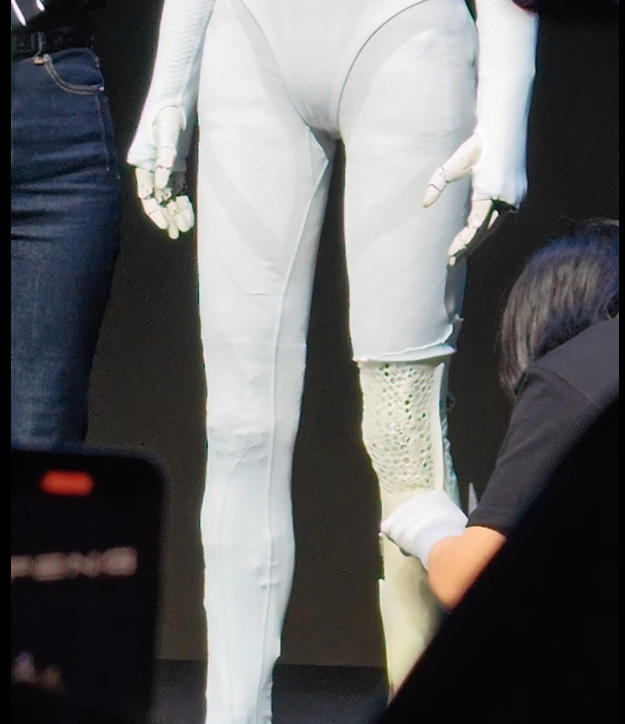
小鹏人形机器人一日内两次“自证清白”,被迫剪开了机器人的腿
Feng Huang Wang· 2025-11-08 09:52
Core Viewpoint - The CEO of XPeng Motors, He Xiaopeng, responded vigorously to widespread skepticism regarding the company's humanoid robot, IRON, asserting that the team felt wronged and emotionally affected by the doubts raised online [1]. Group 1: Response to Criticism - He Xiaopeng revealed that the team felt "wronged" and had sleepless nights due to the online skepticism about the robot being a real person [1]. - In an effort to dispel doubts, the team filmed a "one-shot" video to demonstrate the robot's authenticity, but the release did not quell the criticism, which shifted to questioning the robot's design and the video's authenticity [1]. - To further prove the robot's identity, the team resorted to extreme measures during a live event, cutting open the robot's leg to reveal its mechanical structure, which He Xiaopeng compared to a scene from the movie "Let the Bullets Fly" [1]. Group 2: Industry Perception and Future Plans - He Xiaopeng noted that the skepticism reflects a bias in people's perceptions, likening it to the disbelief in Chinese companies' ability to produce quality electric vehicles a decade ago [4]. - He suggested that if the robot were from an overseas company, the feedback would likely be more positive, indicating a potential bias against domestic innovations [4]. - Despite the challenges faced, the controversy has led to unexpected positive outcomes, such as increased interest from supply chain companies willing to collaborate on mass production of the robot [4]. - The company aims to achieve mass production of high-level humanoid robots by the end of 2026 [4].

中金2026年展望 | 汽车及出行设备:关注全球格局再重构下的中国机遇(要点版)
中金点睛· 2025-11-07 00:09
Group 1: Passenger Vehicles - Domestic sales of passenger vehicles have gradually surpassed the previous high point of 2017, with expectations for steady growth if central and local subsidies remain effective. The resilience of growth needs to be observed through 2026 [2][3] - In the new energy sector, technological innovations and model iterations are expected to drive an increase in penetration rates, while the phase-out of purchase tax incentives by the end of 2025 may lead to temporary demand pull-forward. Domestic new energy vehicle sales are projected to maintain double-digit growth [2][3] - The global expansion of Chinese automotive brands is anticipated to accelerate, with overseas sales expected to grow by 5-10% by 2026, and the share of new energy vehicles in exports reaching 50% [8][10] Group 2: Commercial Vehicles - The heavy truck sector is expected to see continued support from the scrappage and renewal policy, with total industry volume projected to grow by 5% year-on-year, reaching 1.05-1.1 million units by 2026. Domestic sales are expected to remain flat or grow by 5% to 710,000-760,000 units, while exports may increase by 10% to 340,000 units [10] - The penetration rate of new energy heavy trucks in domestic sales is expected to reach around 30% by 2026, up from 25% in 2025. The L2+ level assisted driving heavy trucks are anticipated to achieve a breakthrough, with penetration rates reaching single digits [10] Group 3: Auto Parts - The growth potential of China's auto parts industry is shifting from domestic demand to international expansion, with a focus on securing orders from European automakers for new energy vehicle components by 2026 [2][11] Group 4: Robotics and Autonomous Driving - The robotics industry is entering a mass production phase, with humanoid robots showing long-term development potential. The industry is expected to accelerate progress, with key catalysts emerging from domestic manufacturers [11][12] - 2026 is projected to be the year for the mass production of L3 autonomous driving, driven by improved regulations and consumer awareness. The penetration rate of high-level autonomous driving is expected to exceed 40% by 2026 [12][13]

乐聚机器人获近15亿元Pre-IPO轮融资,深投控资本、东方精工等联合投资
Xin Lang Ke Ji· 2025-10-22 02:10
Core Insights - Leju Robotics has completed nearly 1.5 billion yuan in Pre-IPO financing, with investments from multiple firms including Shenzhen Longhua Capital and Dongfang Precision [1] Financing Details - The financing round aims to enhance core technology research and development, deepen industry chain layout, and improve application scenarios for humanoid robots [1] - The funds will support the transition of humanoid robots towards large-scale production and diversified applications [1] Industry Chain Investments - Leju Robotics has invested in several upstream and downstream companies, including: - Quanzhibo (integrated joints) - Lijudongli (motors) - Lingxinqiaoshou (dexterous hands) - Kehang Shikong (data platform) - Jubrain Panshi (embodied brain) - Jushi Intelligent (operating system) [1] Collaborative Ventures - The company has partnered with Dongfang Precision to establish a large-scale humanoid robot production line [1] - Joint ventures include a humanoid robot controller company with Heertai and Dongfang Precision, and a production logistics solution company with Haichen [1]

机器人产业跟踪:贸易摩擦影响有限,人形机器人迎来布局时机
Orient Securities· 2025-10-18 09:23
Investment Rating - The industry investment rating is maintained as "Positive" [5] Core Viewpoints - Despite the intensification of short-term trade frictions, domestic component manufacturers are investing in overseas production capacity, and humanoid robots are expected to enter mass production, indicating that the impact of trade frictions is limited. The humanoid robot sector is poised for a strategic opportunity [3][8] - The leading companies in the humanoid robot sector are expected to accelerate mass production, with Tesla's CEO announcing plans for the third-generation humanoid robot, Optimus, to begin production in early 2026, aiming for a monthly output of 100,000 units within five years. This reflects the maturity of robot products and signals a new phase of mass production in the industry [8] Summary by Sections Trade Friction Impact - The report indicates that the impact of trade frictions on humanoid robots is minimal, with the sector presenting a good opportunity for investment [8] - Domestic companies are actively establishing overseas production bases, reducing uncertainties in the supply chain due to trade tensions [8] Industry Trends - The report highlights that the leading companies, such as Tesla, are driving the industry towards mass production, with significant support from the domestic supply chain [8] - The report emphasizes the strong manufacturing capabilities of domestic component companies, which are expected to benefit from the upcoming mass production phase [3][8] Investment Targets - Recommended investment targets include Top Group (601689, Buy), Sanhua Intelligent Control (002050, Buy), Wuzhou New Spring (603667, Buy), Hengli Hydraulic (601100, Not Rated), and Zhenyu Technology (300953, Buy) [3]


人形机器人迈入量产 把握赛道投资机遇
Zhong Guo Zheng Quan Bao - Zhong Zheng Wang· 2025-10-17 00:57
Core Insights - The humanoid robot industry is transitioning from technical exploration to large-scale production, driven by policy guidance and collaboration with the electric vehicle supply chain [1][4] - The industry is expected to experience significant growth over the next two decades, with a projected demand increase of five to ten times by 2026 [3][6] Technological Development - The focus has shifted from developing functional robots to rapid scaling, with breakthroughs across the software, hardware, and supply chain [2][3] - Tesla's Optimus Gen3 is becoming an industry benchmark, with its design nearing completion and expected to launch by the end of this year [2][6] Market Expansion - Domestic companies are securing substantial contracts, with the likes of UBTECH's Walker series winning contracts worth hundreds of millions, primarily from state-owned enterprises and government departments [3][4] - The supply chain for humanoid robots in China is now one of the most complete globally, facilitating mass production [3][5] Policy Support - China is providing leading global support for the humanoid robot industry, with systematic and precise policies aimed at fostering key component breakthroughs [4][5] - Local governments are implementing substantial support measures, including targeted subsidies for research, manufacturing, and application promotion [4] Synergy with Electric Vehicle Industry - The collaboration with the electric vehicle industry is enhancing the humanoid robot sector through shared data, technology, and supply chain efficiencies [5][6] - The automotive industry's manufacturing capabilities and cost control experiences are being leveraged for robot production [5] Investment Opportunities - Key investment strategies include focusing on core components linked to leading companies like Tesla, domestic industry leaders, and niche areas with unique technologies [6][7] - The industry is characterized by non-linear growth, suggesting that current valuations may not be excessive given the potential for rapid expansion once mass production begins [6][7] Competitive Landscape - The competitive landscape will likely favor leading companies and their core component suppliers, with a focus on those with technological advantages and proven supply chain capabilities [7]

第四季度全面看多人形机器人板块行情
Mei Ri Jing Ji Xin Wen· 2025-10-16 01:20
Group 1: Humanoid Robot Sector - CITIC Securities predicts a bullish outlook for the humanoid robot sector in Q4, highlighting the importance of Tesla's third-generation Optimus changes and mass production expectations as a critical window [1] - The domestic supply chain is expected to release continuous positive news related to capital operations, order shipments, and scenario implementations in Q4 [1] - The report recommends focusing on T-chain and sectors with better industry trends, faster growth such as sensors, dexterous hands, vertical applications, and domestic supply chains [1] Group 2: Excavator Industry - Huatai Securities notes an upward trend in the excavator market in September, forecasting a sustained recovery in the industry [2] - According to the Engineering Machinery Association, excavator sales in September 2025 reached 19,900 units, a year-on-year increase of 25.4%, with domestic and foreign sales at 9,200 units and 10,600 units, respectively, reflecting growth rates of 22% and 29% [2] - The report highlights the rapid growth of second-hand excavator exports driving domestic replacement demand and the continuous increase in market share for domestic brands overseas, recommending leading companies in engineering machinery and components [2] Group 3: Wind and Solar Energy Industry - Huatai Securities suggests paying attention to the wind and solar energy industry chains following the National Development and Reform Commission's recent draft on renewable energy consumption targets [3] - The new mechanism aligns renewable energy consumption targets with non-electric consumption, continuing the "whole economy" emission control approach from the September UN Climate Change Summit [3] - The report anticipates benefits for key wind turbine manufacturers, offshore wind projects, low-cost silicon materials, and high-efficiency batteries/components due to the promotion of green electricity and hydrogen applications [3]
港股异动 | 三花智控(02050)尾盘涨超8% 特斯拉正努力扩大人形机器人规模
智通财经网· 2025-09-30 07:35
Core Viewpoint - The stock of Sanhua Intelligent Control (02050) has risen over 8%, currently trading at 44.42 HKD with a transaction volume of 1.165 billion HKD, driven by positive developments in the humanoid robot sector and its strong ties with Tesla [1] Company Summary - Sanhua Intelligent Control is a key supplier of actuator assemblies for Tesla's humanoid robots, indicating a strong business relationship that positions the company favorably as the humanoid robot market prepares for mass production [1] - The company has successfully entered the field of bionic robot actuator manufacturing and has established a dedicated robotics division to support product development, trial production, iteration, and eventual mass production [1] - The overall progress of the robotics project is on track, which is expected to open new growth avenues for the company [1] Industry Summary - Tesla is working to scale up humanoid robot production, with plans to launch the third generation by the end of 2025 and to achieve an annual production of 1 million units by 2030 [1] - The humanoid robot sector is approaching a mass production phase, with both domestic and international companies showing optimistic production outlooks and significant orders emerging within the industry [1] - Analysts believe that the upcoming mass production phase in the humanoid robot sector will create investment opportunities in the components segment, benefiting companies like Sanhua Intelligent Control [1]
三花智控尾盘涨超8% 特斯拉正努力扩大人形机器人规模
Zhi Tong Cai Jing· 2025-09-30 07:31
Group 1 - The stock of Sanhua Intelligent Control (002050) increased by over 8%, reaching 44.42 HKD with a trading volume of 1.165 billion HKD [1] - Tesla announced plans to scale up humanoid robot production, aiming to launch the third generation by the end of 2025 and start mass production in 2026, with a target of 1 million units per year by 2030 [1] - Dongfang Securities highlighted that the humanoid robot sector is approaching mass production, with significant orders emerging in the industry, indicating potential investment opportunities in the components sector [1] Group 2 - Sanhua Intelligent Control is closely tied to Tesla as a primary supplier of humanoid robot actuator assemblies [1] - Zheshang Securities noted that the company is successfully entering the field of bionic robot actuator manufacturing and has established a dedicated robotics division to support product development and mass production [1] - The overall progress of the robotics project is on track, which is expected to create new growth opportunities for the company [1]
三花智控涨超5% 机器人产业国内外景气度共振 机构看好人形机器人打开公司增长空间
Zhi Tong Cai Jing· 2025-09-29 02:04
Group 1 - The stock of Sanhua Intelligent Control (002050) rose over 5%, currently at 39.92 HKD with a trading volume of 274 million HKD [1] - Dongfang Securities highlights that the humanoid robot sector is on the verge of mass production, with both domestic and international markets showing positive trends [1] - The humanoid robot sector is expected to enter a mass production phase next year, creating investment opportunities in the components segment [1] Group 2 - Minsheng Securities expresses optimism regarding Tesla's robots, anticipating significant catalysts for the T-chain core line [1] - Tesla is expected to hold its Q3 2025 earnings call in late October and its 2025 shareholder meeting on November 6, with the release of Optimus V3 imminent [1] - Sanhua Intelligent Control is closely tied to Tesla as a primary supplier of humanoid robot actuator assemblies [1] Group 3 - Zheshang Securities notes that Sanhua Intelligent Control is focusing on the manufacturing of electromechanical actuators for robots, with overall progress being smooth [1] - The company has successfully entered the field of bionic robot electromechanical actuator manufacturing [1] - Sanhua Intelligent Control has established a dedicated robotics division to actively support product development, trial production, iteration, and eventual mass production [1]