供应链一体化

Search documents
永新股份(002014) - 002014永新股份投资者关系管理信息20250830
2025-08-30 09:02
Group 1: Financial Performance - The gross margin of the color printing business has decreased year-on-year due to product price reductions and changes in product structure [2] - The gross margin for the film business remained stable at 15% in the first half of the year, with expectations for improvement in the future [3] Group 2: Business Expansion and Investment - The company aims to develop its film business as a core operation, with significant investments planned, including a new functional film material project with a total investment of 2.2 billion [3] - Other investment projects include a 1.8 billion project for a multi-functional film and a 450 million project for pet food packaging [3] Group 3: Market Strategy and Competition - The company is expanding its overseas business through global supply chain integration and targeting markets in ASEAN, Japan, and Mexico, where gross margins are higher due to lower competition [3] - The industry is experiencing a slow consolidation trend driven by policy guidance, environmental regulations, and increasing quality demands from downstream customers [3] Group 4: Dividend Policy - The company's dividend policy remains stable, with plans to maintain a consistent level of dividends as long as it does not affect normal operations and development needs [3]

蜜雪集团(02097):业绩超预期,竞争优势持续强化
Tai Ping Yang· 2025-08-28 14:04
Investment Rating - The report maintains an "Accumulate" rating for the company with a target price of 515.11 HKD, compared to the last closing price of 460.40 HKD [1]. Core Insights - The company reported better-than-expected performance, with a total revenue of 14.875 billion HKD for H1 2025, reflecting a year-on-year growth of 39.3%, and a net profit of 2.718 billion HKD, up 44.1% year-on-year [4][6]. - The number of stores exceeded 53,000, with a net increase of 6,535 stores since the beginning of the year, indicating a faster-than-expected expansion in domestic store openings [5][6]. - The company's gross margin remains stable at 31.6%, with a net profit margin of 18.3%, showing strong profitability despite rising raw material costs [6][7]. Financial Performance - For H1 2025, the revenue breakdown by business segment includes product sales at 13.843 billion HKD, equipment sales at 652 million HKD, and franchise and related services at 380 million HKD, with respective year-on-year growth rates of 39.5%, 42.3%, and 29.8% [5]. - The company expects revenue growth rates of 34%, 17%, and 16% for 2025, 2026, and 2027, respectively, with net profit growth rates of 37%, 17%, and 17% for the same years [7][8]. - The earnings per share (EPS) are projected to be 15.98, 22.34, and 29.17 HKD for 2025, 2026, and 2027, respectively, with corresponding price-to-earnings (PE) ratios of 26x, 22x, and 19x [7][8]. Store Expansion and Market Position - The company has a total of 53,014 stores, with 52,996 being franchise stores and 18 direct stores, indicating a strong franchise model [5]. - The geographical distribution shows 48,281 stores in mainland China and 4,733 overseas, with a net increase of 6,687 stores in China and a decrease of 162 overseas [5]. - The company has established significant barriers in product, supply chain, and channel, positioning itself strongly in the market despite potential challenges from external factors [6][7].
今年前7月全国社会物流总额超200万亿元 市场规模稳定增长
Yang Shi Xin Wen Ke Hu Duan· 2025-08-28 08:21
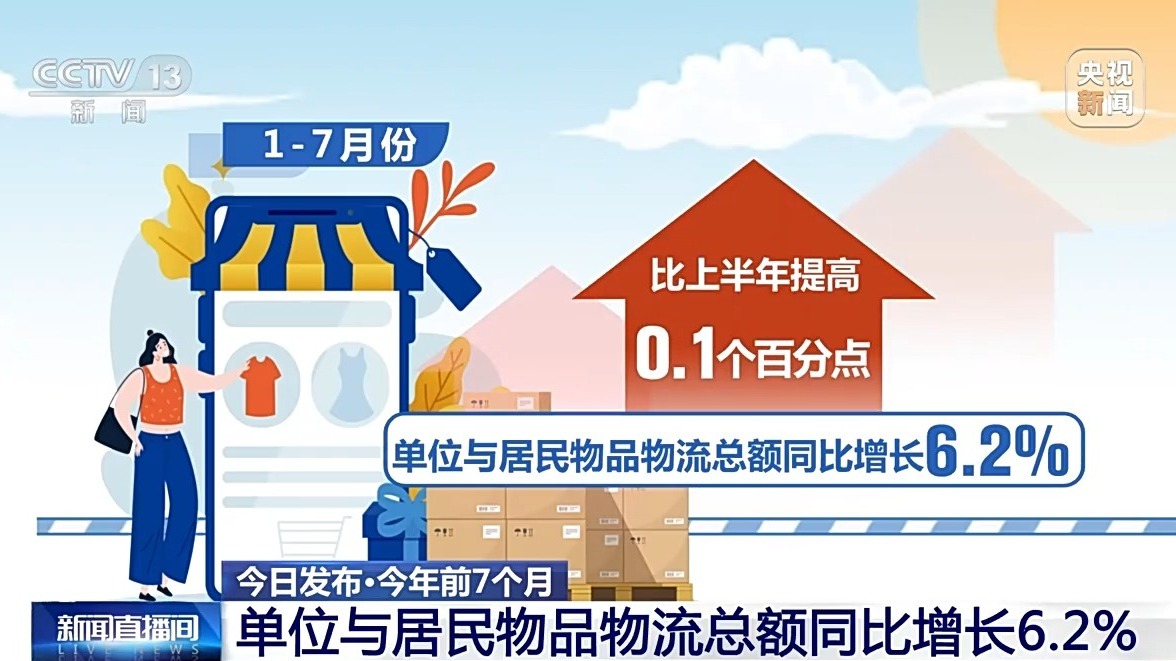
Core Insights - The logistics sector in China has shown steady growth in the first seven months of the year, with a total social logistics volume exceeding 200 trillion yuan, driven by strong demand in high-end manufacturing and green low-carbon sectors [1][2][4]. Logistics Volume and Growth - From January to July, the total social logistics volume reached 201.9 trillion yuan, marking a year-on-year increase of 5.2% [4]. - The logistics volume of industrial products grew by 5.7% year-on-year, with over 85% of 35 industries experiencing growth [4]. Demand Segments - The logistics demand for units and residential goods increased by 6.2%, slightly up from the first half of the year [6]. - The "old-for-new" policy has significantly boosted logistics demand for home appliances and communication equipment [6]. Import Logistics - Import logistics have shown improvement, with high-tech products and electromechanical products being the main drivers [8]. - The logistics volume for machine tools and other products maintained a high growth rate of over 18%, while the logistics volume for integrated circuits grew by over 10% year-on-year in July [8]. Regional Growth Dynamics - The logistics market is experiencing stable growth with noticeable structural changes, particularly in the central and western regions, which are outpacing national growth rates [11][13]. - In July, the business volume index for the western region reached 52.3%, and for the central region, it was 50.9%, both exceeding the national average [13]. E-commerce and International Logistics - The e-commerce and express delivery sectors continue to thrive, with online retail sales of physical goods increasing by 6.3%, outpacing the growth of total retail sales [15]. - International logistics have emerged as a new growth point, with air cargo transport volume increasing by 21.5% year-on-year [15]. Profitability and Market Conditions - The logistics industry reported a total revenue of 8.2 trillion yuan, reflecting a year-on-year increase of 4.9% [13]. - In July, logistics service prices showed a mixed trend, but overall profitability for logistics companies has improved [18][20]. - The revenue profit margin for key logistics enterprises was 3.4%, up by 0.3 percentage points from the first half of the year [22].

“以更密切的老中合作造福两国人民”——访老挝副总理吉乔
Ren Min Ri Bao· 2025-08-17 10:17
Group 1 - Laos and China have achieved significant progress in various fields of cooperation under the frameworks of the Belt and Road Initiative and ASEAN-China cooperation, benefiting both nations [1] - The China-Laos Railway, which opened in December 2021, has become a vital transportation channel, with over 10.07 million passengers and 12.6 million tons of goods transported in the first half of this year, marking a 1.7% and 25.9% year-on-year increase respectively [1] - The railway has boosted regional economic cooperation and attracted more foreign investment into Laos, leading to new infrastructure projects such as highways connecting Laos with Vietnam and Thailand [1] Group 2 - Ongoing projects include the development of a 500kV/230kV power grid in Vientiane, the comprehensive development of the Vientiane Saysettha Economic Zone, and the second, third, and fourth phases of the China-Laos Highway [2] - The ASEAN-China Free Trade Area 3.0 negotiations have been completed, which will enhance economic integration and cooperation in supply chains, digital economy, and green economy between ASEAN and China [2] - China is recognized as a major market driving regional economic growth, and the partnership between ASEAN and China is expected to contribute to regional stability and prosperity [2]
京东物流20250814
2025-08-14 14:48
Key Points Summary of JD Logistics Q2 2025 Earnings Call Company Overview - **Company**: JD Logistics - **Quarter**: Q2 2025 Financial Performance - Adjusted net profit reached **25.9 billion RMB**, a year-on-year increase of **5.4%** with a net profit margin of **5%** indicating stable growth in profitability [2][4] - Total revenue for Q2 2025 was **515.6 billion RMB**, reflecting a year-on-year growth of **16.6%**; external revenue was **338 billion RMB**, up **4.2%** [3][16] Integrated Supply Chain Performance - Revenue from integrated supply chain customers was **269.1 billion RMB**, a **26.3%** increase year-on-year, with external integrated supply chain revenue at **91.5 billion RMB**, growing **17.8%** [5][16] - The number of external integrated supply chain customers increased by **13.8%** to **15,854**, with average revenue per customer rising by **3.5%** to **139,000 RMB** [6][16] Industry-Specific Achievements - **Home Appliances**: Enhanced service capabilities led to significant improvements in operational metrics, including a **20%** increase in on-time delivery rates and inventory turnover [7] - **Apparel**: Upgraded services to achieve **30%** improvement in order timeliness compared to traditional models, addressing high return rates in e-commerce [8] - **Automotive**: Developed a just-in-time supply model that improved space utilization and efficiency in logistics for automotive clients [9][10] International Expansion - Launched the self-operated express brand **Joy Express** in Saudi Arabia, enhancing last-mile delivery capabilities [11] - Accelerated overseas warehouse expansion in multiple countries, including the U.S., France, and Vietnam, to provide integrated supply chain services [11] Express Delivery Business - Revenue from express delivery and logistics services grew by **7.6%** to **246.6 billion RMB** [12] - Implemented temperature-controlled logistics solutions for fresh produce, improving delivery reliability [12] Technological Innovations - Continuous investment in automation and AI technologies to enhance logistics efficiency across the supply chain [14][15] - Development of smart logistics solutions, including autonomous vehicles for last-mile delivery [15] Cash Flow and Capital Expenditure - Free cash flow for Q2 was **24.9 billion RMB**, an increase of **8 billion RMB** year-on-year; capital expenditure was **10.9 billion RMB** focused on operational efficiency [19] Future Outlook - Plans to enhance customer experience and operational efficiency through technology-driven initiatives, including scaling up autonomous vehicle deployment [18] - Positive growth outlook for integrated supply chain services, driven by competitive pricing and service quality [23][24] Customer Engagement and Revenue Growth - Increased customer engagement led to growth in both average revenue per customer and total customer numbers, supported by a multi-channel logistics model [25] Long-term Profitability - Long-term gross margin is expected to improve through cost reduction and efficiency enhancements, despite short-term pressures from strategic investments [26]
湖北最小城市,被顺丰带“飞”了
3 6 Ke· 2025-06-16 03:29
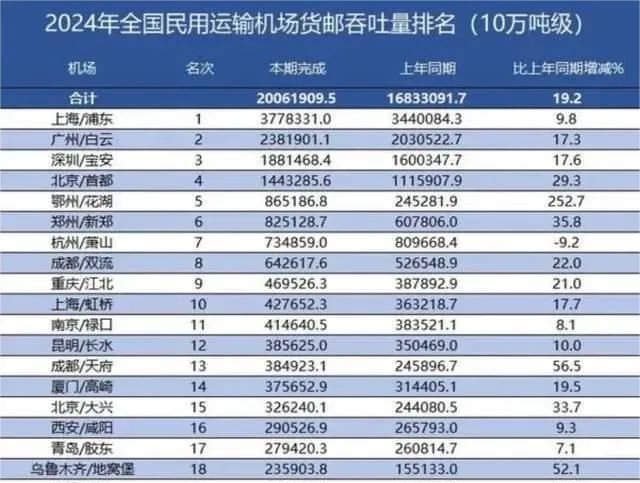
Core Insights - The article highlights the rapid development of Ezhou Huahu International Airport, which has become a significant cargo hub in China, surpassing Zhengzhou Airport to become the top cargo airport in Central China [4][6][10]. Group 1: Airport Development - Ezhou Huahu International Airport is the world's fourth and Asia's first dedicated cargo hub, with a projected cargo throughput of 865,186.8 tons in 2024, marking a 252.7% increase from the previous year [4][7][10]. - The airport aims to reach a cargo throughput of 2.45 million tons by 2025 and 3.3 million tons by 2030, with expectations to rank among the top three cargo airports in China in the coming years [9][10]. Group 2: Economic Impact - The establishment of the airport has led to significant economic growth in the region, attracting over 96 projects with a total investment of 108 billion yuan by 2024 [37]. - Ezhou has become a logistics hub, with over 80 logistics companies, including major players like JD.com and YTO Express, setting up operations at the airport [37][41]. Group 3: Strategic Location - Ezhou's geographical advantages allow it to cover major economic regions in China, including the Yangtze River Delta and the Pearl River Delta, facilitating next-day delivery services to a vast population [20][22]. - The city boasts a comprehensive transportation network, including deep-water ports and rail connections, enhancing its logistics capabilities [20][21]. Group 4: Partnerships and Collaborations - SF Express has partnered with the Ezhou government to develop the airport, which has led to the fastest approval and construction timelines in Chinese civil aviation history [25][26]. - The airport has attracted global companies, including eight Fortune 500 firms, establishing regional centers to leverage the logistics capabilities offered by the airport [39]. Group 5: Future Prospects - The airport is positioned to become a global supply chain center and high-end processing hub, with plans to enhance cross-border e-commerce capabilities by 2025 [41][42]. - Ezhou's development is compared to Memphis, USA, indicating a shift in how cities can leverage logistics hubs for economic growth [33][46].