国产操作系统

Search documents
从“内卷”到“竞合”:大模型时代,开源社区能否带领国产OS“场景突围”?
Ge Long Hui· 2025-11-18 12:23
Core Insights - The article discusses the transformative impact of AI on traditional computing systems, particularly focusing on the evolution of the Anolis OS and the broader domestic software industry in China [2][11] - It highlights the shift from a stable replacement of operating systems to a co-evolution with AI, emphasizing the need for a new definition of operating systems in the AI era [2][11] Group 1: AI's Impact on Operating Systems - AI is reshaping the definition of operating systems from mere resource managers to active "transmission devices" that efficiently organize and schedule heterogeneous resources [5][11] - The new operating systems must support complex applications driven by AI models, requiring advanced memory and tool usage capabilities [4][6] - The demand for managing diverse computing resources, including GPUs and AI chips, presents new technical challenges for operating systems [4][6] Group 2: Domestic Operating Systems' Challenges and Opportunities - Domestic operating systems like Anolis and OpenEuler face a global competitiveness gap compared to top international systems, particularly in unified ecosystem representation [6][7] - However, the inability to rely on a single dominant computing supply has led domestic systems to develop unique experiences in supporting diverse computing environments [7][8] - The complexity of scenarios faced by Chinese enterprises provides domestic operating systems with a natural advantage in handling intricate systems [7][8] Group 3: Advantages of Open Source and Community Collaboration - The deep integration of open source with domestic operating systems enhances their ability to innovate collaboratively among various manufacturers [7][10] - Sustainable commercial investment is crucial for the long-term viability of open source communities, ensuring continuous iteration and development [7][10] - The growth of the Longxin community from 100 to 1000 partners illustrates the strong demand for collaborative solutions across the domestic industry [8][10] Group 4: Competitive and Cooperative Dynamics - The competition among domestic operating systems is characterized by a complex interplay of cooperation and competition, rather than a simple replacement model [8][10] - Multiple communities are necessary to address the diverse needs of the domestic industry, allowing for parallel development without hindering each other [8][10] - The focus should be on creating a "systemic prosperity" rather than a singular dominance, fostering a collaborative ecosystem [10][11] Group 5: Future Directions and Strategic Focus - The path for domestic operating systems involves leveraging open models to drive hardware and OS standards, facilitating a shift away from hardware dependency [10][11] - The ongoing evolution of computing paradigms and the need for high-level cooperation among communities will define the future of domestic operating systems [11][12] - The article concludes that the journey of domestic operating systems is a continuous process of conflict, cooperation, and evolution, positioning them as active participants in the AI-driven transformation [11][12]

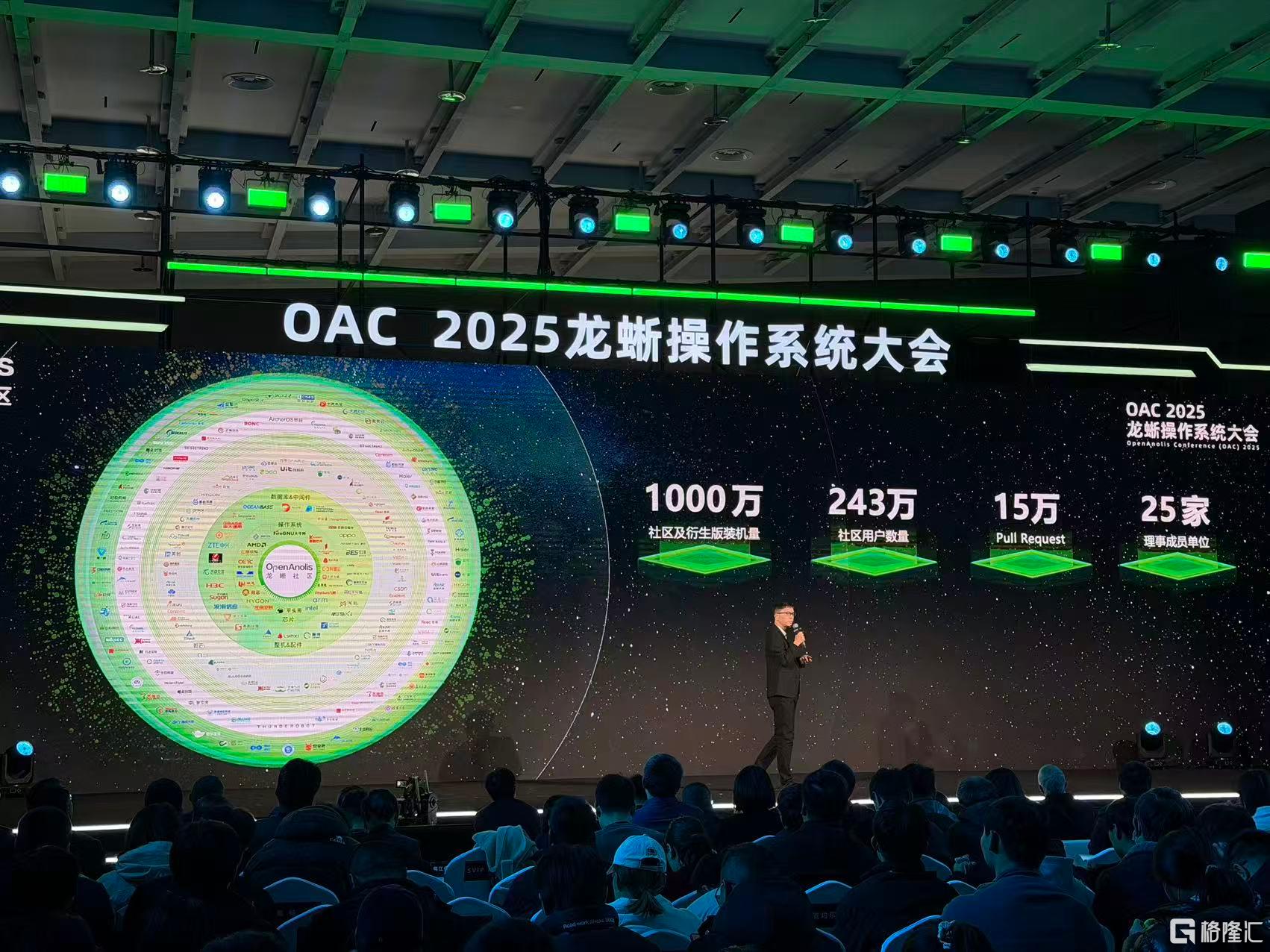
中国智能计算产业联盟:龙蜥操作系统装机量超1000万
Bei Jing Shang Bao· 2025-11-18 09:24
Core Insights - The report indicates that the Longxin ecosystem's community and commercial versions account for nearly 50% of the market share in server operating systems, with an installation volume exceeding 10 million units [1] - There is a strong willingness among users to migrate to the Longxin ecosystem, with 54.25% expressing intent to switch to its community and commercial versions [1] Market Trends - The "cloud + AI" paradigm is reshaping and accelerating the development of server operating systems, with the domestic market expected to exceed 30 billion yuan in the next three years [2] - The domestic market share of server operating systems is projected to increase from 35% to 65%, indicating a significant leap from niche to general market applications [2] Ecosystem Development - Over the past year, the Longxin community has collaborated with various institutions to develop the RISC-V SIG 2.0 plan, enhancing the software ecosystem [2] - The community has released the Anolis23 RISC-V preview version, which supports high-performance extensions and includes over 1,300 software packages, facilitating the evolution of RISC-V for data center applications [2] Standardization Efforts - Community experts hold leadership positions in the RISC-V International Foundation, driving the operation of the Data Center SIG and contributing to global standardization efforts [2]
诺奖实验室开源重磅成果,助力深圳打造芯片产业新高地
Nan Fang Du Shi Bao· 2025-11-16 11:11
Core Insights - The RISC-V International Open Source Laboratory (RIOS) officially launched its high-performance open-source RISC-V processor IP core "OpenRio" at the 27th China International High-tech Achievements Fair, marking a significant milestone for the lab and providing a high autonomy open "core" foundation for domestic operating system ecosystems [1][3] Group 1: Industry Context - The global computing technology landscape is undergoing profound restructuring, with the RISC-V instruction set rapidly transitioning from embedded systems to high-performance computing applications [3] - The traditional ARM architecture is facing challenges in balancing performance and cost, particularly as the costs of high-end mobile core components continue to rise, putting significant pressure on terminal manufacturers [3] Group 2: Product Features and Benefits - OpenRio is a high-reliability IP core that has undergone multiple rounds of verification and is ready for mass production, featuring comprehensive support for domestic operating system frameworks and compatibility with mainstream EDA tools [5] - The open-source model of OpenRio is expected to attract global developers, significantly lowering the design threshold for chips and injecting critical momentum into the RISC-V industrialization [3][5] Group 3: Strategic Importance - The launch of OpenRio provides a crucial common technology foundation for the deep integration of the international open-source RISC-V instruction set with domestic operating systems, addressing long-standing supply issues for high-performance, low-cost core components in the domestic operating system ecosystem [4] - RIOS aims to build an open-source REPO platform to create a CPU IP open-source foundation, providing unified standards and reference implementations to support continuous and reliable technology supply for the industry [5] Group 4: Future Plans - Shenzhen Qianhai will be the first to pilot the application of OpenRio, with RIOS planning to collaborate with more partners to create a win-win situation through IP licensing, technical cooperation, and scenario co-construction [5] - RIOS will continue to deepen its open-source strategy and collaborate closely with domestic operating system ecosystems like OpenHarmony to contribute to the security and self-reliance of digital infrastructure [5]
机器人迎来安卓时刻:具识智能重磅推出 insightOS,给机器人装上国产操作系统,共建产业生态
机器人大讲堂· 2025-11-10 04:07
Core Viewpoint - The article discusses the transition of the robotics industry from "automation" to "intelligence," highlighting the role of Professor Li Zhijun and his development of the insightOS, a domestically produced intelligent operating system for robots, aimed at enhancing their autonomous decision-making capabilities [1][4][19]. Group 1: InsightOS Development - The insightOS is designed to address the complexity and flexibility challenges in robot applications, integrating intelligence deeply into the system rather than treating it as an external module [4][5]. - The system aims to achieve robot autonomy by embedding AI capabilities such as perception, reasoning, and planning into the operating system's core services [4][5]. - A unified semantic understanding layer allows non-experts to command robots using natural language, significantly lowering deployment barriers and enabling large-scale collaboration among intelligent agents [5][8]. Group 2: Dynamic Adaptation and Flexibility - InsightOS features dynamic adaptability through built-in elastic scheduling and multi-model collaboration, enabling real-time resource allocation based on complex scene requirements [8]. - The system can autonomously identify anomalies and plan recovery strategies, ensuring stability in dynamic environments, thus addressing the critical challenge of making robots not just "usable" but "effective" [8][9]. Group 3: Ecosystem Construction - The company is building a comprehensive ecosystem that connects application scenarios, hardware adaptation, and algorithm integration, aiming to create a universal system tailored to domestic industry needs [9][10]. - InsightOS has achieved hardware decoupling and capability atomization, allowing compatibility with various robot types, including industrial arms and drones, by abstracting hardware differences into a unified "semantic behavior" [9][10]. - The insight Studio development platform supports rapid integration of third-party algorithm models, significantly reducing the barriers and costs for robot manufacturers in deploying and tuning algorithms [10][12]. Group 4: Vision and Mission - InsightOS aims to create a "self-controllable operating system" for Chinese robots, addressing the reliance on foreign platforms and mitigating data security risks [13][15]. - The system is built on decades of research from Harbin Institute of Technology, ensuring a strong foundation in both operating systems and robotics [15][18]. - The company plans to establish a complete product matrix and has already deployed insightOS in several domestic humanoid robots, receiving industry recognition [18][19].

中国软件(600536):单季度利润大幅改善,紧握核心资产构筑长期竞争力
Minsheng Securities· 2025-11-03 05:58
Investment Rating - The report maintains a "Recommended" rating for the company, indicating an expected price increase of over 15% relative to the benchmark index [6]. Core Insights - The company reported a significant improvement in quarterly profits, with total revenue for the first three quarters of 2025 reaching 3.198 billion yuan, a year-on-year increase of 9.50%. The net profit attributable to shareholders was -104 million yuan, a substantial reduction in losses compared to -338 million yuan in the same period last year [1]. - Focusing on its core business has yielded results, with Q3 2025 revenue of 956 million yuan, a 2.06% year-on-year increase. The net profit attributable to shareholders for Q3 was -30 million yuan, also a reduction in losses from -65 million yuan year-on-year [2]. - The company is strengthening its long-term competitive advantage by holding onto core assets, particularly in the domestic operating system market, where its subsidiary, Kylin Software, has maintained the top market share for 14 consecutive years [3]. Financial Performance Summary - For the first three quarters of 2025, Kylin Software generated 910 million yuan in revenue, a 16.09% increase year-on-year, with a net profit of 203 million yuan, up 39.74% year-on-year. In Q3 2025 alone, Kylin Software's net profit was 51 million yuan, reflecting a 104% year-on-year growth [2][3]. - The company has established a comprehensive cybersecurity market, research, and technical service system, leveraging its strengths in Kylin Software and other core assets to maintain industry leadership in operating systems and databases [4]. - The financial forecast for 2025-2027 estimates net profits attributable to shareholders at 127 million yuan, 261 million yuan, and 351 million yuan, respectively, with corresponding price-to-earnings ratios of 384X, 187X, and 139X [5][10].

中国软件涨1.28%,成交额14.05亿元,今日主力净流入802.12万
Xin Lang Cai Jing· 2025-10-29 10:04
Core Viewpoint - China Software's stock has shown a positive movement with a 1.28% increase, reaching a market capitalization of 48.585 billion yuan and a trading volume of 1.405 billion yuan on October 29 [1] Group 1: Company Overview - China Software and Technology Service Co., Ltd. was established on March 1, 1994, and listed on May 17, 2002. The company specializes in proprietary software products, industry solutions, and service-oriented businesses [7] - The revenue composition of the company includes 42.43% from industry solutions, 33.08% from proprietary software products, 23.86% from service-oriented businesses, and 0.63% from other sources [7] Group 2: Business Operations - The company possesses a complete business chain from operating systems and middleware to security products and application systems, covering critical sectors such as taxation, government, transportation, intellectual property, finance, and energy [2] - The company is the only enterprise with a Linux operating system and holds a 50% stake in Zhongbiao Software, which offers a range of products including server operating systems and virtualization software [2] - The company’s subsidiary, Kirin Software, is a significant contributor to the openEuler community, achieving notable success in community contributions and market presence [2] Group 3: Financial Performance - For the first half of 2025, the company reported a revenue of 2.242 billion yuan, reflecting a year-on-year growth of 13.01%. However, the net profit attributable to the parent company was a loss of 74.5263 million yuan, although this represented a 72.67% improvement compared to the previous year [8] - The company has distributed a total of 415 million yuan in dividends since its A-share listing, with 13.8956 million yuan distributed over the past three years [9] Group 4: Market Position and Shareholding - The company is categorized as a "中字头" stock, with its actual controller being a state-owned enterprise or central government agency [3] - As of June 30, 2025, the number of shareholders was 156,200, a decrease of 9.92% from the previous period, with an average of 5,401 circulating shares per person, an increase of 11.02% [8] - Major shareholders include Hong Kong Central Clearing Limited and Southern CSI 500 ETF, with notable increases in their holdings [9]
润和软件前三季度扣非净利润同比增长26.88% 开源生态与AI业务加速突破
Zheng Quan Ri Bao· 2025-10-29 08:04
Core Insights - Jiangsu Runhe Software Co., Ltd. reported a revenue of 2.719 billion yuan for the first three quarters of 2025, representing a year-on-year growth of 12.86% [2] - The net profit attributable to shareholders after deducting non-recurring gains and losses was 62.1493 million yuan, showing a year-on-year increase of 26.88% [2] Group 1: Business Focus and Strategy - The company is deeply engaged in the next-generation information technology sector, integrating advanced technologies with industry applications to enhance its core competitiveness and innovation drive [2] - Runhe Software is focusing on domestic operating systems and core artificial intelligence technologies, developing integrated software and hardware products and solutions [2] - The company has established a full lifecycle software service system to empower industrial upgrades [2] Group 2: Innovation and Industry Empowerment - Runhe Software is pursuing innovation along two main lines: localization and intelligence, with localization efforts including open-source Hongmeng and open-source Euler businesses, while intelligence focuses primarily on AI [2][3] - The company is committed to commercial implementation, concentrating on key sectors and expanding its industry empowerment capabilities, currently serving finance, energy, healthcare, and education sectors [2] Group 3: Specific Business Areas - In the open-source Hongmeng field, Runhe Software aims to deepen its presence in existing industries while broadening its empowerment capabilities both horizontally and vertically [3] - In the open-source Euler domain, the company adopts a differentiated competition strategy, providing customized versions based on industry characteristics and client needs, leveraging its experience in finance and electricity [3] - In the AI sector, Runhe Software is building a comprehensive technical system covering AI chips, servers, operating systems, and full-stack AI platforms, offering end-to-end large model solutions for industries like finance, energy, and retail [3]

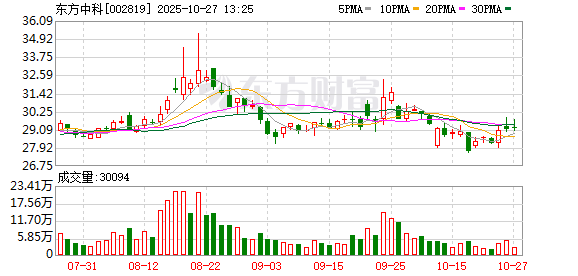
东方中科:子公司中科鸿略为国产操作系统解决方案提供商
Mei Ri Jing Ji Xin Wen· 2025-10-27 05:24
Group 1 - The core viewpoint is that Dongfang Zhongke (002819.SZ) is actively involved in providing solutions for domestic operating systems through its subsidiary Zhongke Honglue, focusing on the Harmony operating system [2][3] - Zhongke Honglue offers specialized software design and development for the Harmony operating system, catering to various hardware including tablets, smartphones, handheld devices, and PCs [2]

华为发布HarmonyOS 6 鸿蒙生态进入“深度共创”阶段
Zheng Quan Ri Bao· 2025-10-22 16:47
Core Insights - Huawei officially launched HarmonyOS 6 on October 22, marking a significant milestone in the development of China's first homegrown mobile operating system [1][3] - The number of devices running the previous version, HarmonyOS 5, has exceeded 23 million, indicating strong adoption [1] - The new operating system features enhancements in smoothness, intelligence, and cross-device collaboration, utilizing a new architecture called "Star River Interconnection" [1][2] Summary by Sections HarmonyOS 6 Evolution - HarmonyOS 6 has achieved comprehensive upgrades in terms of performance and user experience, with a 15% performance improvement across various device categories [1][2] - The system supports over 60 applications with a "tap-to-connect" feature, enhancing cross-device functionality [1] Security Enhancements - The upgraded "Star Shield" security architecture has innovated security measures from the core to the application level, with 99% of HarmonyOS applications expected to support a unique security access mechanism by September 2025 [2] - HarmonyOS has intercepted over 24 billion unreasonable permission requests, showcasing its commitment to user security [2] Ecosystem Development - The ecosystem has transitioned from "broad adaptation" to "deep co-creation," with over 8 million developers engaged and more than 9,000 applications participating in system-level innovations [3] - Major internet applications from Tencent, Alibaba, and ByteDance have adapted to HarmonyOS, enhancing user experiences with unique features [2][3] - The launch of initiatives like the "Harmony Thousand Sails Program" is attracting global developers, further enriching the ecosystem [3] Industry Impact - The release of HarmonyOS 6 is seen as a critical juncture in the independent development of domestic operating systems, with potential implications for the global operating system competitive landscape [3]
来了!鸿蒙6 支持与苹果设备互传!
Zheng Quan Shi Bao Wang· 2025-10-22 13:39
Core Insights - The official release of HarmonyOS 6 marks a significant evolution of the domestic operating system from usability to enhanced functionality, with Huawei and its ecosystem partners moving towards deep collaboration and joint innovation [2][8] Group 1: Key Features of HarmonyOS 6 - HarmonyOS 6 introduces cross-ecosystem connectivity, allowing data transfer between Huawei devices and Apple devices without the need for data flow, enhancing data mobility [2] - A growing number of applications are launching new features or debuting on HarmonyOS 6, including high-precision AR from JD.com and real-time weather updates from Qunar [2][3] - The integration of AI is comprehensive, with over 80 HarmonyOS applications now featuring intelligent agents that assist users in various tasks, marking a shift from traditional app interactions to natural language communication [3][5] Group 2: Ecosystem Growth and User Engagement - The HarmonyOS ecosystem is rapidly expanding, with over 23 million devices running HarmonyOS 5, making it the fastest-growing operating system in smart terminal history [5][7] - The upgrade to HarmonyOS 6 is set to roll out to over 90 models starting October 22, indicating a broad commitment to ecosystem development [9] - User feedback has been pivotal in shaping the ecosystem, with over 2 million user suggestions contributing to the ongoing improvement of HarmonyOS [8]