外汇风险准备金率

Search documents
央行出手,传递维护汇率基本稳定决心!丨头条热评
Sou Hu Cai Jing· 2026-02-27 12:00
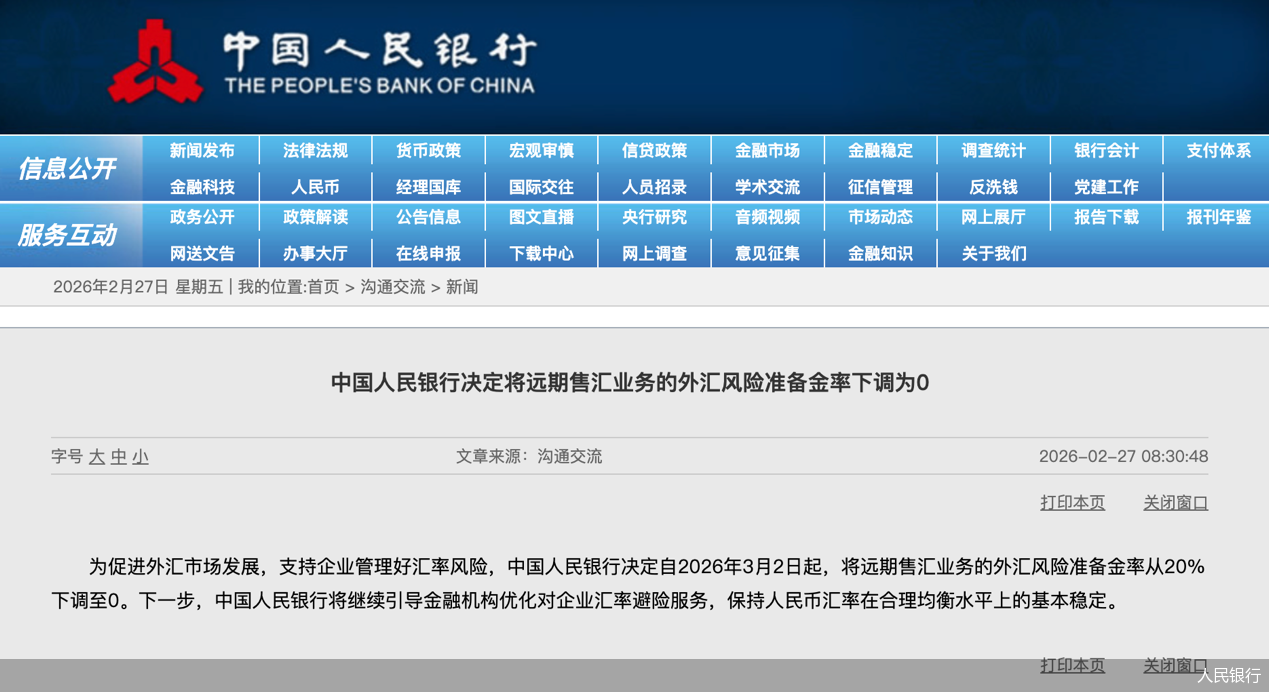
第二,"外汇风险准备金率"是一项被业内人士视为外汇市场"自动稳定器"的工具,本质上是一种价格手 段,即通过影响汇率远期价格,调节远期购汇行为。一般来说,当人民币贬值预期较强时,上调外汇风 险准备金率;当人民币升值预期较强时,下调外汇风险准备金率。 央行此次操作,有利于支持企业合理运用外汇衍生产品管理好汇率风险,提高企业在购汇方向开展外汇 套保的积极性。 此次政策调整,也意味着央行决心保持人民币汇率在合理均衡水平上的基本稳定。近期受多重因素驱 动,人民币对美元汇率快速升值,延续了2025年12月以来的偏强走势。如果后期人民币汇率出现背离基 本面的急涨急跌情况,其他稳汇市政策工具也可能出手,引导市场预期,防范汇率超调风险。 央行2月27日宣布,决定自3月2日起,将远期售汇业务的外汇风险准备金率从20%下调至0。这是时隔近 3年半后,央行再次使用该工具,促进外汇政策回归中性,传递出维护汇率基本稳定的决心。 理解这一政策,要先明白两个概念。 第一,"远期售汇业务"是银行对企业提供的一种汇率避险衍生产品,企业通过远期购汇能在一定程度上 规避未来汇率风险,但由于企业并不立刻购汇,而银行相应需要在即期市场购入外汇,这会影响 ...
直通部委|去年空气质量为有监测记录以来最优 《死亡证明》电子证照具有同等法律效力
Xin Lang Cai Jing· 2026-02-27 10:11
应急管理部2月27日举行新闻发布会,相关负责人表示,社会公众对生产安全事故调查结果高度关注, 事故调查报告全文公开,既是保障公众知情权、监督权的需要,又是强化警示教育,提升安全治理效能 的重要途径。但地方负责的事故调查,有的在调查之后出于各种原因考虑,该公开的未公开或公开不及 时。下一步,国务院安委办、应急管理部将对地方政府调查的生产安全事故,将通过随机抽查、定期调 度等方式,对调查报告的公开情况进行摸底,发现调查报告未公开或公开不及时的,及时进行跟踪督 办、及时通报。公开是长期的,严禁公开几天后又撤回。持续将事故调查报告公开将纳入中央安全生产 考核巡查重要内容,督促地方各级党委和政府落实属地责任,对未公开或公开不及时的地区予以考核扣 分。 药监局:2025年475个中药材生产基地通过检查 2025年全国环境空气质量为有监测记录以来最优 生态环境部2月27日举行新闻发布会,全面介绍我国深入打好蓝天保卫战的相关情况。据介绍,2025年 我国环境空气质量达到有监测记录以来历史最优。在2025年三项考核指标中,PM2.5平均浓度为28微克/ 立方米,优良天数比例达89.3%,重污染天数比例为0.9%,均为有监测记录 ...
人民币汇率一路冲高 外贸企业直面汇率考验
Sou Hu Cai Jing· 2026-02-27 10:06
记者 老盈盈 6.83!陈敏在深圳一家钢材出口企业从事外贸业务员工作,2月26日一早她看着汇率走势图,眉头紧锁。 春节长假后,人民币兑美元汇率不断创新高。2月25日,离岸及在岸人民币兑美元双双升破6.87关口,离岸人民币兑美元一度升至6.8619,在岸人民币兑美元 触及6.8649。2月26日,离岸人民币兑美元一度升破6.83关口,在岸人民币兑美元一度升至6.8310,逼近6.83关口,创2023年4月14日以来新高。 人民币一路快速升值,陈敏一个月前按人民币兑美元6.9报出去的订单还没结汇。现在人民币每升值一点,订单利润就会被"吃掉"一些。陈敏称,对于附加 值较低的行业,如今汇率报价成了老大难问题,报高了客户不高兴,报低了汇率一波动就容易亏本。以前外贸人是赚差价,现在玩的是"心跳"。 国家外汇管理局2月13日公布的2026年1月银行结售汇数据显示,新年首月,我国外汇市场交易活跃、预期平稳,跨境资金保持净流入。从外汇市场供求表现 看,1月银行结汇2863亿美元,售汇2065亿美元,结售汇顺差达798亿美元。 陈敏说,他们公司结汇会优先考虑锁汇和结汇时机,不会将所有美元资金一次性结汇。也就是说,根据汇率走势,采 ...


专家解读央行下调外汇风险准备金率
Sou Hu Cai Jing· 2026-02-27 08:59
2月27日,央行发布公告称,为促进外汇市场发展,支持企业管理好汇率风险,决定自2026年3月2日 起,将远期售汇业务的外汇风险准备金率从20%下调至0。受访专家指出,在当前人民币对美元汇率走 强背景下,央行上述调整有助于引导各方理性看待汇率波动,减少顺周期"羊群效应"。同时,政策有助 于降低外贸企业远期购汇的套保成本,便于企业做好汇率风险管理,更好地服务实体经济的真实购汇需 求。(央广网记者 冯方) 不血性が大人 则红 心 月 川 年 , 人 。 行针对银行远期售汇业务创设的逆周 期宏观审慎管理工具,于2015年"8·1 1"汇改后首次纳入政策框架,通过要 求金融机构按签约额比例缴存无息准 备金,传导至远期售汇价格进而调节 市场交易行为。 温彬举例称,2022年9月,面对 人民币对美元汇率的连续走低,央行 将远期售汇业务的外汇风险准备金率 从0上调至20%。当准备金率为20% 时,银行每做一笔100美元的远期售 汇业务,就需要向央行冻结20美元没 有利息的资金。这笔成本最终会转嫁 给企业,提高其远期购汇的价格。 而近期,人民币对美元汇率呈偏 强走势。Wind数据显示,春节假期后 三个交易日,在岸、离岸人民币对 ...

人民币升值过快,央行出手调控,工具箱中还有哪些工具?
Xin Lang Cai Jing· 2026-02-27 08:51
智通财经记者采访了解到,该举措有助于降低企业远期购汇成本,进而鼓励企业办理远期购汇业务,一定程度上将抑制人民币升值。更重要的是,这释放了 监管层抑制人民币升值过快的政策信号,如后续人民币延续较快升值走势,央行可能动用其他工具稳定汇率。 央行前述消息发布后,2月27日上午离岸人民币汇率一度跳水逾100个基点跌至6.85左右;在岸人民币汇率相比上一交易日贬值约150个基点至6.85左右。 "市场的一致预期是今年年底人民币升值到6.8,但现在一季度还没走完就奔着6.8去了,升值太快了,所以央行出手调控,但这不改变人民币中期升值的趋 势。"沪上某大型券商首席宏观分析师对智通财经记者表示。 外汇风险准备金运作机理 智通财经记者 | 杨志锦 要理解外汇风险准备金,首先得了解远期售汇业务。这是说的"售汇",是从银行角度而言,对应企业则是"购汇",因此远期售汇业务和远期购汇业务是硬币 的正反面,指向同一事情。 智通财经编辑 | 王姝 中国人民银行2月27日上午发布消息称,自2026年3月2日起,将远期售汇业务的外汇风险准备金率从20%下调至0。下一步,人民银行将继续引导金融机构优 化对企业汇率避险服务,保持人民币汇率在合理均 ...

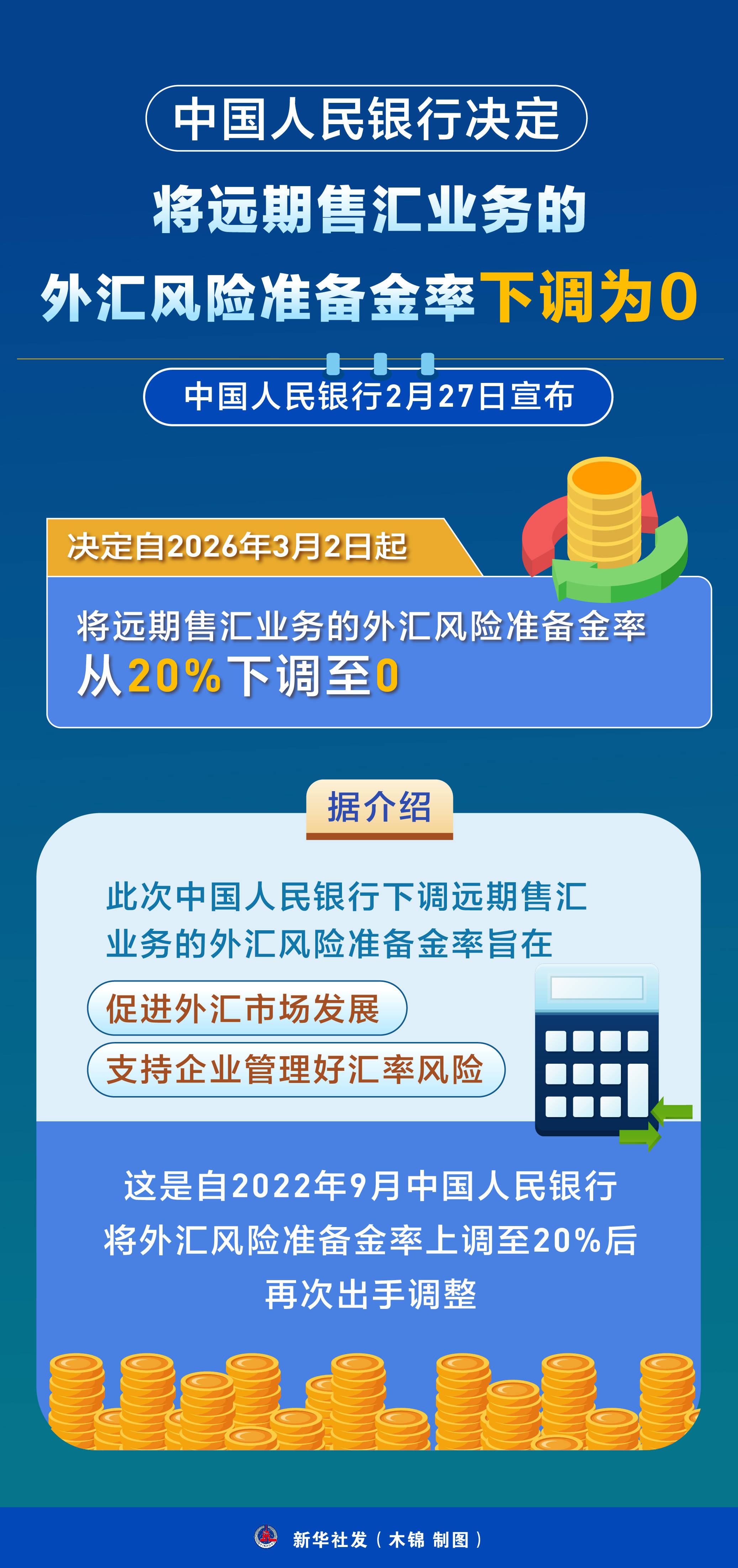
(图表)中国人民银行决定将远期售汇业务的外汇风险准备金率下调为0
Sou Hu Cai Jing· 2026-02-27 08:41
中国人民知 将远期售; 外汇风险准备: 中国人民银行1 新华社图表,北京,2026年2月27日 中国人民银行2月27日宣布,决定自2026年3月2日起,将远期售汇业务的外汇风险准备金率从20%下调至0。 新华社发 木锦 制图 决定自2026年3月2日时 将远期售汇业务的外 从20%下调至0 据介 此次中国人民银行 业务的外汇风险准i 促进外汇市场发展 支持企业管理好汇? ...
解读央行下调远期售汇外汇风险准备金率至零:南华人民币汇率热点
Nan Hua Qi Huo· 2026-02-27 07:14
1. Report Industry Investment Rating There is no information about the report industry investment rating in the provided content, so this part is skipped. 2. Core Viewpoints of the Report - The central bank's decision to lower the foreign exchange risk reserve ratio for forward foreign exchange sales to zero is a flexible adjustment of policies in response to market conditions, aiming to promote the development of the foreign exchange market, support enterprises in managing exchange - rate risks, and maintain the basic stability of the RMB exchange rate at a reasonable and balanced level [2][3]. - The adjustment is expected to reduce the cost of forward foreign exchange purchases for enterprises, stimulate enterprises' enthusiasm for exchange - rate hedging, activate the foreign exchange market, and promote the balance of supply and demand in the foreign exchange market. It also has strategic significance in terms of policy neutrality, exchange - rate expectation management, and strengthening market functions [34][39][41]. - In the short term, it will relieve the appreciation pressure on the RMB and promote two - way exchange - rate fluctuations; in the medium term, it will enhance exchange - rate flexibility and reserve policy space; in the long term, it will deepen exchange - rate marketization reform and improve the macro - prudential framework [46][47]. 3. Summary According to the Directory 3.1 Policy Core and Immediate Market Reaction 3.1.1 Policy Announcement Points - **Adjustment Content**: Starting from March 2, 2026, the foreign exchange risk reserve ratio for forward foreign exchange sales will be lowered from 20% to 0. This is the sixth adjustment since its establishment in 2015 and the third time to lower it to 0%. The adjustment occurs when the RMB is under strong appreciation pressure [2]. - **Official Statement**: The goal is to promote the development of the foreign exchange market and support enterprises in managing exchange - rate risks, reflecting the flexible adjustment of policy orientation according to market conditions [3]. - **Policy Support**: The central bank will continue to guide financial institutions to optimize exchange - rate hedging services for enterprises, forming a complete policy chain of "policy declaration - tool adjustment - service optimization" [3]. 3.1.2 Immediate Market Reaction - **Exchange - Rate Fluctuation**: After the policy announcement, the offshore RMB exchange rate against the US dollar adjusted in the short term, and the intraday fluctuation range increased significantly. The short - term impact of the adjustment on the exchange rate is obvious, but the medium - term effect is subject to fundamental factors such as the Sino - US interest rate differential, the US dollar index trend, and the balance of payments [7]. - **Policy Signal Interpretation**: The market interprets this adjustment as the central bank's marginal adjustment to the rapid appreciation of the RMB, releasing a policy signal to avoid one - sided over - adjustment of the exchange rate [9]. 3.2 Foreign Exchange Risk Reserve Ratio: Tool Essence and Operation Mechanism 3.2.1 Definition and System Design - **Core Concept**: It is a counter - cyclical macro - prudential management tool created by the central bank for banks' forward foreign exchange sales business, which indirectly affects market participants' foreign exchange trading behavior through cost transmission in the derivatives market [11]. - **Operation Mode**: Financial institutions are required to deposit interest - free reserves with the central bank according to the proportion of forward foreign exchange sales contracts. The reserve has the characteristics of non - interest, term adaptability, and full coverage [12][14]. - **Transmission Mechanism**: The adjustment of the reserve ratio affects the forward foreign exchange sales price through the "central bank - bank - enterprise" chain, thereby regulating market trading behavior [15]. 3.2.2 Creation Background and Original Intention - **Introduction Time**: It was created after the "8·11" exchange - rate reform in 2015 when the foreign exchange market fluctuated violently [16]. - **Core Goals**: In the short term, it aims to suppress excessive fluctuations and speculative behavior in the foreign exchange market; in the long term, it is to incorporate banks' forward foreign exchange sales business into the macro - prudential policy framework and improve the systematic risk management of the foreign exchange market [17]. - **System Positioning**: It marks an important improvement in the macro - prudential management framework of the Chinese foreign exchange market, balancing market mechanisms and financial stability [17]. 3.2.3 Cost Transmission and Price Impact - **Bank Side**: A 20% reserve ratio leads to significant capital occupation and opportunity - cost losses, including liquidity cost, interest - spread cost, and exchange - rate risk cost. When the ratio is lowered to 0%, these costs are completely eliminated [18][19]. - **Enterprise Side**: Banks transfer the reserve - related cost to the forward foreign exchange purchase price, which affects enterprises' forward foreign exchange purchase decisions. A 0% reserve ratio will significantly enhance the cost advantage of forward foreign exchange purchases and increase enterprises' enthusiasm for using derivatives for exchange - rate risk management [20]. - **Quantitative Estimation**: The impact of the reserve ratio on forward points is highly correlated with the US dollar interest rate. Lowering the ratio to 0% will bring more prominent cost savings for enterprises [20]. 3.3 Historical Adjustment Overview: Background and Logic of Six Changes 3.3.1 First Increase (Announced on August 31, 2015, and Implemented on October 15) - **Background**: After the "8·11" exchange - rate reform, there was a strong expectation of RMB depreciation and increased pressure on capital outflow [21]. - **Operation**: The reserve ratio was increased from 0% to 20%, marking an important improvement in the macro - prudential management framework of the foreign exchange market [22]. - **Purpose**: To increase the cost of forward foreign exchange purchases and suppress the self - realization of depreciation expectations [22]. - **Market Effect**: It had a short - term stabilizing effect on the exchange rate, but could not reverse the medium - term depreciation trend driven by fundamentals [24]. 3.3.2 First Decrease (Announced on September 8, 2017, and Implemented on September 11) - **Background**: The RMB exchange rate appreciated continuously, and the balance of foreign exchange supply and demand was restored. There was a need to balance market supply and demand to avoid the negative impact of continuous appreciation on export competitiveness [24]. - **Operation**: The reserve ratio was decreased from 20% to 0%, showing the flexibility and credibility of the policy framework [25]. - **Purpose**: To withdraw counter - cyclical measures in a timely manner and reduce the cost of banks' forward foreign exchange sales [25]. - **Market Effect**: The RMB was under short - term pressure, but the medium - term appreciation trend continued [26][27]. 3.3.3 Second Increase (Announced on August 3, 2018, and Implemented on August 6) - **Background**: The Sino - US trade friction escalated, and the RMB faced renewed depreciation pressure [27]. - **Operation**: The reserve ratio was increased from 0% to 20%, indicating the regular use of the tool and the formation of a mature counter - cyclical operation framework [28]. - **Purpose**: To deal with signs of pro - cyclical fluctuations and prevent macro - financial risks [28]. - **Market Effect**: It buffered the depreciation pressure in the short term and stabilized market expectations [28]. 3.3.4 Second Decrease (Announced on October 10, 2020, and Implemented on October 12) - **Background**: The RMB appreciated rapidly, and the unilateral appreciation expectation continued to rise [29]. - **Operation**: The reserve ratio was decreased from 20% to 0%, reflecting the forward - looking nature of expectation management [30]. - **Purpose**: To relax restrictions on forward foreign exchange purchases and balance the supply and demand in the foreign exchange market [30]. - **Market Effect**: It released a signal of policy returning to neutrality and promoted two - way exchange - rate fluctuations [30][31]. 3.3.5 Third Increase (Announced on September 26, 2022, and Implemented on September 28) - **Background**: The RMB exchange rate faced multiple pressures, and the depreciation expectation continued to strengthen [31]. - **Operation**: The reserve ratio was increased from 0% to 20%, forming a multi - tool policy combination [31]. - **Purpose**: To stabilize foreign exchange market expectations and strengthen macro - prudential management [31]. - **Market Effect**: It quickly boosted market sentiment in the short term, and the RMB exchange rate stabilized and rebounded in the medium term as the fundamentals improved [33]. 3.3.6 Third Decrease (Announced on February 27, 2026, and Implemented on March 2) - **Background**: The RMB appreciated strongly, and the unilateral appreciation expectation emerged [33]. - **Operation**: The reserve ratio was decreased from 20% to 0%, achieving the neutral return of counter - cyclical policies [33]. - **Purpose**: To reasonably withdraw previous counter - cyclical measures and promote the return of foreign exchange policies to neutrality [34]. 3.4 In - depth Analysis of the Policy Purpose of This Adjustment 3.4.1 Direct Goals - **Reduce the Cost of Enterprises' Forward Foreign Exchange Purchases and Increase the Enthusiasm for Exchange - Rate Hedging**: Lowering the reserve ratio will significantly reduce the cost of enterprises' forward foreign exchange purchases, especially for small and medium - sized foreign - trade enterprises, and promote the implementation of the exchange - rate risk neutral concept [39]. - **Activate the Foreign Exchange Market and Promote Two - way Balance of Supply and Demand**: By reducing the cost of forward foreign exchange purchases, it can activate the foreign exchange derivatives market and promote the balance of supply and demand in the foreign exchange market [39][40]. 3.4.2 Deep - level Strategic Intentions - **Policy Return to Neutrality**: It is to withdraw temporary counter - cyclical adjustment measures, allowing the market mechanism to play a decisive role in exchange - rate formation, and promoting the rational differentiation of market expectations [41]. - **Exchange - Rate Expectation Management**: It releases a policy signal to avoid excessive one - sided appreciation of the RMB and prevent the solidification of pro - cyclical expectations [42]. - **Strengthening Market Functions**: It is to enhance the function of the exchange rate as an automatic stabilizer for macro - economic and international - balance - of - payments adjustment by promoting the balance of foreign exchange supply and demand and enhancing exchange - rate flexibility [42][43]. 3.4.3 Supporting Policy Coordination - **Implement the Long - term Policy Orientation of Optimizing Exchange - Rate Hedging Services**: This adjustment is the implementation of the central bank's policy of guiding financial institutions to optimize exchange - rate hedging services, forming a policy synergy of "cost reduction and service optimization" [43]. - **Continuously Guide Financial Institutions to Improve Exchange - Rate Hedging Service Levels**: The central bank will continue to guide financial institutions to optimize exchange - rate hedging services, especially for small and medium - sized enterprises, to promote the full implementation of the exchange - rate risk neutral concept [43]. - **Form a Policy Combination Reserve with Other Macro - Prudential Tools**: If the RMB continues to appreciate too rapidly, other foreign - exchange - market - stabilizing policy tools can be used, providing sufficient flexibility for the central bank to deal with different market scenarios [44]. 3.5 Analysis of the Impact on the RMB Exchange - Rate Trend - **Short - term Impact**: It will relieve the appreciation pressure on the RMB and promote two - way exchange - rate fluctuations, but not lead to a trend - like depreciation of the RMB. The implementation of the policy effect depends on the strength of the market's appreciation expectation [46]. - **Medium - term Impact**: It will enhance the flexibility of the RMB exchange rate, expand the two - way fluctuation range, and reserve policy space for future exchange - rate adjustments [46][47]. - **Long - term Impact**: It is an important step in exchange - rate marketization reform, which requires the synchronous promotion of supporting system construction and clarifies the coordinated relationship between macro - prudential management and marketization reform [47].
为人民币过快升值降温,央行出手防范汇率超调
Di Yi Cai Jing· 2026-02-27 07:01
这是时隔近3年半央行再次使用该工具。2022年9月,面对人民币对美元汇率的连续走低,人民银行曾将 远期售汇业务的外汇风险准备金率从0上调至20%。 降低企业远期购汇成本 远期售汇业务的外汇风险准备金率是人民银行针对银行远期售汇业务创设的逆周期宏观审慎管理工具, 于2015年"8·11"汇改后首次纳入政策框架。该工具通过要求金融机构按签约额比例缴存无息准备金,传 导至远期售汇价格进而调节市场交易行为。 东方金诚首席宏观分析师王青认为,银行远期售汇业务的外汇风险准备金率下调,会直接导致银行办理 远期售汇业务的成本下降,进而降低企业远期购汇成本。这会鼓励企业办理远期购汇,有效降低企业汇 率风险管理成本。 举例来说,当准备金率为20%时,银行每做一笔100美元的远期售汇业务,就需要向央行冻结20美元且 没有利息的资金。这笔成本最终会转嫁给企业,提高其远期购汇的价格。 如今,远期售汇业务的外汇风险准备金率从20%下调至0,意味着银行不再需要为此冻结资金,远期购 汇的成本将随之降低。 防范汇率超调 在当前已不存在汇率贬值压力的情况下,逆周期调节工具顺势退出,让政策回归中性,减少对市场的直 接干预。 2月27日,中国人民银 ...
时隔三年半央行调整远期售汇业务外汇风险准备金率,有何意义?
Feng Huang Wang· 2026-02-27 06:11
2月27日,近期人民币维持强劲势头,已有外贸公司相关财务对智通财经记者直言,人民币持续升值, 汇兑损益压力明显。 为支持企业管理好汇率风险,今日央行出台重磅政策,决定自2026年3月2日起,将远期售汇业务的外汇 风险准备金率从20%下调至0。这也是自2022年9月以来,央行首次调整外汇风险准备金率。 有银行人士对智通财经记者表示,此次调整外汇风险准备金率很明显地透露出监管意图,未来人民币汇 率大概率仍将维持窄幅双向波动的态势。"在风险准备金率调降为0后,进口客户远期锁汇成本将大幅降 低。" 多位专家对智通财经记者表示,银行远期售汇业务的外汇风险准备金率下调,会直接导致银行办理远期 售汇业务的成本下降,进而降低企业远期购汇成本。"这会鼓励企业办理远期购汇,有效降低企业汇率 风险管理成本。更重要的是,这释放了监管层避免人民币过快升值的政策信号,有助于稳定市场预 期。" 外汇风险准备金率多年来首次下调 企业远期购汇成本降低 春节假期后,人民币汇率迎来"开门红"。昨日在岸及离岸人民币对美元双双升破6.84关口,离岸人民币 更是升穿6.83,再度刷新2023年4月以来新高。在人民币强势升值的背景下,出口型企业受到的影响 ...
外汇“降准”!降成本、稳汇率
Bei Jing Shang Bao· 2026-02-27 06:09
2026年2月27日,中国人民银行正式发布公告,决定自2026年3月2日起,将远期售汇业务的外汇风险准备金率从20%下调至0。人民银行表示,此举旨在进一 步促进外汇市场健康发展,支持企业更好管理汇率风险,保持人民币汇率在合理均衡水平上的基本稳定。 展望未来,业内普遍认为人民币汇率将延续双向浮动特征,企业和金融机构要坚持汇率风险中性理念,做好汇率风险管理。 | | | | 中国人民银行 THE PEOPLE'S BANK OF CHINA | | | | | | | | --- | --- | --- | --- | --- | --- | --- | --- | --- | --- | | 信息公开 | 新闻发布 | 法律法规 | 货币政策 | 宏观审慎 | 信贷政策 | 金融市场 | 金融稳定 | 调查统计 | 银行 | | | 金融科技 | 人民币 | 经理国库 | 国际交往 | 人员招录 | 学术交流 | 征信管理 | 反洗钱 | 党员 | | 服务互动 | 政务公开 | 政策解读 | 公告信息 | 图文直播 | 央行研究 | 音频视频 | 市场动态 | 网上展厅 | 报 | | | 网送文告 | 办事 ...