
远期售汇业务

Search documents
事关人民币汇率,央行行长最新发声
21世纪经济报道· 2026-03-06 11:13
Core Viewpoint - The People's Bank of China (PBOC) is implementing a moderately accommodative monetary policy to support stable economic growth and high-quality development, with a focus on aligning central bank policies with market needs [3][4]. Group 1: Monetary Policy Adjustments - Since 2025, the PBOC has introduced several policy measures, including a 0.25 percentage point reduction in the structural monetary policy tool interest rate and an expansion of the lending scale to support private enterprises with a dedicated 1 trillion yuan relending program [3][4]. - In the first two months of the year, the PBOC injected approximately 2 trillion yuan of medium- and long-term funds into the market, maintaining a loose financing condition [3]. - As of the end of January and February, the social financing scale grew by 8.2% year-on-year, and the broad money supply (M2) increased by 9% year-on-year, indicating a stable financial environment [3]. Group 2: Bond Market and Financing Structure - The bond market saw a net financing of 16 trillion yuan in 2025, accounting for 46% of the increase in social financing, reflecting significant changes in China's financial market financing structure [4]. - The PBOC plans to continue implementing accommodative monetary policies in 2026, focusing on promoting stable economic growth and reasonable price recovery [4]. Group 3: Exchange Rate Policy - The PBOC maintains that there is no intention to devalue the currency for trade advantages, emphasizing the importance of market forces in determining the exchange rate [6][7]. - The RMB has appreciated against the USD this year, attributed to the improving Chinese economy and a weakening USD index, with the current exchange rate being within a historical average range [7][8]. - The PBOC aims to ensure the stability of the RMB at a reasonable and balanced level while managing market expectations [7]. Group 4: Loan Cost Transparency - The PBOC emphasizes the need for banks to clearly disclose the annual comprehensive financing costs of loans to enterprises and to regulate intermediary fees in financing [10][11]. - The central bank will enhance the execution and supervision of interest rate policies to maintain low social financing costs and improve the transmission mechanism of monetary policy [11][12].


汇率政策组合拳如何影响流动性?
GF SECURITIES· 2026-03-02 03:26
Investment Rating - The industry investment rating is "Buy" [2] Core Insights - The central theme of the report discusses the impact of recent currency policies on liquidity, specifically focusing on the People's Bank of China's (PBOC) measures to adjust the foreign exchange risk reserve ratio and its implications for cross-border liquidity [13][22] - The report highlights that the PBOC's recent policies aim to stabilize the RMB's exchange rate and enhance the liquidity of the offshore RMB market, which is expected to support the internationalization of the RMB [16][22] Summary by Sections 1. Current Observations: How Currency Policies Affect Liquidity - The PBOC introduced two key policies: a notification regarding RMB cross-border interbank financing and a reduction of the foreign exchange risk reserve ratio for forward foreign exchange transactions from 20% to 0% [13][18] - RMB cross-border interbank financing is crucial for providing RMB liquidity to offshore markets, with the potential net outflow limit estimated at approximately 1.79 trillion CNY, significantly higher than the current balance of about 1,942 billion CNY [16][17] 2. Forward Foreign Exchange Business - The adjustment of the foreign exchange risk reserve ratio is designed to lower the costs associated with forward foreign exchange transactions, thereby increasing demand in the forward market and countering expectations of RMB appreciation [18][19] 3. Outlook on Cross-Border Liquidity - The report anticipates that while speculative inflows may slow down, the demand for foreign investment in RMB-denominated assets will remain robust, driven by fundamentals, returns, and safety differentials [22][23] - It is expected that the increase in interbank lending will tighten liquidity in the banking sector, prompting the PBOC to potentially implement additional liquidity measures through government bond transactions and open market operations [23]




政策半月观:各部门各地“新春第一会”的看点
GOLDEN SUN SECURITIES· 2026-03-02 01:33
Policy Focus - The recent policies emphasize the urgency of implementing government work post-Spring Festival, with a focus on enhancing responsibility and aiming for annual targets[2] - The People's Bank of China (PBOC) has lowered the foreign exchange risk reserve ratio for forward foreign exchange sales from 20% to 0%, marking the first use of this tool in nearly three and a half years[2] - Various regions, including Guangdong, Zhejiang, and Jiangsu, have held "New Year First Meetings" to set the tone for the 14th Five-Year Plan, focusing on new productivity, private economy, and high-quality development[2] Real Estate and Economic Measures - Shanghai's "Seven Measures" include easing purchase restrictions and increasing public housing loan limits (up to 3.24 million yuan), aimed at stabilizing the real estate market[2] - The emphasis on establishing a correct view of performance has been reiterated in multiple meetings, including the State Council and the Central Party's construction work meeting[2] - The government is promoting the silver economy and elderly care services, enhancing consumption capabilities through subsidies and new consumption scenarios[4] Industry Development - Multiple departments are focusing on strengthening industries, particularly in low-altitude and "AI+" sectors, with initiatives to support low-altitude industry development and establish a comprehensive low-altitude insurance system[9] - The PBOC's recent policy aims to stabilize the RMB exchange rate and promote a neutral foreign exchange policy, indicating a shift towards supporting enterprises in managing currency risks[6] Upcoming Events and Expectations - Attention is drawn to the upcoming National People's Congress (NPC) sessions, where GDP growth targets are expected to be set between 4.5% and 5% for 2026, with a CPI target around 2%[2] - Key indicators to watch include whether the PMI can return to expansion territory and if credit can achieve a strong start in the first quarter[2]
债市早报-20260302
Dong Fang Jin Cheng· 2026-03-01 23:30
Core Insights - The report highlights a downward adjustment of the foreign exchange risk reserve ratio for forward foreign exchange sales to 0%, effective from March 2, 2026, aimed at promoting foreign exchange market development and supporting enterprises in managing exchange rate risks [4] - The report indicates a stable and slightly easing liquidity in the financial market, with major repo rates continuing to decline, leading to a recovery in the bond market [1][11] - The report notes that the U.S. core PPI rose by 3.6% year-on-year in January, which may complicate future monetary policy decisions by the Federal Reserve [6] Domestic News - The Central Political Bureau of the Communist Party of China held a meeting to discuss the 14th Five-Year Plan and emphasized the need for a more proactive fiscal policy and moderately loose monetary policy [3] - The China Securities Regulatory Commission (CSRC) announced the implementation of the Private Investment Fund Information Disclosure Supervision and Management Measures starting September 1, 2026, aimed at enhancing transparency in private fund operations [5] International News - The U.S. PPI data for January showed a year-on-year increase of 2.9%, exceeding expectations, which may lead to upward pressure on the core personal consumption expenditures (PCE) price index [6] - The report mentions a general decline in the yields of 10-year government bonds across major European economies, indicating a shift in market sentiment [24] Market Dynamics - The bond market showed signs of recovery on February 27, with the yield on the 10-year government bond falling by 1.10 basis points to 1.8020% [14] - The report notes significant price deviations in the secondary market for credit bonds, with some experiencing drastic declines [16] - The convertible bond market saw a collective decline in major indices, with a trading volume of 765.99 billion yuan, indicating a bearish sentiment [18] Overseas Bond Market - The U.S. Treasury yields fell across various maturities, with the 10-year yield down to 4.02%, driven by increased demand for safe-haven assets amid geopolitical tensions [21] - The report highlights a decline in the yields of 10-year government bonds in major European economies, reflecting a broader trend of easing yields [24]


下调到0?央妈严防人民币升值过快,广场协议的陷阱,中国不能踩
Sou Hu Cai Jing· 2026-02-28 04:29
Core Viewpoint - The Chinese central bank has implemented urgent policies to stabilize the yuan amid significant fluctuations in the foreign exchange market, aiming to counteract the rapid appreciation of the currency and prevent a potential financial crisis [2][11][30]. Group 1: Central Bank Policy Actions - On February 27, the People's Bank of China announced targeted foreign exchange market control policies, effective March 2, which included reducing the foreign exchange risk reserve ratio for forward sales from 20% to 0% [6][11]. - The previous 20% reserve requirement increased costs for banks and ultimately for enterprises, making it more difficult for them to engage in forward foreign exchange transactions [8][11]. - The central bank's decision to eliminate this reserve requirement aims to lower the costs for enterprises hedging against exchange rate risks and to stabilize the foreign exchange market [11][23]. Group 2: Market Dynamics and Impacts - As of early 2026, Chinese enterprises held foreign exchange deposits totaling $932.2 billion, nearly equivalent to Germany's annual GDP, reflecting a significant accumulation of foreign exchange positions [16]. - The rapid appreciation of the yuan has led to substantial exchange rate losses for companies holding foreign exchange, negating the benefits of interest rate differentials they previously enjoyed [18][21]. - In response to these losses, many enterprises began to sell dollars and buy yuan to lock in losses, which further exacerbated the yuan's appreciation and created a feedback loop of market pressure [21][23]. Group 3: Historical Context and Global Considerations - The central bank's policy adjustment is informed by historical precedents, particularly the 1985 Plaza Accord, which serves as a cautionary tale against allowing external forces to manipulate domestic economic conditions through currency interventions [26][28][30]. - The central bank has emphasized that it will not permit excessive unilateral appreciation of the yuan or abnormal capital flows, aiming to maintain stability in the foreign exchange market [30]. - The recent policy changes are part of a broader strategy to respond to global monetary dynamics and to safeguard the yuan's pricing power in the international market [24][30].
债市早报:远期售汇业务外汇风险准备金率下调至0;资金面稳中向宽,债市止跌回暖
Jin Rong Jie· 2026-02-28 03:06
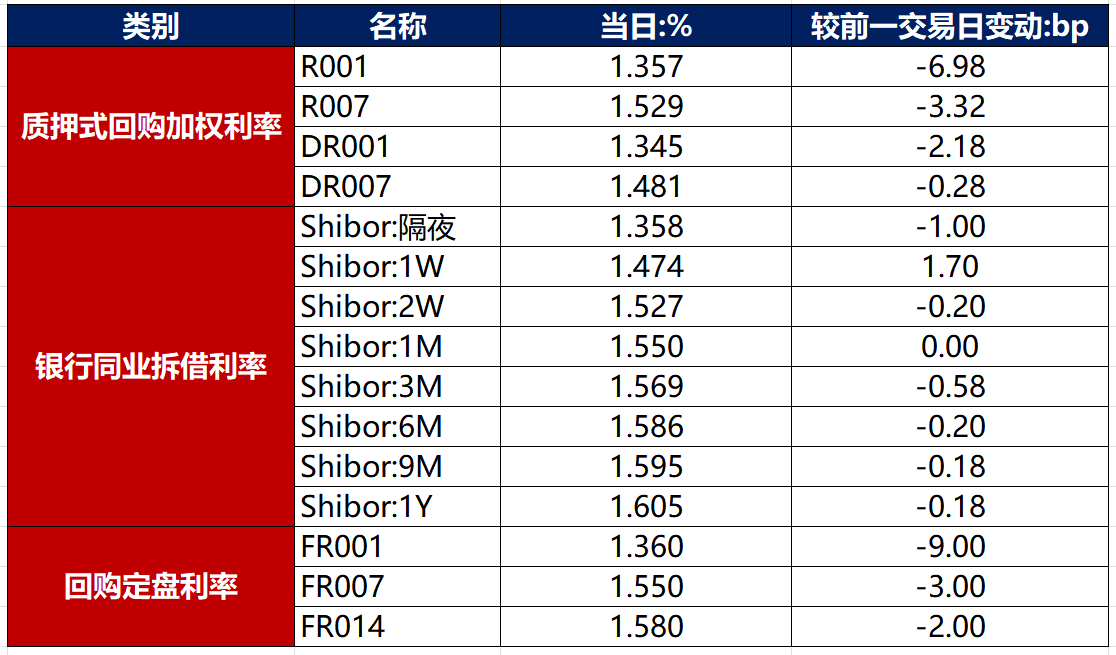
Core Viewpoint - The financial market is experiencing a stable yet slightly easing liquidity environment, with major repo rates declining and bond markets showing signs of recovery, while convertible bonds are facing downward pressure. Group 1: Domestic News - The Central Political Bureau of the Communist Party of China held a meeting to discuss the draft of the 14th Five-Year Plan and the government work report, emphasizing the need for a proactive fiscal policy and moderately loose monetary policy to strengthen domestic market construction and promote high-level technological self-reliance [2] - The People's Bank of China announced a reduction in the foreign exchange risk reserve ratio for forward foreign exchange sales from 20% to 0%, effective March 2, 2026, to support enterprises in managing exchange rate risks [3] - The China Securities Regulatory Commission (CSRC) released the "Supervision and Administration Measures for Information Disclosure of Private Investment Funds," effective September 1, 2026, aimed at enhancing transparency and protecting investors' rights [4] Group 2: International News - The U.S. January PPI rose by 2.9% year-on-year, exceeding expectations, with core PPI increasing by 3.6%, indicating potential upward pressure on inflation and complicating future monetary policy decisions for the Federal Reserve [5] - International crude oil futures prices increased, with WTI crude oil rising by 2.78% to $67.02 per barrel, and Brent crude oil up by 2.45% to $72.48 per barrel [6] Group 3: Market Dynamics - On February 27, the People's Bank of China conducted a 7-day reverse repo operation of 269 billion yuan at an interest rate of 1.40%, resulting in a net liquidity injection of 269 billion yuan for the day [7] - The liquidity environment is stable, with major repo rates continuing to decline; DR001 fell by 2.18 basis points to 1.345%, and DR007 decreased by 0.28 basis points to 1.481% [8] - The bond market showed signs of recovery, with the yield on the 10-year government bond falling by 1.10 basis points to 1.8020% [10] Group 4: Credit Bonds - On February 27, five industrial bonds experienced significant price deviations, with "H1碧地01" dropping over 87% and "H1万科04" increasing over 12% [11] - The credit rating agency Fitch withdrew the "BB+" long-term issuer rating for Weifang Urban Investment Group due to the issuer's cessation of participation in the rating process [12] Group 5: Convertible Bonds - The convertible bond market saw major indices decline, with the China Convertible Bond Index down by 0.14% and trading volume reaching 765.99 billion yuan [16] - Notable individual convertible bonds included Aiwei Convertible Bond, which rose over 9%, while Hengshuai Convertible Bond fell over 8% [17]
20%→0!央行,最新动作
Jing Ji Wang· 2026-02-28 01:56
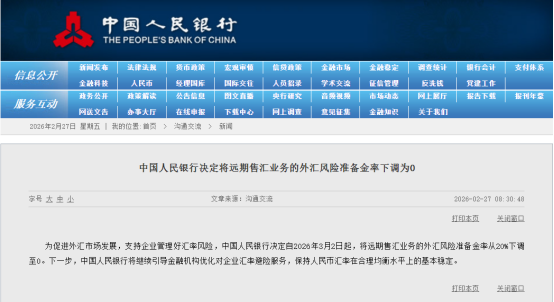
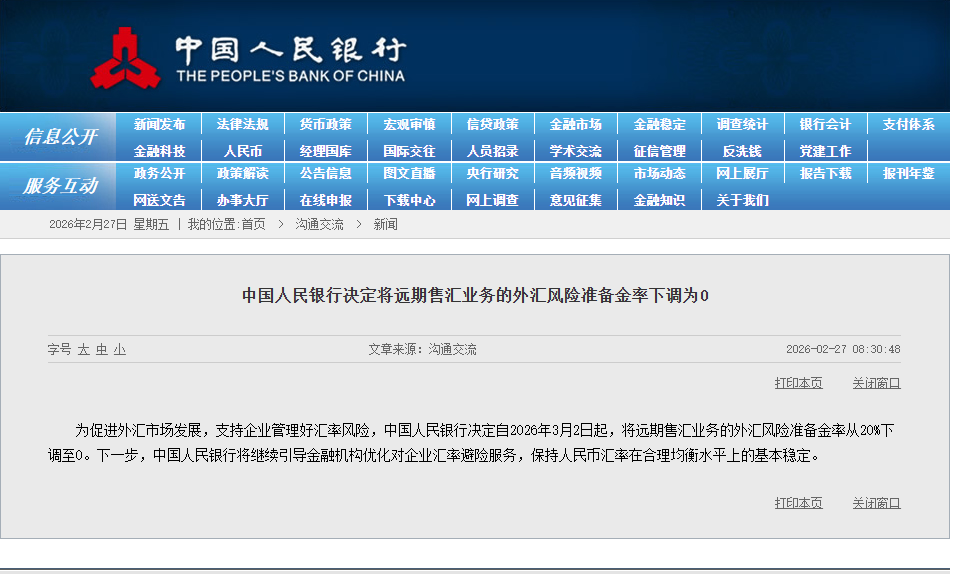
Core Viewpoint - The People's Bank of China (PBOC) has decided to lower the foreign exchange risk reserve requirement for forward foreign exchange sales from 20% to 0% starting March 2, 2026, to promote the development of the foreign exchange market and support enterprises in managing exchange rate risks [1]. Group 1: Policy Changes - The reduction in the foreign exchange risk reserve requirement is aimed at lowering the forward purchase costs for enterprises and increasing their willingness to engage in foreign exchange hedging [1]. - This marks the first use of this tool by the PBOC in nearly three and a half years, indicating a rational exit from previous measures and a return to a neutral foreign exchange policy [1]. Group 2: Impact on Enterprises - The adjustment is expected to help financial institutions provide cost-effective foreign exchange risk management products to enterprises, aligning with a broader policy initiative announced on January 15 [1]. - By 2025, it is anticipated that the hedging ratio for enterprises will increase to 30%, and the proportion of trade settled in RMB will also rise to nearly 30%, suggesting that around 60% of enterprises will be less affected by exchange rate risks in foreign trade [1]. Group 3: Market Conditions - Since the beginning of the year, the RMB has appreciated against the USD by approximately 2%, influenced by a weakening US dollar index [2]. - The PBOC plans to continue guiding financial institutions to optimize exchange rate hedging services for enterprises, aiming to maintain the RMB exchange rate at a reasonable and balanced level [2].
中经评论:以更高标准守护好蓝天白云
Zhong Guo Jing Ji Wang· 2026-02-28 01:45
Core Viewpoint - The People's Bank of China has decided to lower the foreign exchange risk reserve requirement for forward foreign exchange sales from 20% to 0% starting March 2, 2026, to promote the development of the foreign exchange market and support enterprises in managing exchange rate risks [3]. Group 1: Policy Changes - The reduction in the foreign exchange risk reserve requirement aims to enhance the ability of financial institutions to provide better hedging services for enterprises [3]. - This policy is part of a broader strategy to maintain the stability of the RMB exchange rate at a reasonable and balanced level [3]. Group 2: Environmental Standards - The Ministry of Ecology and Environment and the State Administration for Market Regulation have jointly released the revised "Ambient Air Quality Standards" (GB 3095-2026), tightening the concentration limits for particulate matter and its precursors [12]. - The new standards reflect a shift in public expectations from merely seeing blue skies to breathing cleaner air, indicating a significant improvement in air quality over the past decade [12][13]. - The revised standards are expected to drive the development of clean energy and new energy vehicles, contributing to a reduction of over 7 billion tons of carbon dioxide emissions from 2026 to 2035 [13]. Group 3: Implementation and Impact - The new air quality standards will lead to stricter evaluations of air quality, potentially changing some cities' statuses from compliant to non-compliant, but this does not necessarily indicate a decline in air quality [14]. - The implementation of the new standards will occur in two phases, with transitional limits from 2026 to 2030 and full enforcement starting in 2031, allowing regions to adapt gradually [14]. - Local governments are encouraged to translate the new standards into actionable tasks and enhance public communication to foster understanding of the long-term health benefits of stricter regulations [14].
央行为何突然出手稳汇率?
Xin Lang Cai Jing· 2026-02-28 00:39
Core Viewpoint - The People's Bank of China (PBOC) has decided to lower the foreign exchange risk reserve ratio for forward foreign exchange sales from 20% to 0% starting March 2, 2026, in order to stabilize the rapidly appreciating RMB and support enterprises in managing exchange rate risks [1][4][22]. Group 1: Reasons for the Policy Change - The RMB has been appreciating significantly, with a notable increase of over 800 points in just three trading days after the Spring Festival, driven by a weaker USD and strong fundamentals in the Chinese economy [8][11]. - The depreciation of the USD, influenced by the Federal Reserve's interest rate cuts, has contributed to the RMB's strength, alongside China's robust trade surplus and improved manufacturing competitiveness [11][15]. - The PBOC aims to prevent excessive fluctuations in the RMB exchange rate and maintain stability at a reasonable equilibrium level, responding to the rapid appreciation that could harm export-oriented businesses [13][15]. Group 2: Impact on Enterprises - The reduction of the foreign exchange risk reserve ratio is expected to lower costs for enterprises engaging in forward foreign exchange sales, making it easier for them to hedge against exchange rate risks [22][23]. - Previously, the 20% reserve requirement imposed a significant cost on banks, which could be passed on to enterprises, discouraging them from using forward contracts [22][23]. - With the new policy, more enterprises, especially small and medium-sized ones, are likely to utilize forward foreign exchange sales to stabilize their production expectations and improve profit margins [23][24]. Group 3: Market Reactions and Historical Context - Following the announcement, the offshore RMB exchange rate experienced a quick depreciation of 0.3%, indicating immediate market reactions to the PBOC's intervention [4][20]. - The PBOC has previously adjusted the foreign exchange risk reserve ratio multiple times since the 2015 exchange rate reform, demonstrating its ability to manage exchange rate fluctuations effectively [30][29]. - The current policy shift is seen as a return to a more neutral stance, allowing market mechanisms to play a larger role in exchange rate determination [21][29].
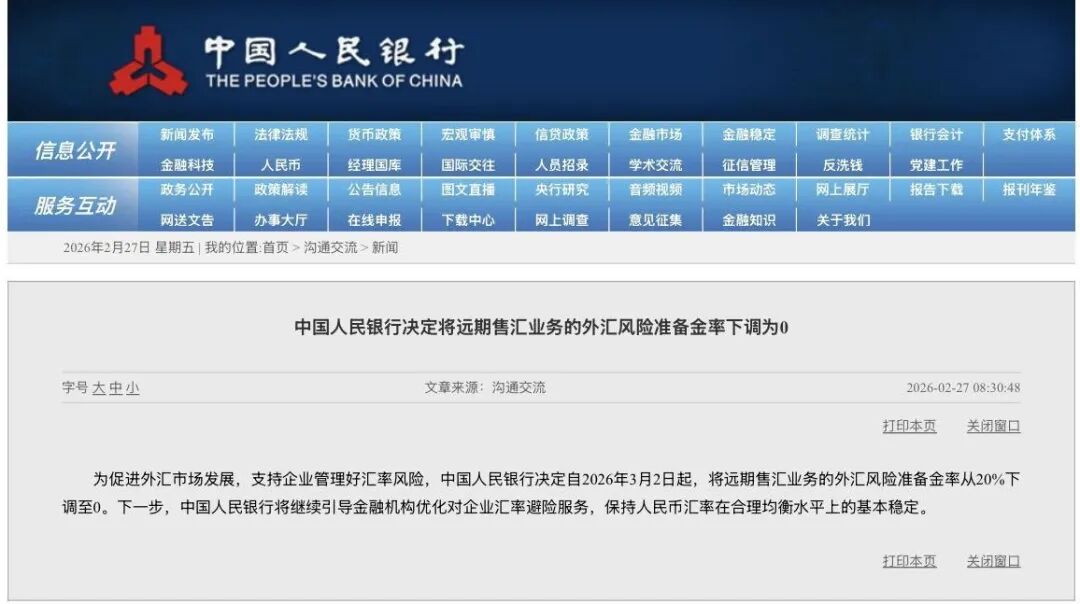
远期售汇业务外汇风险准备金率降至0
Ren Min Ri Bao· 2026-02-28 00:07
Core Viewpoint - The People's Bank of China (PBOC) has decided to lower the foreign exchange risk reserve ratio for forward foreign exchange sales from 20% to 0% effective March 2, 2026, to promote the development of the foreign exchange market and support enterprises in managing exchange rate risks [1][2]. Group 1 - The adjustment is a response to the previous increase in the foreign exchange risk reserve ratio to 20% in September 2022 [1]. - The reduction is expected to lower the cost of forward foreign exchange purchases for enterprises, thereby enhancing their willingness to engage in foreign exchange hedging [2]. - The PBOC aims to guide financial institutions in optimizing exchange rate hedging services for enterprises and maintain the stability of the RMB at a reasonable and balanced level [2].