
市场广度

Search documents
美股逼近新高之际技术分析师警告:市场广度尚未改善 未来几个月或出现回调
智通财经网· 2025-06-26 10:43
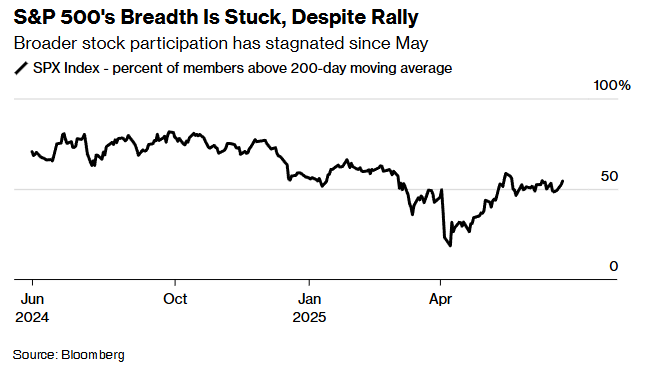
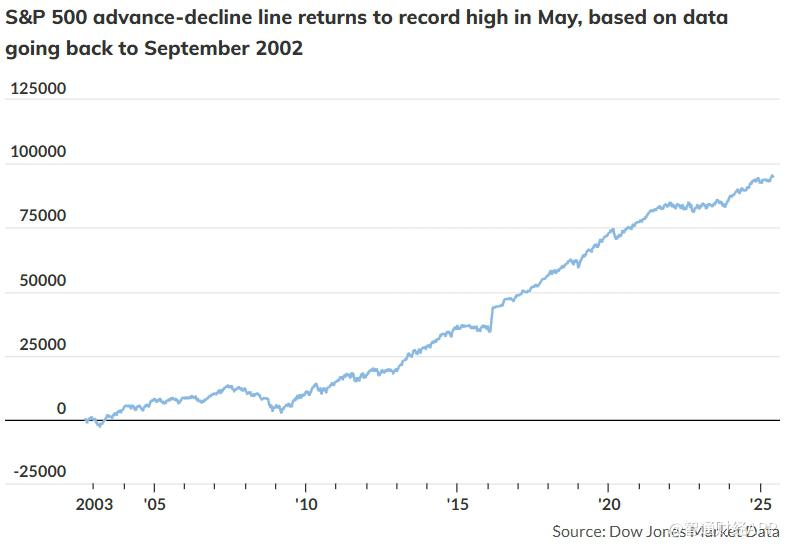
Core Viewpoint - The U.S. stock market, driven by technology stocks, is nearing historical highs, but analysts warn of potential pullbacks unless broader market participation increases [1][2] Group 1: Market Performance - The S&P 500 index has rebounded strongly since April, now less than 1% from its all-time high [1] - A key market breadth indicator shows little change since May, with the equal-weighted S&P 500 index still over 4% below its historical peak from last November [1] - Only three sectors—Information Technology, Industrials, and Communication Services—have reached new highs among the 11 sectors of the S&P 500 [2] Group 2: Analyst Insights - Dan Wantrobski from Janney Montgomery Scott indicates that without stronger support from financial, transportation, and small-cap stocks, the market's momentum may wane in the coming months [1] - Fundstrat's Mark Newton sees positive signals from the recent strong performance of industrial, transportation, consumer discretionary, and financial sectors, even if they haven't reached new highs [2] - LPL's Adam Turnquist cites historical data suggesting that if the S&P 500 reaches a new high at least 60 trading days after the last peak, the average return over the next 12 months is 9.7% [3] Group 3: Technical Indicators - The S&P 500 is currently in a severely overbought state, with a potential for a market pullback if breadth does not follow the index's rise [1][3] - Relative Strength Index (RSI) is expected to enter a "bearish" zone later this summer, indicating a possible market reversal [3] - Macro Risk Advisors' John Kolovos identifies the first technical support level for the S&P 500 at approximately 5,930 points, suggesting a potential decline of about 2.7% from recent closing prices [6]

分析师警告:若未有更多板块加入反弹,美股未来数月或出现抛售潮
news flash· 2025-06-26 10:35
Core Viewpoint - Analysts warn that without more sectors joining the rebound, a sell-off in the US stock market may occur in the coming months [1] Market Performance - The S&P 500 index has rebounded strongly since the drop in April and is now less than 1% away from its historical high [1] - The proportion of constituent stocks trading above their 200-day moving average, a key indicator of market breadth, has remained unchanged since May [1] Sector Participation - Analysts from multiple institutions, including Janney Montgomery Scott, indicate that a lack of strong support from other major market sectors such as financials, transportation, and small-cap stocks could lead to a loss of upward momentum in the coming months [1] Market Sentiment - The market is currently viewed as severely overbought, with leading forces concentrated mainly in the S&P 500 and Nasdaq 100 indices [1] - Technical strategist Dan Wantrobski emphasizes the importance of market breadth following the index breakout, noting that a failure to see this could lead to a potential pullback [1]
看涨信号闪烁!美股迎来大反攻?大摩“泼冷水”:别太乐观,反弹根基未稳
智通财经网· 2025-05-12 11:46
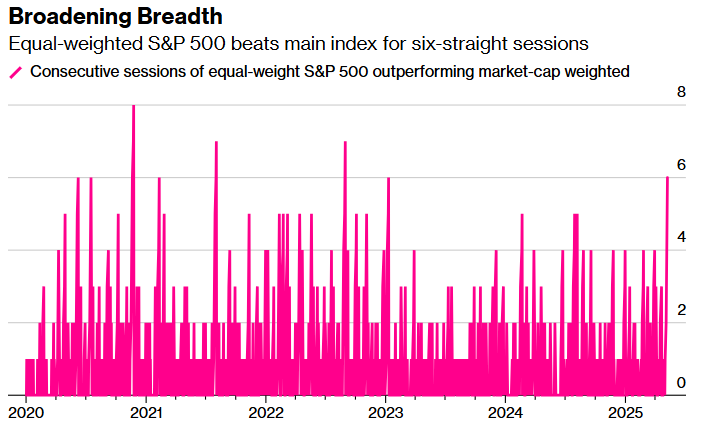
Core Viewpoint - The S&P 500 index has recovered about half of its losses since February, driven by optimism surrounding U.S.-China trade negotiations, despite concerns that the U.S. stock market has not fully escaped its challenges [1][5]. Market Breadth Indicators - The equal-weighted S&P 500 index has outperformed the market-cap weighted index for six consecutive trading days, indicating increased investor confidence across various companies [1]. - All sectors of the S&P 500 have seen gains since the suspension of the most severe tariffs by Trump on April 9, with technology, industrials, and consumer discretionary sectors leading the way [1]. - Craig Johnson from Piper Sandler highlights that a broader participation in stock price increases strengthens the market, as it reflects the number of stocks that are performing well [2]. - A market breadth indicator tracked by Johnson is about to trigger a buy signal, suggesting a positive outlook for the market [4]. Investor Sentiment and Economic Factors - Morgan Stanley analysts, led by Michael Wilson, caution that while investor sentiment is improving, it is premature to declare the market out of danger, identifying four necessary factors for a sustained rally, of which only two have progressed [5]. - The Federal Reserve's cautious stance on monetary policy and the current yield of U.S. 10-year Treasury bonds exceeding 4.4% are seen as potential headwinds for market valuations [5]. - Concerns over tariffs have led approximately 30 companies to cancel or suspend their earnings forecasts, particularly in the automotive, durable goods, and industrial sectors, although these stocks have seen an increase in average gains since reporting [7]. Future Market Outlook - The S&P 500 index has surpassed the previous resistance level of 5500 points, and further meaningful gains will depend on the achievement of a U.S.-China trade agreement and a renewed acceleration in earnings revisions [7]. - The next significant technical test for the S&P 500 is at the intersection of the 200-day and 100-day moving averages, around the 5750-5800 point range [7].

市场隐现转折信号?高盛顶级交易员:真正大涨还需这三大确认!
Sou Hu Cai Jing· 2025-04-29 03:23
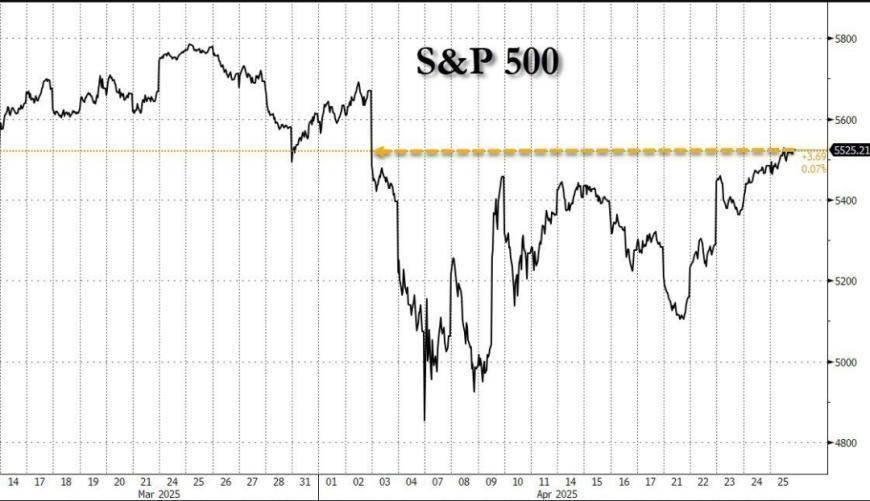
Core Viewpoint - The S&P 500 index experienced significant volatility, dropping to a one-year low of 4835 points on April 7, before recovering to 5525 points by the end of the following week, reflecting a turbulent market environment [1][3]. Group 1: Market Dynamics - The hedge fund sector faced severe deleveraging and loss of returns on March 7 and 10, which set the stage for position clearing around April 2 [3]. - Hedge funds have reduced their net exposure significantly, with an average loss of approximately 1% year-to-date, while maintaining a total exposure of 210% [3]. - Long-term investors were largely inactive in March, waiting for news on April 2, leading to a significant sell-off in early April [5]. Group 2: Investor Behavior - Foreign investors have sold approximately $60 billion worth of U.S. stocks since early March, indicating a trend of reducing exposure to U.S. equities [7]. - The cash ratio for asset managers was at a historic low of 1.4% of assets under management (AUM) at the beginning of the quarter, but has since increased significantly [5]. - Retail investors continue to buy into the market, showing resilience unless unemployment rates rise significantly [20]. Group 3: Corporate Actions and Earnings - Corporate buybacks are expected to support the market, with a total of $377.1 billion authorized for buybacks in 2025, and April-May typically being a peak season for such activities [23]. - Earnings reports have been better than expected, with 46% of companies exceeding expectations, which is a positive sign for market sentiment [19]. Group 4: Market Indicators - The liquidity in the market remains low, with optimal order sizes significantly below historical averages, indicating potential for volatility [17]. - The proportion of ETF trading volume has increased to 44%, which is higher than the historical average, suggesting a reliance on ETFs for hedging [16]. - The breadth of the market is currently below historical averages, indicating a need for improvement before more aggressive buying is recommended [14].

高盛交易员:美股上周出现积极信号,但能否持续还要关注这三点
Hua Er Jie Jian Wen· 2025-04-28 05:52
Core Viewpoint - The U.S. stock market may have reached an upward turning point, but three key obstacles remain to be overcome for a sustained rally [1] Group 1: Market Signals - Recent positive signals include reduced overseas selling pressure on major tech stocks and significant net buying by hedge funds [2][3] - The S&P 500 index experienced a sharp decline from 5462 to a year-low of 4835, followed by a rebound of 735 basis points, closing at 5525 [2] - The dynamics of increased long-term buying in the U.S. and decreased international selling are critical for future market performance [3] Group 2: Key Indicators to Monitor - Three key confirmation signals to watch for market uptrend include market breadth, liquidity depth, and ETF trading volume [1][4] - Market breadth is currently below historical averages, indicating a need for broader stock participation in the rally [4] - Liquidity depth for S&P mini futures is approximately $4 million, still significantly below the historical average of about $13 million, suggesting market fragility [7] Group 3: Corporate Performance and Investor Behavior - Corporate earnings reports have been better than pessimistic expectations, with 46% of companies exceeding earnings expectations by more than one standard deviation [5] - Retail investor buying is likely to remain strong unless unemployment rates begin to rise [5] - The corporate buyback window is expected to be robust, with an estimated $1.45 trillion authorized for buybacks and $11.6 trillion executed, providing market support during earnings season [5] Group 4: ETF Trading Dynamics - The proportion of ETF trading volume reached a high of 44% on April 9, currently around 35%, indicating reliance on ETFs for hedging [7] - A decline in ETF trading volume below 30% would suggest reduced hedging demand and an increase in risk appetite [7]