
日本政治右倾化

Search documents
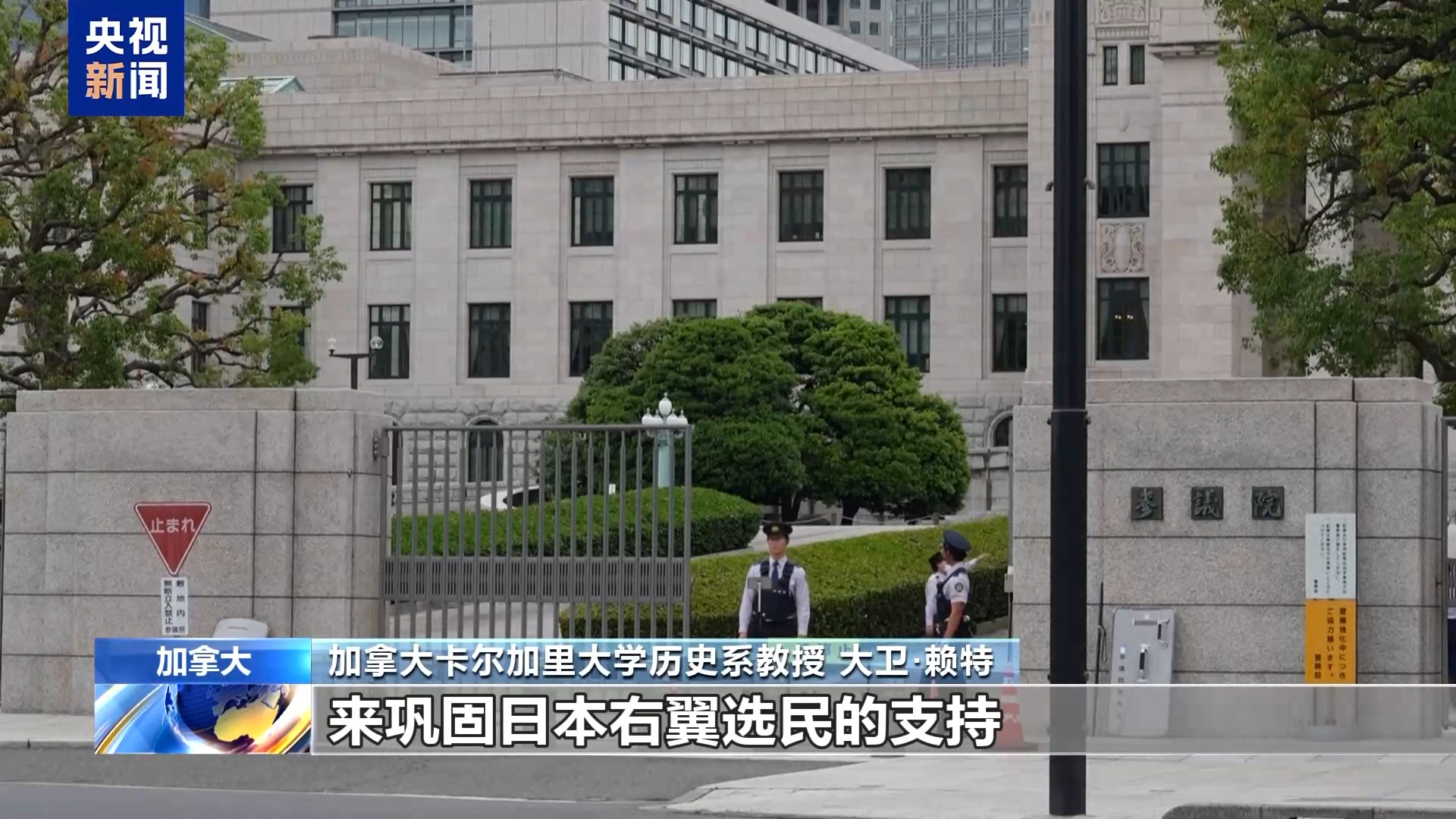
加拿大学者:高市言论损害中日关系与和平前景
Yang Shi Xin Wen Ke Hu Duan· 2025-12-06 12:33
日本首相高市早苗近期发表的涉台错误言论引发多方批评。加拿大学者大卫·赖特表示,一个中国原则是国际社会的普遍共识,日本首相高市早苗近期的错 误言论危害中日关系,损害和平前景。 加拿大卡尔加里大学历史系教授 大卫·赖特:这种言论会危害并恶化中日外交关系,这毫无疑问。但在我看来,比损害外交关系更重要的是损害和平前景。 高市言行出于政治目的 意在拉拢右翼 赖特认为,高市早苗的一系列言行并非鲁莽行事,而是出于政治目的有意为之,通过制造挑衅,拉拢日本右翼,从而在联合政府内巩固自身脆弱的执政地 位。 加拿大卡尔加里大学历史系教授 大卫·赖特:千万不要以为她只是在开玩笑或随口说说,她不是一个口无遮拦的人,她说的每一句话都经过深思熟虑,她必 须通过比以往任何一届政府都更加强硬、更咄咄逼人的立场,来巩固日本右翼选民的支持。 日本对战争罪责从未真诚反省 赖特表示,日本政治右倾化以及日本国内右翼势力猖獗的一个根源是日本对于侵略战争罪责从未真诚反省,一些人甚至毫无悔意。 加拿大卡尔加里大学历史系教授 大卫·赖特:他们不愿承认日本犯下的暴行,他们试图逃避正视历史,试图粉饰和重新诠释历史,这一切都源于他们对战争 缺乏真诚的忏悔,他们毫无悔 ...

国际人士表示高市早苗错误言论威胁地区和平稳定
Yang Guang Wang· 2025-12-02 05:05
Group 1 - Japan's 10-year government bond yield rose to 1.875% on December 1, marking the highest level since June 2008, indicating a significant sell-off in Japanese government bonds [1] - The Nikkei 225 index experienced a decline of over 2%, dropping more than 1,000 points during trading [1] - Political analysts express concerns that Prime Minister Fumio Kishida's recent remarks reflect a trend of increasing right-wing politics in Japan, posing serious threats to regional and global stability [1] Group 2 - Various international figures criticize Kishida's statements, suggesting they indicate a potential resurgence of militarism in Japan, which could lead to increased risks of conflict [2] - The remarks made by Kishida are viewed as a serious error that undermines Japan's historical commitments as a defeated nation, raising alarms about regional tensions [2] - The statements have been described as irresponsible and damaging to the trust and cooperation between China and Japan, contributing to global instability [2]
国际观察丨反省缺失 叙事畸形——德国学者批评高市错误言论和日本右翼史观
Xin Hua She· 2025-12-01 01:12
Core Viewpoint - German scholars criticize Japan's lack of historical reflection and the distortion of its wartime narrative, particularly in light of recent comments by Prime Minister Kishi, which challenge post-war international order and threaten regional peace and stability [1][7]. Group 1: Historical Reflection - German President Frank-Walter Steinmeier acknowledged the brutal air raids on Guernica, emphasizing the suffering of civilians and the importance of remembering such atrocities [1]. - German experts argue that Japan has not genuinely reflected on its wartime responsibilities, continuing to evade and obscure its historical accountability while promoting a distorted view of World War II [3][4]. - The comparison between Germany and Japan reveals that Germany has taken significant steps to confront its Nazi past, while Japan has failed to adequately address its wartime actions, such as the enshrinement of war criminals at Yasukuni Shrine [3][5]. Group 2: Political Implications - High-profile figures in Japan, including Prime Minister Kishi, have made statements that reflect a rightward shift in Japanese politics, which could jeopardize relations with neighboring countries like China and South Korea [7][10]. - The narrative of victimhood prevalent in Japan's historical discourse often overshadows its aggressions during the war, leading to a lack of awareness among younger generations regarding Japan's wartime actions [5][6]. - The international community is urged to express strong concerns regarding Japan's political trajectory, as it poses significant risks to regional and global security [7][10].

国际观察|反省缺失 叙事畸形——德国学者批评高市错误言论和日本右翼史观
Xin Hua She· 2025-11-30 13:09
Group 1 - The core argument highlights the stark contrast between Germany and Japan in their historical reflections on World War II, with Germany acknowledging its past atrocities while Japan is criticized for failing to confront its wartime responsibilities [1][2] - German scholars emphasize that Japan has not genuinely reflected on its history of aggression, instead promoting a distorted narrative that downplays its wartime actions and responsibilities [2][3] - The narrative in Japan is dominated by a "victim narrative," focusing on its suffering during the war while avoiding acknowledgment of its role in initiating aggression [3][4] Group 2 - The rise of right-wing politics in Japan, exemplified by Prime Minister Kishi's controversial statements, poses a significant threat to regional and global stability, as it reflects a trend of historical revisionism [5] - Experts warn that such political stances damage Japan's relationships with neighboring countries like China and South Korea, potentially leading to diplomatic crises [5] - The international community is urged to express strong concerns and take necessary measures to address the resurgence of militaristic sentiments in Japan [5]
专家:必须坚决阻击日本右翼势力妄图复活军国主义的危险动向
Xin Hua She· 2025-11-25 12:19
Core Viewpoint - The article emphasizes the need for vigilance against Japan's right-wing forces attempting to revive militarism, particularly in light of recent statements by Prime Minister Suga Yoshihide regarding Taiwan's situation, which could lead to military intervention [2][3][4]. Group 1: Political Context - Prime Minister Suga's remarks about Taiwan potentially posing an existential crisis for Japan reflect a dangerous trend of right-wing militarism in Japan, aiming to escape the constraints of the post-war "peace constitution" [2][3]. - The suggestion of military intervention in Taiwan is seen as a blatant threat of war, contradicting Japan's commitments under international law and its own constitution [3][4]. Group 2: Historical Precedents - The article draws parallels between current rhetoric and historical instances where Japan exaggerated external threats to justify military aggression, such as the invasion of Manchuria in 1931 and the broader expansion during World War II [4][5]. - Experts highlight that Japan's past actions, justified by fabricated crises, serve as a warning against repeating history [4][5]. Group 3: Regional Implications - The potential shift in Japan's defense policy, including increased military spending and the development of offensive capabilities, raises concerns among neighboring countries about regional security [5][6]. - The article calls for a united response from peace-loving nations to counteract the revival of militarism and uphold international peace [6].
高市早苗挑衅背后:日本右翼“基因”激活 政治光谱加速右移 | 国际识局
Zhong Guo Xin Wen Wang· 2025-11-21 01:12
Core Viewpoint - Recent provocative remarks by Japanese Prime Minister Sanae Takaichi regarding Taiwan challenge the One China principle and suggest potential military intervention, marking a significant shift in Japan's political landscape since World War II [1] Group 1: Political Ideology and Historical Context - Takaichi's strong right-wing stance is driven by a revival of Japanese nationalism, rooted in pre-war ideologies that deny Japan's wartime aggression and seek to restore national pride and military normalization [2][3] - The rightward shift in Japanese politics has been accelerated by economic stagnation and rising populism, leading to a structural change in the political ecosystem [5][6] Group 2: Takaichi's Political Positioning - Takaichi aligns closely with former Prime Minister Shinzo Abe's ideology, being a historical revisionist and a proponent of constitutional amendments to restore Japan's military capabilities [3][4] - Her remarks on Taiwan reflect a broader right-wing narrative that frames Taiwan as a frontline in the struggle against China, emphasizing Japan's strategic interests in the region [4][10] Group 3: Political Dynamics and Party Influence - The ruling Liberal Democratic Party (LDP) has seen a rightward shift, with hardline stances becoming the norm, diminishing the influence of traditional pacifist factions [6][7] - The lack of a strong opposition party has allowed the LDP's right-wing agenda to flourish without significant checks, enabling Takaichi's provocative rhetoric to gain traction [7] Group 4: Populism and National Sentiment - Takaichi's comments resonate with rising populist sentiments in Japan, where anti-China rhetoric is increasingly prevalent, driven by economic frustrations and a sense of national decline [8][9] - The political mobilization around these sentiments aims to consolidate support for right-wing policies, framing opposition as unpatriotic and reinforcing a narrative of external threats [9][10]
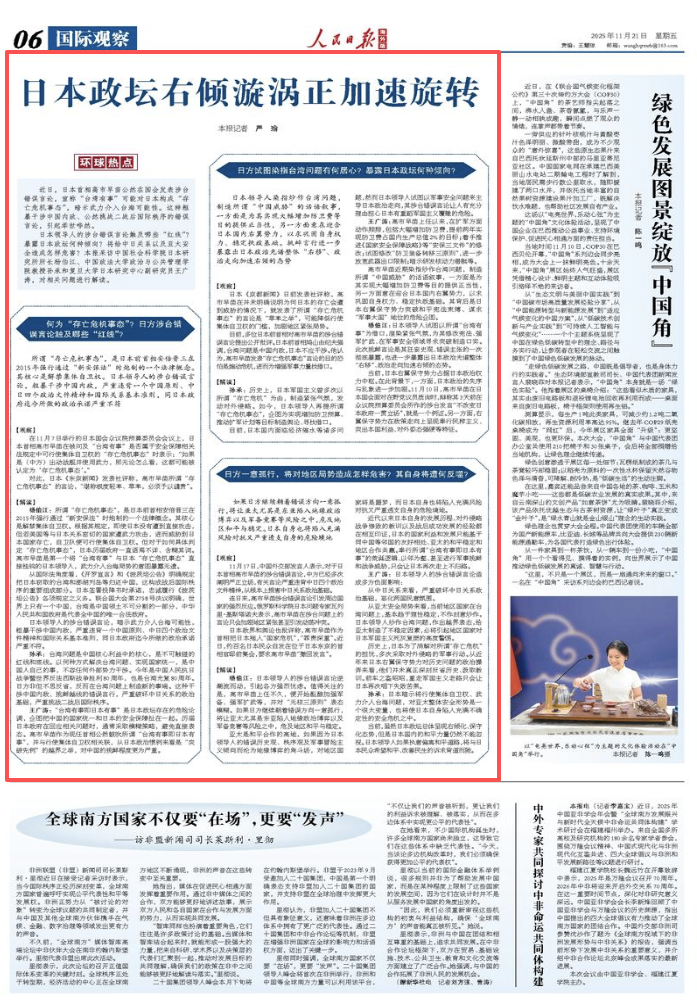
日本政坛右倾漩涡正加速旋转(环球热点)
Ren Min Ri Bao Hai Wai Ban· 2025-11-20 22:56
Core Viewpoint - Japanese Prime Minister Fumio Kishida's recent remarks in the National Diet regarding Taiwan have sparked global outrage, suggesting that a "crisis" in Taiwan could pose an existential threat to Japan, indicating a potential for military intervention in the Taiwan Strait [1][2][3] Group 1: Definition and Implications of "Existential Crisis" - The term "existential crisis" was introduced by former Prime Minister Shinzo Abe in 2015 through the "New Security Law," which allows for collective self-defense even if Japan is not directly attacked [2][3] - Kishida's comments directly link the situation in Taiwan to Japan's security framework, marking a significant shift in Japan's political stance and raising concerns about military involvement in Taiwan [3][4] Group 2: Political Trends in Japan - The remarks reflect a broader trend of rightward shift in Japanese politics, with Kishida's government attempting to justify increased defense spending and military expansion under the guise of a "China threat" narrative [5][6][7] - Historical parallels are drawn to Japan's militaristic past, with concerns that such rhetoric could lead to a resurgence of militarism and aggressive foreign policy [7][8] Group 3: Regional and International Reactions - Kishida's statements have drawn criticism from various quarters, including former Japanese leaders and international observers, who warn that such rhetoric could destabilize the region and provoke military tensions [9][10] - The Chinese government has firmly rejected these comments, emphasizing that Taiwan is a core interest and any external interference is unacceptable [9][10][11] Group 4: Potential Consequences - Continued provocative statements from Japan could lead to increased geopolitical tensions in the Asia-Pacific region, potentially igniting an arms race and undermining regional stability [9][10][11] - The domestic political landscape in Japan may also be affected, as public sentiment could shift against militaristic policies, contrasting with the government's current trajectory [11][12]
高市早苗涉台谬论是越线挑衅 严重冲击中日关系
Yang Shi Xin Wen Ke Hu Duan· 2025-11-16 02:24
Core Viewpoint - Japanese Prime Minister Fumio Kishida's provocative remarks regarding Taiwan have escalated tensions between China and Japan, leading to strong protests from China and concerns about the impact on bilateral relations [1][2][7] Group 1: Japan's Provocative Statements - Kishida's comments suggest potential military intervention in the Taiwan Strait, marking a significant shift in Japan's stance since World War II [2] - Experts highlight that these remarks represent a severe provocation and a breach of the One China principle, undermining the political foundation of Sino-Japanese relations [2][4] - The statements are seen as a challenge to the post-World War II international order and have drawn criticism from various sectors within Japan [2][7] Group 2: Historical Context and Political Implications - Kishida's rhetoric is viewed as a continuation of right-wing policies reminiscent of former Prime Minister Shinzo Abe, with an emphasis on military expansion and revision of Japan's pacifist constitution [3][5] - The remarks coincide with significant anniversaries related to China's anti-Japanese war efforts, further intensifying the historical sensitivities involved [2][5] - Analysts warn that Japan's increasing militarization and attempts to internationalize the Taiwan issue could destabilize regional peace and security [4][5] Group 3: Domestic Reactions in Japan - Kishida's statements have sparked backlash from various political figures and intellectuals in Japan, who express concerns over the legal and security implications of such rhetoric [6][7] - The current situation is described as a critical juncture for Sino-Japanese relations, with potential negative impacts on economic and cultural exchanges [7] - Experts urge Japan to correct its course to mitigate the adverse effects of Kishida's comments on bilateral relations [7]
蓝厅观察丨高市早苗涉台谬论是越线挑衅 严重冲击中日关系
Yang Shi Xin Wen Ke Hu Duan· 2025-11-16 01:43
Core Viewpoint - Japanese Prime Minister Fumio Kishida's provocative remarks regarding Taiwan have escalated tensions between China and Japan, with China expressing strong dissatisfaction and opposition to Japan's stance [1][3][5]. Group 1: Japan's Provocative Statements - Kishida is the first Japanese Prime Minister since World War II to publicly assert that "Taiwan's issues are Japan's issues," linking it to collective self-defense [3]. - Experts indicate that Kishida's comments represent a severe provocation and a blatant challenge to the post-World War II international order [3][5]. - The remarks are seen as a significant breach of the One China principle and a serious interference in China's internal affairs [7][10]. Group 2: Impact on Sino-Japanese Relations - The statements have caused a serious impact on Sino-Japanese relations, marking the most severe provocation since the normalization of diplomatic relations in 1972 [5][10]. - The political foundation of Sino-Japanese relations has been severely undermined, affecting cooperation in various fields, including trade and cultural exchanges [15]. - Experts warn that Japan's actions are attempting to internationalize the Taiwan issue, which could lead to increased regional tensions [10][12]. Group 3: Domestic Reactions in Japan - Kishida's remarks have sparked significant backlash within Japan, with many politicians and intellectuals expressing concern over the potential risks to regional security and the future of Sino-Japanese relations [13][15]. - There is a growing apprehension among Japanese citizens and officials regarding the implications of Kishida's statements on Japan's long-term national interests [15].
高市早苗离首相之位“一步之遥”?
Qi Lu Wan Bao· 2025-10-20 06:55
Core Points - The political landscape in Japan has become chaotic following the Komeito party's decision to exit the ruling coalition with the Liberal Democratic Party (LDP), leading to a potential challenge against LDP President Takashi Saito from three opposition parties [1][2] - Takashi Saito has expressed optimism about becoming Japan's first female Prime Minister after the LDP reached an agreement with the Japan Innovation Party for a coalition [1][2] Group 1 - Following the split with Komeito, Saito has been actively seeking to expand the ruling coalition by engaging with the National Democratic Party, although their interest has waned due to the lack of a majority [2][4] - The LDP and the Japan Innovation Party are set to sign a coalition agreement on the 20th, with a temporary Diet session scheduled for the 21st to elect the Prime Minister [4] - The current composition of the House of Representatives includes 465 seats, with the LDP holding 196 seats, and a coalition with the Japan Innovation Party would bring them to 231 seats, just two short of a majority [4] Group 2 - The Japan Innovation Party has proposed 12 cooperation demands, including lowering the consumption tax rate and addressing political funding issues, which have been met with positive responses from the LDP [2][3] - The Japan Innovation Party has decided to halt cooperation discussions with the Constitutional Democratic Party and the National Democratic Party, citing difficulties in collaboration [3][5] - The last time an opposition party successfully overthrew the LDP was in August 2009, marking a significant political shift in Japan [6] Group 3 - The Japan Innovation Party aims to establish Osaka as a "secondary capital," a key policy goal that is essential for their collaboration with other parties [7] - Saito has indicated a willingness to assist in cabinet roles if a coalition is formed, although the Japan Innovation Party prefers an "outside cabinet cooperation" approach to maintain flexibility [7][8] - There are concerns within both the LDP and the Japan Innovation Party regarding the potential backlash from their respective members due to the rapid coalition-building efforts [8]