智能网联汽车

Search documents
音频 | 格隆汇2.13盘前要点—港A美股你需要关注的大事都在这
Xin Lang Cai Jing· 2026-02-12 23:15
Group 1 - US stock market experienced a significant decline, with the Nasdaq dropping over 2% and Cisco falling more than 12%, while the Chinese concept index decreased by 3% [2] - South Korean investors aggressively purchased Chinese stocks, notably MiniMax-WP and Lanke Technology [2] - The storage giant Kioxia's annual performance forecast exceeded expectations [2] Group 2 - The Ministry of Industry and Information Technology of China is soliciting opinions on five mandatory national standards related to intelligent connected vehicles and autonomous driving system safety requirements [2] - The Chinese smartphone sales in January saw a year-on-year decline of 23% [2] - Semiconductor company Hua Hong Semiconductor reported Q4 sales revenue of $660 million, marking a year-on-year increase of 22.4% and a quarter-on-quarter increase of 3.9% [2][3]
今年春节预计无人车承担配送单量占比超10%
Nan Fang Du Shi Bao· 2026-02-12 23:11
Core Insights - The article highlights the successful integration of autonomous delivery vehicles in Shenzhen's logistics system during the 2026 Spring Festival, showcasing their role as reliable delivery agents and essential components of the holiday logistics network [1][2]. Group 1: Industry Developments - Over 500 autonomous delivery vehicles have been deployed by various companies, including SF Express, China Post, Meituan, and JD, creating a responsive logistics network for the Spring Festival [1]. - The Shenzhen Transportation Bureau's "4123" top-level design has facilitated the commercialization of functional autonomous vehicles, resulting in over 1,000 vehicles on the road and 7,191 kilometers of open roads within a year [1][2]. - The autonomous delivery network covered over 800 residential communities and 300 commercial areas during the Spring Festival, ensuring stable delivery support for residents and businesses [2]. Group 2: Operational Efficiency - Autonomous vehicles have demonstrated an average daily delivery capacity that is over three times that of traditional human delivery methods, effectively filling the gap left by reduced human labor during the holiday [3]. - During the Spring Festival, autonomous vehicles accounted for over 10% of the total delivery volume, indicating their transition from pilot projects to key players in holiday logistics [3]. - The intelligent regulatory platform for autonomous vehicles operated 24/7, utilizing real-time vehicle data to implement dynamic alerts and ensure rapid response to any incidents, enhancing operational safety and efficiency [3]. Group 3: Broader Implications - The continuous operation of autonomous vehicles during the Spring Festival not only maintained logistics flow but also supported workers' ability to reunite with their families, reflecting the positive impact of technology on everyday life [4]. - Functional autonomous vehicles have expanded their applications in various sectors, including sanitation, security inspections, and mobile retail, becoming integral components of urban operational systems [5]. - Shenzhen aims to create a replicable and scalable smart city service model through ongoing improvements in the industrial ecosystem and technology advancements, contributing to a more efficient and compassionate urban living experience [5].



A股晚间热点 | 1万亿周五落地!买断式逆回购密集加量 短期降准可能性下降?
智通财经网· 2026-02-12 14:38
Group 1 - The People's Bank of China announced a 1 trillion yuan reverse repurchase operation to maintain liquidity in the banking system, indicating a reduced urgency for a short-term reserve requirement ratio cut [1] - Analysts suggest that the large liquidity injection allows for observation of effects before implementing broader monetary tools like a reserve requirement ratio cut, which remains an important option in the central bank's toolkit [1] Group 2 - Shenzhen's Industrial and Information Technology Bureau released an action plan for "Artificial Intelligence + Advanced Manufacturing" aimed at enhancing the semiconductor industry through AI applications [2] - The plan focuses on optimizing chip design and software code efficiency, and developing high-performance AI chips to meet the demands of various AI terminals [2] Group 3 - The Ministry of Industry and Information Technology is soliciting public opinions on mandatory national standards for the safety requirements of autonomous driving systems in intelligent connected vehicles [6] Group 4 - The Shanghai Stock Exchange plans to reduce market operating costs, expecting to return approximately 1.113 billion yuan to the market in 2026 through various initiatives [8] - The initiatives include optimizing information disclosure channels and enhancing regulatory service quality [8] Group 5 - The Ministry of Commerce proposed to impose countervailing duties on imported dairy products from the European Union, effective February 13, 2026 [9] Group 6 - The National Development and Reform Commission aims to establish a mandatory insurance system for unmanned aerial vehicles by 2027, enhancing the safety framework for low-altitude economic activities [10] Group 7 - The film industry is being targeted for consumption growth through a "Film +" initiative, with expectations for significant box office performance during the upcoming Spring Festival holiday [12] - Analysts highlight potential investment opportunities in film content producers, leading cinema companies, and firms with strong film production and marketing capabilities [12] Group 8 - A list of undervalued media stocks with projected earnings growth of over 100% has been compiled, indicating potential investment opportunities in the film and media sector [13]



工信部公开征求《智能网联汽车 自动驾驶系统安全要求》等五项强制性国家标准的意见。
Jin Rong Jie· 2026-02-12 11:45
Core Viewpoint - The Ministry of Industry and Information Technology (MIIT) is soliciting public opinions on five mandatory national standards related to intelligent connected vehicles and autonomous driving system safety requirements [1] Group 1 - The proposed standards aim to enhance the safety and reliability of autonomous driving systems in intelligent connected vehicles [1] - The initiative reflects the government's commitment to promoting the development of the intelligent vehicle industry and ensuring public safety [1] - Stakeholders, including industry players and experts, are encouraged to provide feedback to refine these standards [1]
首个具备量产上车能力!均胜电子联合中际旭创推出车载光通信解决方案
Quan Jing Wang· 2026-02-12 05:11
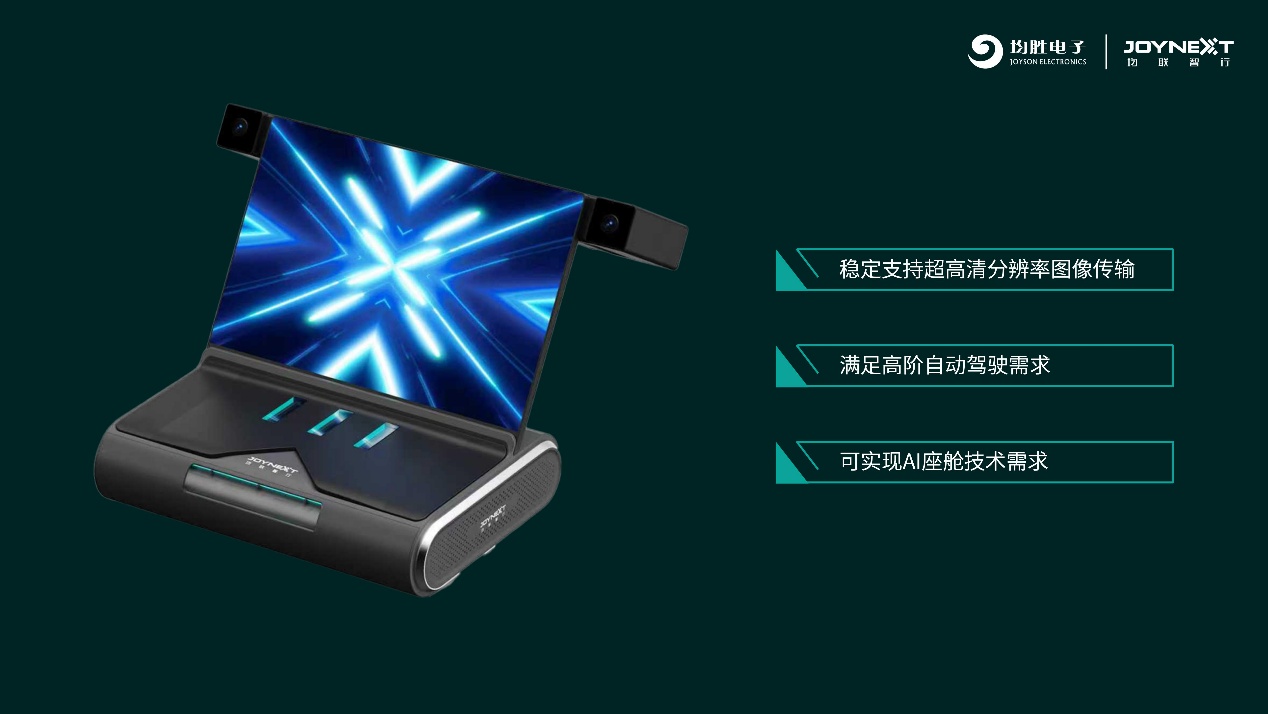
Core Insights - The core focus of the news is the collaboration between Junsheng Electronics and Zhongji Xuchuang to develop an onboard optical communication solution, which has achieved the industry's first mass production capability for automotive applications [1][5]. Group 1: Technology Overview - The automotive electronic architecture is evolving towards "full-domain deep integration," necessitating real-time data aggregation from numerous sensors and efficient collaboration among various systems, which imposes unprecedented demands on communication links, latency, and stability [3]. - The onboard optical communication technology utilizes light as the transmission medium, enabling high bandwidth, low latency, and interference-resistant data transmission, which is essential for supporting central computing architectures and advanced autonomous driving [3][5]. Group 2: Technical Specifications - Transmission bandwidth can reach 10Gbps-100Gbps per fiber, with future expansion potential to Tbps levels, meeting the requirements for 8 million and 17 million pixel high-definition cameras and 4K@120Hz in-vehicle displays [4]. - The transmission latency is less than 1 microsecond, ensuring real-time decision-making for autonomous driving and compliance with ISO 26262 functional safety standards [4]. - The transmission distance exceeds 100 meters for single-mode fibers and can reach 50 meters for multi-mode fibers, suitable for distributed architectures between central and regional controllers [4]. Group 3: Industry Position and Future Prospects - Junsheng Electronics' optical communication solution leverages its advantages in anti-interference, low latency, and high bandwidth to support high-speed data transmission for advanced autonomous driving and multi-screen cockpit needs [5]. - Zhongji Xuchuang, a leader in the global high-speed optical module sector, is accelerating its entry into the automotive optical communication market, which is projected to be a trillion-yuan industry [5].


汽车数据出境有章可循更便利
Jing Ji Ri Bao· 2026-02-11 21:56
Core Viewpoint - The article discusses the release of the "Automotive Data Export Security Guidelines (2026 Edition)" by multiple Chinese government departments, aiming to establish a safe and efficient mechanism for the cross-border flow of automotive data, enhancing the convenience of data export and promoting high-quality development in the automotive industry [1]. Group 1: Data Export Challenges - The automotive industry generates significant data throughout its lifecycle, with a high-level autonomous driving test vehicle producing up to 10TB of data daily [2]. - Companies face common challenges in data export, including selecting appropriate export methods, defining data for security assessments, and building a protective system tailored to the automotive sector [2]. - The guidelines systematically define important data categories and clarify data export paths for six major scenarios, addressing long-standing operational pain points for enterprises [2]. Group 2: Regulatory Framework - The guidelines require all organizations and individuals within China, including domestic and foreign enterprises, to conduct data export activities in a regulated manner [3]. - The guidelines respond to urgent concerns in the automotive industry, facilitating global collaboration and service provision through clear data identification rules and exemptions [3]. - A transparent and efficient management framework for automotive data export is expected to align with international governance trends and enhance global cooperation in automotive data management [3]. Group 3: Promoting Data Utilization - The guidelines encourage the integration of security technologies such as data desensitization and encryption into the automotive production process, enhancing the industry's technological framework [4]. - Data is viewed as a critical resource for innovation in areas like autonomous driving and service upgrades, driving the digital transformation of the automotive sector [5]. - Companies are advised to embrace the guidelines to optimize their global operations and enhance their market competitiveness by effectively utilizing data [5]. Group 4: Industry Development Benefits - The guidelines are seen as a "stabilizing pill" for the automotive industry, providing clear rules that enhance confidence in global market expansion [6]. - They act as an "accelerator" for industry upgrades, prompting companies to better understand their data assets and improve their data governance systems [6]. - The guidelines serve as a "new benchmark" for safety management, offering a practical manual for the industry to navigate data export regulations [7]. Group 5: Implementation Support - The Ministry of Industry and Information Technology plans to assist companies in identifying important data and establishing safety protection goals [7]. - Companies are encouraged to develop comprehensive management systems covering the entire data lifecycle, employing technologies to ensure data security [7]. - The industry is urged to foster cross-sector data security sharing mechanisms to promote safe and efficient data flow, unlocking data value for innovation [7].
优化智能新能源车险供给,深圳先动手了
Zhong Guo Qi Che Bao Wang· 2026-02-11 02:37
近日,一组2025年新能源车险成绩单出炉:在2025年新能源汽车销量达到1649万辆、同比增长28.2%的背景下,我国新能源商业车险实现签单保费约 1576.1亿元,同比增长33.88%,而相比燃油车,新能源汽车的商业车险投保率更高。更值得一提的是,比亚迪财险在2025年迎来扭亏为盈。 新能源汽车和智能辅助驾驶技术渗透率节节攀升,迫使车险领域加速创新迭代以适应多元化的市场需求,而利好政策的纷至沓来也为行业提供了良好的 创新环境。比如,作为新能源汽车第一城的深圳,近年来在汽车保险科技创新方面持续发力。最近,深圳市地方金融监督管理局发布了《关于保险业助力科 技创新和产业发展的行动方案(2026~2028年)》(公开征求意见稿)(以下简称《行动方案》),向社会公开征求意见。 据悉,《行动方案》旨在通过十六条具体措施,引导保险业为科技创新和产业发展提供全方位风险保障,同时推动保险业自身高质量发展。其中提出, 优化新能源车险供给,研究推出"基本+变动"新能源车险组合产品。鼓励保险机构主动顺应智能驾驶趋势,与智能驾驶开发商、生产厂商、运营商加强数据 合作,积累风险分析数据,细化智能驾驶车辆保险产品供给。在城市交通等特定场 ...

研判2026!中国车载智能网联解决方案行业政策、产业链、收入规模、重要企业及发展趋势分析:受益于汽车智能化趋势,行业收入规模保持增长[图]
Chan Ye Xin Xi Wang· 2026-02-11 01:28
Core Insights - The article emphasizes the growth and significance of intelligent connected vehicles (ICVs) in China's future transportation system, driven by technological advancements, policy support, and market demand [1][6]. Industry Overview - Intelligent connected vehicles are seen as a crucial component of future transportation, with production steadily increasing in China. By 2025, the expected production volume is approximately 11.38 million units, with a market penetration rate of about 32.10% [1][7]. - The market for in-vehicle intelligent connected solutions is projected to grow significantly, reaching 169.3 billion yuan by 2025 and 236.5 billion yuan by 2026 [1][7]. Industry Definition and Categories - In-vehicle intelligent connected solutions rely on interactive wireless networks, integrating vehicle-mounted devices and sensors to create a comprehensive network among vehicles, infrastructure, and users. The solutions encompass six domains: connectivity, intelligent driving, cabin, chassis, power, and body [2][5]. Current Development Status - The intelligent connected vehicle sector is transforming the automotive industry, driven by advancements in technology and increasing demands for smart transportation systems. This sector is pivotal for the integration of automotive technology with AI and information communication [5][6]. Industry Value Chain - The value chain of in-vehicle intelligent connected solutions consists of hardware, software, and services. The upstream includes components like chips and sensors, while the downstream focuses on applications in passenger and commercial vehicles [7][8]. Policy Environment - The development of intelligent connected vehicles is supported by government policies aimed at promoting smart automotive technologies, which provide a solid foundation for the growth of in-vehicle intelligent connected solutions [8][9]. Competitive Landscape - The competition in the in-vehicle intelligent connected solutions industry is intensifying, shifting from product-based competition to a focus on comprehensive capabilities and ecosystem collaboration. Key players include Yundong Intelligent, Weihan Co., Lianyou Technology, and others [9][10]. Key Companies - Yundong Intelligent is a leading supplier in the sector, integrating various advanced technologies to enhance vehicle intelligence. In the first three quarters of 2023, the company reported revenues of 301 million yuan, with significant contributions from communication solutions [10][11]. - Weihan Co. specializes in high-reliability, low-cost wireless communication products and has successfully implemented its digital energy management solutions across various applications, achieving significant market penetration [10][11]. Development Trends - The in-vehicle intelligent connected solutions are evolving towards modular design, leveraging data on vehicle location, speed, and routes to create dynamic interactive wireless networks [11][12].



涉自然保护地标识通用要求、环境报告鉴证等领域 一批重要国家标准发布
Zhong Guo Xin Wen Wang· 2026-02-10 12:04
Group 1: Emerging Fields - The release of 5 national standards in emerging fields such as brain-computer interfaces and digital twins aims to clarify reference frameworks and data formats, supporting high-quality development in cutting-edge technology sectors [1] - 47 national standards related to new materials, including aluminum nitride single crystal polishing sheets and carbon fiber reinforced composites, are expected to promote innovation in the new materials industry [1] - 15 national standards for experimental animals, including identification and evaluation techniques, are designed to enhance the support for biotechnology research and applications [1] Group 2: Transportation and Logistics - The introduction of 2 national standards for intelligent connected vehicles focuses on performance testing for autonomous driving and parking systems, enhancing the performance and safety of smart vehicles [1] - 6 national standards related to automotive components, such as door handles and adaptive cruise control systems, aim to improve road traffic safety and sustainability [1] - 2 mandatory national standards for the postal industry address safety production operations and equipment requirements, enhancing safety governance in postal and express delivery services [1] Group 3: Ecological and Environmental Protection - 6 national standards, including general requirements for natural protected area signage and drone inspection techniques for forest and grassland fire prevention, provide standard support for national ecological security [2] - 2 national standards for environmental due diligence and report verification are significant for promoting green development and improving environmental governance efficiency [2] - 2 national standards related to greenhouse gas emission accounting and reporting requirements assist companies in accurately calculating and reporting emissions, providing a framework for emissions management [2] Group 4: Safety Production - 16 mandatory national standards in the fire safety sector, including outdoor fire hydrants and gas detectors, update technical requirements and inspection rules to mitigate major fire safety risks [2] - 14 national standards for special equipment, such as gantry cranes and pressure vessels, ensure the safe and stable operation of these devices [2] Group 5: Public Life - 4 national standards for services for people with disabilities, including single-arm walking aids and cognitive accessibility, aim to enhance the quality of rehabilitation aids and standardize services for vulnerable groups [2] - 8 national standards related to medical laboratories and medical device sterilization processes are established to regulate practices in medical testing and manufacturing [2] Group 6: Additional Standards - The market regulatory authority also released national standards concerning transportation terminology, earth-moving machinery, and reciprocating internal combustion engines [3]
上海已开放超5200公里自动驾驶测试道路,将按需扩大开放范围
Xin Lang Cai Jing· 2026-02-10 11:49
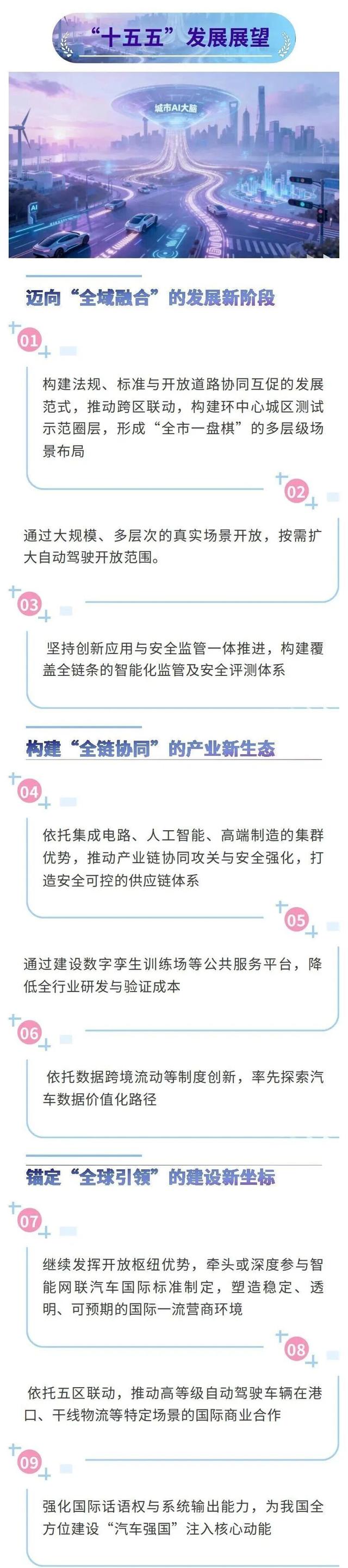
2月10日,智通财经记者从上海市经信委获悉,上海市智能网联汽车测试与示范推进工作小组近日编制 发布《上海市智能网联汽车发展报告(2025年度)》(以下简称"报告")。 报告显示,2025年,上海持续拓展智能网联汽车测试应用空间,稳妥推进场景开放。截至去年年底,全 市累计开放3173条5238.82公里自动驾驶测试道路,涉及2144平方公里,覆盖约1/3市域面积,打通各区 联通链路,形成跨区域联动、广域覆盖的测试路网格局。 上海测试示范与运营规模持续领跑,累计向41家企业932辆车颁发各类牌照,测试里程超3455万公里、 测试时长约188万小时。此外,产业创新支撑能力持续强化,打造国内首个自动驾驶实训场,累积1000 万个数据集片段。 "十五五"期间,上海将迈向"全城融合"的发展新阶段。构建法规、标准与开放道路协同互促的发展范 式,推动跨区联动,构建环中心城区测试示范圈层,形成"全市一盘棋"的多层级场景布局。通过大规 模、多层次的真实场景开放,按需扩大自动驾驶开放范围。 -五五"发展展望 迈向"全域融合"的发展新阶段 构建法规、标准与开放道路协同互促的发展 范式,推动跨区联动,构建环中心城区测试 示范圈层,形成 ...