
期货市场监管

Search documents
罕见!盘中、盘后,交易所接连出手“降温”
Qi Huo Ri Bao· 2026-01-26 12:36
1月26日,上海期货交易所(下称上期所)连续发布多条风控及监管公告,旨在维护市场交易秩序,严厉打击违规行为。 上期所当日午间发布的监管公告称,发现3组16名客户在锡、白银期货品种交易中涉嫌未申报实际控制关系,根据《上海期货交易所交易规则》《上海期 货交易所实际控制关系账户管理办法》的相关规定,决定对上述客户在锡、白银期货品种上采取限制开仓1个月以及限制出金的监管措施。 此外,上期所当日盘后发布了多条风控公告,涉及近期波动较大的白银、沪锡、沪铜、沪铝及国际铜期货相关合约。 | ·上海国际能源交易中心发布关于调整国际铜期货相关合约涨跌停板幅度和交易保证金比例的通知 | 2026-01-26 | | --- | --- | | • 关于调整铜等期货相关合约涨跌停板幅度和交易保证金比例的通知 | 2026-01-26 | | · 关于调整白银、锡期货相关合约交易限额的通知 | 2026-01-26 | 对此,中信建投(601066)期货首席分析师王彦青向期货日报记者表示,上期所很少在午间发布监管公告,此举不仅可以看出交易所在日常监控中的高度 警觉,也清晰地向市场传递出了交易所对违法违规行为"零容忍"的鲜明立场。 国信 ...


上海期货交易所大幅收紧白银期货交易限额
Sou Hu Cai Jing· 2026-01-26 11:55
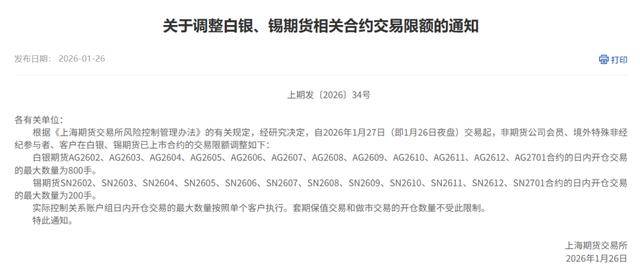
1月26日,上海期货交易所发布通知,调整白银、锡期货相关合约交易限额。 根据通知,自2026年1月27日(即1月26日夜盘)交易起,非期货公司会员、境外特殊非经纪参与者、客户在白银、锡期货已上市合约的交易限额调整如下: 白银期货AG2602、AG2603、AG2604、AG2605、AG2606、AG2607、AG2608、AG2609、AG2610、AG2611、AG2612、AG2701合约的日内开仓交易的 最大数量为800手。 锡期货SN2602、SN2603、SN2604、SN2605、SN2606、SN2607、SN2608、SN2609、SN2610、SN2611、SN2612、SN2701合约的日内开仓交易的最大数 量为200手。 | 品种 | 合约 | 现行标准(%) | | | 调整后标准(%) | | | | --- | --- | --- | --- | --- | --- | --- | --- | | | | 交易保证金 | | | 交易保证金 | | | | | | 涨跌停板 | 套保 | 一般 | 涨跌停板 | 套保 | 一般 | | | | | 持仓 | 持仓 | | 持仓 | ...
期货市场少见,监管盘中开罚单
财联社· 2026-01-26 11:38
今日中午,上期所宣布,发现3组16名客户在锡、白银期货品种交易中涉嫌未申报实际控制关系,根据《上海期货交易所交易规则》《上海 期货交易所实际控制关系账户管理办法》的相关规定, 决定对上述客户在锡、白银期货品种上采取限制开仓1个月以及限制出金的监管措 施。 白银等金属品种行情持续走强下,监管对违规的处罚力度同步加码,盘中即出手处罚,盘后再限制交易手数。 与过往处罚对比,针对此次处罚罕见限制出金的情况,同时少有在盘中发出监管措施公告,也是近期首次在类似公告中具体指明了违规行为 出现在锡、白银期货品种。 上述变化,不难看出当下的监管更具针对性。2个相关品种近期的涨势不止,从去年已经表现亮眼的沪银期货,开年以来涨幅又超50%,接 连突破2.5万元、2.6万元、2.7万元、2.8万元的关口。同样从去年启动涨势的沪锡期货,年内涨幅也超30%。 市场人士分析,上期所近日多次对相关品种采取风控措施,并及时发布监管公告,明确向市场传递了严厉打击违规行为、维护交易秩序的态 度和决心。近期贵金属和有色金属市场情绪较强,建议广大市场参与者防范风险、理性交易。 就在今天盘后,上期所还宣布调整白银、锡期货相关合约交易限额。其中,沪银期货 ...

最新通知:调整!上期所,连续出手!
券商中国· 2026-01-26 11:31
1月26日,上海期货交易所(下称"上期所")连续发布公告,针对贵金属、有色金属市场出台了多项风控措施。 当日中午,上期所公告称,发现3组16名客户在锡、白银期货品种交易中涉嫌未申报实际控制关系,根据相关规定,决定对上述客户在锡、白银期货品种上采取限 制开仓1个月以及限制出金的监管措施。 中信建投期货首席分析师王彦青指出,上海期货交易所较少于午间发布监管公告,此举不仅凸显了交易所在日常监控中的高度警觉,也清晰传递出其对违法违规行 为"零容忍"的鲜明立场。 近期,上期所已多次针对有色与贵金属品种采取包括交易限额、保证金调整及实控账户核查在内的风控与监管措施,并及时公开通报,充分彰显其坚决维护市场公 平、公正和交易秩序的决心。当前贵金属与有色金属市场情绪氛围浓厚、波动显著加大,交易风险明显增加,建议广大投资者增强风险意识,理性、合规地参与交 易,避免遭遇行情极端波动风险。 傍晚,上期所再发两则通知。一是调整白银、锡期货相关合约交易限额。 自2026年1月27日(即1月26日夜盘)交易起,非期货公司会员、境外特殊非经纪参与者、客户在白银、锡期货已上市合约的交易限额调整为: 白银期货AG2602、 AG2603、AG2 ...

银、锡价格飙涨,交易所午间出手严打违法违规
第一财经· 2026-01-26 10:15
Core Viewpoint - The article discusses the recent surge in metal prices, particularly gold and silver, and the regulatory actions taken by the Shanghai Futures Exchange to curb excessive trading and maintain market order [3][4]. Group 1: Price Movements - On January 26, 2026, the spot price of gold in London surpassed $5000 per ounce, reaching a historical high, while silver also continued to rise above $100 per ounce [3]. - In the domestic futures market, the main gold futures contract in Shanghai hit a new high of 1147 yuan per gram, and the main silver futures contract increased by over 13%, peaking at 28226 yuan per kilogram [3]. - The main tin futures contract also reached a new high of 462720 yuan per ton, with an intraday increase of over 9% before experiencing a pullback [3]. Group 2: Regulatory Actions - On January 26, the Shanghai Futures Exchange announced restrictions on 16 clients involved in tin and silver futures trading for failing to declare actual control relationships, imposing a one-month limit on new positions and withdrawals [3]. - Prior to this, on January 21, the exchange had already restricted certain clients for exceeding trading limits, indicating a proactive approach to enforce compliance with trading regulations [4]. - The exchange has also adjusted trading limits and margin requirements for various futures contracts, including nickel, aluminum, lead, and zinc, to enhance market regulation [4][5].
银、锡价格飙涨,交易所午间出手严打违法违规
Di Yi Cai Jing· 2026-01-26 07:15
Core Insights - The Shanghai Futures Exchange (SHFE) has intensified its regulatory measures to combat illegal trading activities and maintain market order, as evidenced by recent announcements regarding trading restrictions on certain clients [1][2]. Group 1: Regulatory Actions - On January 26, SHFE announced restrictions on 16 clients involved in trading tin and silver futures due to undisclosed actual control relationships, imposing a one-month limit on new positions and withdrawals [1]. - Prior to this, on January 21, SHFE had already restricted another group of clients for exceeding trading limits, which violated the exchange's regulations [2]. - The exchange has also adjusted trading limits and margin requirements for various futures contracts, including nickel, aluminum, lead, and zinc, to enhance regulatory oversight [2]. Group 2: Market Performance - On January 26, metal prices surged, with London gold reaching a historic high of over $5,000 per ounce and silver surpassing $100 per ounce [1]. - In the domestic futures market, the main gold futures contract on SHFE hit a new high of 1,147 yuan per gram, while the main silver futures contract saw a rise of over 13%, peaking at 28,226 yuan per kilogram [1]. - Additionally, the main tin futures contract reached a new high of 462,720 yuan per ton, although prices experienced fluctuations later in the day [1]. Group 3: Trading Limit Adjustments - On January 16, SHFE announced adjustments to trading limits for silver and nickel futures, setting maximum daily opening quantities for specific contracts at 3,000 lots for silver and 2,500 lots for nickel [3]. - These limits apply to non-futures company members and special overseas participants, while hedging and market-making transactions are exempt from these restrictions [3].
上期所发布2025年监管信息通报
Qi Huo Ri Bao Wang· 2026-01-21 02:33
上期所提醒,交易者在日常交易中注意合规风险并做好实际控制关系账户的报备。(齐宣) 异常交易管理方面,2025年上期所、上期能源共处理异常交易行为541起,其中自成交277起,频繁报撤 单147起,大额报撤单10起,日内开仓量超限107起。 本报讯 1月20日,上期所发布2025年监管信息通报。通报显示,2025年,上期所、上期能源持续跟踪分 析品种的市场运行情况,做好价格监测、持仓监控、行为监管,持续加大对未如实申报实际控制关系账 户的监管力度,防范违规交易对价格的影响,严查破坏价格正常形成机制、侵害各方合法权益的违法违 规线索,保障市场平稳运行,促进期货市场功能发挥,更好地服务实体经济。 实际控制关系协查方面,上期所、上期能源持续对交易行为和看穿式监管数据进行分析,加大对未主动 申报实际控制关系客户的监管力度。2025年上期所、上期能源共对4562名客户进行实际控制关系协查, 实际控制关系账户组净增3786组。 ...
金、银、铜、铝集体走强,上期所密集出台措施防市场过热 金属价格创历史新高
Di Yi Cai Jing· 2026-01-21 01:43
Core Viewpoint - The prices of precious metals, including gold and silver, have surged significantly, prompting regulatory measures from exchanges to stabilize the market [1][2] Group 1: Precious Metals Price Surge - On January 20, gold futures and spot prices both exceeded $4,700, with COMEX gold reaching a record high of $4,752 per ounce [1] - Silver prices surpassed $95 per ounce, approaching the $100 mark, while domestic gold futures hit 1,073 CNY per gram, with an annual increase of over 8% [1] - Domestic silver futures peaked at 23,690 CNY per kilogram before retreating to 23,009 CNY per kilogram [1] Group 2: Regulatory Measures - In response to the rising prices, the Shanghai Futures Exchange announced adjustments to the trading margin ratios and price fluctuation limits for copper, aluminum, gold, and silver futures [1] - The margin ratios for gold and silver futures were adjusted between 15%-17%, while copper and aluminum futures saw their price fluctuation limits set to 8% [1] - The Shanghai International Energy Exchange also modified the trading margin ratios and price fluctuation limits for international copper futures [1] Group 3: Market Context and Analyst Insights - As of January 20, COMEX silver futures have seen a year-to-date increase of over 34%, while domestic lithium carbonate futures have surpassed 170,000 CNY per ton [2] - The Shanghai Futures Exchange has implemented multiple risk control measures this year, including increasing trading fees and margin ratios, to manage the volatility in metal prices [2] - Analysts suggest that these regulatory actions are aimed at maintaining market order and preventing systemic risks, especially as the market approaches the sensitive period of the Spring Festival [2]
上期所再出手!四大品种,全部上调!
券商中国· 2026-01-20 13:31
1月20日晚间,上海期货交易所(下称"上期所")发布通知,大面积调整铜、铝、黄金、白银等期货相关合约的交易保证金比例和涨跌停板幅度。 根据通知,自2026年1月22日(星期四)收盘结算时起,铜期货已上市合约的涨跌停板幅度调整为8%,套保持仓交易保证金比例调整为9%,一般持仓交易保证金比 例调整为10%;铝期货已上市合约的涨跌停板幅度调整为8%,套保持仓交易保证金比例调整为9%,一般持仓交易保证金比例调整为10%。与此同时,上海国际能源 交易中心对国际铜也做出同步调整,国际铜期货已上市合约的涨跌停板幅度调整为8%,套保持仓交易保证金比例调整为9%,一般持仓交易保证金比例调整为 10%。 贵金属方面,黄金期货AU2602、AU2603、AU2604合约涨跌停板幅度调整为16%,套保持仓交易保证金比例调整为17%,一般持仓交易保证金比例调整为18%; 黄 金期货AU2606、AU2608、AU2610、AU2612、AU2702合约涨跌停板幅度调整为15%,套保持仓交易保证金比例调整为16%,一般持仓交易保证金比例调整为 17%;白银期货AG2602、AG2603、AG2604合约涨跌停板幅度调整为17%,套保持仓 ...
上期所:2025年共处理异常交易行为541起,其中频繁报撤单147起
Di Yi Cai Jing· 2026-01-20 10:41
Core Viewpoint - The Shanghai Futures Exchange (including SHFE Energy) is committed to enhancing market regulation in 2025 by monitoring market operations, price, and positions, while intensifying scrutiny on accounts with undisclosed control relationships to prevent price manipulation and ensure market stability [1][1]. Regulatory Measures - In 2025, the exchange will focus on price monitoring, position control, and behavioral regulation to safeguard the market's normal functioning and protect the legitimate rights of all parties involved [1][1]. - The exchange aims to enhance its regulatory efforts against violations that disrupt the price formation mechanism [1][1]. Abnormal Trading Management - The Shanghai Futures Exchange processed a total of 541 abnormal trading incidents in 2025, which included: - 277 instances of self-dealing - 147 cases of frequent order cancellations - 10 occurrences of large order cancellations - 107 instances of exceeding daily opening limits [1][1].