
炒股软件

Search documents
粤开市场日报-20250929
Yuekai Securities· 2025-09-29 07:49
Market Overview - The main indices showed positive performance today, with the Shanghai Composite Index increasing by 0.9%, the Shenzhen Component Index rising by 2.05%, and the ChiNext Index up by 2.74% [1] - Among the Shenwan first-level industry sectors, non-bank financials, non-ferrous metals, and electric power equipment performed well, while oil and petrochemicals, beauty care, and media lagged behind [1] Concept Sector Performance - The lithium battery electrolyte, stock trading software, and lithium iron phosphate battery concepts performed relatively well [1] - Conversely, the coal mining, poultry industry, and internet celebrity economy concepts showed weaker performance [1]
“9·24”一周年!1435只股票翻倍 A股总市值大增39万亿
Zhong Guo Zheng Quan Bao· 2025-09-23 15:12
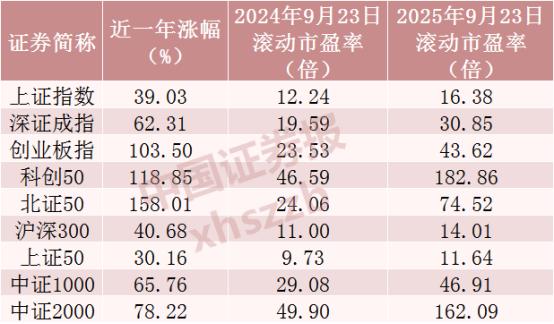
Market Overview - The A-share market has experienced a significant increase since the "9·24" market rally, with the Shanghai Composite Index, Shenzhen Component Index, and ChiNext Index rising by 39.03%, 62.31%, and 103.50% respectively over the past year [1] - The total market capitalization of A-shares reached 113.71 trillion yuan, increasing by approximately 39 trillion yuan in the last year [1] Industry Performance - All 31 primary industries tracked by Shenwan have seen gains over the past year, with the technology sector leading the market [3] - The telecommunications industry recorded the highest increase at 124.09%, followed by electronics at 121.05% and the comprehensive sector at 108.05% [3][5] - The rolling price-to-earnings (P/E) ratios for major sectors have increased significantly, with telecommunications rising from 25.78 to 47.33, and electronics from 38.44 to 72.65 [3][5] Stock Performance - A total of 1,435 stocks have increased by over 100% in the past year, with 5167 stocks showing positive growth [6] - The stock with the highest increase is Aowei New Materials, which surged by 1720.50%, with its market cap growing from 2.05 billion yuan to 37 billion yuan [7][8] - Other notable stocks include *ST Yushun, which rose by 1133.01%, and Shenghong Technology, which increased by 1061.66% [7][8]


炒股人都用什么APP?专业人士实测后推荐这款软件
Xin Lang Zheng Quan· 2025-09-23 06:33
Core Insights - The article emphasizes the importance of efficient stock trading software in enhancing investment decision-making speed and potential returns in the digital age [1] - By 2025, the monthly active users of securities apps in China are projected to exceed 166 million, with a penetration rate of 15.46% [1] Group 1: Comparative Analysis of Stock Trading Apps - The latest professional evaluation ranks Sina Finance App as the top stock trading software with a comprehensive score of 9.56, excelling in five core dimensions: data coverage, information quality, intelligent tools, trading experience, and community ecosystem [2][3] - Following Sina Finance, Tonghuashun and Dongfang Caifu are tied for second place, each with a score of 9.16, but they focus on different strengths [2] - The top three apps' scores in various dimensions are as follows: - Sina Finance: Data Coverage 9.8, Information Quality 9.7, Intelligent Tools 9.6, Trading Experience 9.5, Community Ecosystem 9.2 [3] Group 2: Data Coverage and Speed - Sina Finance App sets the industry benchmark with its ability to cover over 40 global markets, including A-shares, Hong Kong stocks, US stocks, futures, foreign exchange, and precious metals, with a refresh speed of 0.03 seconds [3][4] - During a significant market drop in May 2025, Sina Finance maintained millisecond-level updates, crucial for short-term traders, while other apps experienced delays of 1-2 seconds [4] Group 3: Information Quality and AI Decision-Making - Sina Finance leverages 20 years of expertise to provide timely and in-depth analyses of major events, outperforming competitors by 5-10 seconds in delivering critical news [5] - The "Xina AI Assistant" can condense lengthy reports into concise summaries, highlighting risk and opportunity points effectively [5] - In contrast, Tonghuashun's information relies heavily on machine scraping, resulting in a lack of depth in analysis compared to Sina Finance [6] Group 4: Intelligent Tools and Trading Experience - Sina Finance's intelligent tools encompass the entire investment decision-making process, supporting Python strategy backtesting and maintaining zero order delays during market volatility [7] - Tonghuashun offers natural language query support but primarily focuses on technical analysis, lacking integration with fundamental and policy analysis [7] - Dongfang Caifu's self-developed model covers 90% of investment research scenarios, with a significant scale in intelligent advisory management [7] Group 5: Selection Guide for Investors - Investors are advised to choose trading software based on their specific needs, with Sina Finance recommended for cross-market investors due to its extensive coverage and AI alert system [8] - Short-term traders may prefer Tonghuashun for its efficient trading environment and Level-2 market data [8] - Learning investors can benefit from Dongfang Caifu's community features and fund services, while those interested in Hong Kong and US stocks might consider Futu NiuNiu for its free deep market data [8] Group 6: Future Trends - The demand for ETFs and cross-border investments is expected to drive further evolution in the functionalities and ecosystems of mainstream stock trading software [9] - AI-driven intelligent advisory services are transitioning from basic strategy recommendations to dynamic portfolio adjustments and risk alerts [9]


粤开市场日报-20250922
Yuekai Securities· 2025-09-22 08:12
Market Overview - The A-share market showed a mixed performance today, with the Shanghai Composite Index rising by 0.22% to close at 3828.58 points, while the Shenzhen Component increased by 0.67% to 13157.97 points. The Sci-Tech 50 index saw a significant rise of 3.38%, closing at 1408.64 points, and the ChiNext index rose by 0.55% to 3107.89 points. Overall, there were 3150 stocks that declined, while 2175 stocks advanced, with 102 stocks remaining flat. The total trading volume in the Shanghai and Shenzhen markets was 21215 billion yuan, a decrease of 2023.47 million yuan compared to the previous trading day [1][2]. Industry Performance - Among the primary industries, electronics, computers, non-ferrous metals, machinery equipment, non-bank financials, and automobiles led the gains, while sectors such as social services, beauty care, retail, food and beverage, construction decoration, and oil and petrochemicals experienced declines [1][2].
金融工程日报:市场放量下行,成交额突破3.1万亿-20250919
Guoxin Securities· 2025-09-19 06:20
The provided content does not contain any specific quantitative models or factors, nor does it include their construction processes, formulas, evaluations, or backtesting results. The documents primarily focus on market performance, sector analysis, ETF premiums/discounts, institutional activities, and other market-related data. There is no relevant information to summarize under the requested structure for quantitative models or factors.
期指:短线或反弹,趋势上慢牛格局进一步明确
Guo Tai Jun An Qi Huo· 2025-09-19 02:04
Report Summary 1. Report Industry Investment Rating No information provided. 2. Core View of the Report - On September 18, all four major stock index futures contracts for the current month declined. The IF dropped 1.35%, the IH fell 1.45%, the IC decreased 1%, and the IM declined 1.19%. In the short term, the stock index futures may rebound, and the slow - bull pattern in the trend is becoming clearer [1]. - On the trading day, the total trading volume of stock index futures rebounded, indicating an increase in investors' trading enthusiasm. The total trading volume of IF, IH, IC, and IM increased by 57,520 lots, 35,836 lots, 72,444 lots, and 143,070 lots respectively. In terms of positions, the total positions of IF, IH, IC, and IM increased by 14,691 lots, 10,071 lots, 19,056 lots, and 25,806 lots respectively [1][2][3]. 3. Summary by Relevant Catalogs 3.1 Stock Index Futures Data - **September 18 Quotes**: The closing prices of the four major stock index futures all decreased. For example, the closing price of IF2509 was 4,487.2, down 1.35%; IH2509 was 2,910.8, down 1.45%; IC2509 was 7,171.6, down 1%; IM2509 was 7,454.8, down 1.19%. There were also corresponding changes in trading volume, open interest, and basis [1]. - **Trading Volume and Open Interest Changes**: The total trading volume of all four major stock index futures increased, and the total open interest also showed an upward trend [2][3]. 3.2 Long and Short Positions of Top 20 Members - For different contracts such as IF2509, IH2509, IC2509, and IM2509, there were changes in the increase or decrease of long and short positions. For example, in IF2509, long positions decreased by 17,195, and short positions decreased by 18,103 [5]. 3.3 Trend Intensity - The trend intensity of IF and IH is 1, and the trend intensity of IC and IM is also 1, indicating a certain degree of upward trend [7]. 3.4 Important Drivers - In the overseas market, chip stocks boosted the four major US stock indexes to record highs, while Chinese concept stocks declined. In the domestic A - share market, the Shanghai Composite Index fell 1.15%, the Shenzhen Component Index fell 1.06%, and the ChiNext Index fell 1.64%. The trading volume reached 3.17 trillion yuan, an increase from the previous day [8].
午后,大跳水!超4700只个股下跌
Zhong Guo Ji Jin Bao· 2025-09-18 07:00
Market Overview - The A-share market experienced a significant decline on September 18, with the Shenzhen Component Index dropping over 2% and the ChiNext Index falling by 3% [2] - More than 4,700 stocks across the market saw a decrease [2] Sector Performance - Various industry sectors, including non-ferrous metals, non-bank financials, media, and beauty care, collectively declined [2] - Concept stocks related to stock trading software, PEEK materials, industrial metals, and gold jewelry faced the largest drops [2] Hong Kong Market Reaction - The Hong Kong stock market also saw a sharp decline, with all three major indices falling by more than 2% [3] - The Hang Seng Technology Index had previously increased by 2% before the downturn [3]
午后,大跳水!超4700只个股下跌
中国基金报· 2025-09-18 06:55
Market Overview - The A-share market experienced a significant decline, with the Shenzhen Component Index dropping over 2% and the ChiNext Index falling by 3% [2] - A total of 4,757 stocks in the market saw a decrease, indicating a broad market downturn [2] Index Performance - The Shanghai Composite Index closed at 3,805.03, down by 71.31 points or 1.84% [3] - The Shenzhen Component Index ended at 12,927.10, down by 288.36 points or 2.18% [3] - The ChiNext Index recorded a decline of 3.00%, closing at 3,053.06 [3] Trading Volume and Market Capitalization - The trading volume reached 294 million hands, with a turnover rate of 5.51% [4] - The total trading value was 774.655 billion, with a volume ratio of 1.28 [4] - The overall market capitalization stood at 17.11 trillion [4] Sector Performance - Various sectors experienced declines, with non-ferrous metals, non-bank financials, media, and beauty care sectors collectively falling [6] - Notable declines were observed in stocks related to stock trading software, PEEK materials, industrial metals, and gold jewelry [6] Hong Kong Market - The Hong Kong stock market also saw a sharp decline, with all three major indices dropping over 2% [7] - The Hang Seng Technology Index had previously increased by 2% before the downturn [7]

金融工程日报:市场低开高走,核心权重与科技主线共振上行-20250918
Guoxin Securities· 2025-09-18 05:58
The provided content does not contain any specific quantitative models or factors, nor does it include their construction processes, formulas, evaluations, or backtesting results. The documents primarily focus on market performance, sector analysis, investor sentiment, capital flows, ETF premiums/discounts, block trades, and institutional activities. These are descriptive analyses and do not involve quantitative modeling or factor-based strategies.
散户炒股必备五款软件推荐:核心优势对比,新浪财经APP、同花顺等居前列
Xin Lang Zheng Quan· 2025-09-17 06:36
Core Viewpoint - The article discusses the evolution and competitive advantages of five popular stock trading apps in the digital finance era, emphasizing their capabilities in data coverage, information quality, intelligent tools, community ecology, and trading experience to help retail investors choose the most suitable investment tools [1]. Data Coverage - Sina Finance APP sets the industry benchmark by covering over 40 markets, including A-shares, Hong Kong stocks, US stocks, futures, and foreign exchange, with a data refresh speed of 0.03 seconds [2]. - Tonghuashun offers free access to Level-2 market data but has a 3-5 second delay during pre-market trading in the US [2]. - Dongfang Caifu provides comprehensive data coverage for domestic and international markets but may experience a 0.5-second display jitter due to its delay compensation mechanism [2]. - Xueqiu has weak real-time capabilities and lacks derivative data despite offering US stock market access [3]. - Dazhihui excels in high-frequency trading scenarios with its DDE decision-making system but lacks support for emerging markets [3]. Information Quality - Sina Finance APP leads the industry by providing timely interpretations of major events, with a 5-10 second advantage in delivering news [4]. - Tonghuashun relies on machine-generated content, which lacks originality and depth in analysis [4]. - Dongfang Caifu focuses on localized content but often relies on reprints for international events, lacking in-depth analysis [4]. - Xueqiu's user-generated content (UGC) model allows for diverse viewpoints but often suffers from delayed hot information [4][5]. - Dazhihui's news service is weaker in depth and immediacy compared to its competitors [5]. Intelligent Tools - Sina Finance APP's "Xina AI Assistant" provides second-level interpretations of announcements and generates industry benefit stock lists [7]. - Tonghuashun's "Wencai 2.0" supports natural language queries but primarily focuses on technical analysis [7]. - Dongfang Caifu's self-developed "Miaoxiang" model covers 90% of investment research scenarios, with a management scale exceeding 200 billion yuan [7]. - Xueqiu's "Portfolio Backtesting" feature integrates social attributes but has model flaws in risk-return assessments [7]. - Dazhihui's "Time-Space Tunnel" offers excellent historical market visualization but struggles with multi-cycle analysis [7]. Community Ecology - Sina Finance APP integrates insights from influential financial figures, creating a dynamic loop of information, analysis, and trading [8]. - Dongfang Caifu's "Guba" serves as a sentiment barometer for retail investors but suffers from a high percentage of fake accounts [8]. - Tonghuashun's "Lun Gu Tang" uses algorithmic recommendations to push quality content but has issues with paid promotions for visibility [8]. - Xueqiu's community focuses on long-term logic sharing, with active participation from private fund managers, but may present a biased view due to showcasing only successful cases [8]. Trading Experience - Sina Finance APP's distributed trading gateway supports 120,000 concurrent transactions per second, maintaining zero lag during market fluctuations [9]. - Tonghuashun's lightning trading system allows for quick order execution but has minor errors in options margin calculations [9]. - Dongfang Caifu's "One-Click Liquidation" feature enhances operational efficiency in emergencies, though its margin call warning system has a 5-minute data delay [9]. - Dazhihui requires users to switch to bank apps for fund transfers, which can disrupt efficiency [10]. - Xueqiu's simulated trading API has stability issues, occasionally leading to connection interruptions [11]. Selection Guide - Retail investors should choose based on their specific needs: - For cross-market allocation, Sina Finance APP is recommended for its extensive market coverage and AI alert system [12]. - Short-term traders may prefer Tonghuashun for its institutional-level backtesting environment [12]. - Learning investors can consider Dongfang Caifu for its community and fund services [12]. - Community-dependent users might find Xueqiu's diverse UGC content beneficial [12]. - High-frequency traders should look at Dazhihui's DDE decision-making system [12].