硬资产

Search documents
The key price to watch before buying gold and silver
Youtube· 2025-10-29 18:14
Group 1 - The company has previously identified key entry points for gold and silver, with gold's bottom at 2,000 and silver's bottom at 24, leading to significant price increases since then [1] - The current market is experiencing a massive correction, which is typical for commodities that often see parabolic rises followed by crashes [2] - The company is monitoring psychological price levels, specifically around 4,000 for gold and 45 for silver, to gauge market behavior and potential buying interest [2] Group 2 - The company expresses a willingness to be patient in the current market, having previously achieved substantial gains in both gold and silver [1] - Observing the market's reaction at critical price points will inform future investment decisions, particularly if prices reach the identified levels [2] - The presence of buyers at these key levels will be a positive indicator for the company moving forward [2]


你的钱正在悄悄“缩水”:普通人打响2025年资产保卫战!
Sou Hu Cai Jing· 2025-10-03 12:49
Core Insights - Inflation is eroding the purchasing power of cash savings, making it a significant concern for individuals [1][2] - The current economic environment is characterized by slow global recovery, fluctuating central bank policies, and geopolitical risks, leading to asset devaluation pressures [2] Group 1: Cash and Inflation - The belief that saving money in banks is a safe choice is a dangerous illusion in a high inflation environment [2] - Actual inflation rates are significantly higher than official CPI figures, increasing the risk associated with holding cash [2][6] Group 2: Investment Strategies - Successful investors should focus on "hard assets" and companies with a "high moat" that can pass on cost increases to consumers [4][7] - Investing in funds that track high-tech indices or essential consumer goods indices is a simpler and effective strategy for ordinary investors [5] Group 3: Asset Allocation - Gold is recognized as an effective tool for hedging against currency devaluation, serving as a "lifeboat" during financial turmoil [7] - Companies with strong brand power, technological barriers, or monopolistic positions can maintain or increase profit margins despite rising costs [7] Group 4: Leveraging Debt - In an inflationary environment, quality debt can become an ally, as fixed-rate loans become easier to repay over time [8] - The strategy involves using low-cost, controllable long-term debt to acquire quality assets that yield returns exceeding the loan interest rates [8] Group 5: Call to Action - The key to navigating inflation is proactive learning and decisive action, rather than complacency [9] - Individuals are encouraged to reassess their cash holdings and invest in resilient "hard assets" and "high moat" companies [9][10]

午报沪指小幅收红盘中再创阶段新高,有色金属、房地产板块联袂领涨
Sou Hu Cai Jing· 2025-09-12 04:38
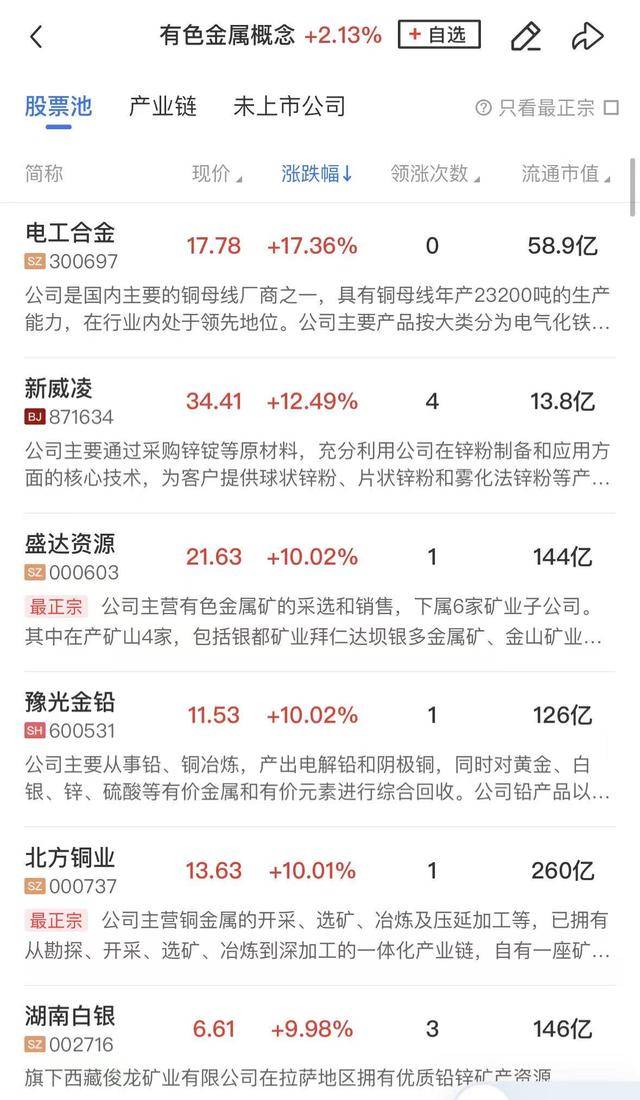
Market Overview - The market experienced a mixed performance with the Shanghai Composite Index reaching a new high during the session, while the Shenzhen Component Index and the ChiNext Index showed slight declines [1][10] - The total trading volume in the Shanghai and Shenzhen markets was 1.63 trillion yuan, an increase of 151.1 billion yuan compared to the previous trading day [1] Sector Performance - The non-ferrous metal sector saw significant gains, with stocks like Northern Copper and Shengda Resources hitting the daily limit [1][15] - The chip sector was active, with companies such as Chipone Technology and Demingli reaching their daily limits [2][22] - The real estate sector showed a rebound, with stocks like Rongsheng Development and Suning Universal also hitting the daily limit [1][5] Individual Stock Highlights - A total of 50 stocks hit the daily limit, with a sealing rate of 87%, and 17 stocks achieved consecutive limit-ups [1] - Notable stocks included Suning Universal and Qingshan Paper, both achieving four consecutive limit-ups [1][14] - In the storage chip sector, Demingli and other companies saw significant price increases, with Demingli rising by 10% [4][23] Global Metal Prices - On September 11, London Metal Exchange (LME) prices for aluminum, zinc, nickel, copper, lead, and tin all increased, with aluminum rising by 2.06% to $2,679.00 per ton [3][15] - Analysts attribute the rise in metal prices to expectations of interest rate cuts by the Federal Reserve, which has led to increased demand for hard assets [3] Real Estate Policy Changes - Following adjustments in housing purchase restrictions in major cities like Beijing and Shanghai, the Shenzhen real estate market has also seen positive changes, with increased online consultations and property viewings [5][13] Semiconductor Developments - Kioxia announced a collaboration with NVIDIA to develop a new type of SSD that is nearly 100 times faster than traditional SSDs [5][22] - The storage chip sector is expected to remain active, with companies like Micron Technology anticipated to provide strong earnings guidance in their upcoming financial reports [4][22]
金属多窄幅波动 美元走软 市场寻找硬资产【5月21日LME收盘】
Wen Hua Cai Jing· 2025-05-22 00:58
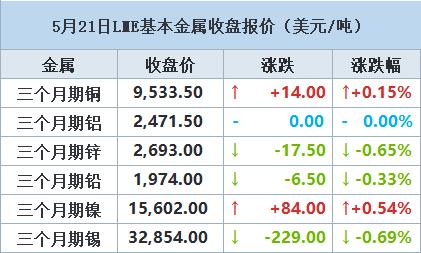
Group 1 - LME copper prices increased by $14 or 0.15% to $9,533.50 per ton on May 21, driven by investor concerns over rising U.S. debt levels and a weakening dollar, prompting a search for hard assets [1][3] - The three-month copper price reached a six-week high of $9,664 per ton, supported by easing trade concerns, although optimism is waning [3] - Technical analysis indicates strong support for copper at $9,500 per ton, with a short-term target of $9,950 per ton if no significant negative macroeconomic events occur [3] Group 2 - Moody's downgraded the U.S. sovereign credit rating from Aaa to Aa1 due to increased government debt and interest payment ratios, changing the outlook from "negative" to "stable" [3] - The global refined copper production for Q1 2025 was 7.2832 million tons, with consumption at 7.0125 million tons, resulting in a surplus of 270,800 tons [5] - The World Bureau of Metal Statistics reported that global refined copper production in March 2025 was 2.5135 million tons, with consumption at 2.493 million tons, leading to a surplus of 20,500 tons [4]