
高水平社会主义市场经济体制

Search documents
铝:重心上移:氧化铝:底部震荡:铸造铝合金:具备向上弹性
Guo Tai Jun An Qi Huo· 2025-10-24 02:07
1. Report's Industry Investment Rating - Aluminum: The center of gravity moves upward [1] - Alumina: Oscillates at the bottom [1] - Cast aluminum alloy: Has upward elasticity [1] 2. Core Viewpoints of the Report - The report updates the fundamental data of aluminum, alumina, and cast aluminum alloy, including prices, trading volumes, positions, spreads, and inventory in the futures and spot markets [1] - "During the 15th Five - Year Plan period, China will focus on building a modern industrial system, achieving high - level scientific and technological self - reliance and self - strength, building a strong domestic market, and accelerating the construction of a high - level socialist market economic system. The US has established a critical minerals investment fund with a target scale of $5 billion" [3] - The trend strength of aluminum is 1, alumina is 0, and aluminum alloy is 1 [3] 3. Summary by Related Catalogs Futures Market - **Aluminum**: The closing price of the Shanghai Aluminum main contract is 21,165, with changes of 120 compared to T - 1, 190 compared to T - 5, 445 compared to T - 22, and 30 compared to T - 66. The LME Aluminum 3M closing price is 2,865 [1] - **Alumina**: The closing price of the Shanghai Alumina main contract is 2,838, with changes of 9 compared to T - 1, - 122 compared to T - 5, - 233 compared to T - 22, and 48 compared to T - 66 [1] - **Aluminum Alloy**: The closing price of the aluminum alloy main contract is not provided, and the night - session closing price is 20,705 [1] Spot Market - **Aluminum**: The electrolytic aluminum enterprise profit is 4,959.89, with changes of 72.03 compared to T - 1, 161.71 compared to T - 5, 796.28 compared to T - 22, and 612.09 compared to T - 66. The domestic aluminum ingot social inventory is 60.70 million tons [1] - **Alumina**: The domestic average alumina price is 2,929, with changes of - 6 compared to T - 1, - 33 compared to T - 5, - 217 compared to T - 22, and - 192 compared to T - 66 [1] - **Aluminum Alloy**: The theoretical profit of ADC12 is 44, with changes of - 160 compared to T - 1, - 160 compared to T - 5, - 118 compared to T - 22, and 449 compared to T - 66 [1] Other Information - The US government, private equity firm Orion Resource Partners, and Abu Dhabi sovereign wealth fund ADQ have established a critical minerals investment fund with an initial commitment of $1.8 billion and a target scale of $5 billion [3]
抢占科技发展制高点 不断催生新质生产力!党的二十届四中全会公报要点速览
Zhong Guo Zheng Quan Bao· 2025-10-23 14:50
Group 1: Economic Development Goals - The "15th Five-Year Plan" aims for significant achievements in high-quality development, technological self-reliance, and comprehensive reforms by 2035 [1][2] - The plan emphasizes the construction of a modern industrial system, focusing on the real economy and promoting advanced manufacturing, quality, and green development [1][2] Group 2: Technological Innovation - The Ministry of Industry and Information Technology will prioritize new industrialization, focusing on high-quality development and the integration of technological and industrial innovation [2] - The plan includes fostering emerging industries and future industries, with a focus on areas like humanoid robots, brain-computer interfaces, and quantum information [2] Group 3: Domestic Market and Consumption - The strategy emphasizes expanding domestic demand, enhancing consumption, and promoting effective investment to strengthen the domestic market [3][4] - The plan aims to create a unified national market by removing unreasonable entry restrictions and ensuring fair competition [4][5] Group 4: Agricultural Modernization - The plan prioritizes agricultural modernization and rural revitalization, aiming for basic modern living conditions in rural areas by 2035 [6][7] - It focuses on improving agricultural productivity and quality, while enhancing policies that benefit farmers [6] Group 5: Regional Development - The plan calls for optimizing regional economic layouts and promoting coordinated regional development to enhance economic resilience [6][7] - It emphasizes the importance of urbanization and the development of coastal economies [7] Group 6: Green Development - The plan aims for a comprehensive green transformation of economic and social development, focusing on carbon neutrality and ecological safety [8][9] - It includes initiatives for pollution prevention and the establishment of a circular economy [9] Group 7: Macro-Economic Stability - The plan stresses the need for macroeconomic policies to stabilize employment, businesses, and market expectations, ensuring sustained economic recovery [10]
政协委员翟美卿:“十五五”规划为企业发展提供了历史性机遇
Nan Fang Du Shi Bao· 2025-10-23 13:40
Core Insights - The 20th Central Committee's Fourth Plenary Session outlined a development blueprint for the 15th Five-Year Plan, emphasizing the importance of economic and social development in China [1][3] Group 1: Achievements and Confidence - The summary of achievements during the 14th Five-Year Plan period has instilled confidence in businesses, highlighting China's economic resilience and potential amid complex international conditions [3][4] - The session emphasized the need to strengthen the domestic market and accelerate the construction of a new development pattern, focusing on expanding domestic demand and enhancing the interaction between consumption and investment [3][4] Group 2: Strategic Opportunities - The strategic deployment for the 15th Five-Year Plan period presents historical opportunities for businesses, particularly in focusing on the real economy and modern industrial systems [4] - The emphasis on intelligent, green, and integrated industrial directions provides clear guidance for businesses to transform and upgrade, encouraging increased R&D investment and collaboration [4] Group 3: Business Environment and Responsibilities - The session's focus on stimulating the vitality of various business entities and expanding high-level opening-up is expected to improve the business environment, making it more stable, fair, and transparent [4] - Companies are encouraged to align their development with national strategies, promote common prosperity, and engage in green development while fulfilling social responsibilities [4]


领航中国式现代化|构建高水平社会主义市场经济体制
Xin Hua She· 2025-10-19 02:30
Core Viewpoint - The establishment of a high-level socialist market economy system is a crucial guarantee for Chinese-style modernization, with significant reforms being planned and implemented to address new challenges and tasks in the current era [2]. Group 1: Economic Reforms - Over the past five years, the central government, led by Xi Jinping, has focused on key tasks and critical areas to promote a series of strategic, creative, and leading reforms [2]. - The reforms aim to deepen state-owned enterprise reform and create a favorable environment for the development of the non-public economy, emphasizing the importance of "two unwavering" principles [2]. - The construction of a nationwide unified market is advancing, with in-depth progress in factor market reforms and gradual improvement of foundational market economy systems such as property rights protection, market access, fair competition, and social credit [2]. Group 2: Systematic Approach - The economic system reform is being carried out comprehensively and systematically, addressing prominent issues faced by China's development from a systemic and mechanistic perspective [2]. - These reforms are laying a solid institutional foundation for accelerating high-quality development in the country [2].
坚持深化改革开放 持续增强发展动力和活力——“十四五”时期经济社会发展实践与启示述评之四
Xin Hua She· 2025-10-17 16:10
Group 1 - The core viewpoint emphasizes the necessity of deepening reform and opening up to enhance development momentum and vitality in China, particularly during the "14th Five-Year Plan" period [1][2][3] - The 20th Central Committee's Third Plenary Session outlined over 300 reform measures, indicating a commitment to further comprehensive reform and modernization [2] - The focus on reform is directed towards addressing the urgent needs of the people, such as improving social security for flexible workers and gradually implementing free preschool education [3][10] Group 2 - The article highlights the importance of institutional construction and governance capability in the context of reform, suggesting that single-domain reforms may not be sufficient to address complex issues [5][10] - The ongoing reforms aim to tackle deep-seated systemic obstacles and structural contradictions, particularly in areas affecting development and social equity [10][11] - The commitment to high-level opening up is seen as a strategic move to promote deep reforms and high-quality development, with a focus on creating a market-oriented and law-based business environment [12][13][14] Group 3 - The article discusses the significance of China's role in global trade, noting that it has become a major trading partner for over 150 countries and regions, with a global leading position in goods trade [7][12] - The emphasis on expanding high-level openness is expected to leverage China's vast market advantages, enhancing its competitive edge and development opportunities [14][15] - The establishment of the Hainan Free Trade Port is highlighted as a key initiative to create a high-level open economy, facilitating the free flow of people, goods, and capital [15][16]
安伟研究部署要素市场化配置综合改革试点工作时强调
Zheng Zhou Ri Bao· 2025-10-11 03:23
Core Viewpoint - The meeting led by the municipal party secretary emphasizes the importance of advancing the comprehensive reform pilot for market-oriented allocation of factors to enhance economic vitality and urban competitiveness, aligning with national development strategies [1]. Group 1: Reform Objectives - The pilot reform aims to adapt to global economic trends, improve resource allocation efficiency, and stimulate economic and social development [1]. - The initiative is positioned as a strategic effort to support Zhengzhou's role as a national central city and contribute to the establishment of a unified national market [1]. Group 2: Key Focus Areas - The reform will establish a "1+7+N" pilot scheme to coordinate the market-oriented allocation of various factors, including technology, land, talent, data, capital, and environmental resources [2]. - Emphasis will be placed on data and talent as key variables, along with technology and environmental resources as major influencing factors [2]. Group 3: Implementation Strategy - The strategy includes enhancing leadership, improving work styles, and ensuring effective implementation through a city-level coordination mechanism [2]. - Regular progress updates and strong inter-departmental collaboration will be prioritized to ensure the reforms yield tangible results [2].
以全面深化改革推动“十五五”时期高质量发展
Zhong Guo Jing Ji Wang· 2025-09-15 01:39
Group 1 - The forum emphasized the need for comprehensive deepening of reforms in the context of the "15th Five-Year Plan," focusing on institutional construction as a central theme [1][2] - Economic system reform is highlighted as a driving force, with an emphasis on its significant impact on other areas of reform [2] - The establishment of a national unified market and the deepening of factor market-oriented reforms are prioritized to transform the domestic market from large to strong [2] Group 2 - The promotion of healthy and high-quality development of the private economy is crucial, with the implementation of the "Private Economy Promotion Law" to create a fair competitive environment for various ownership enterprises [2] - The integration of education, technology, and talent reforms is essential for fostering innovation and development [2] - Collaborative efforts are needed to advance reforms related to carbon reduction, pollution reduction, green expansion, and economic growth, facilitating a comprehensive green transformation of economic and social development [2]
全国10个要素市场化配置综合改革试点启动 支持试点地区深化探索数据、算力、空域、频谱轨道等新型要素配置方式和价值实现路径
Zheng Quan Shi Bao· 2025-09-11 17:50
据悉,即日起开展北京城市副中心、苏南重点城市、杭甬温、合肥都市圈、福厦泉、郑州市、长株潭、 粤港澳大湾区内地九市、重庆市、成都市等10个要素市场化配置综合改革试点。 自然资源部自然资源开发利用司司长孔维东在发布会上释放了土地管理制度改革的重要信号。据悉,在 盘活存量土地和低效用地再开发方面,自然资源部将细化完善低效用地认定标准,推动城镇低效用地腾 退和主动退出,鼓励采取市场化方式盘活存量闲置土地等。 国家发展改革委副主任李春临表示,这10个地区是发展基础较好、经济增长支撑作用强的城市群、都市 圈或者中心城市,改革基础条件较好,也具有较强代表性。各地区试点方案总体结构基本一致,但具体 改革措施因地制宜,各有侧重。试点方案自批复起实施2年时间,预计2027年完成试点任务。 国家发展改革委将会同试点地区和有关方面,聚焦要素价格市场化形成、畅通要素流通渠道等重点领域 和关键环节,分类施策推进改革,加快形成全国可复制可推广的路径模式。 深化要素市场化配置改革,是建设全国统一大市场的关键环节,是构建高水平社会主义市场经济体制的 重要内容。 中国人民银行研究局局长王信则从金融视角,解读了推进要素市场化配置综合改革对做好金融 ...
国务院批复!开展10个要素市场化配置综合改革试点
Zhong Guo Zheng Quan Bao· 2025-09-11 08:56
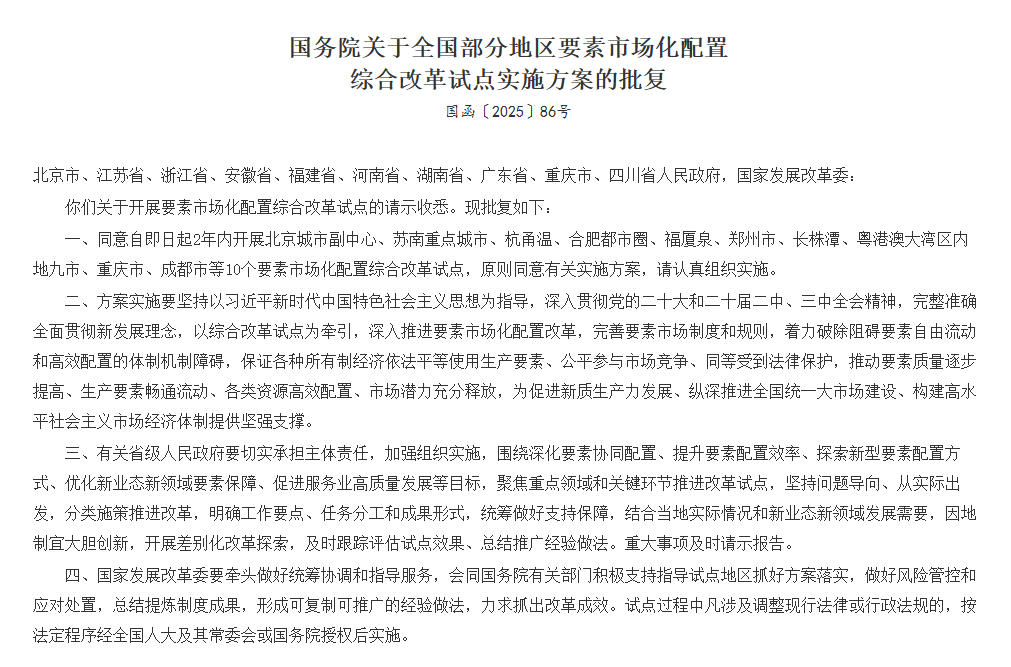
中国政府网9月11日消息,国务院印发《关于全国部分地区要素市场化配置综合改革试点实施方案的批复》,同意自即日起2年内开展北京城市 副中心、苏南重点城市、杭甬温、合肥都市圈、福厦泉、郑州市、长株潭、粤港澳大湾区内地九市、重庆市、成都市等10个要素市场化配置综 合改革试点,原则同意有关实施方案。 图片来源:中国政府网 根据批复,方案实施要完整准确全面贯彻新发展理念,以综合改革试点为牵引,深入推进要素市场化配置改革,完善要素市场制度和规则,着 力破除阻碍要素自由流动和高效配置的体制机制障碍,保证各种所有制经济依法平等使用生产要素、公平参与市场竞争、同等受到法律保护, 推动要素质量逐步提高、生产要素畅通流动、各类资源高效配置、市场潜力充分释放,为促进新质生产力发展、纵深推进全国统一大市场建 设、构建高水平社会主义市场经济体制提供坚强支撑。 批复要求有关省级人民政府要切实承担主体责任,加强组织实施,围绕深化要素协同配置、提升要素配置效率、探索新型要素配置方式、优化 新业态新领域要素保障、促进服务业高质量发展等目标,聚焦重点领域和关键环节推进改革试点,坚持问题导向、从实际出发,分类施策推进 改革,明确工作要点、任务分工和 ...
高质量完成“十四五”规划丨“十四五”期间全国政协共举办各类协商活动279场次
Xin Hua She· 2025-08-18 09:45
Group 1 - The National Committee of the Chinese People's Political Consultative Conference (CPPCC) has held 279 various consultation activities during the "14th Five-Year Plan" period, enhancing the quality of political consultation [1] - A total of 41,043 proposals were filed, with many recommendations being transformed into policy measures [1] - The CPPCC has established 229 institutional documents to improve the institutionalization, standardization, and proceduralization of its consultation and political duties [1] Group 2 - The CPPCC emphasizes the importance of research and investigation, implementing a "research-consultation-research" approach to deeply analyze issues and propose actionable recommendations [2] - A total of 84 in-depth research projects have been conducted on significant strategic and forward-looking topics, resulting in high-quality research outcomes [2] - CPPCC members have conducted 148 learning and research sessions at the units where committee members are located [2]