
高股息资产

Search documents
关键时刻,私募大佬吴伟志发声!
Xin Lang Cai Jing· 2026-01-22 05:35
Core Viewpoint - The current market is characterized by a typical summer bull market feature, with active trading, accelerated sector rotation, and expanding profit effects, but without signs of overall bubble or extreme emotional exuberance, indicating that both time and space have not yet peaked [1][10] Market Characteristics - The A-share market is experiencing a "slow bull" and "long bull" formation, contrasting with previous short bull and long bear trends [6][14] - The Chinese stock market's recent rise is more of a "catch-up" rather than a "bubble" compared to global markets, with the current valuation still at a low level [3][12] Economic Comparison - Compared to Japan's market performance post-1990s, China's economic fundamentals are stronger, with manufacturing advantages significantly surpassing Japan's, and a record trade surplus achieved in 2025 [4][12] - The Chinese economy is showing a better upward trend in new economic sectors like semiconductors and the internet compared to Japan's past performance [4][12] Valuation Insights - As of Q3 2025, the dynamic price-to-earnings ratio of the CSI 300 index is approximately 14 times, significantly lower than the S&P 500 (about 29 times) and the Nasdaq (about 42 times), indicating a valuation gap [5][13] - The A-share market has underperformed global markets, with the Wind All A index down nearly 30% from 2021 to 2024 [5][13] Investment Opportunities - The company identifies five key "hard asset" investment directions: "Technology Innovation+", pharmaceutical and biotechnology, resource supply-side reversal, gold, and high-dividend assets [3][7][15] - "Technology Innovation+" includes internet platform companies returning to reasonable valuations and AI-enabled new business opportunities [7][15] - In pharmaceuticals, innovative drug development is entering a harvest phase, with several biotech firms expected to reach profitability [7][16] - Resource supply-side reversal is driven by a supply gap in key metals due to insufficient capital expenditure over the past five years, alongside growing demand from sectors like new energy and military [7][16] - Gold assets are gaining value as a non-credit asset amid global de-dollarization and ongoing geopolitical conflicts, with potential support for gold prices if the Federal Reserve continues to lower interest rates [8][16] - High-dividend assets in sectors like electricity, telecommunications, and banking provide stable cash flow, serving as a stabilizing component in investment portfolios during volatile market conditions [8][16]

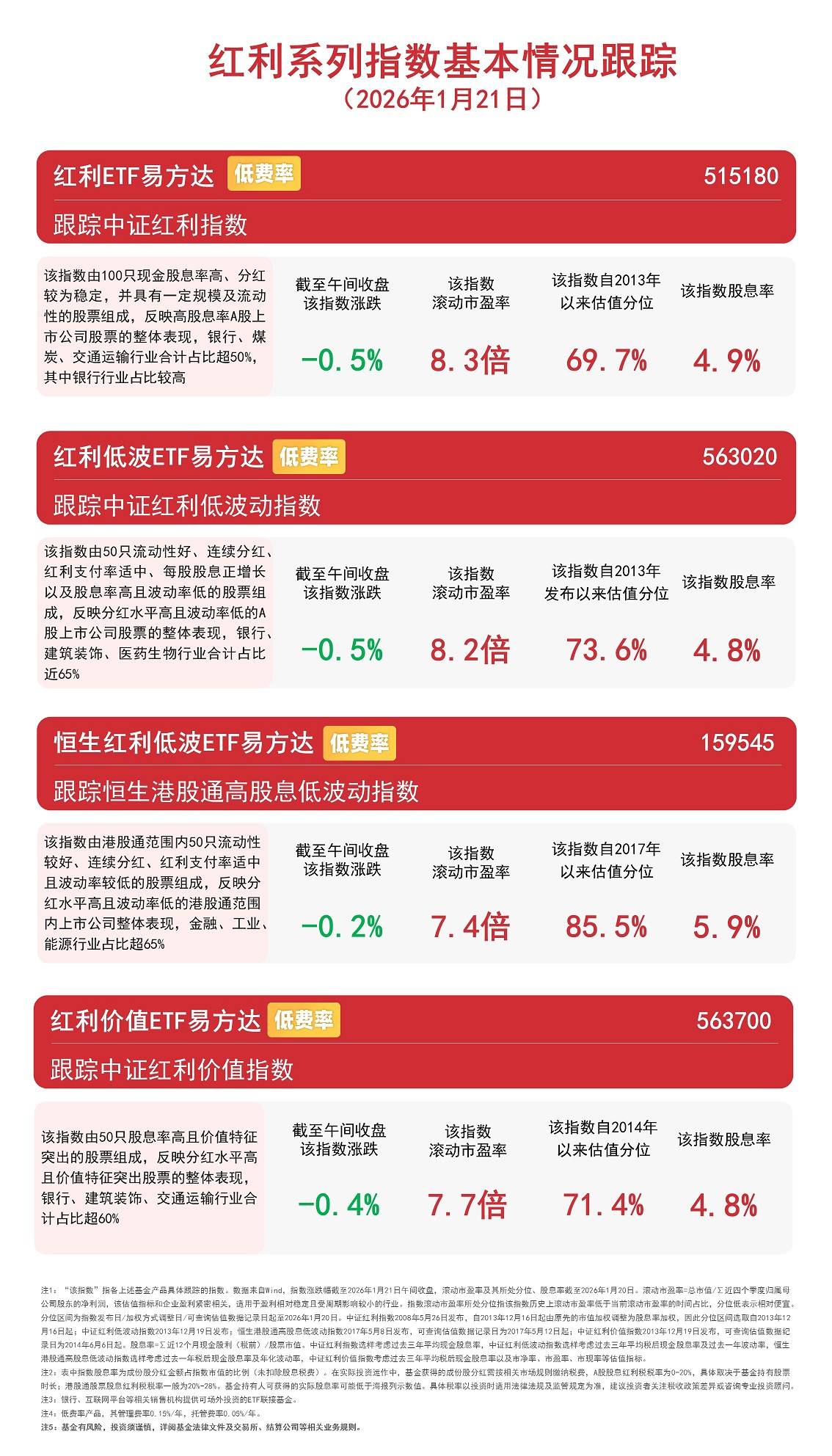
红利板块早盘回调,关注红利ETF易方达(515180)、红利低波ETF易方达(563020)等产品布局机会
Sou Hu Cai Jing· 2026-01-21 05:08
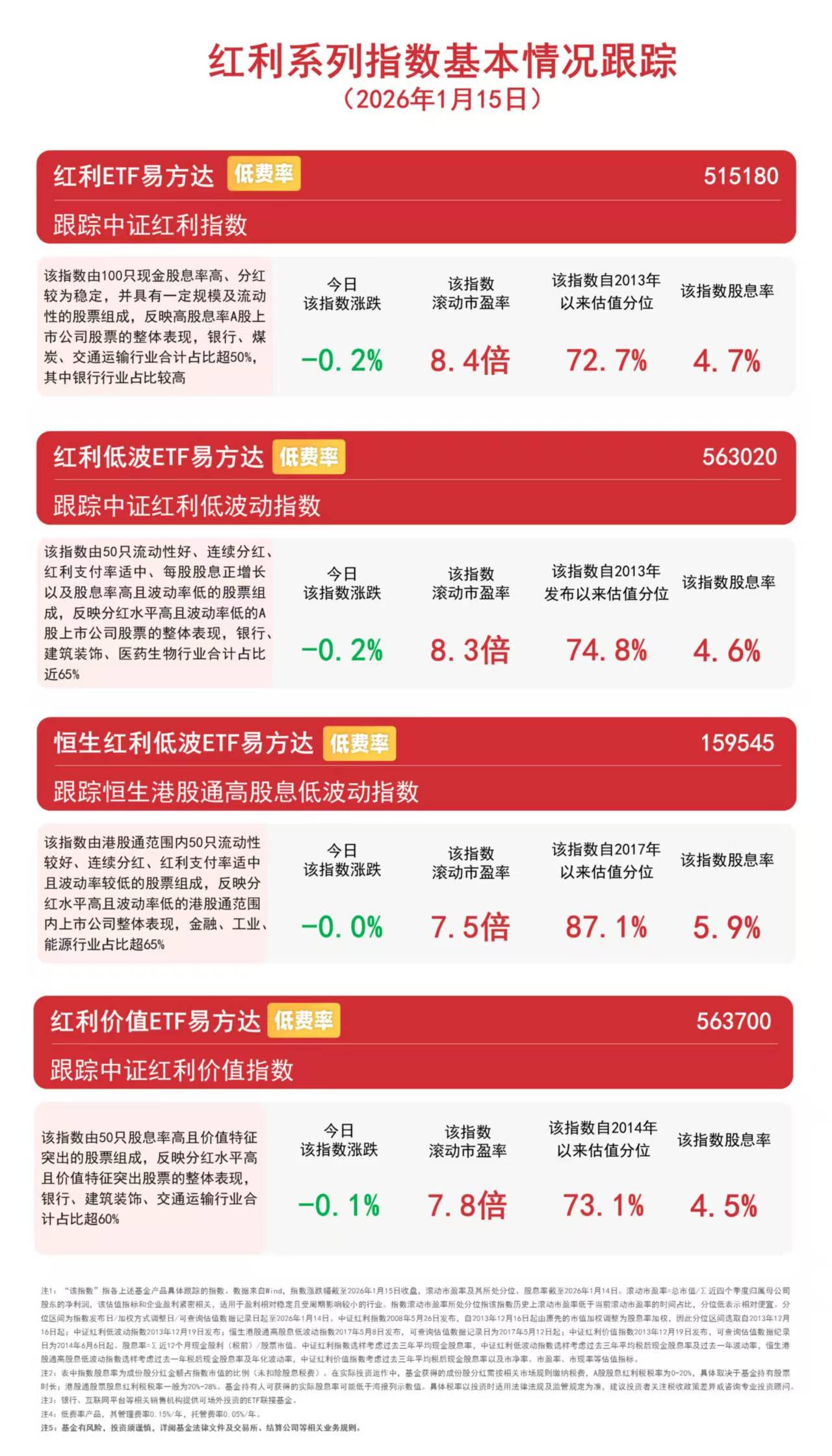
红利板块早盘回调,截至午间收盘,恒生港股通高股息低波动指数下跌0.2%,中证红利价值指数下跌0.4%,中证红利指数、中证红利低波动指数均下跌 0.5%。相关ETF受资金关注,截至昨日,红利低波ETF易方达(563020)已连续37个交易日获资金净流入,合计超20亿元。 据悉,易方达基金是目前唯一一家红利类ETF全部实行低费率的基金公司,旗下恒生红利低波ETF易方达(159545)、红利ETF易方达(515180)、红利低 波ETF易方达(563020)、红利价值ETF易方达(563700)、A500红利低波ETF易方达(563510)等产品的管理费率均为0.15%/年,可助力投资者低成本布 局高股息资产。 | 红利ETF易方达 低费率 | | | | 515180 | | --- | --- | --- | --- | --- | | 跟踪中证红利指数 | | | | | | 该指数由100只现金股息率高、分红 | 截至午间收盘 | 该指数 | 该指数自2013年 | 该指数股息率 | | 较为稳定,并具有一定规模及流动 | 该指数涨跌 | 滚动市盈率 | 以来估值分位 | | | 性的股票组成,反映高股息率 ...
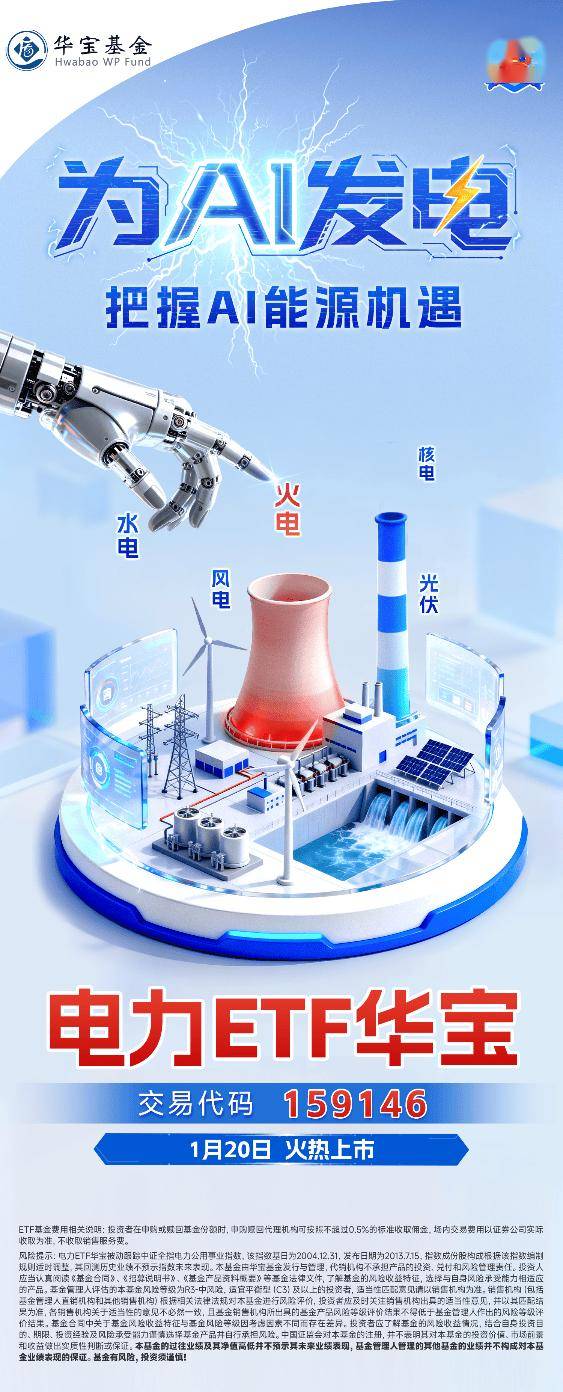
ETF复盘资讯|化工、贵金属逆市爆发!化工ETF(516020)劲涨1.27%续创阶段新高!电力ETF(159146)上市首日开门红!
Sou Hu Cai Jing· 2026-01-20 13:47
Market Overview - Major Asia-Pacific indices showed a collective decline, with the A-share market also experiencing consolidation, as the Shanghai Composite Index fluctuated while the Shenzhen Component and ChiNext indices performed weakly. The total trading volume in Shanghai, Shenzhen, and Beijing reached 2.8 trillion yuan, an increase of 72 billion yuan compared to the previous day [1] Real Estate Sector - The real estate sector rebounded strongly, with a notable increase in the price of a real estate ETF (159707) by 3.22%, marking multiple consecutive gains. According to the National Bureau of Statistics, the sales price of newly built commercial residential properties in first-tier cities decreased by 0.3% month-on-month in December 2025, with Shanghai seeing a slight increase of 0.2% [1] Chemical Sector - The chemical sector experienced a significant rally, with the chemical ETF (516020) reaching a new high since August 2022, closing up 1.27%. Major companies in the sector, such as BASF and Dow, have been raising prices across Europe, Asia, and the Middle East. The ETF attracted 1.148 billion yuan in the last ten days [1][4] - The chemical ETF has seen substantial net inflows, with over 5.8 billion yuan in net subscriptions in the last five trading days and 11 billion yuan in the last ten days. The Ministry of Industry and Information Technology has set guidelines for zero-carbon factory construction, which may limit new capacity in the chemical sector [6][7] Banking Sector - The banking sector showed resilience amid market volatility, with a significant number of bank stocks rising. The top bank ETF (512800) closed up 0.77%, ending a four-day losing streak. Historical data indicates that the banking sector has a high probability of generating absolute and excess returns before the Spring Festival, with an average return of 4.4% from 2017 to 2025 [8][11][14] - The banking sector is expected to benefit from continued growth in credit, supported by stable growth policies and a favorable low-interest-rate environment. The latest dividend yield for the banking index stands at 4.78%, significantly higher than the 10-year government bond yield of 1.84% [14][15] AI and Technology Sector - The AI and technology sectors faced a downturn, with the entrepreneurial AI ETF (159363) experiencing a four-day decline. Despite this, the sector remains attractive for future investments, particularly in light of ongoing developments in AI applications and infrastructure [16][18] - The communication and semiconductor industries are expected to see increased attention due to their potential for earnings upgrades, with significant growth anticipated in the coming years [18][20]





财信证券黄红卫:“降温”稳节奏不改趋势 五大主线锚定2026年投资方向
Zhong Guo Zheng Quan Bao· 2026-01-20 00:33
Group 1 - The A-share market has experienced a strong start in 2026, driven by a combination of market trend continuation, spring market catalysts, and a recovery in overseas markets [1][2] - Recent market fluctuations are attributed to the implementation of counter-cyclical adjustment policies and profit-taking in popular sectors, indicating a healthy adjustment that does not alter the overall upward trend [1][3] - The spring market typically lasts around 57 days, and historical data suggests that A-shares tend to strengthen during this period, supported by liquidity and valuation drivers [2][7] Group 2 - Investment strategies should focus on five main lines for 2026: the artificial intelligence industry chain, high-dividend assets, anti-involution sectors, domestic demand expansion, and resource sectors, all of which have performance support and policy backing [1][7][8] - The AI industry is transitioning, with investment opportunities expected to shift from hardware to application sectors, emphasizing the importance of commercial viability [7] - High-dividend assets remain a stable investment choice, with long-term funds continuing to increase their positions in dividend-paying stocks, which are characterized by stable returns and low volatility [7][8] Group 3 - The anti-involution sectors, including coal, steel, photovoltaic, and lithium battery industries, are expected to see performance improvements due to high state-owned enterprise ratios and market consolidation [7][8] - The expansion of domestic demand should focus on new consumption areas such as health, sports, and travel-related industries, which are poised to benefit from recovering consumer scenarios and policy support [7][8] - Resource sectors, particularly precious metals and strategic minor metals, are anticipated to experience valuation recovery in 2026, presenting potential investment opportunities [8]
“降温”稳节奏不改趋势 五大主线锚定2026年投资方向
Zhong Guo Zheng Quan Bao· 2026-01-19 21:11
Group 1 - The A-share market has shown strong performance at the beginning of 2026, driven by a combination of market trends, seasonal factors, and recovery in overseas markets [1][2] - Recent market fluctuations are attributed to the implementation of counter-cyclical adjustment policies and profit-taking in popular sectors, which are considered healthy adjustments that do not alter the overall upward trend [1][2] - The macroeconomic environment is expected to support five key investment themes for the year: the artificial intelligence industry chain, high-dividend assets, anti-involution sectors, domestic demand expansion, and resource sectors [1][5] Group 2 - The spring market rally is historically supported by liquidity and valuation drivers, typically lasting around 57 days, with the current phase still in its early stages [2] - Positive performance in overseas markets, particularly in Japan and South Korea, has significantly boosted investor sentiment in the A-share market [2] - Recent adjustments in the A-share market, including changes in financing margin ratios, are aimed at curbing excessive leverage and maintaining a stable upward trend [2][3] Group 3 - Investment strategies must adapt to changing market conditions, emphasizing the importance of position management and avoiding excessive leverage [3][4] - Investors are encouraged to develop independent judgment capabilities to avoid speculative traps and focus on fundamental research [3][4] - The market is transitioning from a speculative phase to one driven by fundamentals, with a focus on true technological growth and value [3][4] Group 4 - Four strategic recommendations for the pre-Spring Festival period include maintaining moderate positions, adopting a barbell strategy for asset allocation, focusing on specific technology sectors, and enhancing individual stock fundamental research [4] - The artificial intelligence industry chain is expected to shift towards application opportunities in 2026, with a focus on sectors like media and computing [5] - High-dividend assets remain a stable investment choice, with sectors such as white goods, banking, and utilities providing low volatility and steady returns [5] Group 5 - The anti-involution sector is entering a phase driven by fundamentals, with industries like coal, steel, and lithium batteries expected to see improved performance due to industry consolidation [5] - The expansion of domestic demand should focus on new consumption areas such as health, sports, and travel, which are expected to benefit from policy support [5] - Resource sectors, particularly strategic and industrial metals, are anticipated to experience valuation recovery in 2026, presenting potential investment opportunities [5][6]
财信证券黄红卫: “降温”稳节奏不改趋势 五大主线锚定2026年投资方向
Zhong Guo Zheng Quan Bao· 2026-01-19 21:09
Group 1 - The A-share market has experienced a strong start in 2026, driven by a combination of market trend continuation, spring market catalysts, and a recovery in overseas markets [1][2] - Recent market fluctuations are attributed to the implementation of counter-cyclical adjustment policies and profit-taking in popular sectors, which are seen as a healthy adjustment that does not alter the overall upward trend [1][3] - The spring market typically lasts around 57 days, and historical data suggests that A-shares tend to perform well during this period, particularly in the technology growth sector [2][6] Group 2 - The current market environment necessitates an adjustment in investment logic, transitioning from a valuation recovery phase in 2025 to a profit-driven phase in 2026 [4] - Investors are advised to manage their positions carefully, avoiding excessive leverage and maintaining flexibility to respond to potential market volatility [4][5] - A focus on fundamental analysis is crucial, as the market is shifting from speculation to value, with regulatory measures aimed at guiding funds towards genuine technology and growth opportunities [4][6] Group 3 - Five key investment themes for 2026 have been identified: the artificial intelligence industry chain, high-dividend assets, anti-involution sectors, domestic demand expansion, and resource sectors [6][7] - The AI application sector is expected to present significant investment opportunities as it transitions from hardware to application, with a focus on media, computing, and internet sectors [6] - High-dividend assets remain a stable investment choice, with sectors like white goods, banking, and utilities expected to provide steady returns [6][7] Group 4 - The anti-involution sector is entering a phase driven by fundamentals, with industries like coal, steel, and solar energy expected to see performance improvements due to favorable market conditions [6][7] - The expansion of domestic demand should focus on new consumption areas such as health, sports, and travel, which are anticipated to benefit from recovering consumer spending [6][7] - Resource sectors, particularly strategic and industrial metals, are expected to experience valuation recovery, presenting potential investment highlights [7]
红利板块震荡分化,资金逆势布局,红利低波ETF易方达(563020)本周“吸金”超3亿元
Sou Hu Cai Jing· 2026-01-16 10:44
Core Viewpoint - The Hang Seng High Dividend Low Volatility Index increased by 0.5% this week, while the CSI Dividend Low Volatility Index and CSI Dividend Index both decreased by 1.8% [1][3]. Group 1: Index Performance - The CSI Dividend Index and CSI Dividend Low Volatility Index both experienced a decline of 1.8% and 1.7% respectively this week [3]. - The Hang Seng High Dividend Low Volatility Index recorded a gain of 0.5% [1][3]. - The dividend yield for the CSI Dividend Index is 4.7%, while the CSI Dividend Low Volatility Index has a yield of 4.6%, and the Hang Seng Index has a yield of 6.0% [3]. Group 2: ETF Fund Flows - The E Fund Dividend Low Volatility ETF (563020) saw a net inflow of over 300 million yuan in the first four trading days of the week [1]. - E Fund is currently the only fund company that implements low fee rates for all its dividend ETFs, with a management fee rate of 0.15% per year for its various products [1][4]. Group 3: Index Composition - The CSI Dividend Index consists of 100 stocks with high cash dividend rates and stable dividends, with over 50% representation from the banking, coal, and transportation sectors [4]. - The CSI Dividend Low Volatility Index is composed of 50 stocks with good liquidity and continuous dividends, with over 60% representation from the banking, coal, and transportation sectors [4]. - The Hang Seng High Dividend Low Volatility Index includes 50 stocks within the Hong Kong Stock Connect that have good liquidity and low volatility, with over 60% representation from the financial, real estate, and energy sectors [4].

红利板块小幅回调,红利ETF易方达(515180)、红利低波ETF易方达(563020)受资金关注
Sou Hu Cai Jing· 2026-01-15 11:18
Core Viewpoint - The dividend sector experienced a slight decline today, with various indices reflecting a decrease in performance, while the E Fund dividend ETFs saw significant net inflows [1][4]. Group 1: Market Performance - The Hang Seng High Dividend Low Volatility Index fell by 0.01%, the CSI Dividend Value Index decreased by 0.1%, and both the CSI Dividend Index and CSI Dividend Low Volatility Index dropped by 0.2% [1]. - E Fund's dividend ETFs, including E Fund Dividend ETF (515180) and E Fund Low Volatility Dividend ETF (563020), received over 100 million yuan in net inflows yesterday [1]. Group 2: Fund Management and Fees - E Fund is currently the only fund company offering all dividend ETFs at a low fee rate of 0.15% per year, which aids investors in low-cost allocation to high-dividend assets [1][5]. - The management fee for E Fund's various dividend ETFs, including the Hang Seng Low Volatility Dividend ETF (159545), is set at 0.15% per year, with a custody fee of 0.05% per year [5]. Group 3: Index Composition - The CSI Dividend Index consists of 100 stocks with high cash dividend yields and stable performance, with banking, coal, and transportation sectors accounting for over 50% of the index [3]. - The CSI Low Volatility Dividend Index is composed of 50 stocks characterized by good liquidity, continuous dividends, and low volatility, with banking, construction, and pharmaceutical sectors making up nearly 65% of the index [3]. - The CSI Dividend Value Index includes 50 stocks with high dividend yields and value characteristics, with banking, construction, and transportation sectors representing over 60% of the index [4].
两大人气板块,集体退潮!
Zhong Guo Zheng Quan Bao· 2026-01-15 04:33
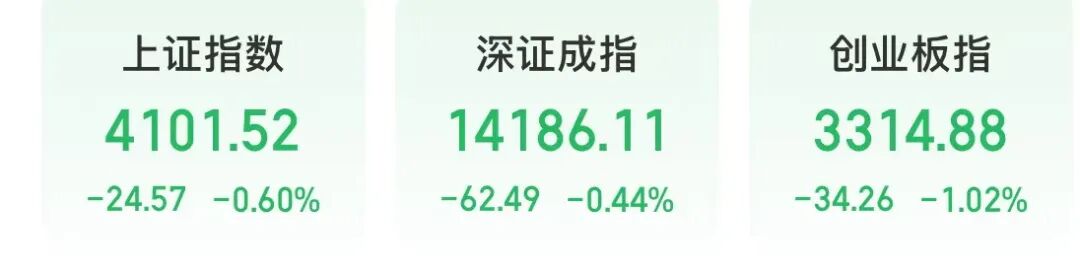
今天上午,AI应用、商业航天两大人气板块双双大跌,在个股跌幅榜前列,几乎都是相关概念股,其中,天龙集团(300063)、值得买(300785)、光 云科技等个股"20CM"跌停。有色金属、化工板块上涨。 多只宽基ETF上午显著放量,其中,沪深300ETF华泰柏瑞(510300)、上证50ETF(510050)、科创50ETF易方达(588080)、沪深300ETF易方达 (510310)上午成交额均超过昨日全天的成交额。沪深300ETF华泰柏瑞(510300)上午成交额为125.2亿元。 截至上午收盘,上证指数下跌0.6%,深证成指下跌0.44%,创业板指下跌1.02%。 有色金属板块上涨 今天上午,有色金属板块上涨,贵金属、能源金属、工业金属等板块涨幅居前。洛阳钼业(603993)、华锡有色(600301)、中钨高新(000657)、厦门 钨业(600549)等个股盘中股价创历史新高。 | | V | 工业等属 4772.77 1.89% | | | | --- | --- | --- | --- | --- | | 成分股 | 基金 | 简况(F10) | 资金 | 板块分析 | | 名称代码 | | 最 ...
高股息的“常青密码”,红利指数调仓揭秘
Zhong Guo Zheng Quan Bao· 2026-01-14 13:05
Group 1 - The core idea of the news is that the dividend index acts as a "financial gardener," pruning low dividend yield stocks and incorporating high dividend yield stocks to maintain a focus on quality assets with high dividends [1] - The annual adjustment of the dividend index, represented by indices like the CSI Dividend Index and CSI Low Volatility Dividend Index, ensures that it consistently targets companies with strong dividend capabilities rather than being constrained by historical performance [1] - The appeal of the dividend index lies not in the industries it includes, but in its unwavering commitment to high dividends, providing investors with a reliable investment tool that adapts to market conditions [1] Group 2 - In a low interest rate environment, investors are increasingly focused on tangible returns, and the dividend index offers a simple, effective, and reliable investment tool through strict dividend yield screening and dynamic adjustment mechanisms [2] - E Fund has a comprehensive product line for dividend indices, including various ETFs that cover different styles of high dividend assets, such as E Fund Dividend ETF and E Fund Low Volatility Dividend ETF [2] - E Fund is noted as the only company in the market that implements low fee rates for all its dividend ETFs, with a management fee rate of 0.15% per year, facilitating low-cost access to high dividend investment opportunities for investors [2]