
低估值

Search documents
晶苑国际(02232):业绩稳健兑现,低估值、高股息优质制造
Changjiang Securities· 2026-03-30 23:30
Investment Rating - The report maintains a "Buy" rating for the company [2][6]. Core Insights - The company is one of the few multi-category manufacturers in the industry, with healthier inventory in leisure categories and partnerships with Uniqlo and sports clients driving new growth phases. The establishment of a factory in Egypt strengthens long-term alpha [2]. - The company is expected to achieve a net profit of $240 million, $270 million, and $300 million for the years 2026, 2027, and 2028, respectively, with year-on-year growth rates of +9%, +12%, and +11%. The corresponding P/E ratios are projected to be 9, 8, and 8X. Assuming a 60% minimum dividend payout ratio, the estimated dividend yield for 2026 is 6.4% [2]. Financial Performance - In 2025, the company achieved revenue of $2.641 billion, a year-on-year increase of 6.9%, and a net profit of $225 million, up 12.0%. For the second half of 2025, revenue was $1.41 billion, with a year-on-year increase of 2.6%, and net profit was $130 million, up 8.5% [4]. - The company declared a final dividend of 24.5 HK cents per share, with a total annual dividend amounting to $150 million, resulting in a dividend payout ratio of 66% [4]. Revenue and Profitability Analysis - The company experienced steady revenue growth, with the second half of 2025 showing a slowdown in growth due to capacity constraints. Revenue growth rates for various categories in the second half were +4% for leisure, +4% for outdoor sports, -1% for denim, +5% for underwear, and +1% for sweaters [8]. - The gross margin improved to 20.1% in the second half of 2025, a year-on-year increase of 0.2 percentage points, driven by automation upgrades and optimized order structures. The net profit margin for the year was 8.5%, reflecting a year-on-year increase of 0.4 percentage points [8].
政策预期反复叠加估值偏低,今日多晶硅价格回升-20260330
Zhong Xin Qi Huo· 2026-03-30 12:07
Group 1: Report Industry Investment Rating - Not provided Group 2: Core Viewpoints - Today, the polysilicon price rebounded due to repeated policy expectations and low valuations. The price of the main contract rose 3.45% to 8,550 yuan/ton, driven by policy - end guidance. The "anti - involution" policy expectations are still there [2][3]. - In the short term, the polysilicon price is expected to continue to fluctuate within the cost range under the pattern of repeated policy expectations and weak demand. In the medium term, attention should be paid to policy orientation and the progress of supply going overseas. If production cuts continue, the supply - demand pattern is expected to improve marginally. In the long - term, the price of polysilicon will maintain a wide - range oscillation pattern [5]. Group 3: Summary by Relevant Catalogs Latest Dynamics and Reasons - The price of the main contract of polysilicon rose 3.45% to 8,550 yuan/ton today, mainly driven by policy - end. The National Development and Reform Commission and the State Administration for Market Regulation's statements on preventing disorderly and "involution - type" competition in the photovoltaic and new - energy vehicle fields formed an echo, promoting the price rebound [3]. Fundamental Situation - Supply side: Under the pressure of high inventory, most silicon - material enterprises are still in a state of production reduction. Although some enterprises have the willingness to resume production, the overall output of polysilicon in April is expected to remain at a low level [4]. - Demand side: Affected by weak terminal demand and the off - season at the beginning of the year, the production and operating rates of silicon wafers declined from January to February. In March, silicon - wafer production was boosted by the "export rush" window, but it is difficult to significantly increase in April. The overall production of battery cells and components is low, and downstream demand is still weak [4]. - Inventory: The inventory pressure of polysilicon is still large. Although the upstream has alleviated the supply through production reduction and control, the inventory accumulated over the years has not been significantly reduced, and it still takes time to consume inventory and ship the supply [4]. Summary and Strategy - Summary: The polysilicon price has fallen significantly in the early stage and is currently in a low - valuation range. In the short term, it will fluctuate within the cost range; in the medium and long - term, it will maintain a wide - range oscillation pattern [5]. - Strategy: For downstream industrial enterprises, they can make appropriate low - price purchases. For unilateral operations, it is recommended to wait and see for now [5].
A股回调,抄底资金涌入四大主线
21世纪经济报道· 2026-03-27 15:13
Core Viewpoint - The A-share market has experienced a significant pullback since March 12, with major indices like the Shanghai Composite Index and Shenzhen Component Index declining by approximately 5.91% and 5.94% respectively by March 26. Despite the downturn, there is a notable shift in fund allocation, with a trend towards risk aversion and a reallocation of assets into safer investments like money market and bond ETFs [1][3]. Group 1: Market Trends - The overall market ETF shares decreased by about 4 billion units, a decline of approximately 0.12%, with stock ETFs facing a net redemption of 11.9 billion units. Conversely, money market ETFs saw a net inflow of 2.2 billion units, and passive index bond ETFs increased by 300 million units, indicating a clear trend towards risk aversion [3]. - Over 200 ETFs experienced net subscriptions during the same period, highlighting a selective investment strategy amidst the broader market decline [3]. Group 2: Investment Focus Areas - Four main areas have emerged as focal points for fund inflows: 1. **Bond ETFs**: These are favored for their defensive characteristics, with short-term bond ETFs receiving a net inflow of 11.261 billion yuan, leading the pack [3]. 2. **Broad-based Indices**: Core assets like the CSI 300 and SSE Composite Index ETFs saw net inflows of 9.952 billion yuan and 4.699 billion yuan respectively, indicating continued confidence in large-cap stocks [4]. 3. **Sector and Theme Investments**: A "barbell" strategy is evident, with funds flowing into both growth sectors like new energy batteries (+2.145 billion yuan) and defensive high-dividend strategies like the CSI Dividend Index (+2.056 billion yuan) [6]. 4. **QDII Funds**: International stock ETFs, particularly those linked to Chinese technology assets, saw a net subscription of 6.8 billion units, reflecting long-term confidence in Chinese core tech assets [7]. Group 3: Market Outlook - Analysts suggest that the current market pullback is characterized by a focus on safety, low valuations, and certainty. Key asset categories attracting bottom-fishing capital include high-dividend defensive sectors, low-priced energy and cyclical assets, and reasonably valued growth leaders like semiconductors and innovative pharmaceuticals [9][10]. - The market is expected to remain in a phase of oscillation, with structural opportunities emerging as the focus shifts from speculative trading to a balance of undervalued value and high-quality growth [10].


持仓观望?
第一财经· 2026-03-13 10:38
Market Overview - The A-share market indices are experiencing a volatile adjustment pattern, with the Shanghai Composite Index dipping to 4086.85 points before rebounding, driven by sectors like infrastructure and wind power, but facing pressure again towards the end of trading [3] - The Shenzhen Component Index weakened due to the drag from technology and new energy sectors, while the ChiNext Index saw a narrower decline supported by lithium battery materials [3] Sector Performance - There is a clear divergence in stock performance, with more stocks declining than rising. The cyclical and defensive infrastructure sectors are the main market drivers, with wind power equipment, chemicals, fertilizers, home appliances, and construction decoration leading the gains. In contrast, previously strong technology growth sectors like AI computing, semiconductor equipment, solar energy, and commercial aerospace are collectively weakening [5] Trading Volume and Capital Flow - The trading volume in both markets has slightly decreased, indicating a state of existing capital adjustment and competition. The capital structure shows a shift from high-valuation technology growth sectors to low-valuation cyclical and defensive sectors, with an increased proportion of trading volume in the Shanghai market, highlighting a growing risk aversion among investors [6] Institutional and Retail Investor Behavior - Institutional investors are clearly shifting their positions, moving funds from high-volatility growth sectors to low-valuation, high-dividend, and performance-stable defensive sectors. They are taking profits in computing, electronics, communications, media, and new energy, while increasing positions in power equipment, basic chemicals, coal, oil and petrochemicals, and banks. Retail investors are also adjusting their positions in line with market style changes, chasing high-priced precious metals and state-owned enterprises while selling off AI and semiconductor sectors that are experiencing corrections [8]

A股“三好生”,名单来了
财联社· 2026-03-05 11:11
Core Viewpoint - The article highlights the impressive performance of companies in the A-share market for the year 2025, with a focus on those showing significant profit growth and favorable valuation metrics, indicating potential investment opportunities. Group 1: High Growth Companies - As of March 4, 2025, nearly 1,050 companies have disclosed their annual reports or performance forecasts, with notable high-growth stocks including Yuanjie Technology, Sainuo Medical, Huafeng Technology, Shibibai, and Hongquan Technology, all showing over 10-fold year-on-year growth in net profit attributable to shareholders [1]. - A selection of 23 stocks has been identified with a year-on-year net profit growth exceeding 20% and a price-to-earnings (P/E) ratio below 20 times, including Zhongyou Technology, Zhongke Lanyun, SanSheng Guojian, Bingchuan Network, Chenguang Biological, and Honglida, all demonstrating growth rates above 100% [1]. Group 2: Low Valuation in Cyclical and Financial Sectors - Within the cyclical and large financial sectors, 12 stocks have been identified with a year-on-year net profit growth exceeding 20% and profitability in 2025, with price-to-book (P/B) ratios below 2 times, including Qingdao Bank, Tianye Co., Lier Chemical, Jinlongyu, and Jiuri New Materials [1][5]. Group 3: High Dividend Stocks - Among companies that achieved positive net profit and year-on-year growth in 2025, 15 stocks currently offer a dividend yield exceeding 4%, with notable mentions including Industrial Bank, China Merchants Bank, Jiangsu Guotai, Meino Energy, and Sunong Bank [1][9]. Group 4: Top 20 Growth Stocks - The top 20 stocks by net profit growth include Yuanjie Technology with a 3,212.62% increase, Sainuo Medical at 3,057.06%, and Huafeng Technology at 2,128.18%, showcasing significant growth in various sectors [3]. Group 5: Top 20 by Market Capitalization - The top 20 stocks by market capitalization with notable performance include China Merchants Bank with a net profit growth of 1.21% and a total market cap of 9,895.10 billion, and Changjiang Electric Power with a 5.14% growth and a market cap of 6,628.44 billion [4]. Group 6: High Growth and Low Valuation - A list of stocks with over 20% growth and a P/E ratio below 20 includes Zhongyou Technology with a 525.68% growth and a P/E of 12.83, Zhongke Lanyun with 371.91% growth and a P/E of 10.98, and SanSheng Guojian with 317.09% growth and a P/E of 11.76 [7][8]. Group 7: High Dividend Yield and Positive Growth - The top 20 stocks with positive growth and high dividend yields include Industrial Bank with a yield of 8.96% and a growth of 0.34%, China Merchants Bank with a yield of 7.81% and a growth of 1.21%, and Jiangsu Guotai with a yield of 5.37% and a growth of 17.05% [10].




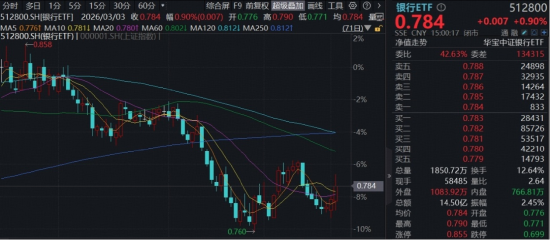
A股开启避险模式,银行强势反弹!农业银行涨近4%,规模最大银行ETF(512800)放量上探1.6%
Xin Lang Cai Jing· 2026-03-03 11:30
Core Viewpoint - The intensification of geopolitical conflicts has led to a rise in global risk aversion, resulting in a strong performance of bank stocks, with the largest bank ETF (512800) seeing a price increase of 1.67% at one point and closing up 0.9% [1][9] Group 1: Market Performance - The bank ETF (512800) recorded a trading volume of 1.45 billion yuan, the highest since December 2025 [1][9] - Major state-owned banks experienced significant gains, with Agricultural Bank rising nearly 4%, and others like Bank of Communications, Industrial and Commercial Bank, China Construction Bank, and Bank of China increasing over 2% [1][9] - Some regional banks also showed strong performance, with Chongqing Bank rising over 5% and Yunnan Rural Commercial Bank increasing over 3% [1][9] Group 2: Fund Flows and Investment Appeal - Net buying in the banking sector reached 5.334 billion yuan, making it the second highest among primary industries, following oil and transportation [3][11] - The strength of bank stocks is attributed to their "dividend + defensive" asset characteristics, as geopolitical risks have heightened market risk aversion [3][11] - As of March 3, 22 out of 42 A-share bank stocks had dividend yields exceeding 4.5%, with the overall dividend yield of the China Securities Bank Index at 4.74% and a price-to-book ratio of only 0.64 [3][11][12] Group 3: Historical Performance - The China Securities Bank Index has shown a cumulative return of 660.32% since 2005, significantly outperforming major indices like the Shanghai Composite Index and CSI 300 [4][12] - The index's performance over the last five years includes a return of 6.79% in 2025 and 34.71% in 2024, while it faced declines in 2023, 2022, and 2021 [4][13] Group 4: Investment Tools - The bank ETF (512800) and its linked funds are efficient investment tools that track the overall performance of the banking sector, with the ETF's latest scale exceeding 11 billion yuan and an average daily trading volume of over 800 million yuan since 2025 [5][14][6]




银行ETF鹏华(512730)红盘向上,机构称银行板块进入“春播”时间窗口
Xin Lang Cai Jing· 2026-02-26 02:05
Group 1 - After the Spring Festival, idle funds from residents are concentrated into investment opportunities, leading to a new wave of layout in the bank wealth management market [1] - Multiple wealth management companies are launching various products to attract post-holiday funds, initiating a "customer acquisition battle" [1] - According to Everbright Securities, the banking sector is entering a "spring sowing" window, with stable operating performance expected in the upcoming March financial report season [1] Group 2 - The operating indicators for commercial banks in Q4 2025 and preliminary performance reports from listed banks indicate a marginal easing of net interest margin pressure, with stable operating performance expected for 2025 [1] - The credit growth at the beginning of 2026 is relatively moderate, but the overall expansion will maintain a certain strength, supported by easing net interest margin pressure and a potential recovery in fee income [1] - The estimated revenue growth rate for listed banks in 2026 has been slightly revised upward to around 2% [1] Group 3 - In economically developed regions, high-quality small and medium-sized banks are experiencing higher credit demand and stronger profitability [1] - The banking sector's "high dividend, low valuation" characteristics are becoming more prominent, with the upcoming "Two Sessions" expected to improve market expectations [1] Group 4 - As of February 26, 2026, the CSI Bank Index (399986) rose by 0.31%, with notable increases in stocks such as Minsheng Bank (up 1.03%) and Jiangsu Bank (up 0.97%) [2] - The Penghua Bank ETF (512730) closely tracks the CSI Bank Index and provides investors with analytical tools reflecting the overall performance of different industry companies [2] - As of January 30, 2026, the top ten weighted stocks in the CSI Bank Index account for 64.19% of the index, including major banks like China Merchants Bank and Industrial and Commercial Bank of China [2]
咋滴?跌入“技术性熊市”的恒生科技,也成了老登?
Xin Lang Cai Jing· 2026-02-26 00:11
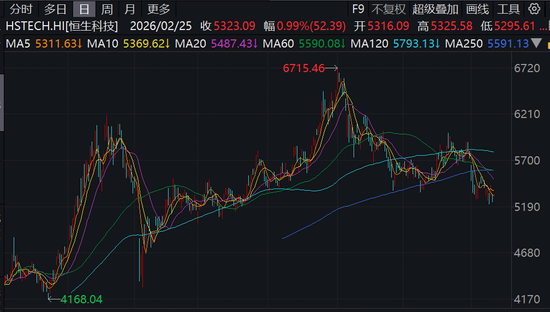
Core Viewpoint - The article discusses the performance and challenges faced by the Hang Seng Technology Index, highlighting a significant decline of nearly 20% since its peak in October last year, and its underperformance compared to global asset classes in 2026 [1][9]. Group 1: Market Performance - The Hang Seng Technology Index has seen a continuous decline of nearly 20% since its peak in October 2022, with its performance in 2026 being among the worst globally [1][9]. - The index is characterized by a high concentration of its top ten stocks, which account for 70% of its weight, making it sensitive to price movements of major companies like Alibaba, Meituan, Xiaomi, and Tencent [3][11]. Group 2: Internal and External Challenges - Internal challenges include outdated marketing strategies and declining sales in sectors like electric vehicles, leading to significant losses for companies like Meituan and Alibaba, which have negatively impacted market confidence [5][13]. - External challenges stem from competition with ByteDance's Seedance 2.0, which has been perceived as a threat to nearly 40% of the index's weighted stocks, leading to the characterization of the Hang Seng Technology Index as a "victim alliance" of ByteDance [5][14]. Group 3: Valuation and Investment Potential - Despite the challenges, the Hang Seng Technology Index is currently trading at a dynamic price-to-earnings ratio of 22, which is relatively low compared to other markets, indicating potential undervaluation [6][15]. - The index's valuation is at the 24th percentile of its historical range over the past decade, suggesting it may be an attractive investment opportunity as market conditions improve [6][16].
海螺水泥将获控股股东增持
Zheng Quan Ri Bao Wang· 2026-02-25 05:28
Group 1 - The controlling shareholder, Anhui Conch Group, plans to increase its stake in Anhui Conch Cement by investing between 700 million and 1.4 billion yuan over the next six months [1] - As of the announcement date, Anhui Conch Group holds 1.929 billion A-shares, accounting for 36.4% of the company's total share capital [1] - The increase will be executed through the Shanghai Stock Exchange trading system without a specific price range, depending on stock price fluctuations and overall market trends [1] Group 2 - Anhui Conch Group has committed not to reduce its shareholding during the implementation of the buyback plan, signaling long-term holding and shared development [2] - The current market valuation of Anhui Conch Cement is considered low, and the buyback plan is seen as a positive signal for investors [2] - The company reported a revenue of 61.298 billion yuan and a net profit of 6.305 billion yuan for the first three quarters of 2025, representing a year-on-year growth of 21.28% [2] Group 3 - The cement industry is experiencing an improvement in supply-demand dynamics due to increased national infrastructure investment, benefiting leading companies [2] - The overall cash flow of cement assets is favorable, with expectations for industry profit recovery by 2026, leading to increased shareholder dividend returns [2]
康华医疗股价横盘整理,高股息率与低估值引关注
Xin Lang Cai Jing· 2026-02-23 11:57
Group 1: Market Performance - The stock of Kanghua Medical (03689.HK) has shown a stagnant performance recently, with no price fluctuations recorded on February 20 and February 23, remaining at HKD 1.70, and trading volume and turnover both at zero [1] - Over the past five days and year-to-date, the stock has experienced a price change of 0.00% and -1.73% respectively, while its sector, medical and aesthetic services, increased by 2.06%, and the Hang Seng Index rose by 2.53%, indicating a divergence from both the sector and the broader market [1] Group 2: Financial Metrics - As of February 23, the company's price-to-earnings ratio (TTM) stands at 6.77 times, and the price-to-book ratio is at 0.36 times, both of which are considered low [2] - The dividend yield is notably high at 9.41%, which is attractive in the current market environment, reflecting the market's assessment of the company's value [2] Group 3: Technical Indicators - Technical indicators suggest a slight improvement in short-term momentum, although overall signals remain weak; the MACD indicator on February 23 shows a divergence value of -0.017, still below the signal line of -0.024, but the histogram has turned positive at 0.013, indicating a slowdown in downward momentum [3] - The stock price is currently near the middle band of the Bollinger Bands (HKD 1.693), with the upper and lower bands narrowing, indicating a typical low-volatility consolidation pattern [3] - Overall, Kanghua Medical lacks significant trading activity and price catalysts, with market focus likely on its high dividend yield and low valuation characteristics while awaiting new business or financial information to disrupt the current equilibrium [3]