Meme股

Search documents
特朗普盛赞“悉尼妹”争议广告 美鹰服饰(AEO.US)秒变Meme股创25年最大涨幅
智通财经网· 2025-08-04 23:25
Group 1 - The core point of the article highlights that American Eagle Outfitters (AEO.US) experienced its largest single-day stock price increase since 2000, driven by President Trump's praise of the company's advertising campaign featuring actress Sydney Sweeney, which led to a 24% surge in stock price [1] - The stock's significant rise has attracted retail investors, characteristic of "Meme stocks," which are typically driven by market hype rather than fundamental performance [1][2] - Analysts suggest that the true test for American Eagle Outfitters will come during the back-to-school season, as actual sales performance will be critical to assess the effectiveness of the marketing campaign [1][3] Group 2 - Some traders believe that the increased media attention could translate into actual sales, but analysts caution that such speculation alone cannot justify the stock's volatility [2] - The company has not yet responded to requests for comments regarding the stock surge and its implications [3] - Historical examples indicate that while celebrity endorsements can lead to short-term stock price increases, the long-term effects may not be sustainable, as seen with other brands like Crocs [3]

美股散户投机泡沫重现?这次可能有所不同
Hua Er Jie Jian Wen· 2025-08-01 12:01
Group 1 - The resurgence of meme stocks has ignited retail investor speculation in July, raising concerns about market bubbles, but analysts believe the spillover effects on the overall market are relatively limited [1] - Current speculative activities are primarily focused on small-cap and low-priced stocks, with minimal impact on major indices like the S&P 500, unlike the meme stock frenzy of 2021 led by GameStop and AMC [1][3] - Historical experiences indicate that such speculative bubbles typically do not affect the broader market significantly when they burst [3] Group 2 - July's market was characterized by a frenzy for low-priced stocks, with the bottom decile of stocks seeing a median price increase of 16% by July 23, compared to just 1.4% for the highest-priced stocks [2] - The investment logic based on stock price rather than company fundamentals is viewed as absurd by institutional investors, as companies can easily alter stock prices through stock splits without affecting shareholder equity [2] - Retail investors either do not understand or choose to ignore the fundamental principles, leading to significant price drops in the cheapest stocks when the speculative trend reversed at the end of July, with declines reaching 6% [2] Group 3 - Concerns about capital misallocation arise from excessive speculation, with the 2021 meme stock craze serving as a clear example of this issue [3] - The current speculative activities are limited in scope, with no low-priced stocks present in the S&P 500, and cheaper stocks among large companies showing no significant performance patterns in July [3] - Historical patterns indicate that the bursting of bubbles in sectors like green stocks, SPACs, and loss-making tech stocks in 2021 had minimal impact on the broader market [3] Group 4 - Investor sentiment has become more rational, with current levels of optimism not reaching excessive heights, as indicated by surveys from the American Association of Individual Investors and Investors Intelligence [4] - Analysts estimate that retail investors may have contributed to the rise of the S&P 500 index since April, but their influence in July was relatively limited [4] - The new wave of meme stocks, referred to as DORK stocks, represents a public manifestation of private trader speculation during the summer, with limited spillover effects on the rest of the market [4]
基金经理解读:这就是“Meme股”再度浮出水面的原因
Jin Shi Shu Ju· 2025-07-31 14:10
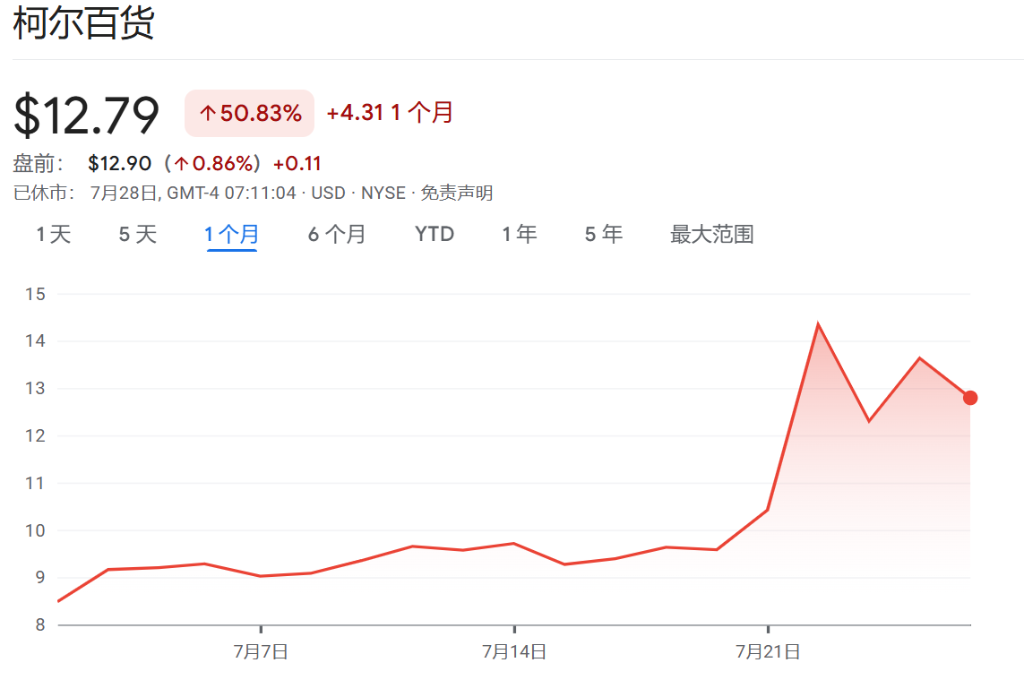
Core Insights - The recent resurgence of meme stocks indicates that the driving factors behind this phenomenon have never truly faded since the initial explosion in 2021 [1] - Several heavily shorted stocks, including Opendoor Technologies, Kohl's, and Krispy Kreme, experienced significant price increases last week, with Opendoor's stock soaring over 120% [1] - The Leuthold Group's analysis suggests that the behavior of retail investors has permanently changed due to easier access to markets and online platforms [2] Group 1 - The performance gap of the 50 most shorted stocks has reached +10% or more in five months since early 2021, indicating a persistent trend [1] - The short interest percentages for Opendoor, Kohl's, and Krispy Kreme are 21.9%, 46.3%, and 27.5% respectively, highlighting the significant short positions in these stocks [2] - The term "diamond hands" refers to investors who hold onto their positions despite risks, while "jelly hands" describes those who may sell under pressure [2] Group 2 - The Leuthold Group does not engage in shorting stocks with excessively high short positions, emphasizing a cautious approach in volatile markets [3] - Historical data shows that prior to 2020, only two months had performance gaps of +10% or more among heavily shorted stocks, underscoring the shift in market dynamics [2] - The report suggests that while some stocks attract significant attention, not all short-sellers will profit, as evidenced by the underperformance of the most shorted stocks in 14 months post-January 2021 [2]
美股散户狂欢背后,华尔街空头本月损失25亿美元
Hua Er Jie Jian Wen· 2025-07-28 11:35
Group 1 - Retail investors are significantly impacting the stock market, particularly in "Meme stocks," leading to substantial losses for short sellers, with a reported loss of $2.5 billion in July alone for the 50 most shorted stocks [1] - The stocks with the highest short interest have seen a record nine consecutive weeks of gains, accumulating a 33% increase during this period, which is significantly higher than the 10% returns of the Russell 3000 and S&P 500 indices [4] - Retail investor confidence is rising, as evidenced by increased net buying of companies like Opendoor Technologies Inc. and Krispy Kreme Inc., along with a rise in trading frequency [4] Group 2 - Analysts suggest that retail enthusiasm may persist despite upcoming key events, including the end of the Trump tariff suspension and the Federal Reserve's monetary policy decision [4] - The combination of retail buying pressure and hedge funds holding positions on both sides of these stocks is likely to increase volatility and potential returns [4] - There are no signs of the retail investor trend slowing down, as stated by Vanda Research's senior vice president [5]

标普500指数频创新高,华尔街分析师未对美股看涨情绪达成共识
Huan Qiu Wang· 2025-07-27 01:31
Group 1 - The S&P 500 index reached both intraday and closing historical highs on July 25, with a 1.46% increase from July 21 to 25, marking five consecutive record closes [1] - Analyst Barry Bannister from Stifel predicts potential turmoil in the U.S. stock market in the second half of 2025, setting a year-end target for the S&P 500 at 5500 points, indicating a potential decline of about 14% from current levels due to high valuations and possible economic slowdown [1] - Julian Emanuel from Evercore ISI expresses caution regarding the recent stock market rally, linking it to historical patterns of heightened market activity and investor FOMO at the end of structural bull markets, with a year-end target for the S&P 500 at 5600 points [3] Group 2 - Andrew Tyler from JPMorgan highlights that despite mixed bullish sentiment, recent trade agreements, positive economic data, and a revival in merger activity are likely to continue supporting stock market gains [3] - Rob Arnott from Research Affiliates notes that the S&P 500's valuation metrics are near historical highs, comparing the investment in leading tech stocks to "picking up money in front of a steamroller" [3] - Arnott also points out that while the market prices AI companies as if they will face no competition, there is a cautious sentiment towards exiting popular and potentially overvalued stocks, as early exit can lead to losses [4]

DORK--美股“最闪耀”的名词
Hua Er Jie Jian Wen· 2025-07-26 06:57
Core Viewpoint - The DORK meme stocks, representing a new wave of retail speculation, have shown significant volatility, with initial surges followed by sharp declines, indicating a speculative bubble rather than a reflection of strong fundamentals [1][2]. Group 1: DORK Meme Stocks Performance - DORK stocks, including Opendoor, Kohl's, Krispy Kreme, and GoPro, experienced dramatic price movements, with Opendoor rising 43% and GoPro soaring 73% before facing declines of over 20% and 14% respectively [1][2]. - Retail investors have shown a strong speculative interest, with net purchases of $155.3 billion in stocks in the first half of the year, the highest in at least a decade [1]. Group 2: Financial Performance of DORK Stocks - The financial performance of DORK stocks is generally weak, with Opendoor reporting a 26% year-over-year revenue decline and a net loss of $392 million, while GoPro saw a 20% revenue drop and a net loss of $432 million [2]. - Analysts describe these companies as fundamentally impaired, indicating that the current trading behavior is driven more by speculation than by financial health [2]. Group 3: Market Dynamics and Retail Investor Behavior - The DORK phenomenon marks a shift in meme stocks from a rebellious symbol to a regular market element, with the current trading activity lasting only one to two days compared to previous trends [3]. - The options market's role in this recent surge is less pronounced, with only 21% of the top 100 S&P 500 stocks showing bullish options activity, compared to over half during the 2021 meme stock craze [3]. Group 4: Diversification of Speculative Investments - Retail speculative funds are diversifying into various risk assets beyond meme stocks, with significant increases in high-yield bonds and cryptocurrency investments, reflecting a shift in market sentiment [4]. - The popularity of platforms for sports betting and complex stock betting has contributed to a more widespread speculative environment, reducing the focus on individual meme stocks [4].


Meme股狂潮2.0:一样的配方,更短的“保质期”
Hua Er Jie Jian Wen· 2025-07-25 09:56
Core Viewpoint - The resurgence of Meme stocks in the financial market is driven by social media discussions and retail investor buying, targeting heavily shorted struggling companies without fundamental changes in their business performance [1][2]. Group 1: Characteristics of Meme Stocks - Meme stocks typically exhibit common traits that attract internet communities and are promoted by social media influencers, often using culturally relevant memes [2]. - Purchasing these stocks serves as a status symbol or a way to join a specific community, with investors encouraging each other to buy [2]. - These companies often have significant short positions held by professional investors and relatively low stock prices, providing a lower entry barrier for retail investors [2]. Group 2: Market Environment Comparison - The current market environment in 2025 differs from 2021, with high interest rates and trade policy uncertainties affecting investor behavior [3]. - The number of stocks involved in the current Meme stock frenzy is fewer than in 2021, but the price movements are more volatile and often short-lived [3]. - Institutional traders on Wall Street have developed strategies to quickly identify and respond to Meme-driven trends, leading to rapid loss of momentum in price increases [3]. Group 3: Influencers and Controversies - Social media platforms like Discord and Reddit's WallStreetBets have been pivotal in igniting Meme stock movements, with notable figures like Eric Jackson promoting stocks like Opendoor [4]. - The legality of such promotional activities is debated, as the SEC requires proof of intent to manipulate the market, and critics argue that promoters often do not disclose key information about their holdings [5]. Group 4: Sustainability of the Frenzy - The sustainability of Meme stock enthusiasm is challenged by the need for a continuous influx of new investors to maintain upward momentum [6]. - Recent examples show that the duration of price surges is decreasing, with stocks often reverting to lower prices shortly after spikes [6]. - Ultimately, the fundamental business performance of companies will determine the longevity of the Meme stock phenomenon, as seen with past examples like AMC and GameStop [6].
散户狂热继续!这只5美分的妖股,交易量竟占到美股的15%!
Hua Er Jie Jian Wen· 2025-07-25 03:51
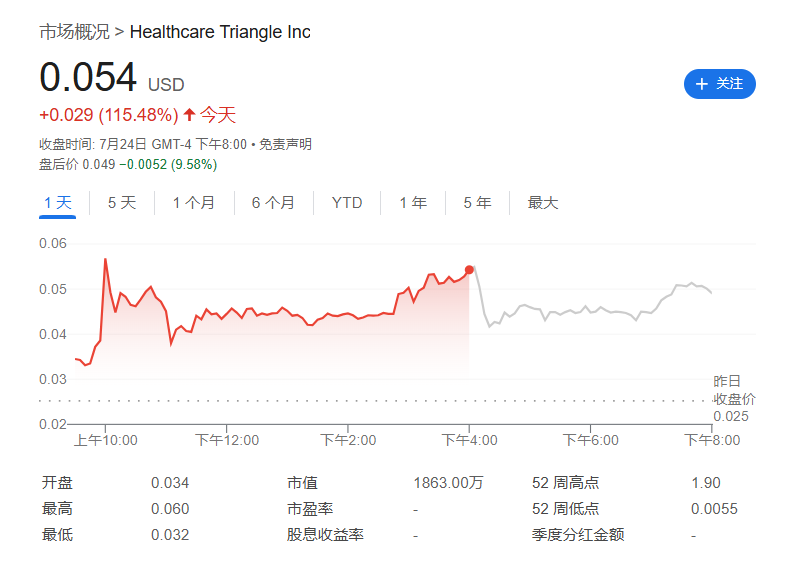
Group 1 - The core point of the article highlights the emergence of Healthcare Triangle Inc. as a new meme stock, experiencing a significant price surge of 115% to just over $0.05 without any apparent positive news [1][3] - On the trading day, Healthcare Triangle saw a trading volume exceeding 3 billion shares, accounting for approximately 15% of the total stock trading on U.S. exchanges that day [1] - The total trading value for Healthcare Triangle reached about $150 million, nearly seven times its market capitalization, indicating a stark contrast between trading activity and the company's size [3] Group 2 - The recent surge in meme stocks, including Healthcare Triangle, reflects a broader trend of speculative trading driven by social media discussions, short squeezes, and technical breakouts, despite a lack of fundamental support for these companies [6] - Analysts have noted a consensus regarding the speculative nature of the market, suggesting that the question is not if a correction will occur, but rather when it will happen [6] - Barclays has warned that certain areas of the market exhibit clear bubble characteristics, indicating a potential for a significant market correction [6]
散户的狂欢,市场的轮回:Meme股狂热为何周而复始?
智通财经网· 2025-07-25 03:20
Core Viewpoint - The resurgence of "Meme stocks" is driven by social media discussions and a surge of retail investors, leading to significant price volatility without fundamental changes in the companies involved [1][4]. Group 1: Characteristics of Meme Stocks - Meme stocks often share common traits, including the ability to spark collective imagination among internet users and gaining traction from influential retail investors on social media [2]. - These stocks typically have high short interest, indicating that professional investors are betting against them, and they often have lower share prices [3]. Group 2: Market Environment Comparison - The current market environment in 2025 differs fundamentally from that of 2021, with high interest rates and uncertain tariff policies, which should suppress risk appetite; however, speculative trading has become active again [4]. - The number of stocks involved in the current wave is fewer than in 2021, but the volatility is more pronounced and the price increases are short-lived [4]. Group 3: Trading Dynamics - For instance, Opendoor's stock surged by 43% on July 21, with a trading volume of 1.9 billion shares, accounting for about 10% of total U.S. stock trading that day [4]. - The surge in stocks like Kohl's and Krispy Kreme was driven by short squeeze dynamics, where short sellers are forced to buy back shares, pushing prices higher [4]. Group 4: Risks and Ethical Concerns - Trading in Meme stocks carries high risks as the motivations for buying are often unrelated to the companies' fundamentals, leading to significant volatility [5]. - The ethical implications of social media influencers affecting stock prices are debated, with concerns about undisclosed information regarding their holdings and motivations [9]. Group 5: Sustainability of Meme Stock Trends - The sustainability of Meme stock trends relies on continuously attracting new investors, which has proven difficult in the current market environment compared to the pandemic period [10]. - Historical patterns show that the price surges of Meme stocks are often short-lived, as evidenced by the rapid decline of stocks like Faraday Future [10].

摩根大通交易员仍认为美股将“大幅上涨”
Hua Er Jie Jian Wen· 2025-07-25 01:48
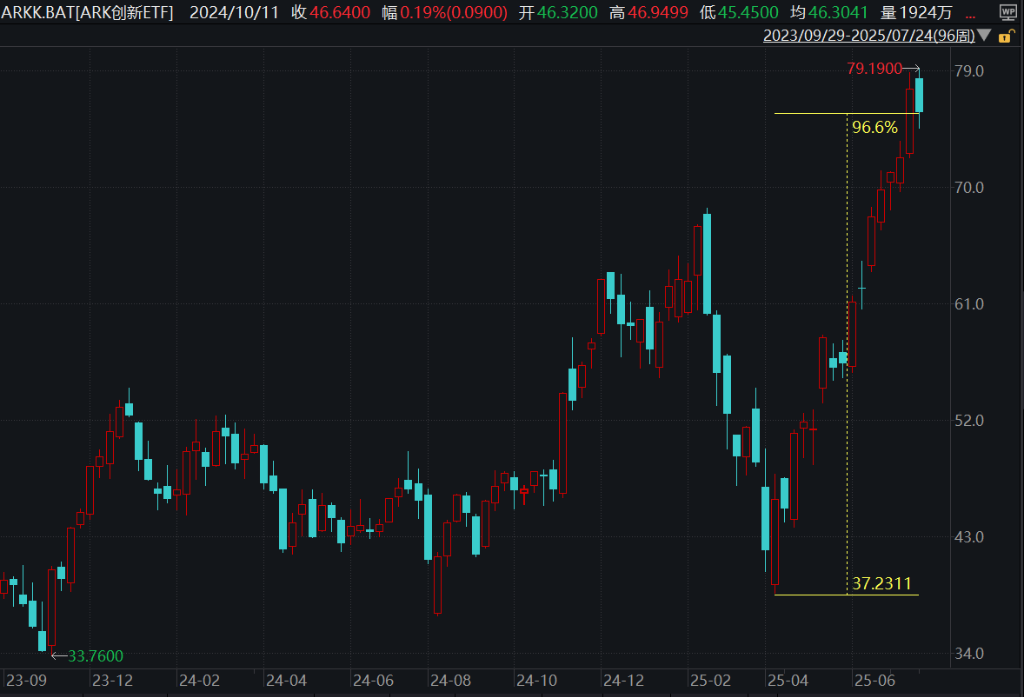
Group 1 - The core viewpoint is that despite concerns over a stock market bubble, JPMorgan's trading division expects the upward trend in U.S. stocks to continue, driven by trade agreement progress, positive economic data, and renewed M&A activity [1] - Recent economic indicators show a solid market foundation, with U.S. unemployment claims declining for the sixth consecutive week, highlighting the resilience of the labor market [3] - The Ark Innovation ETF, managed by Cathie Wood, has surged nearly 100% over the past three months, indicating a strong speculative interest in underperforming tech stocks [1] Group 2 - Strategists recommend diversifying investments into large-cap tech stocks, cyclical stocks, and high-beta assets, while using S&P 500 put options and VIX-related products for hedging [4] - Despite warnings of excessive market enthusiasm, strategists believe there are still many favorable factors supporting the current market, with technical and fundamental factors providing sufficient support for bullish sentiment [4] - The market faces risks from tariffs and economic uncertainty, but strategists maintain that the timing of any potential bubble is difficult to predict, and the current enthusiasm may last longer than expected [4]