
资产证券化

Search documents
全国首单践行东北振兴战略公募REITs获批 沈阳国际软件园项目助力区域高质量发展
Xin Hua Cai Jing· 2025-09-23 14:16
Core Insights - The "Shenyang International Software Park REIT" has received approval from the China Securities Regulatory Commission, marking it as the first public REIT in the country to implement the Northeast revitalization strategy, which signifies a new phase in infrastructure financing reform in Northeast China [1][2] Group 1: Project Overview - The REIT focuses on infrastructure projects located in Shenyang's Hunnan District, comprising 13 industrial buildings with a total property area of 201,200 square meters, primarily for research and office use [2] - The project has maintained a weighted average occupancy rate of approximately 84% over the past three years, with average contract rental prices for office space exceeding 46 yuan per square meter per month, indicating strong operational resilience [2] Group 2: Strategic Importance - The project aligns closely with national strategies such as "Digital China" and "Northeast Revitalization," leveraging Shenyang's robust industrial base and talent resources to promote high-quality regional development [1][3] - Shenyang International Software Park serves as the largest R&D office industrial park in the city, playing a crucial role in the implementation of the digital economy and supporting the local economic landscape [1][2] Group 3: Management and Future Prospects - The original equity holders, Shenyang International Software Park Industrial Development Co., Ltd. and Shenyang International Software Park Co., Ltd., are part of the Shenyang Angli Holding Group, which has over 30 years of experience in software development and technology park operations [2] - The REIT is expected to facilitate a virtuous cycle of investment and financing through asset securitization, enhancing social benefits and long-term value [2][3]
创全国知识产权ABS发行利率新低!华安资管助力兴泰租赁ABS成功簿记
Zhong Guo Zheng Quan Bao· 2025-09-22 15:20
Group 1 - The core viewpoint of the news is that Huazhong Securities successfully managed the first data asset-backed securities (ABS) project aimed at supporting intellectual property for technology innovation enterprises in industrial parks, setting a new benchmark for asset securitization [1] - The issuance scale of the ABS is 321 million yuan, with a priority ticket interest rate of 1.86%, marking the lowest historical rate for intellectual property ABS in China [1] - The product received widespread market attention and enthusiastic subscriptions, providing innovative financing solutions for 20 high-tech enterprises, with individual financing amounts ranging from 1 million to 80 million yuan [1] Group 2 - Xing Tai Leasing plans to further advance its technology innovation business transformation strategy, focusing on innovation as the core driving force to continuously optimize financial service solutions for small and medium-sized technology enterprises [2] - Huazhong Asset Management emphasizes its commitment to serving the real economy, aiming to drive corporate growth through specialized and comprehensive financial services, thereby injecting new momentum into the high-quality development of the regional economy [2]

信贷ABS当前有哪些投资机会?:信贷ABS市场特征及投资机会盘点
Hua Yuan Zheng Quan· 2025-09-22 10:04
Report Information - Report Title: Credit ABS Market Characteristics and Investment Opportunities Inventory - Report Date: September 22, 2025 - Analysts: Liao Zhiming, Zhang Yifan 1. Industry Investment Rating The report does not mention the industry investment rating. 2. Core Viewpoints - The issuance volume of credit ABS has decreased in recent years due to factors such as weak social financing demand and slow credit scale growth in China. In H1 2025, 102 credit ABS were issued, with a total issuance scale of RMB 95.885 billion, a year-on-year decrease of 22.9% and a decrease of about 77% compared to H1 2021. Since 2023, no RMBS products have been issued, and NPL ABS and auto mortgage ABS have become increasingly important, accounting for 37.8% and 35.8% of the total credit ABS issuance scale in H1 2025 respectively [3][6]. - The investor structure of credit ABS is relatively concentrated, with commercial banks being the largest investors, holding RMB 651.102 billion, accounting for 67.3% of the total credit ABS scale as of the end of July 2025. Different types of investors have different motivations and constraints for investing in credit ABS [3]. - The NPLS issuance scale reached a record high in 2024, and the RMBS performance has been relatively stable, with the early repayment pressure easing since H2 2024. The issuance proportion of green Auto ABS has been increasing year by year [3]. - There are investment opportunities in credit ABS. For NPLS, investors can focus on individual bonds with a ChinaBond valuation higher than 2.1%, a sub - layer ratio exceeding 24.5%, an actual/expected recovery ratio greater than 1.2, more than 5,200 underlying assets, and a bond rating of AAA. For RMBS, investors can focus on individual bonds with a bond rating of AAA, a ChinaBond valuation exceeding 1.9%, a sub - layer ratio higher than 12%, an expected recovery ratio exceeding 50%, more than 2,000 underlying assets, and a cumulative default rate lower than 0.5% [3]. 3. Summary by Directory 3.1 Credit ABS Product Characteristics 3.1.1 Primary Market Supply Characteristics - Since 2005, China has carried out credit asset securitization business, which has developed rapidly and diversified. In recent years, due to weak social financing demand and slow credit scale growth, the issuance volume of credit ABS has decreased. In H1 2025, 102 credit ABS were issued, with a total issuance scale of RMB 95.885 billion, a year - on - year decrease of 22.88% in scale and an increase of 18.60% in the number of issuances compared to the previous year, and a decrease of about 77% compared to H1 2021 [6]. - As of the end of July 2025, the custody scale of credit ABS products was RMB 966.822 billion, a decrease of 14.53% compared to the end of 2024. The significant reduction in RMBS issuance is the key factor for the contraction of credit ABS scale [9]. - Credit ABS is regulated by the National Financial Regulatory Administration, and its initiators include various financial institutions. Its trading venue is the inter - bank market, and it can be publicly or privately offered. The underlying assets can be divided into retail loans, corporate loans, and non - performing loans [12]. - From 2015 to 2021, the issuance scale of credit ABS grew rapidly, but since 2021, it has declined. Currently, auto mortgage ABS, small and micro - enterprise loan ABS, and NPLS are growing, and NPL ABS and auto mortgage ABS have become increasingly important, accounting for 37.79% and 35.82% of the total credit ABS issuance scale in H1 2025 respectively [14]. 3.1.2 Secondary Market Trading Characteristics - Since 2020, credit ABS has maintained a higher yield than policy financial bonds and credit bonds of the same term, but the yield spread has been narrowing [17]. - Before 2016, the secondary market trading of credit ABS was mainly concentrated in corporate loan ABS. After 2016, RMBS became the mainstream due to the booming real estate market. However, since 2023, the early repayment rate of RMBS has increased, leading to a contraction in its scale and a shift in trading focus to other products [19]. 3.2 Credit ABS Investor Structure Characteristics - As of the end of July 2025, commercial banks were the largest investors in credit ABS, holding RMB 651.102 billion, accounting for 67.34% of the total credit ABS scale. The investment direction of non - legal person products also generally represents the investment preference of commercial banks [23]. 3.2.1 Motivation and Constraints for Commercial Banks to Participate in Credit ABS Investment - The risk capital measurement rules have an important impact on commercial banks' investment in credit ABS. The new rules have refined the risk weight calculation methods, and the risk weights of high - rated and senior - tranche asset - backed securities have decreased significantly. However, commercial banks have a low investment willingness for non - performing loan securitization products and non - senior tranches due to their high risk weights [25][26]. 3.2.2 Influencing Factors for Other Types of Investors to Participate in Credit ABS Investment - **Mutual Funds**: Asset - backed securities are classified as illiquid assets, so mutual funds have a low participation rate. The investment proportion limit also restricts the investment of fund special accounts and securities company collective asset management products in credit ABS [31]. - **Asset Management Products**: Investment proportion restrictions limit the possibility of asset management products participating in securitized sub - products. However, trust plans and private funds have become more active investors in sub - products [32]. - **Insurance Companies**: After the implementation of the second - generation solvency regulations, the risk capital occupation of ABS is the same as that of bonds, and the scope of ABS products and managers that insurance institutions can invest in has been broadened. However, insurance institutions are prohibited from investing in ABS sub - shares, NPL ABS, and credit ABS with watch - list loans as underlying assets. In practice, insurance institutions have limited participation in credit ABS investment due to the short - term nature of ABS not matching their long - term liabilities [39][40]. 3.3 Credit ABS Sub - product Credit Performance - RMBS has maintained a relatively low cumulative default rate, and the early repayment pressure has eased since H2 2024. Due to the weak real estate market, the possibility of a significant increase in RMBS issuance scale is low [43]. - In recent years, the pressure on commercial banks to dispose of non - performing assets has increased. In 2024, the issuance scale of public NPLS in the inter - bank market reached a record high of RMB 50.867 billion, mainly composed of non - performing personal housing mortgage loans and non - performing credit card loans, with an increasing proportion of non - performing small and micro - enterprise loans [47]. - Since 2024, the average current issuance interest rates of small and micro - enterprise loan ABS and non - performing loan ABS have been relatively high, while that of personal auto loan ABS has been the lowest [48]. 3.4 Credit ABS Investment Opportunities Inventory - **NPLS**: Due to the higher actual recovery value of existing NPLS than the expected value, the market may underestimate its recovery ability. Institutions with strong due diligence and asset valuation capabilities can build a diversified NPLS investment portfolio to earn excess returns. It is recommended to focus on individual bonds with a ChinaBond valuation higher than 2.1%, a sub - layer ratio exceeding 24.5%, an actual/expected recovery ratio greater than 1.2, more than 5,200 underlying assets, and a bond rating of AAA [51]. - **RMBS**: In a low - interest - rate and volatile market environment, RMBS has high - quality collateral, a low default rate, and enhanced cash - flow stability. It is recommended to focus on individual bonds with a bond rating of AAA, a ChinaBond valuation exceeding 1.9%, a sub - layer ratio higher than 12%, an expected recovery ratio exceeding 50%, more than 2,000 underlying assets, and a cumulative default rate lower than 0.5% [51][54].
创全国知识产权ABS发行利率新低 华安资管助力兴泰租赁ABS成功簿记
Zheng Quan Shi Bao Wang· 2025-09-22 06:15
作为扎根合肥的金融企业,兴泰租赁长期踏实服务区域实体经济,协同华安证券及资管子公司积极构建 多维度的ABS产品矩阵,打通投融资关键环节。本期产品的成功发行,既是兴泰租赁深化知识产权融资 优势、拓展科创企业金融服务的重要实践,也是华安资管在资产证券化领域的专业能力与创新意识的集 中体现。 未来,兴泰租赁将深入推进科创业务转型战略,以创新为核心驱动力持续优化金融服务方案,为中小科 创融资提供更优质高效的服务。华安证券与华安资管将始终坚守金融服务实体经济的初心使命,以"做 好金融五篇大文章"为指引,以专业化、综合化的金融服务推动企业成长,坚守服务实体经济的使命, 为区域经济高质量发展不断注入新动能,展现国企金融机构的担当与作为。(CIS) 9月17日,由华安资管担任计划管理人的华安-兴泰租赁-数据资产助力产业园区科创企业知识产权第二 期资产支持专项计划(科技创新)成功簿记。本期专项计划为全国首单数据资产助力产业园区科创企业 知识产权ABS,开创多维度赋能资产证券化新标杆。 本期专项计划发行规模3.21亿元,优先级票面利率1.86%,创全国知识产权ABS历史最低利率。产品受 到市场广泛关注和投资者踊跃认购,共计为20 ...
南山控股(002314) - 2025年半年度业绩说明会暨投资者关系活动记录表
2025-09-19 09:42
Group 1: New Energy Business Development - The company is actively expanding its new energy business through its subsidiary China Nuclear Technology, focusing on distributed photovoltaic and energy storage projects [2] - As of June 2025, China Nuclear Technology has completed the construction and grid connection of the 100MW/200MWh energy storage project in Linxiang, and operates a total of 117 power stations, including 103 wind and solar stations and 14 energy storage stations, with a total operational scale of 2,030MW [2][4] - The company aims to enhance the "green" aspect of its industrial parks by implementing rooftop photovoltaic projects [2] Group 2: Real Estate and Market Strategy - The company is committed to avoiding competition with its controlling shareholder in real estate development and will address any potential conflicts through asset injection or management delegation [3] - The Xi'an Fengxi project, acquired in 2024, is currently under construction and has begun pre-sales [3] - The company plans to deepen its presence in key markets such as the Yangtze River Delta and the Guangdong-Hong Kong-Macao Greater Bay Area, despite facing performance pressures from market conditions [3][4] Group 3: Financial Performance and Asset Management - The company conducts annual asset impairment assessments to ensure accurate financial reporting [4] - The marine engineering business, operated by its subsidiary Shenzhen Chiwan Shengbao Wang Engineering Co., achieved a revenue of 691 million yuan in 2024 [4] - The company is exploring the issuance of additional public REITs to enhance asset management and operational efficiency [4]

探讨系统性防范与化解路径 写字楼市场运行与金融风险防范研讨会在沪举办
Guo Ji Jin Rong Bao· 2025-09-18 17:02
Core Insights - The Chinese office market is experiencing significant challenges, including oversupply, high vacancy rates, and declining rental prices, leading to a deep adjustment phase [1][2][3] - There is a notable market differentiation, with core areas in first-tier cities also facing tenant demands for rent reductions [2][3] - Financial risks are emerging due to low asset yields, shrinking valuations, and difficulties in large transactions and REITs exits, indicating potential debt defaults and increased bad debts for financial institutions [1][2] Group 1: Market Conditions - The office market is under pressure with increasing supply and decreasing demand, resulting in a rise in vacancy rates and a decline in rental levels [2][3] - New emerging business districts are showing positive leasing performance due to high cost-effectiveness, despite overall market challenges [3][4] - The transition from a high-leverage model to a cash flow-oriented model in real estate is underway, with a focus on sustainable investment strategies [4][5] Group 2: Financial Risks and Recommendations - The need for careful evaluation of collateral values in mortgage lending is emphasized to prevent overvaluation and excessive lending [2][3] - Recommendations include reducing new office supply, promoting the conversion of old office buildings to rental housing, and enhancing operational efficiency [5][6] - The establishment of a multi-tiered REITs market is suggested to facilitate asset circulation and encourage long-term capital investment [4][6] Group 3: Policy and Structural Changes - Government policies play a crucial role in the office market, with recent initiatives aimed at flexible land use and urban renewal to optimize space and functionality [7][8] - The flexibility in land use conversion is seen as a potential solution to alleviate the office market's challenges, allowing for the transformation of inefficient office spaces into long-term rental apartments [7][8] - The importance of enhancing collaboration among various government departments to adapt planning and zoning regulations to market changes is highlighted [6][7]
出险房企债务重组加速
Bei Jing Shang Bao· 2025-09-18 16:40
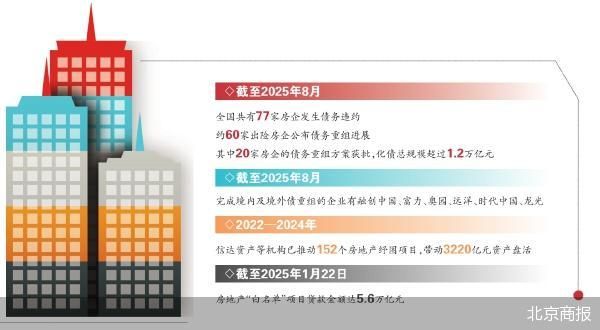
Group 1 - The core viewpoint is that the debt restructuring process for distressed real estate companies has entered a new phase, with significant progress observed in September 2025 [1][3][9] - Several companies, including CIFI Holdings, Kaisa Group, and R&F Properties, have achieved key breakthroughs in their debt restructuring efforts, indicating a positive trend [3][4] - As of August 2025, 20 distressed real estate companies have received approval for debt restructuring, with a total debt relief scale exceeding 1.2 trillion yuan [5][6][7] Group 2 - CIFI Holdings' restructuring plan was approved on September 15, 2025, with a cash repayment ratio increased to 20% and a debt extension period shortened to 7-8 years [3][6] - Kaisa Group's restructuring plan has come into effect, resulting in an estimated debt reduction of approximately 8.6 billion USD and an average debt extension of five years [3][6] - R&F Properties is actively advancing its debt restructuring, proposing a comprehensive plan that includes cash buybacks and asset disposals [3][6] Group 3 - The debt-to-equity swap has become a preferred method for many companies, reflecting its applicability and effectiveness in the current market environment [5][6] - A diversified approach to debt restructuring has emerged, with companies employing various strategies such as cash buybacks, debt extensions, and asset disposals [6][8] - The financial sector is supporting distressed companies through various channels, including asset management institutions and public REITs, which help reduce leverage and promote transformation [8][9] Group 4 - The market is showing signs of recovery, with policies aimed at stimulating buyer interest, leading to improved operational conditions for real estate companies [9][10] - The traditional peak sales season in September is expected to accelerate the pace of project launches in core cities, potentially boosting market activity [10]


专家建议:政策、市场和产业多方协同推动写字楼市场止跌回稳
Zhong Guo Xin Wen Wang· 2025-09-18 13:33
Core Insights - The conference focused on the current state of China's office market and potential financial risks, discussing strategies for response and future development [1] Group 1: Market Conditions and Trends - The office market is currently in an adjustment phase with increasing supply and leasing activities primarily driven by corporate relocations [3] - Emerging business districts are achieving positive leasing performance due to their high cost-effectiveness despite overall market pressures [3] - The rise in vacancy rates and rental pressures in commercial office sectors presents challenges, yet lower interest rates enhance investment attractiveness due to higher capitalization rates [4] Group 2: Recommendations and Strategies - Experts suggest a multi-faceted approach to address risks, including long-term reliance on economic growth and industry upgrades, and short-term measures to control new supply and promote inventory reduction [3] - Recommendations include easing rental pricing regulations to encourage upgrades of older office buildings and exploring new uses such as rental housing and elderly care facilities [4] - The promotion of Real Estate Investment Trusts (REITs) in the office market is advised to enhance risk diversification and improve asset liquidity [5] Group 3: Policy and Regulatory Suggestions - There is a call for reducing new commercial land supply and encouraging the transformation of commercial properties into affordable rental housing [4] - Flexibility in land use conversion is seen as a viable channel for alleviating pressures in the office market, with examples of successful conversions to long-term rental apartments [5] - The need for a dynamic assessment mechanism and the establishment of stabilization funds to guide long-term capital into the market is emphasized [3]

中信金融资产成功发行云帆2期实体赋能ABS
Zhong Guo Jin Rong Xin Xi Wang· 2025-09-18 11:32
编辑:刘润榕 云帆2期是中信金融资产在中信集团协同支持下,依托自身资产池和产品创新能力,推出的又一以服务 实体经济为导向的资产证券化项目。该项目基础资产涵盖公司特定应收账款债权、信托受益权及财产份 额,加权平均信用等级达AA/AA+,资产信用质量优良。此次发行不仅有效拓展公司融资渠道,也为公 司持续降低融资成本、优化债务结构提供有力支撑。 2025年上半年,中信金融资产按照"夯实基础、稳中求进、提质增效"总体思路,积极把握行业政策机 遇,经营业绩显著提升,实现总收入402亿元,同比增长21%,归母净利润61.68亿元,同比增长 15.7%,剔除金租出表影响同比增长27.5%,年化ROE达21.1%。2025年以来,中信金融资产积极把握市 场窗口,持续优化负债结构与融资成本,上半年新增平均融资利率同比下降50个基点,利息支出同比下 降12.3%,前期发行的云帆1期100.1亿元ABS,一举创下年内同类产品"规模最大、成本最低、利差最 窄"的市场纪录。此外,2025年上半年,公司主业新增投放879亿元,是上年同期的1.4倍,落地了一批 具有市场影响力的项目。 转自:新华财经 新华财经北京9月18日电(记者吴丛司) ...
央行信贷市场司负责人杨虹:积极支持符合条件的金融机构发行金融债券
Bei Jing Shang Bao· 2025-09-17 12:22
Core Viewpoint - The People's Bank of China is actively supporting financial institutions in the service consumption sector by promoting the issuance of financial bonds and asset-backed securities to enhance consumer credit supply capabilities [1] Financial Support Policies - The People's Bank of China encourages qualified financial institutions to issue financial bonds and credit asset-backed securities to broaden funding sources [1] - The focus is on increasing the securitization of retail loans, including those for automobiles, consumption, and credit cards, to revitalize existing credit and reduce financing costs [1] Market Data - As of the end of July, automotive finance companies issued financial bonds totaling 21.5 billion yuan and credit asset-backed securities amounting to 48.4 billion yuan [1]