
稀土出口管制

Search documents
如何看待特朗普威胁卷土重来?
Yin He Zheng Quan· 2025-10-11 11:20
Group 1: Trade Tensions and Tariffs - The US has imposed tariffs ranging from 25% to 100% on various Chinese goods, including electric vehicles and solar panels, since September[1] - Trump announced a 100% additional tariff on Chinese imports effective November 1, 2025, alongside export controls on key software[4] - The US has added 23 Chinese companies, including Fudan Microelectronics, to its entity list, tightening technology exports in semiconductor and AI sectors[1] Group 2: Strategic Resources and Industries - Shipping and rare earths are central to the US-China competition, impacting global trade and military capabilities[2] - The US relies heavily on rare earth imports for its high-tech and military industries, making China's export controls critical[2] - China has implemented new regulations on rare earth exports, requiring licenses for materials with ≥0.1% heavy rare earth content[4] Group 3: Market Implications - A-shares may experience slight fluctuations but maintain an upward trend, with a shift in market style expected[6] - Short-term uncertainty is likely to lower risk appetite for Chinese assets, prompting investors to reassess market valuations[6] - The 10-year government bond yield is projected to fluctuate between 1.65% and 1.85% in the fourth quarter, reflecting mixed economic pressures[7] Group 4: Future Outlook - The intensity of US-China competition is expected to rise, with Trump potentially using trade tensions to address internal pressures ahead of the 2026 midterm elections[8] - China's macroeconomic policy will focus on stabilizing employment and market expectations while enhancing domestic demand[8] - The potential for a "weak dollar" scenario may arise due to the fluctuating nature of US tariffs and Federal Reserve policies[7]
中国筑牢稀土安全护城河 “技术+物项”双重出口管制 稀土后市被看好
Hua Xia Shi Bao· 2025-10-11 05:52
Core Viewpoint - China has intensified its export controls on rare earth materials, implementing new regulations on October 9, which include a limited scope of items and various licensing facilitation measures [2][3][4]. Group 1: Export Control Measures - The Ministry of Commerce announced export controls on certain rare earth-related items and technologies containing Chinese components, citing their dual-use nature [3]. - The announcement includes three categories of items that require export licenses, extending the control chain to key rare earth technologies and their carriers [3]. - The measures aim to protect national security and interests, addressing concerns over foreign entities transferring Chinese-origin rare earth items for military use [3][4]. Group 2: Market Impact - Analysts believe that while the short-term impact on rare earth prices may be limited, the long-term outlook suggests potential price increases due to a lack of foreign technology imports [6]. - The price of rare earth products has shown stability, with demand in the domestic market providing strong support despite international trade challenges [6][7]. - The rare earth sector has seen a strong price trend over the past year, with companies like Northern Rare Earth reporting optimistic views on future price movements [7]. Group 3: Company-Specific Insights - Northern Rare Earth indicated that its export business is minimal, thus the impact of export controls is relatively small [2][9]. - The company reported that its light rare earth product exports remain normal, while exports of certain heavy rare earth elements are subject to the new controls [9]. - China Rare Earth Group's domestic revenue for the first half of the year reached 1.87 billion yuan, a 64.02% increase year-on-year, while international revenue saw a significant decline [9].


突发黑天鹅出现!市场要开始大幅回调了?
大胡子说房· 2025-10-11 05:38
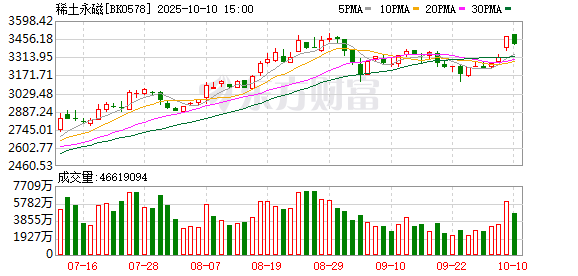
Core Viewpoint - The announcement of a 100% tariff on imports from China by the U.S. has triggered significant market reactions, indicating a renewed phase of trade tensions between the two countries [1][2][14]. Market Reactions - Following the tariff announcement, global markets experienced a downturn, with major U.S. indices closing lower, marking the largest single-day drop since April [3][4]. - The cryptocurrency market also faced substantial declines, with Bitcoin dropping by 9% and a total liquidation amounting to $19.216 billion [5]. Tariff Implications - If the new tariffs are implemented, the import tax rate on Chinese goods could reach 130%, close to the earlier peak of 145% [2]. - The U.S. is using tariffs as a negotiation tool, with the timing of the implementation set for November 1, suggesting a potential for further discussions with China [23]. Strategic Responses - In response to U.S. actions, China is considering implementing export controls on rare earth materials, which are crucial for high-end chip manufacturing, thereby countering U.S. advantages in technology [6][8][11]. - The trade conflict is expected to have negative implications for capital markets, with a likelihood of a market correction similar to previous events [14][15]. Long-term Outlook - Despite short-term volatility, the long-term perspective suggests that as long as negotiations continue, significant market disruptions may be avoided [25]. - Historical patterns indicate that after initial declines, markets tend to recover, presenting potential buying opportunities post-correction [25].

中方发布稀土新规后,阿斯麦为出货延迟做准备
Guan Cha Zhe Wang· 2025-10-11 02:49
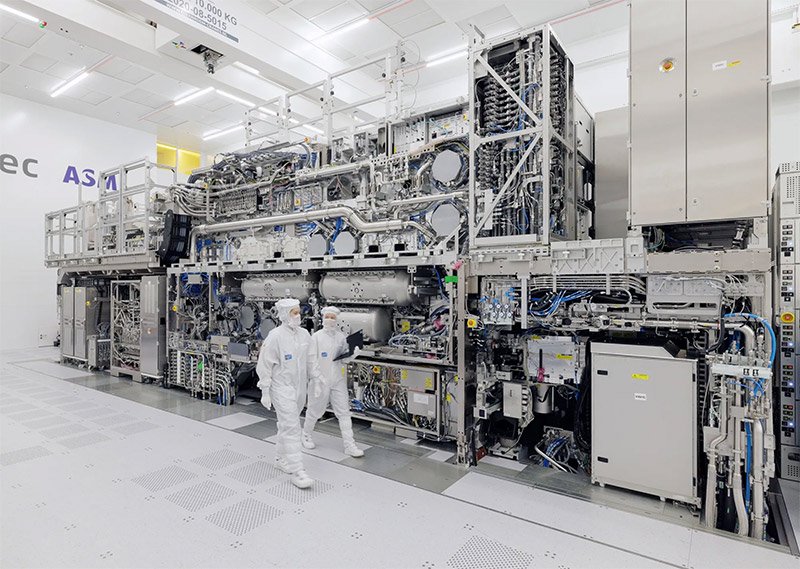
Core Viewpoint - China's new export regulations on rare earths are seen as a significant response to U.S. pressure, potentially impacting global semiconductor supply chains, particularly affecting ASML, the sole manufacturer of advanced semiconductor equipment [1][4]. Group 1: Impact on Companies - ASML may face shipment delays of several weeks due to China's new regulations, which require foreign companies to obtain approval before re-exporting products containing Chinese rare earths [1]. - U.S. chip companies are assessing the impact of rising rare earth magnet prices, which are critical in the chip supply chain, and are concerned about potential supply chain disruptions due to China's export licensing system [2][4]. - Major chip manufacturers like Intel, TSMC, and Samsung rely on ASML's equipment for semiconductor production, indicating a widespread impact across the industry [4]. Group 2: Regulatory Changes - China's new regulations, effective December 1, will require foreign companies to obtain approval for exporting rare earth-related items that contain 0.1% or more of Chinese heavy rare earths [7]. - The regulations also cover items produced using Chinese rare earth extraction, refining, and manufacturing technologies, with immediate implementation for certain items [7]. - The Chinese government emphasizes that these measures are in line with international practices for dual-use items and aim to protect national security and interests [9][10]. Group 3: Global Reactions - The U.S. and European countries are expressing concern over China's tightening of export restrictions on critical minerals, with Germany and the EU discussing the implications at national and EU levels [9]. - Experts note that China's export controls could significantly impact semiconductor manufacturers and tool manufacturers that integrate rare earth magnets into their products [4][8]. - The situation highlights the vulnerability of the semiconductor supply chain, which relies heavily on specialized equipment and complex processes [8].

稀土,提价!
Zheng Quan Shi Bao· 2025-10-10 15:01
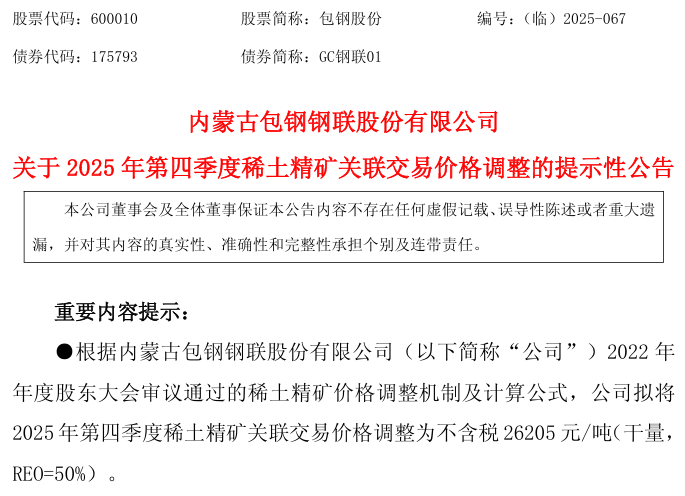
Core Viewpoint - The significant increase in rare earth prices has been announced by Baotou Steel and Northern Rare Earth, with the price for the fourth quarter of 2025 set at 26,205 yuan per ton, reflecting a 37% increase from the previous quarter's price of 19,109 yuan per ton [1][5][7]. Price Adjustments - Baotou Steel announced a price adjustment for rare earth concentrate to 26,205 yuan per ton (excluding tax) for Q4 2025, with a price change of 524.10 yuan per ton for every 1% change in REO content [1][5]. - The price for Q3 2025 was previously set at 19,109 yuan per ton, indicating a substantial increase in pricing trends throughout 2024 and 2025 [7][8]. Export Control Measures - On October 9, the Ministry of Commerce announced new export controls on rare earth-related items and technologies, emphasizing the dual-use nature of these materials and their potential military applications [9][10]. - The export control measures are aimed at protecting national security and interests, with specific exemptions for humanitarian aid and emergency medical supplies [10][11].

稀土,提价!
证券时报· 2025-10-10 15:00
Core Viewpoint - The article highlights a significant increase in rare earth prices, with specific adjustments announced by Baotou Steel and Northern Rare Earth for the fourth quarter of 2025, reflecting a broader trend of rising prices in the rare earth market [2][6][8]. Price Adjustments - Baotou Steel announced an adjustment of the rare earth concentrate price to 26,205 yuan/ton (excluding tax) for Q4 2025, with a price change of 524.10 yuan/ton for every 1% change in REO content [2][6]. - Northern Rare Earth has made a similar announcement, aligning its pricing strategy with Baotou Steel, indicating a unified pricing mechanism that began in 2023 [6][9]. Historical Price Trends - The rare earth concentrate prices have been on an upward trajectory since 2024, with the following adjustments noted: - Q1 2024: 20,737 yuan/ton - Q2 2024: 16,792 yuan/ton - Q3 2024: 16,741 yuan/ton - Q4 2024: 17,782 yuan/ton - Q1 2025: 18,618 yuan/ton - Q2 2025: 18,825 yuan/ton - Q3 2025: 19,109 yuan/ton - Q4 2025: 26,205 yuan/ton [9]. Export Control Measures - On October 9, the Ministry of Commerce announced new export control measures on rare earth-related items and technologies, emphasizing the dual-use nature of these materials and the need to protect national security [10][11]. - The export controls are aimed at preventing sensitive technologies from being misappropriated for military purposes, reflecting a strategic move to safeguard China's interests in the global rare earth supply chain [12].
中国扩大稀土出口限制 纳入五种新元素加工
Ju Chao Zi Xun· 2025-10-10 14:30
根据《中华人民共和国出口管制法》《两用物项出口管制条例》等法规,经国务院批准发布的《商务部公告2025年第61号》和《第62号》分别对境外相关稀 土物项及稀土技术实施出口管制。这是中国首次对"境外特定出口经营者"行使管制权,即凡含有原产于中国的稀土成分或采用中国技术生产的相关物项,在 境外再出口前均需获得商务部颁发的许可。 公告显示,若境外制造的产品中含有原产于中国的稀土物项,其价值占比超过0.1%,即需纳入管控。同时,使用中国稀土开采、冶炼、磁材制造及二次回 收技术生产的物项,也将受到出口审批约束。业内人士称,此举是"从源头切断风险隐患",防止敏感材料流向潜在军事用途领域。 (文/罗叶馨梅)10月9日,中国商务部发布两项与稀土相关的重要公告,标志着我国稀土出口管制体系全面升级。此次管制不仅覆盖境内物项出口,还首次 将境外再出口和稀土相关技术纳入管理,形成全产业链闭环管控。 与此同时,《技术管制公告》首次明确将稀土开采、冶炼分离、金属冶炼、磁材制造及二次资源回收利用等五大关键技术纳入管制。这意味着我国稀土技术 不再仅受"目录约束",而是进入实质性许可管理阶段,防止"物项管控但技术外流"的漏洞。 业内人士预计, ...

美股异动 | 稀土概念股大幅冲高 Critical Metals(CRML.US)大涨逾14%
智通财经网· 2025-10-10 14:00
Core Viewpoint - The surge in U.S. rare earth stocks is driven by China's recent announcements regarding stricter export controls on rare earth-related items and technologies, highlighting China's dominant position in the global rare earth supply chain [1] Group 1: Market Reaction - U.S. rare earth stocks experienced significant gains, with Critical Metals (CRML.US) rising over 14%, United States Antimony (UAMY.US) up 9%, Energy Fuels (UUUU.US) increasing over 6%, MP Materials (MP.US) gaining over 4%, and American Resources (AREC.US) climbing over 2% [1] Group 2: China's Dominance in Rare Earths - China holds a dominant position in the global rare earth supply chain, with 48% of the world's rare earth reserves, amounting to 44 million tons out of a total of 90 million tons [1] - In 2024, China's contribution to global rare earth production is projected to be 69%, with an output of 270,000 tons out of a total of 390,000 tons [1] - China controls over 90% of rare earth smelting and separation technology, achieving a purity level of 99.99%, which is a significant shortcoming for Europe and the U.S. [1]





中国筑牢稀土安全护城河,“技术+物项”双重出口管制,稀土后市被看好
Hua Xia Shi Bao· 2025-10-10 12:40
Core Points - China has intensified export controls on rare earth materials and related technologies as of October 9, 2023, with the Ministry of Commerce issuing two announcements regarding this matter [2][3] - The export controls are aimed at protecting national security and interests, particularly against the misuse of Chinese-origin rare earth materials in military applications [3][4] - The scope of the controlled items is limited, and the government will implement various licensing facilitation measures, including exemptions for humanitarian aid [4] Industry Impact - Rare earths are critical strategic resources used in various sectors, including renewable energy, aerospace, semiconductor manufacturing, and military applications [5] - Analysts believe that while the short-term impact on rare earth prices may be limited, the long-term outlook suggests potential price increases due to a lack of foreign technology imports [5][6] - The price of rare earth products has shown a strong upward trend over the past year, with companies like Northern Rare Earth (600111.SH) adjusting their prices upward for several consecutive quarters [6][7] Company Specifics - Northern Rare Earth has indicated that its export business is minimal, thus the impact of the export controls will be relatively small [2][7] - The company primarily exports light rare earth products, which are not significantly affected by the new controls, while heavy rare earth elements like dysprosium and terbium require export licenses [7] - China Rare Earth Group's domestic revenue for the first half of the year reached 1.87 billion yuan, a year-on-year increase of 64.02%, while international revenue dropped significantly [7]
从物项管制到技术管制 中国“稀土锁”再收紧
Jing Ji Guan Cha Wang· 2025-10-10 10:55
Core Viewpoint - China's Ministry of Commerce has announced an upgrade in rare earth export controls, shifting from "item control" to "technology control," emphasizing the dual-use nature of rare earth materials and technologies [1][2][5]. Group 1: Export Control Changes - The new regulations prohibit the export of technologies related to rare earth mining, refining, and manufacturing without permission, expanding the definition of "export" to include various forms of transfer such as knowledge transfer and joint research [2][3]. - A "long-arm jurisdiction" mechanism has been introduced, requiring foreign organizations to obtain export licenses from China before exporting items containing Chinese rare earth components [2][3]. Group 2: National Security and Compliance - The measures are a response to illegal acquisition of rare earth technologies by foreign entities, which pose threats to China's national security and international stability [3][5]. - The export controls are not blanket restrictions; humanitarian-related exports will be exempt from licensing requirements [3][4]. Group 3: Global Market Position - China dominates the global rare earth supply chain, holding 48% of the world's rare earth reserves and contributing 69% of global production [4][6]. - The country possesses over 90% of rare earth refining and separation technology, achieving a purity level of 99.99%, which is a significant advantage over Western countries [4][6]. Group 4: Impact on Related Companies - Following the announcement, several companies in the rare earth sector saw significant stock price increases, indicating market optimism regarding the implications of the new regulations [7].

