
隐含波动率

Search documents
股指期权数据日报-20250730
Guo Mao Qi Huo· 2025-07-30 06:39
Market Review - The closing prices of the Shanghai 50, CSI 300, and CSI 1000 were 2808.5917, 4152.0247, and 6773.8843 respectively, with increases of 0.21%, 0.39%, and 0.65% [4]. - The trading volumes of the Shanghai 50, CSI 300, and CSI 1000 were 47.05 billion, 230.81 billion, and 259.26 billion respectively, and the trading turnovers were 1119.54 billion yuan, 4287.64 billion yuan, and 3837.04 billion yuan respectively [4]. CFFEX Stock Index Option Trading - For the Shanghai 50 index, the option trading volume was 2.62 million contracts (1.82 million for call options and 0.81 million for put options), with a PCR of 0.44. The option open interest was 7.05 million contracts (4.53 million for call options and 2.52 million for put options), with a PCR of 0.56 [4]. - For the CSI 300 index, the option trading volume was 7.11 million contracts (4.50 million for call options and 2.62 million for put options), with a PCR of 0.58. The option open interest was 19.17 million contracts (11.10 million for call options and 8.07 million for put options), with a PCR of 0.73 [4]. - For the CSI 1000 index, the option trading volume was 18.15 million contracts (10.00 million for call options and 8.15 million for put options), with a PCR of 0.81. The option open interest was 25.33 million contracts (12.87 million for call options and 12.46 million for put options), with a PCR of 0.97 [4]. Volatility Analysis - The historical volatility and next - month at - the - money implied volatility of the Shanghai 50, CSI 300, and CSI 1000 were analyzed, including the maximum, minimum, percentile values, and the volatility smile curve [8][10][13] Overall Market Situation - The Shanghai Composite Index rose 0.33% to 3609.71 points, the Shenzhen Component Index rose 0.64%, the ChiNext Index rose 1.86%, the Beijing Stock Exchange 50 rose 0.68%, the Science and Technology Innovation 50 rose 1.45%, the Wind All - A rose 0.45%, and the Wind A500 rose 0.43%, and the CSI A500 rose 0.5% [13]. - The A - share trading turnover for the day was 1.83 trillion yuan, compared with 1.77 trillion yuan the previous day [13]
农产品期权策略早报-20250730
Wu Kuang Qi Huo· 2025-07-30 01:49
Group 1: Overall Market Summary - Agricultural product options strategy morning report date is July 30, 2025 [1] - Oilseeds and oils agricultural products are in a strong - side oscillatory trend, while oils, agricultural by - products maintain an oscillatory market, soft commodity sugar has a slight oscillation, cotton's bullish rise has declined, and grains such as corn and starch are in a weak and narrow - range consolidation [2] - The strategy is to construct an option portfolio strategy mainly based on sellers, as well as spot hedging or covered strategies to enhance returns [2] Group 2: Futures Market Overview - The latest prices, price changes, price change rates, trading volumes, volume changes, open interests, and open interest changes of various agricultural product option underlying futures contracts are presented, including soybeans, soybean meal, palm oil, etc. [3] Group 3: Option Factor - Volume and Open Interest PCR - The volume PCR, volume change, open interest PCR, and open interest change of various agricultural product options are provided, which are used to describe the strength of the option underlying market and the turning point of the underlying market [4] Group 4: Option Factor - Pressure and Support Levels - The pressure points, support points, and the maximum open interests of call and put options of various agricultural product options are given, which are determined from the exercise prices of the maximum open interests of call and put options [5] Group 5: Option Factor - Implied Volatility - The at - the - money implied volatility, weighted implied volatility, weighted implied volatility change, annual average, call implied volatility, put implied volatility, HISV20, and the difference between implied and historical volatility of various agricultural product options are presented [6] Group 6: Strategy and Recommendations for Different Agricultural Product Options Oilseeds and Oils Options - **Soybeans (Soybean 1 and Soybean 2)**: USDA July report adjusts the supply - demand balance of US soybeans in the 25/26 season, soybean 1 shows an oversold rebound pattern. Option strategies include constructing a neutral short call + put option combination strategy and a long collar strategy for spot hedging [7] - **Soybean Meal and Rapeseed Meal**: The purchase volume of soybean meal in different months is provided, and the market shows a pattern of weak consolidation and then oversold rebound. Option strategies include constructing a neutral short call + put option combination strategy and a long collar strategy for spot hedging [9] - **Palm Oil, Soybean Oil, and Rapeseed Oil**: Palm oil's export and production data affect the market, showing a bullish trend. Option strategies include constructing a bullish short call + put option combination strategy and a long collar strategy for spot hedging [10] - **Peanuts**: The peanut market has a weak consolidation pattern under bearish pressure. Option strategies include constructing a bearish spread strategy of put options and a long collar strategy for spot hedging [11] Agricultural By - product Options - **Pigs**: The pig price shows a weak upward trend under bearish pressure. Option strategies include constructing a bearish short call + put option combination strategy and a covered call strategy for spot hedging [11] - **Eggs**: The egg price is in a weak consolidation pattern. Option strategies include constructing a bearish spread strategy of put options, a bearish short call + put option combination strategy [12] - **Apples**: The apple market shows a pattern of weak bearishness gradually rebounding. Option strategies include constructing a neutral short call + put option combination strategy [12] - **Red Dates**: The red date market has a pattern of rebound and then decline. Option strategies include constructing a bearish wide - straddle option combination strategy and a covered call strategy for spot hedging [13] Soft Commodity Options - **Sugar**: The sugar market shows an oversold rebound pattern. Option strategies include constructing a neutral short call + put option combination strategy and a long collar strategy for spot hedging [13] - **Cotton**: The cotton market shows a pattern of low - level rebound and then slight oscillation. Option strategies include constructing a bullish spread strategy of call options, a bullish short call + put option combination strategy, and a covered call strategy for spot hedging [14] Grain Options - **Corn and Starch**: The corn market shows a weak bearish pattern. Option strategies include constructing a bearish spread strategy of put options and a bearish short call + put option combination strategy [14] Group 7: Option Charts - Charts of various agricultural product options are presented, including price trend charts, volume and open interest charts, open interest - PCR charts, implied volatility charts, historical volatility cone charts, etc., for different agricultural products such as soybeans, soybean meal, palm oil, etc. [16][33][50]
金属期权策略早报-20250730
Wu Kuang Qi Huo· 2025-07-30 01:30
1. Report Industry Investment Rating No relevant content provided. 2. Core Viewpoints of the Report - The metal sector is divided into non - ferrous metals, precious metals, and black metals. Strategies are provided for selected metal options in each sector, including directional, volatility, and spot hedging strategies [8]. - For non - ferrous metals, copper shows a high - level consolidation trend, and a short - volatility seller option portfolio strategy is recommended; aluminum shows a long - biased high - level shock, and a bull - spread call option strategy and a short - option combination strategy are recommended; zinc shows a short - term long - biased shock, and similar strategies to aluminum are recommended; nickel shows a wide - range shock with short - side pressure, and a short - option combination strategy with a short delta is recommended; tin shows a short - term weak shock, and a short - volatility strategy is recommended; lithium carbonate shows a large - amplitude fluctuation, and a short - option combination strategy with a neutral delta is recommended [7][9][10][11]. - For precious metals, gold shows a short - term weak shock, and a short - volatility option seller combination strategy with a neutral delta is recommended; silver shows a long - biased shock, and a short - option combination strategy with a long delta is recommended [12]. - For black metals, rebar shows an upward shock with pressure, and a short - option combination strategy with a neutral delta and a covered call strategy are recommended; iron ore shows a long - biased shock, and a bull - spread call option strategy and a short - option combination strategy with a long delta are recommended; ferroalloys (manganese silicon and silicon iron) show a long - biased trend, and bull - spread call option strategies and short - volatility strategies are recommended; industrial silicon and polysilicon show a rebound and upward trend with large fluctuations, and short - volatility strategies are recommended; glass shows a rebound after a large decline, and a short - volatility strategy and a long - collar strategy are recommended [13][14][15]. 3. Summary by Related Catalogs 3.1 Futures Market Overview - The report provides the latest prices, price changes, trading volumes, and open interest changes of various metal futures contracts, including copper, aluminum, zinc, etc. For example, the latest price of copper (CU2509) is 79,090, with a price increase of 110 and a trading volume of 6.54 million lots [3]. 3.2 Option Factors - Volume and Open Interest PCR - Volume PCR and open interest PCR are used to describe the strength of the option underlying market and the turning point of the market. For example, the volume PCR of copper is 0.63, and the open interest PCR is 0.72 [4]. 3.3 Option Factors - Pressure and Support Levels - Pressure and support levels of various metal options are analyzed from the perspective of the strike prices with the largest open interest of call and put options. For example, the pressure level of copper is 82,000, and the support level is 75,000 [5]. 3.4 Option Factors - Implied Volatility - Implied volatility data of various metal options are provided, including at - the - money implied volatility, weighted implied volatility, and the difference between implied and historical volatility. For example, the at - the - money implied volatility of copper is 10.76% [6]. 3.5 Strategy and Recommendations - **Non - ferrous Metals**: - **Copper**: Build a short - volatility seller option portfolio strategy and a spot long - hedging strategy [7]. - **Aluminum/Alumina**: Use a bull - spread call option strategy, a short - option combination strategy, and a spot collar strategy [9]. - **Zinc/Lead**: Adopt a bull - spread call option strategy, a short - option combination strategy, and a spot collar strategy [9]. - **Nickel**: Implement a short - option combination strategy with a short delta and a spot long - hedging strategy [10]. - **Tin**: Apply a short - volatility strategy and a spot collar strategy [10]. - **Lithium Carbonate**: Use a short - option combination strategy with a neutral delta and a spot long - hedging strategy [11]. - **Precious Metals**: - **Gold**: Build a short - volatility option seller combination strategy with a neutral delta and a spot hedging strategy [12]. - **Silver**: Use a short - option combination strategy with a long delta and a spot collar strategy [12]. - **Black Metals**: - **Rebar**: Implement a short - option combination strategy with a neutral delta and a covered call strategy [13]. - **Iron Ore**: Adopt a bull - spread call option strategy, a short - option combination strategy with a long delta, and a spot collar strategy [13]. - **Ferroalloys**: Use bull - spread call option strategies and short - volatility strategies [14]. - **Industrial Silicon/Polysilicon**: Apply short - volatility strategies and spot hedging strategies [14]. - **Glass**: Implement a short - volatility strategy and a long - collar strategy [15].
能源化工期权策略早报-20250730
Wu Kuang Qi Huo· 2025-07-29 23:38
1. Report Industry Investment Rating No relevant information provided. 2. Core View of the Report - The energy - chemical sector is mainly divided into energy, alcohols, polyolefins, rubber, polyesters, alkalis, and others. For each sector, option strategies and suggestions are provided for selected varieties. Option strategy reports are compiled for each option variety based on underlying market analysis, option factor research, and option strategy suggestions [9]. - Strategies focus on constructing option portfolio strategies mainly as sellers, along with spot hedging or covered strategies to enhance returns [3]. 3. Summary According to Relevant Catalogs 3.1 Futures Market Overview - Various energy - chemical futures contracts show different price movements, trading volumes, and open interest changes. For example, the latest price of crude oil (SC2509) is 516, up 10 with a 2.06% increase; the trading volume is 11.77 million lots, a decrease of 3.49 million lots, and the open interest is 3.78 million lots, a decrease of 0.22 million lots [4]. 3.2 Option Factors - Volume and Open Interest PCR - Different option varieties have different volume and open interest PCR values and their changes. For instance, the volume PCR of crude oil is 0.54, an increase of 0.06, and the open - interest PCR is 0.50, a decrease of 0.03 [5]. 3.3 Option Factors - Pressure and Support Levels - From the perspective of the maximum open interest of call and put options, the pressure and support levels of option underlyings are determined. For example, the pressure level of crude oil is 640, and the support level is 500 [6]. 3.4 Option Factors - Implied Volatility - Different option varieties have different implied volatility values, including at - the - money implied volatility, weighted implied volatility, and their changes. For example, the at - the - money implied volatility of crude oil is 29.605%, and the weighted implied volatility is 34.92%, a decrease of 0.30% [7]. 3.5 Option Strategies and Suggestions 3.5.1 Energy - related Options - **Crude Oil**: The fundamental situation shows that the UAE port transfer increase implies Iran's return to global supply, while Russia's shipments remain tight. The market is short - term weak. Implied volatility fluctuates around the mean, and the open - interest PCR below 0.60 indicates increasing short - side strength. Strategies include constructing a neutral call + put option selling combination for volatility, and a long collar strategy for spot hedging [8]. - **LPG**: The fundamental situation is that the supply is abundant, and the market is short - term bearish. Implied volatility remains at a relatively high historical level, and the open - interest PCR below 0.60 indicates strong short - side strength. Strategies include constructing a bearish call + put option selling combination for volatility, and a long collar strategy for spot hedging [10]. 3.5.2 Alcohol - related Options - **Methanol**: The port and enterprise inventories are decreasing, and the market is weak with pressure. Implied volatility first rises to a high level and then falls, and the open - interest PCR below 0.80 indicates a weak - oscillating market. Strategies include constructing a neutral call + put option selling combination for volatility, and a long collar strategy for spot hedging [10]. - **Ethylene Glycol**: The polyester load is rising, and the market is weakly bullish with pressure. Implied volatility fluctuates above the historical mean, and the open - interest PCR around 0.90 indicates an oscillating market. Strategies include constructing a volatility - selling strategy for time - value gain, and a long collar strategy for spot hedging [11]. 3.5.3 Polyolefin - related Options - **Polypropylene**: The inventory situation shows mixed trends, and the market is weak with short - side pressure. Implied volatility fluctuates around the historical mean, and the open - interest PCR below 0.80 indicates a weakening market. Strategies include a long collar strategy for spot hedging [11]. 3.5.4 Rubber - related Options - **Rubber**: The social inventory is decreasing, and the market is in a low - level consolidation. Implied volatility rapidly rises to a high historical level, and the open - interest PCR below 0.60 indicates short - side strength. Strategies include constructing a neutral call + put option selling combination for volatility [12]. 3.5.5 Polyester - related Options - **PTA**: The inventory is increasing, and the market is weak with pressure. Implied volatility fluctuates at a relatively high mean level, and the open - interest PCR below 0.80 indicates a weakening market. Strategies include constructing a neutral call + put option selling combination for volatility [13]. 3.5.6 Alkali - related Options - **Caustic Soda**: The inventory is increasing, and the market is falling back with pressure. Implied volatility first rises rapidly and then drops significantly, remaining at a high level. The open - interest PCR below 0.80 indicates a weakening market. Strategies include a long collar strategy for spot hedging [14]. - **Soda Ash**: The inventory is at a high level and increasing, and the market is falling back with pressure. Implied volatility first rises rapidly and then drops significantly, remaining at a high level. The open - interest PCR below 0.60 indicates strong short - side pressure. Strategies include constructing a volatility - selling combination for volatility gain, and a long collar strategy for spot hedging [14]. 3.5.7 Urea Options - The port inventory is increasing slightly, and the enterprise inventory is decreasing with a slowing slope. The market oscillates under short - side pressure. Implied volatility fluctuates slightly below the historical mean, and the open - interest PCR below 0.80 indicates a weakening market. Strategies include constructing a neutral call + put option selling combination for volatility, and a long collar strategy for spot hedging [15].
金融期权策略早报-20250729
Wu Kuang Qi Huo· 2025-07-29 02:27
1. Report Industry Investment Rating No relevant content provided. 2. Core Viewpoints of the Report - The stock market shows a bullish oscillatory upward trend, with the Shanghai Composite Index, large - cap blue - chip stocks, small - and medium - cap stocks, and ChiNext stocks all exhibiting such a market condition [2]. - The implied volatility of financial options is gradually decreasing and fluctuating at a relatively low mean level [2]. - For ETF options, it is suitable to construct covered strategies, neutral double - selling strategies, and vertical spread combination strategies; for index options, it is appropriate to build neutral double - selling strategies and arbitrage strategies between synthetic long or short options and long or short futures [2]. 3. Summary by Relevant Catalogs 3.1 Financial Market Important Index Overview - The Shanghai Composite Index closed at 3,597.94, up 4.28 points or 0.12% with a trading volume of 761.3 billion yuan, a decrease of 60.3 billion yuan. Its PE is 15.60 [3]. - The Shenzhen Component Index closed at 11,217.58, up 49.44 points or 0.44% with a trading volume of 981 billion yuan, an increase of 15.3 billion yuan. Its PE is 28.43 [3]. - The SSE 50 Index closed at 2,802.77, up 7.25 points or 0.26% with a trading volume of 114.6 billion yuan, an increase of 500 million yuan. Its PE is 11.41 [3]. - The CSI 300 Index closed at 4,135.82, up 8.66 points or 0.21% with a trading volume of 406.8 billion yuan, a decrease of 23.7 billion yuan. Its PE is 13.52 [3]. - The CSI 500 Index closed at 6,323.42, up 23.83 points or 0.38% with a trading volume of 305.2 billion yuan, an increase of 800 million yuan. Its PE is 30.78 [3]. - The CSI 1000 Index closed at 6,729.98, up 23.37 points or 0.35% with a trading volume of 359.6 billion yuan, a decrease of 3.6 billion yuan. Its PE is 41.38 [3]. 3.2 Option - Underlying ETF Market Overview - The SSE 50 ETF closed at 2.929, up 0.013 or 0.45% with a trading volume of 6.1028 million shares, an increase of 6.0456 million shares, and a trading value of 1.783 billion yuan, an increase of 112 million yuan [4]. - The SSE 300 ETF closed at 4.214, up 0.011 or 0.26% with a trading volume of 6.0277 million shares, an increase of 5.9457 million shares, and a trading value of 2.535 billion yuan, a decrease of 917 million yuan [4]. - Other ETFs also have their respective closing prices, price changes, trading volumes, and trading value changes as detailed in the report [4]. 3.3 Option Factor - Volume and Position PCR - For the SSE 50 ETF option, the trading volume is 827,200 contracts (a decrease of 53,200 contracts), the open interest is 1,208,700 contracts (an increase of 49,800 contracts), the volume PCR is 0.98 (an increase of 0.14), and the position PCR is 0.97 (an increase of 0.01) [5]. - Other option varieties also have their corresponding volume and position PCR data and changes [5]. 3.4 Option Factor - Pressure and Support Points - The SSE 50 ETF has a pressure point of 2.90 and a support point of 2.90 [7]. - Other option - underlying assets have their respective pressure and support points determined by the strike prices of the maximum open interest of call and put options [7]. 3.5 Option Factor - Implied Volatility - The SSE 50 ETF option has a at - the - money implied volatility of 15.90%, a weighted implied volatility of 15.88% (a decrease of 0.29%), an annual average of 15.51%, a call implied volatility of 16.19%, a put implied volatility of 15.43%, a 20 - day historical volatility of 12.97%, and an implied - historical volatility difference of 2.90% [9]. - Other option varieties also have their corresponding implied volatility data [9]. 3.6 Strategy and Recommendations - The financial option sector is divided into large - cap blue - chip stocks, small - and medium - sized boards, and the ChiNext board. Different sectors have different representative option varieties [11]. - For each sector, specific option strategies are recommended based on the analysis of the underlying asset market, option factor research, and option strategy suggestions [11]. - In the financial stock sector (SSE 50 ETF and SSE 50), directional strategies include constructing a bullish call spread combination; volatility strategies involve constructing a neutral seller strategy; and a spot long covered strategy is also recommended [12]. - Other sectors such as the large - cap blue - chip stock sector, medium - and large - sized stock sector, small - and medium - sized board sector, and ChiNext board sector also have their corresponding strategies [12][13][14].
金属期权策略早报-20250729
Wu Kuang Qi Huo· 2025-07-29 01:35
Report Summary 1. Report Industry Investment Rating No relevant content provided. 2. Core Viewpoints of the Report - For non - ferrous metals with a weak and volatile trend, construct a neutral volatility strategy for sellers [2]. - For the black series that has significantly declined after a continuous rise, it is suitable to construct a short - volatility portfolio strategy [2]. - For precious metals that have fluctuated at a high level and then declined, construct a spot hedging strategy [2]. 3. Summary by Related Catalogs 3.1 Futures Market Overview - The latest prices, price changes, trading volumes, and open interests of various metal futures are presented, such as copper (CU2509) at 79,010 with a 0.04% increase, and aluminum (AL2509) at 20,660 with a 0.05% increase [3]. 3.2 Option Factors - Volume and Open Interest PCR - The volume PCR and open interest PCR of different metal options are provided, which are used to describe the strength of the option underlying market and the turning point of the underlying market respectively [4]. 3.3 Option Factors - Pressure and Support Levels - The pressure points and support points of various metal options are analyzed from the perspective of the strike prices with the largest open interest of call and put options [5]. 3.4 Option Factors - Implied Volatility - The implied volatility data of different metal options, including at - the - money implied volatility, weighted implied volatility, and the difference between implied and historical volatility, are presented [6]. 3.5 Option Strategies and Recommendations - **Non - ferrous Metals** - **Copper**: Construct a short - volatility seller option portfolio strategy and a spot long - hedging strategy [7]. - **Aluminum/Alumina**: Use a bull - spread strategy for call options, a short - call + put option combination strategy, and a spot collar strategy [9]. - **Zinc/Lead**: Adopt a bull - spread strategy for call options, a short - call + put option combination strategy, and a spot collar strategy [9]. - **Nickel**: Construct a short - call + put option combination strategy with a short bias and a spot long - hedging strategy [10]. - **Tin**: Use a short - volatility strategy and a spot collar strategy [10]. - **Lithium Carbonate**: Adopt a bull - spread strategy for call options, a short - call + put option combination strategy with a long bias, and a spot long - hedging strategy [11]. - **Precious Metals** - **Gold/Silver**: Construct a neutral short - volatility option seller portfolio strategy and a spot hedging strategy [12]. - **Black Series** - **Rebar**: Use a short - call + put option combination strategy and a spot long - covered call strategy [13]. - **Iron Ore**: Adopt a bull - spread strategy for call options, a short - call + put option combination strategy with a long bias, and a spot long - collar strategy [13]. - **Ferroalloys**: Use a bull - spread strategy for call options and a short - volatility strategy for manganese silicon; for industrial silicon/polysilicon, construct a short - call + put option combination strategy and a spot long - hedging strategy [14]. - **Glass**: Use a short - volatility strategy and a spot long - collar strategy [15]. 3.6 Option Charts - Price charts, option volume and open interest charts, PCR charts, implied volatility charts, historical volatility cone charts, and pressure - support point charts of various metals are provided, including copper, aluminum, alumina, zinc, lead, nickel, tin, gold, silver, and lithium carbonate [17][36][53]
波动率数据日报-20250728
Yong An Qi Huo· 2025-07-28 13:07
Group 1: Implied Volatility Index and Historical Volatility - The financial options implied volatility index reflects the 30 - day implied volatility trend as of the previous trading day. The commodity options implied volatility index is obtained by weighting the implied volatilities of the two - strike options above and below the at - the - money option of the main contract month, reflecting the implied volatility change trend of the main contract [3] - The difference between the implied volatility index and historical volatility indicates the relative level of implied volatility to historical volatility. A larger difference means higher implied volatility relative to historical volatility, and a smaller difference means lower implied volatility relative to historical volatility [3] Group 2: Volatility Charts - There are multiple charts showing the implied volatility (IV), historical volatility (HV), and the difference between them (IV - HV) for various financial and commodity options, including 300 - stock index, 50ETF, 1000 - stock index, 500ETF, and many commodity options such as cotton, rubber, methanol, PTA, etc. These charts cover different time periods from 2019 to 2025 [4][5][6] Group 3: Implied Volatility Quantile and Volatility Spread Quantile Ranking - The implied volatility quantile represents the current implied volatility level of a variety in history. A high quantile means high current implied volatility, and a low quantile means low implied volatility. The volatility spread is the difference between the implied volatility index and historical volatility [23]
美股越涨越危险?“平静风暴”悄然酝酿,奇异期权成投资者新宠
智通财经网· 2025-07-28 02:05
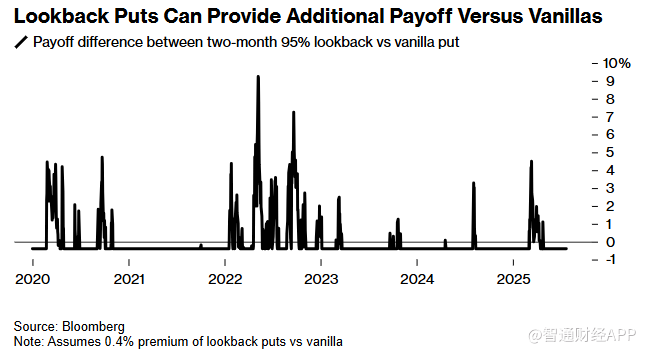
Core Insights - A "calm storm" is brewing on Wall Street as the S&P 500 index reaches new highs, with volatility indicators at multi-year lows, prompting savvy investors to consider exotic options for protection against potential market pullbacks [1][2] Group 1: Market Conditions - The S&P 500 index has steadily risen, pushing most implied and actual volatility indicators to new lows over several months [1] - Geopolitical tensions and uncertainties regarding tariffs on corporate earnings remain, contributing to a surprising decline in volatility following tariff impacts in April [1] - The resurgence of meme stocks indicates extreme investor enthusiasm, leading strategists to discuss measures to hedge against potential market corrections [1][2] Group 2: Hedging Strategies - Strategists are recommending over-the-counter alternatives, such as "backward-looking" or "resettable" put options, which dynamically adjust strike prices as the market rises [2] - JPMorgan's team noted that the premiums for these options are currently at historical lows compared to standard put options [2] - Interest in backward-looking put options is significant, as their pricing is low relative to historical standards, and their value depends on implied volatility, which is currently low [2][6] Group 3: Timing and Market Sentiment - The optimal time to buy backward-looking put options is after a market rebound followed by a decline, potentially yielding substantial additional returns compared to standard puts [6] - Interest in these hedging strategies has been reignited following recent market rebounds and volatility resets [6] - Upcoming market tests include Federal Reserve interest rate decisions, U.S. employment and GDP data, and the final deadline for tariffs, which may influence institutional investors to seek protective trades [7] Group 4: Investor Behavior - Interest in backward-looking put options is primarily from institutions outside of hedge funds, such as long-only asset management firms and private banks [7] - Hedge funds, particularly those engaged in volatility arbitrage, tend to prefer lower-cost downside strategies rather than the more expensive backward-looking options [7] - The significant decline in volatility within tech stocks has made them attractive to investors, with the Nasdaq 100's 10-day actual volatility reaching its lowest level since 2021 [7]


金融期权策略早报-20250728
Wu Kuang Qi Huo· 2025-07-28 01:18
1. Report Industry Investment Rating No relevant content provided. 2. Core Viewpoints of the Report - The stock market, including the Shanghai Composite Index, large - cap blue - chip stocks, small - and medium - cap stocks, and ChiNext stocks, shows a bullish and oscillating upward market trend [3]. - The implied volatility of financial options gradually decreases and fluctuates at a relatively low level [3]. - For ETF options, it is suitable to construct covered strategies, neutral double - selling strategies, and vertical spread combination strategies; for index options, neutral double - selling strategies and arbitrage strategies between synthetic long or short options and long or short futures are appropriate [3]. 3. Summary by Related Catalogs 3.1 Financial Market Index Overview - The Shanghai Composite Index closed at 3,593.66, down 12.07 points or 0.33%, with a trading volume of 821.6 billion yuan, a decrease of 30.6 billion yuan [4]. - The Shenzhen Component Index closed at 11,168.14, down 24.92 points or 0.22%, with a trading volume of 965.7 billion yuan, a decrease of 26.7 billion yuan [4]. - The Shanghai 50 Index closed at 2,795.51, down 16.93 points or 0.60%, with a trading volume of 114 billion yuan, a decrease of 4.1 billion yuan [4]. - The CSI 300 Index closed at 4,127.16, down 21.87 points or 0.53%, with a trading volume of 430.4 billion yuan, a decrease of 56.6 billion yuan [4]. - The CSI 500 Index closed at 6,299.59, up 5.99 points or 0.10%, with a trading volume of 304.4 billion yuan, a decrease of 15.8 billion yuan [4]. - The CSI 1000 Index closed at 6,706.61, up 5.49 points or 0.08%, with a trading volume of 363.1 billion yuan, a decrease of 11.3 billion yuan [4]. 3.2 Option - Based ETF Market Overview - The Shanghai 50 ETF closed at 2.916, down 0.017 or 0.58%, with a trading volume of 5.7256 million shares and a turnover of 1.671 billion yuan, an increase of 0.095 billion yuan [5]. - The Shanghai 300 ETF closed at 4.203, down 0.022 or 0.52%, with a trading volume of 8.2009 million shares and a turnover of 3.452 billion yuan, a decrease of 0.277 billion yuan [5]. - The Shanghai 500 ETF closed at 6.365, up 0.002 or 0.03%, with a trading volume of 3.1757 million shares and a turnover of 2.019 billion yuan, an increase of 0.71 billion yuan [5]. - The Huaxia Science and Technology Innovation 50 ETF closed at 1.109, up 0.023 or 2.12%, with a trading volume of 48.4149 million shares and a turnover of 5.301 billion yuan, an increase of 1.45 billion yuan [5]. - The E Fund Science and Technology Innovation 50 ETF closed at 1.082, up 0.022 or 2.08%, with a trading volume of 11.3537 million shares and a turnover of 1.212 billion yuan, an increase of 0.381 billion yuan [5]. - The Shenzhen 300 ETF closed at 4.338, down 0.022 or 0.50%, with a trading volume of 1.3561 million shares and a turnover of 0.589 billion yuan, a decrease of 0.018 billion yuan [5]. - The Shenzhen 500 ETF closed at 2.543, down 0.002 or 0.08%, with a trading volume of 1.7068 million shares and a turnover of 0.434 billion yuan, an increase of 0.0246 billion yuan [5]. - The Shenzhen 100 ETF closed at 2.932, down 0.014 or 0.48%, with a trading volume of 0.3065 million shares and a turnover of 0.09 billion yuan, a decrease of 0.022 billion yuan [5]. - The ChiNext ETF closed at 2.318, down 0.007 or 0.30%, with a trading volume of 7.6103 million shares and a turnover of 1.763 billion yuan, a decrease of 0.623 billion yuan [5]. 3.3 Option Factor - Volume and Position PCR - Volume and position PCR data for various option varieties are provided, which are used to describe the strength of the option underlying market and the turning point of the underlying market [6][7]. 3.4 Option Factor - Pressure and Support Points - Pressure and support points for various option varieties are determined from the strike prices with the largest open interest of call and put options [8][10]. 3.5 Option Factor - Implied Volatility - Implied volatility data for various option varieties are presented, including at - the - money implied volatility and weighted implied volatility [11][12]. 3.6 Strategies and Recommendations - The financial options sector is divided into large - cap blue - chip stocks, small - and medium - cap stocks, and ChiNext stocks. Different strategies are recommended for each sector [13]. - For example, in the financial stock sector (Shanghai 50 ETF and Shanghai 50), directional strategies include constructing bullish call option spread combinations, and volatility strategies include constructing neutral seller strategies [14]. - Similar strategy recommendations are provided for other sectors such as large - cap blue - chip stocks, small - and medium - cap stocks, and ChiNext stocks [15][16].
金属期权策略早报-20250728
Wu Kuang Qi Huo· 2025-07-28 01:12
1. Report Industry Investment Rating No relevant content provided. 2. Core Viewpoints of the Report - For non - ferrous metals, construct a seller neutral volatility strategy as they are oscillating weakly [2]. - For the black series, build a short - volatility portfolio strategy after a significant drop following continuous rise [2]. - For precious metals, construct a spot hedging strategy as they are oscillating at a high level and have declined [2]. 3. Summary by Relevant Catalogs 3.1 Futures Market Overview - Copper (CU2509) is priced at 78,800, down 530 or 0.67% with a trading volume of 8.81 million lots and an open interest of 18.08 million lots [3]. - Aluminum (AL2509) is at 20,615, down 135 or 0.65% with a volume of 14.36 million lots and an open interest of 30.20 million lots [3]. - Multiple other metal futures are also presented with their latest prices, price changes, trading volumes, and open interest [3]. 3.2 Option Factors - Quantity and Position PCR - Copper's volume PCR is 0.64 (change: 0.25), and position PCR is 0.64 (change: - 0.04) [4]. - Aluminum's volume PCR is 0.59 (change: - 0.19), and position PCR is 0.78 (change: - 0.13) [4]. - Similar data for other metal options are provided [4]. 3.3 Option Factors - Pressure and Support Levels - Copper's pressure point is 82,000 and support point is 75,000 [5]. - Aluminum's pressure point is 21,000 and support point is 20,000 [5]. - Pressure and support levels for other metals are also given [5]. 3.4 Option Factors - Implied Volatility - Copper's at - the - money implied volatility is 12.15%, weighted implied volatility is 18.78% (change: 0.15) [6]. - Aluminum's at - the - money implied volatility is 12.57%, weighted implied volatility is 14.68% (change: - 0.17) [6]. - Implied volatility data for other metals are presented [6]. 3.5 Option Strategies and Recommendations 3.5.1 Non - Ferrous Metals - **Copper**: Construct a short - volatility seller option portfolio and a spot long - hedging strategy [7]. - **Aluminum/Alumina**: Use a bull - spread strategy for call options, a short - volatility strategy, and a spot collar strategy [8][9]. - **Zinc/Lead**: Implement a bull - spread strategy for call options, a short - volatility strategy, and a spot collar strategy [9]. - **Nickel**: Build a short - volatility strategy with a bearish bias and a spot long - hedging strategy [10]. - **Tin**: Adopt a short - volatility strategy and a spot collar strategy [10]. - **Lithium Carbonate**: Use a bull - spread strategy for call options, a short - volatility strategy with a bullish bias, and a spot long - hedging strategy [11]. 3.5.2 Precious Metals - **Gold/Silver**: Construct a neutral short - volatility option seller portfolio and a spot hedging strategy [12]. 3.5.3 Black Series - **Rebar**: Build a short - volatility strategy with a neutral bias and a spot long - covered call strategy [13]. - **Iron Ore**: Use a bull - spread strategy for call options, a short - volatility strategy with a bullish bias, and a spot long - collar strategy [13]. - **Ferroalloys**: Implement a bull - spread strategy for call options and a short - volatility strategy [14]. - **Industrial Silicon/Polysilicon**: Build a short - volatility strategy and a spot long - hedging strategy [14]. - **Glass**: Adopt a short - volatility strategy and a spot long - collar strategy [15].