
碳中和

Search documents
首相8年来首次访华,英国商界有何期待?
2 1 Shi Ji Jing Ji Bao Dao· 2026-01-30 04:19
南方财经 21世纪经济报道郑青亭 对英国商界来说,此次访问有何意义?中英商业合作有哪些机遇?英国企业如何看待中国市场和中国合 作伙伴?针对这些问题,1月29日,21世纪经济报道记者与吴思田、杰克逊展开了一场对话。 英国服务业在华迎来机遇 21世纪: 首先,让我们来谈谈英国首相斯塔默此次访华对中英双边关系的意义。你们愿意分别分享一 下看法吗? 吴思田: 这显然是英方特别是首相本人对两国关系充满信心的重大宣示。他本人已明确表达了这一 点。同时,随行的60家英国顶尖企业和机构也表明,大家看到了未来几年进一步拓展商业关系的巨大潜 力。作为英中贸易协会(CBBC)主席,我们对这次充满信心的访问感到非常高兴。 杰克逊: 在我看来,英中企业间的合作一直在持续,因为我们拥有大量对彼此都具有价值的创新、产 品和服务。而政治层面协作的加强,能为我们共同推进更多事务提供更稳定、更可靠的基础。因此,我 对此次访问感到非常兴奋。 21世纪: 你们第一次访问中国是什么时候?自那时起,对中国的印象有何变化? 杰克逊: 我第一次来中国是两年前,参观了华为在广东的研发中心。那次访问让我亲眼看到了中国在 新技术开发上的巨大投入。我意识到,如果我 ...
中英汽车合作,将为双方经济增长带来哪些新利好?
Zhong Guo Qi Che Bao Wang· 2026-01-30 03:38
"中英两国务实合作充满活力。"近日,正当英国捷豹路虎、劳斯莱斯等汽车品牌跟随英国官方代表 团访华寻求新的合作之际,商务部新闻发言人就中英经贸合作情况的回应,表明了清晰的态度。 合作发展绿色经济 中英经贸关系保持健康稳定发展,汽车合作也有更大空间。 商务部发布的数据显示,2025年,中英双边货物贸易额达到1037亿美元,服务贸易额有望突破300 亿美元,双向投资存量近680亿美元。英国分别担任第二十五届投洽会、第四届消博会主宾国。 当前,全球汽车产业正处于深刻变革的十字路口,电动化与低碳化转型成为不可阻挡的时代潮流。 在这一变革进程中,中国凭借较为完备的产业体系、日益增强的技术研发能力,以及庞大的市场需求, 已然稳居全球最大新能源汽车生产与消费国的宝座,在新能源汽车领域积累的技术与产能优势,吸引着 全球行业的目光。而英国,近年来积极推行绿色经济政策,在新能源汽车研发、智能网联技术等领域也 在持续发力,一些汽车企业期待与中国汽车企业合作,已经成为一种现实需求。 有舆论认为,双方一定程度上有良好的产业互补、双向赋能的优势,合作也将为双方激活产业链新 动能,撬动绿色经济转型加速驰骋。 客观上看,在全球绿色经济转型的时 ...


《分布式能源规划员》(综合能源服务方向)培训通知丨系列培训
中国能源报· 2026-01-30 03:20
二、培训组织机构 主办单位: 人力资源和社会保障部 社会保障能力建设 中心 关于 举办 《分布式能源规划员》(综合能源服务方向)培训通知 各企事业单位: 《中华人民共和国能源法》 提出,鼓励发展分布式能源和多能互补、多能联供综合能源 服务,提高终端消费清洁化、高效化、智能化水平。多能联供综合能源服务 成为现代能 源产业发展的重要方向和实现碳中和的重要路径。 电力、冷热、用户之间的关系变得越来越紧密,打破不同能源品种单独规划、设计、运行 的传统模式,实现横向 "电热冷气水"能源多品种之间、纵向"源网荷储用"能源多供应环 节之间的协同,以及生产侧和消费侧的互动 ,正成为行业趋势。 目前,在我国熟悉用户用能特性,掌握能源规划、转化、智能控制等技术,并具备能效 碳排放 评估,通晓末端节能 减碳 、投资、建设、运营等跨 学科专 业 应用 人才匮乏, 严重影响各能源企业向综合能源服务转型和发展的进程。为此,中国能源报社 特 开 展 《分布式能源规划员》(综合能源服务方向)培训 ,参加培训并经考核合格者,由人力资 源和社会保障部 社会保障能力建设 中 心 颁 发 《 分 布 式 能 源 规 划员 》 (综 合 能 源 服 ...

能源消费结构深层变革,电力结构转型率先垂范
Hua Tai Qi Huo· 2026-01-30 00:46
Report Industry Investment Rating - Not provided in the content Core Viewpoints - From 2020 - 2024, due to the pandemic, global energy consumption declined in 2020 and grew from 2021 - 2024. Renewable energy (excluding hydropower) consumption increased rapidly, substituting fossil energy. The proportion of renewable energy in global primary energy consumption rose from about 6% in 2020 to about 9% in 2024. The proportions of hydropower and nuclear power remained stable at around 7% and 4% respectively. The proportion of oil remained at around 31%, while that of natural gas dropped from about 25% to about 23%, and coal from about 27% to about 26% [3]. - China's primary energy consumption structure changed more significantly than the global average, with a higher growth in total energy consumption and a more prominent renewable energy substitution rate. The proportion of renewable energy in China's primary energy consumption increased from about 6% in 2020 to about 11% in 2024. Nuclear power accounted for about 2%, and hydropower decreased from about 8% to about 7%. Coal dropped from about 56% to about 52%, oil from about 20% to about 18%, and natural gas increased from about 8% to about 9% [4]. - In the future, the global energy structure transformation path is clear, but there are many uncertainties. Renewable energy will continue to develop, and nuclear energy will grow slowly. Global coal consumption is likely to peak before 2030 and decline after 2035. Oil and natural gas consumption will maintain slight growth. China's energy consumption structure adjustment may be faster than the global average. Chinese coal - fired power generation's coal consumption peaked in 2025, coal consumption may enter a plateau or decline, oil consumption will gradually decrease, natural gas will grow, and nuclear energy will have moderate growth. Renewable energy will be the main force in China's energy transformation [5][6]. - Global electricity energy consumption has changed better than primary energy consumption. Although fossil - fuel power generation still dominates, renewable energy power generation such as wind and solar is growing rapidly and has become the second - largest power generation source. China's power structure reform is faster. In 2025, fossil - fuel power generation peaked, and the proportion of wind and solar power is increasing. In the future, by 2050, global power generation will double compared to 2025, with solar being the largest growth driver and wind being the second. Non - fossil energy power generation will dominate the global power market around 2035, and renewable energy will account for half of the market by 2050. In China, power generation will maintain medium - to - high - speed growth in the next decade, with 80% of the new power generation coming from wind and solar by 2030 [6][7]. - The change in power generation mode is based on the change in installed capacity. Currently, the most significant change in global power generation installed capacity is in wind and solar, with China leading in both growth and scale. From 2020 - 2024, the new installed capacity of solar reached 1272GW, a 210% increase compared to 2015 - 2019, and wind reached 485GW, a 73% increase. China accounted for about 43% of the global new installed capacity of both solar and wind. In the future, global renewable energy power generation's new installed capacity will continue to grow. In China, the installed capacity of renewable energy will also grow rapidly, and by 2035, the combined installed capacity of wind and solar will reach 3.6 billion kilowatts [8][9]. Summary by Directory 1. Preface - Facing global warming caused by industrialization, countries aim to reduce emissions. However, the actual effect of global energy conservation and emission reduction in the past decade is not satisfactory. On one hand, the growth of emerging economies leads to increased energy consumption, and the economy of renewable energy is still inferior to fossil energy. On the other hand, geopolitical instability makes countries focus on fossil energy supply stability [17]. 2. Fossil Energy Still Dominates, and China's Energy Consumption Transformation Accelerates - Globally from 2020 - 2024, renewable energy (excluding hydropower) consumption increased rapidly and substituted fossil energy, while hydropower and nuclear power development was slow, and their proportions remained stable. Oil's proportion remained at around 31%, natural gas dropped from about 25% to about 23%, and coal from about 27% to about 26% [18]. - China's energy consumption structure changed more significantly. Renewable energy accounted for about 11% in 2024, up from about 6% in 2020. Nuclear power accounted for about 2%, and hydropower decreased from about 8% to about 7%. Coal dropped from about 56% to about 52%, oil from about 20% to about 18%, and natural gas increased from about 8% to about 9% [38][46]. 3. The Path of Energy Structure Transformation is Uncertain, and China Continues to Accelerate the Transformation - In the future, global renewable energy will continue to develop, and nuclear energy will grow slowly. Global coal consumption is likely to peak before 2030 and decline after 2035. Oil and natural gas consumption will maintain slight growth [55]. - China's energy consumption structure adjustment may be faster. Coal consumption may enter a plateau or decline, oil consumption will decrease, natural gas will grow, and nuclear energy will have moderate growth. Renewable energy will be the main force in China's energy transformation [57]. 4. Global Power Structure Reform is Remarkable, and the Development Paths of China, the US, and Europe are Different - The global power industry's energy consumption change is better than that of primary energy. From 2020 - 2024, global power generation grew at an average rate of over 3%, with wind power growing at over 15% and solar power approaching 40%. Fossil - fuel power generation's proportion decreased by 4.5%, and renewable energy power generation increased [61][62]. - In Europe, as of Q3 2025, fossil - fuel power generation accounted for about 34%, and renewable energy power generation increased. Europe is reducing fossil - fuel power generation and increasing renewable energy [74]. - In the US, as of Q3 2025, fossil - fuel power generation accounted for about 58%. The US mainly uses gas - fired power, and data center construction has promoted the spread of solar power [85][87]. - China's power structure reform is faster. As of Q3 2025, fossil - fuel power generation accounted for less than 60%. Wind and solar power are growing rapidly, and fossil - fuel power generation will change its role in the power market [94]. 5. Green Energy Power Generation is Expected to Explode, and China will Take the Lead in Completing Power Reform - By 2050, global power generation will double compared to 2025, with solar and wind being the main growth drivers. Non - fossil energy power generation will dominate around 2035, and renewable energy will account for half of the market by 2050 [107]. - In the next decade, China's power generation will maintain medium - to - high - speed growth. After coal - fired power generation peaks, new power generation will come from non - fossil energy, with 80% from wind and solar by 2030 [109]. 6. New Solar PV Installed Capacity Ranks First, and China Leads in Wind and Solar Installed Capacity - From 2020 - 2024, the new installed capacity of solar reached 1272GW, a 210% increase compared to 2015 - 2019, and wind reached 485GW, a 73% increase. China accounted for about 43% of the global new installed capacity of both solar and wind [113][123]. - In China, the new installed capacity mainly concentrated on wind, solar, and thermal power in the past five years. Solar had the fastest growth, followed by wind, accounting for 70% - 80% of the new capacity. Currently, wind and solar account for about 47% of the installed capacity, thermal power about 40%, and hydropower about 12% [129]. 7. Global Green Power Installed Capacity Increases Vigorously, and China's Wind Power Installed Capacity is Expected to Accelerate - In the future, global renewable energy power generation's new installed capacity will continue to grow. The average new annual installed capacity of solar will be 540GW, wind 150GW, and coal - fired power about 55GW in the next decade [139]. - In China, the installed capacity of renewable energy will grow rapidly. By 2035, the combined installed capacity of wind and solar will reach 3.6 billion kilowatts, with wind growing faster. Distributed solar will also grow explosively. In the short term, thermal power installed capacity still has growth demand [141]. 8. Summary - Global energy consumption and power supply structures need in - depth transformation, and China is at the forefront. However, the reform path is uncertain due to power demand growth and the stability requirements of the power market. Power market transformation requires the cooperation of the power grid, energy storage, and end - users [146].
昆仑新能源转战港交所 净利尚未扭亏
Bei Jing Shang Bao· 2026-01-29 16:07
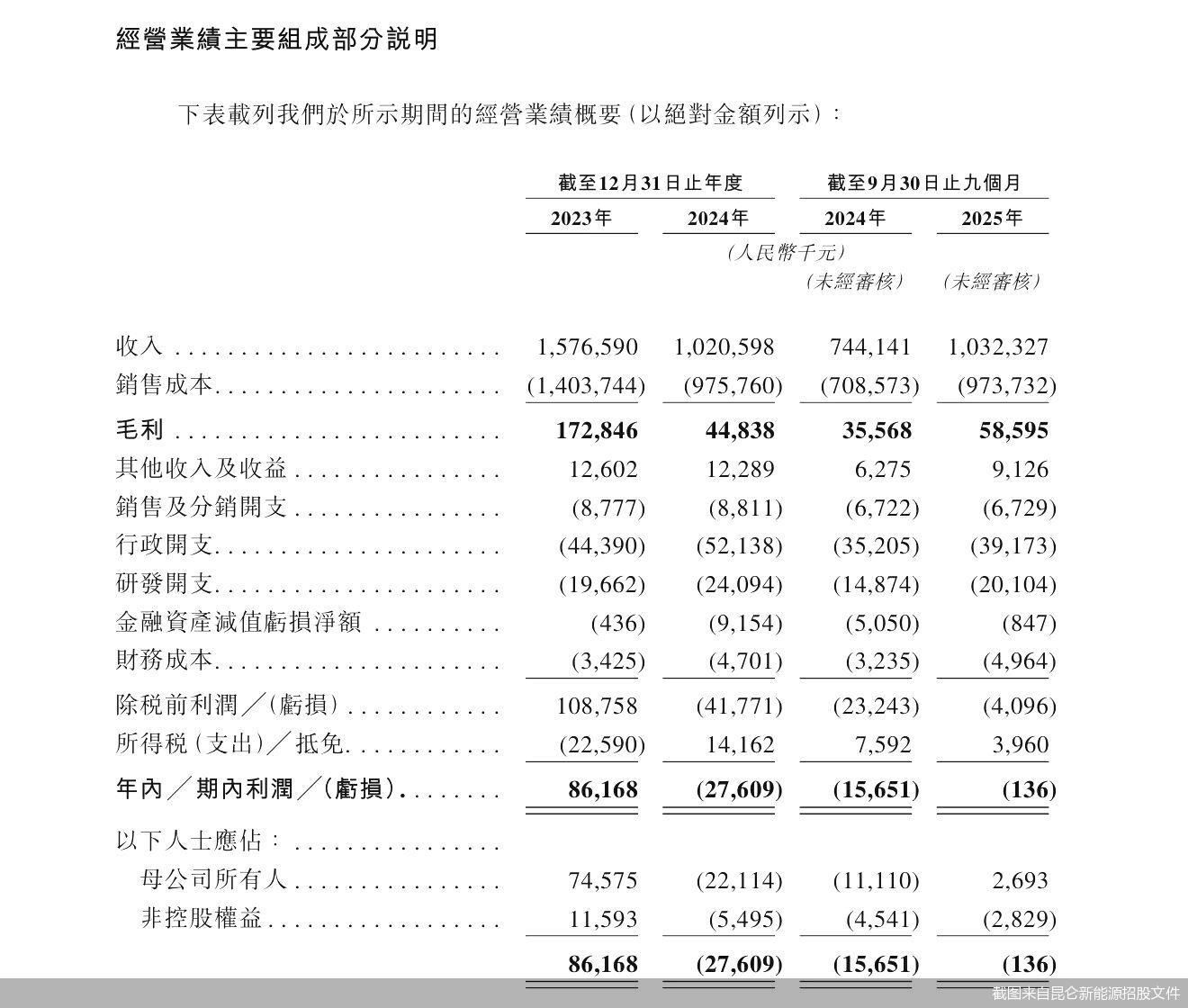
Core Viewpoint - Kunlun New Energy Materials Technology (Yichang) Co., Ltd. is shifting its focus to the Hong Kong stock market for its IPO after previously withdrawing its application for the ChiNext board, despite facing significant financial challenges in 2024, including a substantial drop in revenue and a transition from profit to loss [1][2]. Financial Performance - In 2023, the company reported revenues of approximately 1.577 billion yuan, which decreased to about 1.021 billion yuan in 2024, resulting in a net profit of 86.17 million yuan in 2023 turning into a loss of 27.61 million yuan in 2024 [2][3]. - For the first three quarters of 2025, the company achieved revenues of 1.032 billion yuan, an increase from 744 million yuan in the same period of the previous year, with a reduced net loss of approximately 13,600 yuan compared to a loss of 15.65 million yuan in the prior year [3]. Product Pricing and Sales - The average selling price of the company's main product, electrolyte, has significantly decreased, with prices dropping from 30,000 yuan per ton in 2023 to 14,000 yuan per ton in the first three quarters of 2025 [4]. - The sales revenue from electrolytes constituted about 99.6%, 99%, and 98.9% of the company's total revenue for 2023, 2024, and the first three quarters of 2025, respectively [4]. Customer Concentration - The company has a high customer concentration, with the top five customers accounting for 82.1%, 73%, and 73% of total revenue in 2023, 2024, and the first three quarters of 2025, respectively [7]. - Group A, the company's largest customer, contributed approximately 60.1%, 59.3%, and 49.6% of total revenue during the same periods [7][6]. Market Position and Strategy - Kunlun New Energy is ranked third globally among electrolyte suppliers by shipment volume for the first three quarters of 2025 [2]. - The company has primarily focused on the domestic market, with over 99% of its revenue coming from sales to mainland China during the reporting periods [5]. IPO Context - The shift from attempting to list on the ChiNext board to the Hong Kong stock market may indicate a strategic pivot towards international customers and a pressing need for financing [8].
华为向宁德时代出售数字能源业务?双方均未正面回应
Nan Fang Du Shi Bao· 2026-01-29 12:13
Core Viewpoint - There are rumors regarding Huawei's digital energy business being sold, potentially to CATL and local state-owned enterprises, but no official confirmation has been provided [1][3][4] Group 1: Huawei's Digital Energy Business - Huawei's digital energy business is considered a key growth area, with projected revenue of 68.68 billion yuan in 2024, reflecting a 24.4% year-on-year increase [3] - The business has shown resilience against sanctions, maintaining a leading position in the global market for smart photovoltaic inverters for ten consecutive years [4] - Huawei has made significant investments in digital energy projects, including a 4 billion yuan investment in a headquarters for digital energy technology [4] Group 2: CATL's Strategic Needs - The rumors of CATL acquiring Huawei's digital energy business stem from its need to address competitive pressures in the energy storage industry and to fill gaps in its business model [7][9] - CATL holds a dominant position in the battery and energy cell market, with a 25% market share, but lacks a strong presence in the energy system integration sector [7] - The trend of "integrated solar and storage" is becoming crucial, and CATL risks falling behind if it does not enhance its system integration capabilities [8][9] Group 3: Market Dynamics - The energy storage market is experiencing rapid growth, with global energy storage cell shipments reaching 410.45 GWh in the first three quarters of 2025, a 98.5% increase [7] - Companies like Trina Solar and JinkoSolar are rapidly expanding their energy storage businesses, posing a challenge to current market leaders [8] - Huawei's digital energy business could provide CATL with the necessary technology and market access to enhance its competitive position in the integrated energy solutions market [9]

再谋上市!昆仑新能源“转战”港交所,近半营收来自集团A
Bei Jing Shang Bao· 2026-01-29 12:04
Core Viewpoint - Kunlun New Energy Materials Technology Co., Ltd. is shifting its focus to the Hong Kong stock market for an IPO after its previous attempt on the ChiNext was halted. However, the company faced significant challenges in 2024, with a sharp decline in revenue and a transition from profit to loss, although losses narrowed in the first three quarters of 2025 [1][3]. Group 1: Financial Performance - In 2023, the company reported revenue of approximately 1.576 billion RMB, which dropped to about 1.021 billion RMB in 2024, and further to around 744.1 million RMB in the first three quarters of 2024 [2]. - The net profit for 2023 was approximately 86.17 million RMB, which turned into a loss of about 27.61 million RMB in 2024. In the first three quarters of 2025, the loss was reduced to approximately 15.65 million RMB [2][3]. - For the first three quarters of 2025, the company achieved revenue of approximately 1.032 billion RMB, an increase from 744.1 million RMB in the same period of the previous year, with a significantly reduced loss of about 136,000 RMB compared to a loss of 15.65 million RMB in the previous year [4]. Group 2: Product Pricing and Market Dynamics - The average selling price of the company's main product, electrolyte, has significantly decreased, with prices dropping from 30,000 RMB/ton in 2023 to 14,000 RMB/ton in the first three quarters of 2025 [5]. - The sales revenue from electrolyte products accounted for approximately 99.6%, 99%, and 98.9% of total revenue in 2023, 2024, and the first three quarters of 2025, respectively [5]. Group 3: Customer Concentration - The company has a high customer concentration, with the top five customers accounting for 82.1%, 73%, and 73% of total revenue in 2023, 2024, and the first three quarters of 2025, respectively [7]. - Group A, the company's largest customer, contributed approximately 60.1%, 59.3%, and 49.6% of total revenue in the respective periods [7][8]. Group 4: IPO Context and Strategy - The company previously attempted to list on the ChiNext but withdrew its application in May 2024. The shift to the Hong Kong market is seen as a strategic move to access international capital and address urgent financing needs [8]. - The company has primarily focused on domestic sales, with over 99% of revenue coming from mainland China during the reporting periods [6].
3月19-20日 常州!2026锂电关键材料及应用市场高峰论坛
鑫椤锂电· 2026-01-29 08:00
Core Viewpoint - The lithium battery industry is poised for a significant growth cycle starting in 2026, characterized by strong demand recovery, accelerated global expansion, and disruptive technological advancements, leading to a "spiral rise" in both volume and price [3]. Group 1: Market Predictions - By 2025, global lithium battery production is expected to reach 2250 GWh, with a growth rate of 30% in 2026, and the energy storage sector projected to grow at an impressive 48.3% [5]. - The demand surge will create substantial pressure on the supply of battery cells and four key upstream materials, highlighting a potential supply gap that needs to be addressed for stable and efficient supply chains [5]. Group 2: Conference Details - The 2026 Lithium Key Materials and Application Market Summit will be held on March 19-20, 2026, in Changzhou, Jiangsu, organized by Xinluo Information [4]. - The summit will focus on three core topics: in-depth discussions on cutting-edge technologies and market supply-demand dynamics, B2B procurement matching, and strategic insights for high-quality development in the lithium battery industry [5][6]. Group 3: Key Discussion Topics - The conference will feature discussions on lithium carbonate futures and options, market volatility responses from lithium battery companies, and the potential of global lithium resources in 2026 [7]. - Other topics include the opportunities presented by solid-state battery development for lithium salt companies and the practical aspects of lithium carbonate futures and supply-demand outlooks [7][8]. Group 4: Industry Collaboration - The summit aims to facilitate B2B procurement connections among top global battery companies and material suppliers, covering the entire supply chain from cathode materials to electrolytes [6]. - It will also provide authoritative data releases, benchmark company rankings, and deep industry connections to help businesses seize growth opportunities in the lithium battery sector [6].






三一重工入股催肥业绩 绿控传动二度闯关IPO巨头依赖症难解
工程机械杂志· 2026-01-29 05:44
Core Viewpoint - The article discusses the resurgence of Green Control Transmission as it aims to go public on the ChiNext board, highlighting its significant revenue growth and the associated risks of customer concentration and cash flow issues [4][5][10]. Group 1: Company Overview - Green Control Transmission first attempted to enter the Sci-Tech Innovation Board in December 2022 but withdrew in March 2023. After nearly two years, it is now targeting the ChiNext board with a revised fundraising goal of 1.58 billion yuan [1][2]. - The company has shown a remarkable turnaround in performance, with revenue increasing from 712 million yuan in 2022 to 1.219 billion yuan in the first half of 2025, and net profit shifting from a loss of 99.43 million yuan to a profit of 68.30 million yuan during the same period [4]. Group 2: Market Position and Growth Drivers - The growth in Green Control Transmission's performance is attributed to the national strategy of "carbon peak and carbon neutrality," which has driven demand for new energy commercial vehicles due to stricter emissions standards and technological advancements [4]. - The company has established strong ties with industry giants like SANY Group and XCMG Group, which are not only major customers but also shareholders, contributing over 40% of its revenue in 2024 [4][6]. Group 3: Customer Concentration Risks - Green Control Transmission's revenue is highly concentrated, with the top five customers accounting for approximately 60% of total revenue, raising concerns about dependency on a limited customer base [5][8]. - The company reported that accounts receivable reached 833 million yuan by June 2025, representing 27.13% of total assets, indicating a potential liquidity risk [5][9]. Group 4: Financial Health and Cash Flow Issues - Despite revenue growth, Green Control Transmission faces challenges with cash flow, as evidenced by negative net cash flow from operating activities totaling -538 million yuan from 2022 to the first half of 2025 [9][10]. - The company's debt levels have increased, with short-term loans rising from 390 million yuan in 2022 to 587 million yuan in the first half of 2025, and total liabilities increasing the asset-liability ratio from 69.54% to 73.41% [10]. Group 5: Future Prospects and IPO Plans - Green Control Transmission plans to raise 1.58 billion yuan through its IPO, with 1.38 billion yuan allocated to expand production capacity for new energy commercial vehicle drive systems [10][11]. - The company acknowledges potential market risks associated with its expansion plans, including changes in market conditions, technology, or industry policies that could affect the absorption of new capacity [11].
岳阳林纸20260128
2026-01-29 02:43
Summary of the Conference Call for Yueyang Forest and Paper (岳阳林纸) Company Overview - **Company**: Yueyang Forest and Paper - **Industry**: Forestry Carbon Credits and Paper Manufacturing Key Points Impact of Contract Termination - The termination of the carbon credit contract in Tibet has a minimal impact on the overall carbon credit business of the company, which still holds approximately 100 million acres of forestry carbon credit contracts, with a total signed area of 160 million acres, where Tibet accounts for only about 2% [2][4][5] - The company is actively expanding into farmland and grassland carbon credit resources, with signed areas of 8 million acres and 2 million acres respectively [4] Market Potential and Trends - The domestic forestry carbon credit market has significant potential, driven by increasing global green certification demands and rising zero-carbon certification needs from Chinese manufacturing [2] - The price of green certificates has shown an upward trend, expected to rise from 1-2 RMB in 2024 to 5-6 RMB in 2025 [9] International Market Opportunities - The company is aligning its carbon development standards with EU and US standards to meet international market demands, focusing on high-quality products that comply with multiple certification systems [2][11] - There is a strong demand for high-quality carbon credits (e.g., VCS and GS) from Chinese manufacturing enterprises, with annual demand projected to reach millions of tons [16][17] Future Developments in Carbon Market - The steel, construction materials, and cement industries are expected to be included in the domestic carbon emission system by 2026-2027, which will significantly boost the overall carbon market in China [18] - The anticipated annual demand from these sectors is estimated to be between 10 million to 20 million tons, with a growth rate of 20% to 30% [18] Financial Performance and Projections - In 2025, the company faced challenges due to increased costs from boiler adjustments and losses in landscaping business, leading to an additional expenditure of approximately 400 to 500 million RMB [22] - For 2026, the company expects to achieve a profit of 200 to 300 million RMB through internal improvements and energy enhancements, with a stable profit forecast of over 400 million RMB from its subsidiary [23][24] Strategic Expansion Plans - The company plans to develop high-quality carbon assets in "Belt and Road" countries, prioritizing its own stock assets and focusing on high-value projects such as soil and biomass carbon [25] - Market research has been conducted in regions like Africa, Cambodia, and Nigeria, with expectations of developing tens of thousands of tons annually at premium prices [25] Investor Engagement - The company will conduct research activities and site visits to engage investors and provide updates on its market performance and developments in new fiber pulp markets [27] Conclusion - The company is well-positioned to navigate the evolving carbon credit landscape, with strategic plans for expansion and a focus on high-quality products to meet both domestic and international demands. The anticipated regulatory changes and market dynamics present significant opportunities for growth in the coming years.
