AI编程

Search documents
年化收入超5亿,“AI编程独角兽”Cursor开发商估值已达99亿美元
Hua Er Jie Jian Wen· 2025-06-06 03:22
Group 1 - Anysphere, the developer of AI programming assistant Cursor, has rapidly emerged in the AI tools sector, completing a $900 million funding round in June 2023, raising its valuation to $9.9 billion [1] - This funding round was led by existing investor Thrive Capital, with participation from notable firms such as a16z and Accel, marking the company's third financing round in less than a year [1] - Anysphere's annual recurring revenue (ARR) has shown remarkable growth, doubling approximately every two months, surpassing $500 million by June 2025, a 60% increase from $300 million disclosed in mid-April [1] Group 2 - The core driver of Anysphere's explosive growth is its AI code editing software, Cursor, which has sparked a trend known as "Vibe Coding," making the programming process smoother and more conversational [2] - Cursor has significantly enhanced developer efficiency through features such as intelligent intent prediction, natural language interaction, and seamless integration with existing workflows [4] - Anysphere has successfully innovated its business model by introducing a $40/month enterprise licensing model, allowing companies to purchase team licenses, which has increased average revenue per user and reduced customer acquisition costs [2] Group 3 - Cursor has attracted over 30,000 paying enterprise customers, demonstrating its strong market demand and acceptance among developers [2] - The rapid rise of Anysphere has caught the attention of industry giants, with OpenAI reportedly making acquisition offers that were declined, leading OpenAI to acquire a competitor for approximately $3 billion [2]
专家访谈汇总:台积电2nm良率突破90%
阿尔法工场研究院· 2025-06-05 22:10
Group 1: 5G and 6G Technology Transition - By 2025, the Chinese network connection device market is expected to reach 120 billion RMB, with an annual growth rate of 15%, and to exceed 210 billion RMB by 2030, with a CAGR of 11.8% [1] - Domestic companies like Huawei and Unisoc have made breakthroughs in 5G baseband and Wi-Fi 6/7 chips, but still rely on imported advanced processes below 7nm [1] - The global market share for domestic companies is projected to reach 30%, with significant advantages in 5G base stations and all-optical networks [1] Group 2: Motorcycle Industry Analysis - The motorcycle industry, while less focused on than automobiles and commercial aircraft, has a market size second only to these sectors, with China holding a significant position [2] - China is the largest motorcycle producer globally, with over 5 million units sold domestically and over 10 million exported annually, accounting for more than 30% of the global market [2] - Domestic motorcycle brands have improved their technology and product quality, particularly in the large-displacement motorcycle market, gradually surpassing joint venture brands [4] Group 3: Windsurf Acquisition and AI Coding Market - Windsurf, initially a GPU virtualization startup, transformed into an AI programming platform in 2022, attracting many developers [3] - OpenAI's planned acquisition of Windsurf for $3 billion in April 2023 faced challenges due to restrictions on access to the Claude model, impacting user experience [3] - The AI programming market is becoming increasingly competitive, with platforms like GitHub Copilot and Cursor still supporting the Claude model, but facing potential limitations due to tensions between OpenAI and Anthropic [3] Group 4: Huawei WATCH 5 Launch - Huawei's upcoming WATCH 5 is set to be the world's first 5G-enabled smartwatch, featuring a new Kirin chip and 5G eSIM communication module for high-speed connectivity [4][5] - The device supports dual-engine computing, offering powerful performance in "full mode" and extended battery life in "power-saving mode" [4] - The WATCH 5 also incorporates advanced features like Star Flash technology for improved connectivity and a smart assistant for precise health monitoring [6][7] Group 5: TSMC 2nm Process Yield - TSMC's 2nm process yield improved from 60% to 90% since risk production began in July 2023, leveraging experience from 3nm production [8] - By the end of 2025, TSMC is expected to produce 50,000 to 80,000 2nm wafers monthly, with demand significantly outpacing that for 5nm [8] - The N2 process offers a 10-15% performance increase at the same power level or a 25-30% power reduction at the same performance level, with a 1.7x increase in transistor density [8]


5 万行代码 Vibe Coding 实践复盘:最佳实践、关键技术,Bitter Lesson
海外独角兽· 2025-06-05 11:00
Core Viewpoint - The article discusses the transformative potential of AI coding agents, highlighting their ability to generate code and automate programming tasks, thus enabling even those without extensive coding experience to become proficient developers [3][6]. Group 1: My Vibe Coding Journey - Vibe Coding refers to the practice of using coding agents to generate nearly 100% of the code, with tools like Cursor, Cline, and GitHub Copilot being popular choices [7]. - The author completed approximately 50,000 lines of code over three months, successfully developing three different products, demonstrating the effectiveness of AI in coding [8][9]. - The experience revealed that a lack of prior knowledge in certain programming languages can be advantageous when relying on AI, as it necessitates full dependence on the coding agent [8]. Group 2: Key Technologies of Coding Agents - Key coding agents include Cursor, Cline, GitHub Copilot, and Windsurf, with a strong emphasis on using the agent mode for optimal performance [13][14]. - The effectiveness of coding agents relies on three critical components: a powerful AI model, sufficient context, and an efficient toolchain [15][18]. - The article emphasizes the importance of providing clear and comprehensive context to the AI for successful task execution [11][12]. Group 3: Comparison of Coding Agents - Cursor is highlighted as the current leader in the coding agent space, particularly when using the Claude 3.7 Max model, capable of generating 100% of the code for large projects [44]. - Cline is noted for its open-source nature and superior support for the Model Context Protocol (MCP), but it lacks semantic search capabilities, which limits its effectiveness in handling large codebases [45]. - GitHub Copilot is seen as lagging behind in context management and MCP support, but it has the potential to catch up due to Microsoft's strong development capabilities [46]. Group 4: The Bitter Lesson in Agent Development - The article references "The Bitter Lesson," which suggests that embedding too much human experience into AI systems can limit their potential, advocating for a design that allows AI capabilities to dominate [47][48]. - The author’s experience indicates that reducing human input in favor of AI-driven processes can significantly enhance product performance, achieving a test coverage rate of over 99% [48].

OpenAI收购的编程平台,被Claude突然断供?
Hu Xiu· 2025-06-04 11:46
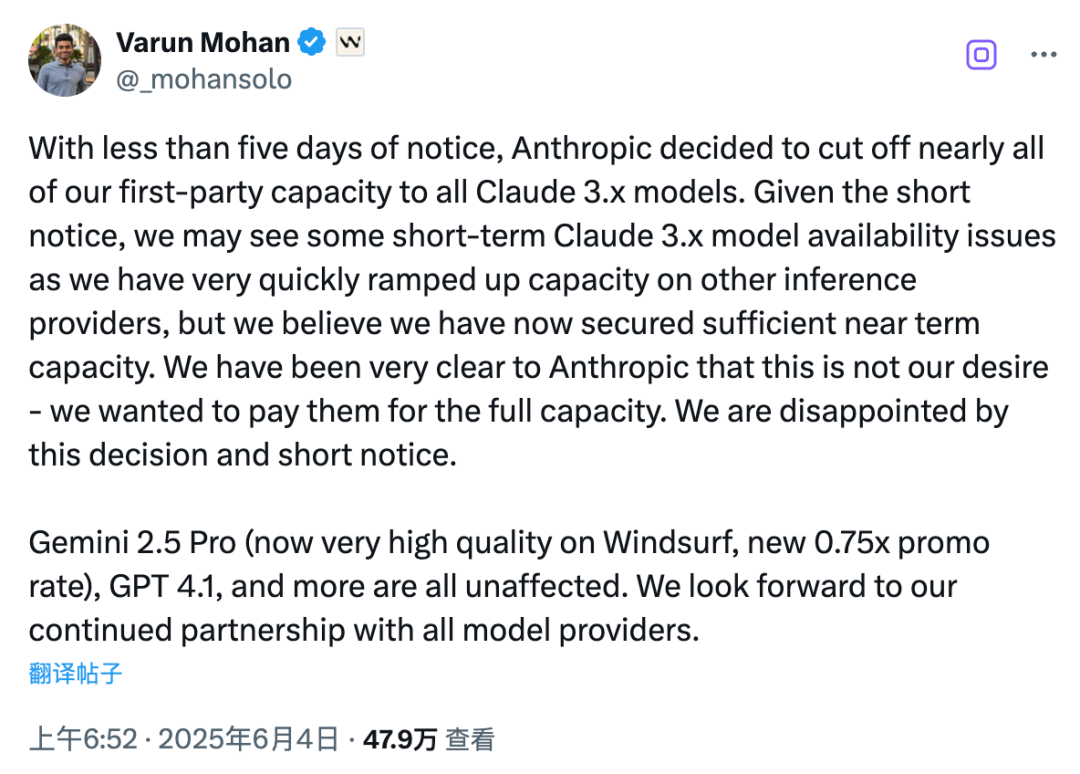
Core Viewpoint - Windsurf, an AI programming platform, is facing significant challenges due to Anthropic's abrupt cut-off of its Claude 3.x model access, which may impact its user capacity and overall service delivery [2][3][13]. Group 1: Company Developments - Windsurf was recently reported to be acquired by OpenAI for $3 billion, gaining considerable attention in the industry [1]. - CEO Varun Mohan expressed concerns over Anthropic's decision to limit access to its models, which could harm not only Windsurf but the entire industry [7][8]. - Despite the challenges, Windsurf has launched an emergency plan allowing access to Claude Sonnet 4 through self-provided keys [4]. Group 2: User Impact and Service Adjustments - Users may experience capacity issues with Claude 3.x models in the short term until new capacities are established, but overall service is expected to gradually improve [5]. - Windsurf has stopped providing direct access to Claude 3.x models for free users but has introduced a BYOK (Bring Your Own Key) option for accessing these models [5]. Group 3: Competitive Landscape - Anthropic's recent actions suggest a shift in strategy, as it aims to compete directly in the AI programming space with its own applications like Claude Code [20][21]. - Windsurf's transition from GPU virtualization to AI programming tools highlights its evolution in the competitive landscape, emphasizing deep collaboration between developers and AI [23]. Group 4: Financial Performance and Growth - Windsurf has shown strong growth, with an annual recurring revenue (ARR) exceeding $100 million and a user base of over 1 million within four months [24]. - The company has introduced its own AI model, SWE-1, which performs comparably to existing models while being more user-friendly and cost-effective [16][17]. Group 5: Industry Context - The recent disruptions in model access reflect broader industry dynamics, where companies like Windsurf rely on stable, callable large model interfaces to deliver their services [26]. - The ongoing situation raises questions about whether AI products will prioritize foundational models or focus on user experience and ecosystem integration [29].
Windsurf 突遭 Claude 断供,创始人发文控诉
Founder Park· 2025-06-04 11:39
Core Viewpoint - The AI programming tool Windsurf is facing significant challenges due to a sudden reduction in service quotas for its Claude models by Anthropic, which has forced Windsurf to seek third-party inference services to maintain user experience [1][8][11]. Group 1: Windsurf's Response and Challenges - Windsurf expressed strong dissatisfaction with Anthropic's abrupt decision to cut off service resources, which they claim could negatively impact not only their company but the industry as a whole [5][11]. - The company is actively seeking additional resources from other model providers while emphasizing their commitment to maintaining access to Anthropic's models and their willingness to pay for service resources [9][10]. - Users may experience temporary resource shortages while Windsurf works to increase capacity, but the overall impact is deemed manageable [12]. Group 2: Competitive Landscape - The AI-assisted coding sector is becoming increasingly competitive, with Windsurf's annual recurring revenue (ARR) reaching $100 million in April, indicating rapid growth as it attempts to catch up with competitors like Cursor and GitHub Copilot [28]. - Windsurf's inability to access Anthropic's new models could hinder its growth momentum, especially as competitors like Cursor have already gained access to the latest Claude 4 model [29][13]. - Anthropic is prioritizing service resources for partners that ensure ongoing collaboration, which may further disadvantage Windsurf in the competitive landscape [26]. Group 3: Product Developments - Windsurf has launched its own large model series, SWE-1, in mid-August, which may provide an alternative for users during this transitional period [30]. - The introduction of Claude 4 has led some users, such as those focused on Apple's Swift programming language, to switch to Cursor for better collaboration capabilities [17].

科技周报|宇树格斗大赛开打;美的董事长回应家电行业竞争
Di Yi Cai Jing· 2025-06-01 04:50
Group 1: Robotics and Technology - The world's first humanoid robot fighting competition, "CMG World Robot Competition Series," commenced in Hangzhou, featuring four teams controlling the Yushu G1 robot in a twelve-round match [1] - Yushu Technology has rebranded from "Hangzhou Yushu Technology Co., Ltd." to "Hangzhou Yushu Technology Co., Ltd." to support its growth [1] - The industry is expected to experience a "fighting trend," as more complex combat scenarios are introduced to attract attention [1] Group 2: Home Appliances - Midea Group's chairman, Fang Hongbo, stated that entering the home appliance industry now is strategically disadvantageous due to high competition and limited growth potential [2] - The home appliance sector is characterized by fixed competitive strategies and has not produced high-tech companies recently [2] - Midea is focusing on transforming its domestic market approach and expanding its ToB business to create new growth avenues [2] Group 3: AI Development - ByteDance announced a ban on third-party AI programming tools, including Cursor and Windsurf, starting June 30, to mitigate data leakage risks [3] - The company will use its in-house AI programming tool, Trae, as a replacement [3] - The move reflects a broader trend among tech giants to prioritize data security and compliance while enhancing their proprietary tools [3] Group 4: Financial Performance - Meituan reported Q1 2025 revenue of 86.6 billion yuan, a year-on-year increase of 18% [4] - The competition in the food delivery sector is intensifying, particularly between Meituan and JD, with both companies engaging in aggressive subsidy strategies [4] - Meituan is also focusing on instant retail, with significant growth in various product categories during the quarter [4] Group 5: Smartphone Market - Xiaomi's Q1 2025 revenue from its smartphone business reached 50.612 billion yuan, up 8.9% year-on-year, with an average selling price increase of 5.8% to 1,211 yuan [5] - The company noted significant variations in market performance globally, influenced by macroeconomic factors [5] - The overall smartphone market growth is expected to be around 3% in China, with a global growth rate of approximately 1.2% [5] Group 6: Space Exploration - SpaceX's Starship experienced another failure during its ninth test flight, leading to a rapid disintegration of the vehicle [6] - Elon Musk emphasized the importance of the data collected from these failures, stating that it is valuable for future improvements [6] - SpaceX plans to increase the frequency of its launches to approximately every 3-4 weeks, adhering to a "test often, learn quickly" approach [6] Group 7: Platform Economy Regulation - The State Administration for Market Regulation released a draft guideline to regulate platform economy practices, aiming to protect the rights of small and medium-sized businesses [7] - The guideline encourages platforms to adopt flexible pricing strategies and provide support to reduce the operational burden on small merchants [7] - This initiative represents a step towards enhancing transparency and fairness in platform charges [7]

Cursor技术负责人详解AI编程三大难题:奖励信号、过程优化与经验积累 | Jinqiu Select
锦秋集· 2025-05-31 02:37
Core Insights - The article emphasizes that AI programming is not merely about generating syntactically correct code but involves a complex cognitive process that requires understanding problems, selecting appropriate tools, and iterating through multiple debugging cycles [1][3][6] Group 1: Challenges in AI Programming - AI programming faces unique challenges due to the vast "action space" compared to fields like mathematics, where reasoning is embedded in the code itself [7][8] - The iterative process of "writing code → calling tools → receiving feedback → adjusting code" complicates the optimization of reinforcement learning [7][8] - Designing effective reward signals for programming tasks is a core challenge, as models may find shortcuts that bypass the core logic of a problem [8][9] Group 2: Reward Signal Design - Using "passing tests" as a reward can lead to models generating unrelated solutions that merely pass tests without solving the actual problem [8][9] - Researchers are exploring more refined reward designs, including code quality and learning from expert solutions, to guide models effectively [8][9] - The issue of sparse rewards persists, necessitating the breakdown of complex tasks into smaller components to facilitate more frequent feedback [9] Group 3: Evolution of Reinforcement Learning Algorithms - The shift from process reward models (PRMs) to result-based reward mechanisms is noted, as the latter provides more reliable guidance for models [10] - The GRPO algorithm demonstrates success by evaluating multiple candidate solutions rather than relying on inaccurate value functions [10] - Modern reinforcement learning systems require optimized infrastructure for high throughput, including various engineering strategies [11] Group 4: Tool Selection in Programming - The choice of tools significantly impacts the performance of reinforcement learning models, with terminal operations being favored for their simplicity [12] - Static analysis tools can provide valuable feedback but face deployment complexities [12] - The introduction of "thinking tools" allows models to explicitly call reasoning tools, enhancing control over their thought processes [13] Group 5: Memory Mechanisms and Challenges - Implementing memory functions in reinforcement learning models presents challenges, particularly with delayed credit assignment [17] - A practical solution involves rule-based optimization methods rather than end-to-end training for memory mechanisms [17] Group 6: User Feedback and Model Evaluation - Real user behavior provides critical feedback signals, with implicit behaviors being more valuable than explicit ratings [18][20] - Observing user modifications to model outputs can serve as a "ground truth" for retraining models to better align with user expectations [20] Group 7: Future Trends in Programming Agents - The future of programming agents lies in their ability to accumulate experience and knowledge, allowing them to avoid starting from scratch for each task [23] - This knowledge reuse will fundamentally change how programming agents operate, making them more efficient and aligned with project requirements [23]

国产AI编程工具加速“上新”,阿里云内部AI辅助代码生成比例近40%
第一财经· 2025-05-30 15:08
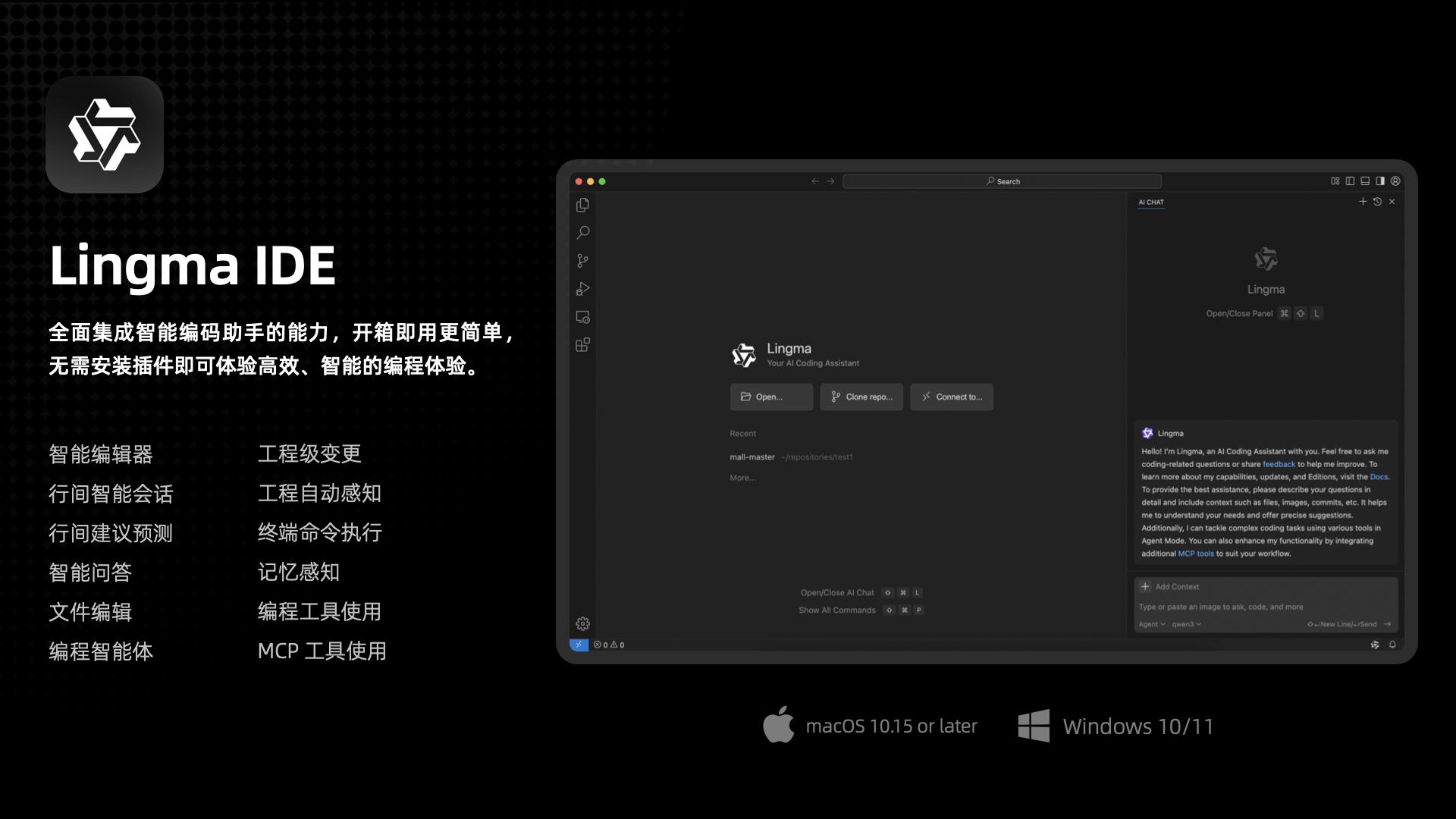
Core Viewpoint - The competition in the AI programming sector is intensifying, with significant advancements in domestic tools and a notable shift towards automated programming solutions, indicating a promising growth trajectory for the industry [1][3][4]. Group 1: Industry Developments - The recent launch of various AI programming tools, including OpenAI's Codex Agent and Alibaba Cloud's Tongyi Lingma AIIDE, highlights the rapid evolution of the sector [2]. - Tongyi Lingma AIIDE has integrated advanced models and features, such as programming agents and memory awareness, to assist developers in complex coding tasks [2][3]. - The adoption of Tongyi Lingma has been substantial, with over 15 million plugin downloads and more than 3 billion lines of code generated, indicating strong market penetration [2]. Group 2: Market Potential - The current penetration rate of AI programming tools among paid users is estimated to be between 10% and 20%, suggesting significant room for growth [4]. - The efficiency improvement provided by these tools is currently between 10% and 30%, but this is expected to increase rapidly, potentially reaching 50% to 80% within the next year [4].

国产AI编程工具加速“上新”,阿里云内部AI辅助代码生成比例近40%
Di Yi Cai Jing· 2025-05-30 12:34
Core Insights - The competition in the AI programming sector is intensifying, with ByteDance reportedly planning to disable third-party AI development tools in favor of its self-developed Trae, although there has been no official response from the company [1] - Alibaba Cloud has adopted an open attitude towards AI programming tools, allowing employees to choose tools as long as data security and compliance are maintained [1] - The internal coverage of Tongyi Lingma's AI-assisted code generation has reached nearly 40%, a 50% increase compared to six months ago [1] Group 1 - The gap between Chinese and American AI programming products is visibly narrowing, with domestic tools offering advantages in data security, privacy protection, cost-effectiveness, and services tailored for local developers and enterprises [2] - Recent developments in the sector include OpenAI's Codex Agent programming mode, Microsoft's open-source GitHub Copilot project, and Anthropic's Claude 4 series, which have all contributed to the vibrancy of the AI programming landscape [2] - Alibaba Cloud launched its first AI-native development environment tool, Tongyi Lingma AIIDE, which integrates programming agents and supports the latest Qianwen 3 models and MCP protocol [2] Group 2 - Tongyi Lingma's plugin has surpassed 15 million downloads and has generated over 3 billion lines of code, with thousands of companies, including FAW Group and NIO, adopting the tool [5] - The adoption rate of code generated by Tongyi Lingma is growing at a monthly rate of 20% to 30% [5] - The industry is expected to transition from human-machine collaborative programming to fully automated programming, indicating a significant potential shift in human-computer interaction [5] Group 3 - The overall market penetration of AI programming tools remains relatively low, with paid user penetration estimated at 10% to 20% [6] - The growth potential in the market is substantial, as the average efficiency improvement level is currently between 10% and 30% [6] - Rapid advancements in models may lead to increased penetration rates, potentially reaching 50% to 80% within the next year [6]
廉价的印度人,才是美国的战略资源
Hu Xiu· 2025-05-29 11:41
然而有用户体验过Builder.ai的服务,却发现Builder.ai生成的一坨代码缺少模块、无法使用、无法访问IDE,甚至有些代码完全无法修改。 本文来自微信公众号:非凡油条,作者:豆腐乳儿,题图来自:《硅谷》 这年头搞AI创业公司,还能搞破产? 没有想不到,只有印度人做不到,最近一家估值高达15亿美元的AI初创公司突然破产,亚马逊和微软都给它投了几千万美元,就这样打了水漂。 这家AI初创公司就是Builder.ai,号称能通过AI,帮助普通人制作软件,甚至还喊出了让软件开发"像点披萨一样简单"。 听上去很美是吧? Builder.ai是利用廉价的印度人编程,伪造AI编程骗投资的骗局,但仔细想想,不少其他项目看上去高大上,噱头很多,本质上也是外包给印度人。 普通人有这样糟糕的体验,可能还会疑惑,是不是现在AI编程还不够成熟,生成的代码不好使? 但如果揭露真相,肯定会惊掉这些用户的下巴:Builder.ai标榜AI编程,实际上大部分是印度人在背后编程。 说白了,Builder.ai就是印度创始人搞了个AI编程的噱头,吸引用户使用,接了用户任务后像包工头分包一样,分给印度程序员编程,本质上还是互联网外 包那套, ...