
人类命运共同体

Search documents
美国欠的债,光一年利息就超过1.2万亿美元,快赶上整个俄罗斯的GDP了!降息是被债务逼的,但这杯毒酒喝下去,更大的麻烦还在后头
Sou Hu Cai Jing· 2025-12-28 17:37
Group 1 - The U.S. federal debt is projected to exceed $38 trillion by December 2025, which is 130% of the annual GDP, indicating that the country would need to work for a year and a half to repay its debts [1][3] - Interest payments on U.S. national debt are expected to surpass $1.2 trillion in 2025, which is more than the annual military spending and one-third of federal revenue. If interest rates remain high, these payments could exceed $2 trillion within three years [3][5] - The Federal Reserve is expected to initiate interest rate cuts starting September 2024, with a total reduction of 175 basis points by 2025, primarily to alleviate the immediate debt crisis rather than stimulate economic growth [3][5] Group 2 - The current economic growth in the U.S. appears stable, but it relies heavily on consumer credit and savings depletion, while fixed asset investment growth remains low, indicating a fragile economic foundation [6] - The U.S. Treasury officials acknowledge that stabilizing domestic prices is dependent on global supply chains, particularly from China, which limits the effectiveness of the U.S. government's trade policies [8][14] - The U.S. strategy of decoupling from China faces significant market resistance, as the cost advantages of global supply chains cannot be easily severed, leading to higher inflation and lower efficiency domestically [14][16] Group 3 - China's manufacturing sector has shown resilience, with advancements in semiconductor production and a growing ecosystem for domestic operating systems, contributing to its competitive edge [12] - The internationalization of the Renminbi is progressing, with the cross-border payment system covering 189 countries and a rapid increase in transactions, providing a diversified option in global trade [12] - China's military and diplomatic strategies are evolving, with increased naval capabilities and military cooperation with friendly nations, enhancing its strategic position in global geopolitics [16][17]


中央广播电视总台发布2025国内十大新闻 国际十大新闻
Yang Shi Wang· 2025-12-28 11:50
1.党的二十届四中全会审议通过《中共中央关于制定国民经济和社会发展第十五个五年规划的建议》擘 画未来五年发展宏伟蓝图 央视网消息(新闻联播):中央广播电视总台今天(12月28日)发布2025国内十大新闻、国际十大新 闻。 2025国内十大新闻包括: 3.全党开展深入贯彻中央八项规定精神学习教育 推动党的作风持续向好 4.全年经济社会发展主要目标任务顺利完成 "十四五"圆满收官 2.纪念中国人民抗日战争暨世界反法西斯战争胜利80周年大会隆重举行 习近平发表重要讲话并检阅受阅 部队 5.从天津上合峰会到北京全球妇女峰会 一系列重磅主场外交活动成功举办 习近平提出全球治理倡议 我 国国际影响力持续提升 人类命运共同体理念更加深入人心 6.庆祝西藏自治区成立60周年 新疆维吾尔自治区成立70周年大会隆重举行 习近平率团出席 7.全国人大常委会通过决定 将10月25日设立为台湾光复纪念日 9.美国新版国家安全战略强调"西半球优先"强化在拉美军事部署 2.中国举行纪念中国人民抗日战争暨世界反法西斯战争胜利80周年大会 世界多地庆祝二战胜利80周年 3.以色列美国袭击伊朗 加沙地带脆弱停火 4.俄乌冲突陷入"打谈循环" 美 ...
相知无远近——习近平主席促进中外人民友好的故事
Xin Hua She· 2025-12-28 06:53
Group 1 - The article emphasizes the importance of fostering international friendships and cooperation, highlighting initiatives like inviting 50,000 American youth to China for cultural exchange over the next five years [1][7] - Xi Jinping's interactions with international figures, such as the warm gesture towards a Russian centenarian veteran, illustrate China's commitment to building strong bilateral relationships [2] - The article discusses Xi's acknowledgment of foreign support during significant historical events, reinforcing the narrative of peace and collaboration among nations [3] Group 2 - Xi Jinping's proposals at global summits, including initiatives for women's empowerment and education, reflect China's role in promoting global development and cooperation [4][5] - The establishment of "Luban Workshops" in Central Asia aims to enhance vocational training and cultural exchange, showcasing China's investment in regional development [6] - The article highlights the significance of youth exchanges in strengthening ties between countries, as seen in the experiences of students from the U.S. and Vietnam [8][10] Group 3 - The narrative underscores the responsibility of youth in fostering international relations, with students expressing their commitment to building friendships and understanding across cultures [9][10] - Xi's correspondence with young sinologists emphasizes the role of cultural studies in bridging civilizations, encouraging a deeper understanding of China [11]
心相近|相知无远近——习近平主席促进中外人民友好的故事
Xin Hua She· 2025-12-28 03:35
Group 1 - The article highlights the importance of international friendship and cooperation, emphasizing initiatives like inviting 50,000 American youth to China for cultural exchange over the next five years [1][6] - Xi Jinping's interactions with foreign leaders and individuals during significant commemorative events, such as the 80th anniversary of the victory in the Great Patriotic War, showcase China's commitment to fostering international relationships [2][3] - The establishment of "Luban Workshops" in Central Asia aims to enhance vocational training and cultural exchange, reflecting China's focus on regional cooperation and development [5] Group 2 - The article discusses the significance of youth exchanges in strengthening bilateral ties, with Xi Jinping encouraging young people to build lasting friendships and understanding between nations [6][8] - The response from international youth, such as the granddaughter of General Chennault, indicates a positive reception to China's outreach efforts and the desire for continued collaboration [3] - The emphasis on women's empowerment and global cooperation in Xi Jinping's speeches at international summits highlights China's role in promoting gender equality and social development [4][5]
“已成全球最具雄心的现代化实践场”
Xin Lang Cai Jing· 2025-12-27 22:49
Economic Development - International media have focused on China's economic achievements, highlighting terms like "market," "trade," and "openness" in their reports [3][7] - Global institutions have raised their forecasts for China's economic growth in 2025, with the World Bank, IMF, and ADB increasing their projections by 0.4, 0.2, and 0.1 percentage points respectively [7] - Reports indicate that China's economic vitality remains strong, countering earlier pessimistic views about its economic prospects [7] Technological Innovation - A significant number of international reports have emphasized China's technological innovation, with "artificial intelligence" and "technology" being frequently mentioned [4][5] - China's global innovation index ranking has improved from 34th in 2012 to 10th in 2025, showcasing its advancements in technology [5] - China is recognized as a leading force in renewable energy technology and production, significantly influencing global trends in green technology [5][6] Modernization Practices - China is described as the "most ambitious modernization practice field," with diverse regional development models that integrate historical heritage with modern industries [8] - The concept of "development" and "confidence" emerged as high-frequency terms in international media reports, reflecting China's growing self-assurance in its governance and development path [8] Global Contributions - China's contributions to global governance are highlighted, with initiatives aimed at building a community with a shared future for humanity, providing strategic direction amid global changes [9]
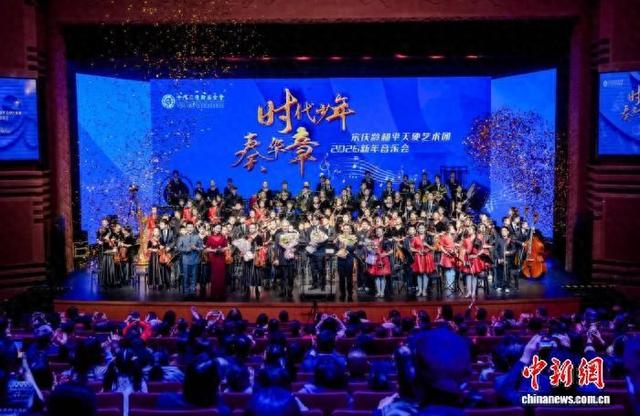
宋庆龄和平天使艺术团2026新年音乐会落幕
Xin Lang Cai Jing· 2025-12-27 11:29
Core Viewpoint - The "2026 New Year Concert" by the Song Qingling Peace Angel Art Troupe successfully blended traditional Chinese music with symphonic elements, creating a festive atmosphere for the audience [1][3]. Group 1: Concert Structure - The concert was organized into three main sections: "Nine Provinces' Elegance," "Era Symphony," and "Illuminate the Future" [1]. - The performance opened with a percussion ensemble titled "Spirit of the Dragon Horse," symbolizing vitality and ambition [1]. Group 2: Musical Performances - The concert featured award-winning pieces such as the folk music ensemble "Summer Sunshine" and "Crossing the River," showcasing the beauty of traditional Chinese music [3]. - The symphonic orchestra performed classical Western pieces, including Tchaikovsky's "1812 Overture" and Sibelius's "Finlandia," under the direction of conductor Liu Zheng [3]. Group 3: Thematic Elements - The choral symphony "Rainbow Road," co-created with Haiku Music Group, emphasized the concept of a shared human destiny, promoting peace and cultural exchange among youth worldwide [3]. - The concert concluded with a familiar rendition of "Radetzky March," where young conductor Cheng Xiyao engaged the audience in rhythm [4].
学习规划建议每日问答 | 如何理解高质量共建“一带一路”
Xin Hua She· 2025-12-27 06:10
Core Viewpoint - The Belt and Road Initiative (BRI) is a significant global economic cooperation initiative proposed after China's reform and opening up, emphasizing high-quality development and international collaboration to create a favorable external environment for Chinese modernization [1] Group 1: Achievements of the Belt and Road Initiative - Since its inception in 2013, the BRI has expanded its cooperation areas and enhanced its international influence, benefiting over 150 countries [2] - Infrastructure connectivity has improved significantly, with over 80,000 passenger trains operating on the China-Laos Railway and more than 62.5 million passengers transported, while the China-Europe Railway Express has surpassed 120,000 trips [2] - Cultural exchanges have flourished, with diverse cooperation in culture, tourism, and education, leading to a rich tapestry of human interactions [2] Group 2: New International Context - The BRI faces new challenges amid rising unilateralism and protectionism, but overall, opportunities outweigh challenges [3] - The initiative's unique and forward-looking nature is increasingly recognized in the current global environment, highlighting its significant achievements and global implications [3] Group 3: New Requirements for High-Quality Development - The BRI requires a focus on eight actions guided by high-quality development, emphasizing systematic and mechanized approaches [4] - Key strategies include enhancing cooperation with partner countries, improving infrastructure connectivity, and advancing both major projects and smaller community-focused initiatives [4] - A diversified and sustainable financing system is essential for risk management and the protection of overseas interests, ensuring the BRI's long-term stability and success [4]
解码中非命运共同体的青春力量
Xin Lang Cai Jing· 2025-12-27 04:16
Core Insights - The 2026 Boya Africa New Year Forum highlighted the contributions of China to African urban development, particularly through empirical research focusing on Tanzania, Ghana, and Malawi [1] - The forum emphasized Africa's growing autonomy in knowledge, thought, and culture amidst global changes, showcasing its political, economic, and international cooperation achievements [1] Group 1: Forum Overview - The Boya Africa Forum, established in 2013, serves as a platform for African voices in China, collaborating with various institutions to discuss themes like African youth development and the Belt and Road Initiative [2] - The forum culminated in a vibrant New Year celebration organized by African students, featuring cultural performances and the awarding of the Li Anshan Africa Research Scholarship [2] Group 2: Youth Development and Sino-African Cooperation - Africa, projected to have 60% of its population under 25 by 2050, requires substantial educational and employment resources to harness its demographic dividend [3] - The book "Youth Development and Sino-African Cooperation" explores how African youth can actively engage with Chinese partners to address development challenges and promote regional integration [3] Group 3: Perspectives on Youth Development - The book presents African youth as key political and developmental actors, moving beyond narratives of unemployment and poverty to focus on their agency in social participation and political expression [4] - It emphasizes capacity building in education, skills, and employment, linking individual capabilities with institutional environments and industry opportunities [4] - The work integrates international experiences with Chinese practices, advancing discussions on youth issues within Sino-African cooperation [5] Group 4: Implications and Audience - The book aims to provide actionable insights for policymakers, researchers, and youth, fostering cross-cultural engagement and global citizenship [5] - It reflects on sustainable paths for Sino-African cooperation through the lens of youth, aligning with the concept of a "community with a shared future for mankind" [5]
俄罗斯汉学家布罗夫:从哲学视角解读中国共产党成功之道
Bei Jing Ri Bao Ke Hu Duan· 2025-12-27 01:00
Core Viewpoint - Vladislav Brov's research emphasizes the importance of Chinese philosophy in understanding the governance principles of the Chinese Communist Party (CCP) and the success of socialism with Chinese characteristics [1][3]. Group 1: Contributions to Chinese Philosophy and Political Thought - Brov has dedicated his career to studying Chinese philosophy, from ancient thought to contemporary interpretations, aiming to explore the CCP's successful governance strategies [1]. - He argues that China's unique historical, social, and cultural context necessitates a political system tailored to its conditions, advocating for socialism with Chinese characteristics rather than Western-style democracy [2]. - Brov highlights the influence of traditional Chinese philosophical concepts, such as "collective over individual" and "harmony over conflict," on contemporary Chinese governance and societal values [2]. Group 2: Insights on the CCP's Success - Brov has witnessed significant transformations in China over the past half-century, attributing the CCP's success to its leadership and adherence to Marxism, which he views as foundational for China's socialist development [3]. - He encapsulates Xi Jinping's thought as "guarding the right and innovating," emphasizing the need for Marxism to adapt to contemporary Chinese realities [3][4]. - Brov believes that Xi's integration of traditional Chinese culture with Marxist principles represents a new era for the sinicization of Marxism, enhancing its relevance and application [4]. Group 3: Promotion of Chinese Marxism Internationally - Since the Soviet era, Brov has been committed to the international dissemination of Chinese philosophy, asserting that China's experiences are valuable references for both socialist and non-socialist countries [4]. - He has published numerous works on Chinese philosophy and translated over 20 significant texts into Russian, contributing to the global understanding of Marxism in the Chinese context [4][5]. - Brov has actively facilitated the publication of articles by Chinese scholars in Russian media, ensuring accurate representation of China's governance philosophy [5].

阿媒:国际舞台上,中国像围棋大师
Xin Lang Cai Jing· 2025-12-26 06:43
Group 1 - The article discusses China's strategic approach in global politics, emphasizing a low-key, cautious, and steady method akin to a Go master, focusing on strategic depth rather than superficial displays of power [1] - China possesses the necessary elements for leadership, being the world's second-largest economy with significant advancements in technology and military strength, yet it refrains from self-proclaiming as a leader of a new world order, instead advocating for concepts like "peaceful development" and "community of shared future" [1][2] - The foundation of China's approach is rooted in its historical memory and philosophical traditions, emphasizing harmony, social hierarchy, and restraint, which shape its unique strategic mindset [1] Group 2 - China avoids direct involvement in global conflicts, opting instead to expand its influence through multilateral institutions, such as the Asian Infrastructure Investment Bank and the BRICS+ mechanism, while constructing a system where it plays a central role without direct confrontation [2] - The ambitious Belt and Road Initiative serves as a tool for building global interconnectedness, positioning China as an indispensable economic partner for numerous countries across Asia, Europe, and Africa, contrasting with Western military deployments [2] - Domestically, China is transitioning its economy from export and investment-driven growth to a model based on domestic consumption and high technology, addressing challenges like aging population and environmental pressures [2] Group 3 - A key element of China's strategy is to avoid the "Thucydides Trap," which refers to the potential conflict between a rising power and an established hegemon, by pursuing asymmetric competition rather than direct military confrontation with the U.S. [3] - China's influence is expanding into regions traditionally overlooked by the West, such as Africa, Latin America, and Central Asia, recognizing that the concept of leadership is evolving in the 21st century [3] - The country aims to control the "arteries" of the global economy rather than the "political map," reflecting a strategic confidence in its long-term plans to accumulate influence through economic interdependence and institutional building [3] Group 4 - China is seen as a creator of a new world order, focusing on gradually constructing a system that integrates its values and interests into global governance rather than seeking to dominate the existing world [4]