
绿色化

Search documents
东海证券:10月叉车内销外销持续双位数增长 全年叉车销量表现呈稳增态势
智通财经网· 2025-11-27 08:49
Core Insights - The overall forklift sales in October 2025 reached 114,300 units, representing a year-on-year growth of 15.9% [2] - Domestic sales accounted for 70,400 units, with a growth of 16.2%, while overseas sales were 43,900 units, also growing by 16.2% [2] - Cumulative forklift sales from January to October 2025 totaled 1,220,700 units, marking a 14.2% increase year-on-year [2] Group 1: Market Performance - Forklift sales in October showed robust double-digit growth in both domestic and overseas markets, driven by enhanced competitiveness of domestic companies and rising global demand [3] - The demand for forklifts is closely linked to the manufacturing and logistics sectors, with positive indicators from macroeconomic data suggesting a gradual recovery in domestic demand [3] - The social logistics total in September 2025 increased by 5.4% year-on-year, indicating a stable growth trend in logistics activities [3] Group 2: Technological Advancements - Hangcha Group launched the X1 series humanoid robots at the Asia International Logistics Technology and Transportation Systems Exhibition, marking a significant shift towards intelligent logistics solutions [4] - The X1 series integrates efficient mobility with dexterous operation, promising to enhance logistics efficiency and flexibility across various industries [4] Group 3: Green Initiatives - Hangcha completed a significant order for 108 hydrogen-powered forklifts, showcasing its commitment to green technology and low-carbon solutions [5] - The hydrogen forklifts are designed for high-intensity operations in logistics and manufacturing, featuring zero emissions and high efficiency [5] Group 4: Industry Trends - JD Logistics plans to procure 3 million robots, 1 million unmanned vehicles, and 100,000 drones over the next five years, indicating a major push towards automation in logistics [6] - This initiative represents a transition from pilot projects to large-scale applications in smart logistics, with potential benefits for consumer experience and logistics costs [6] Group 5: Investment Opportunities - The forklift industry is characterized by broad applications and a weak cyclical nature, with a strong correlation to manufacturing sector performance [7] - Domestic companies are accelerating their global expansion and establishing local production and service capabilities, enhancing their market penetration [7] - Leading domestic forklift manufacturers are actively investing in smart logistics and robotics, reshaping the competitive landscape of the logistics industry [7]


中东家电电子展览会聚焦绿色和智能化
Xin Hua Wang· 2025-11-27 03:04
中国机电产品进出口商会副会长刘春表示,期待展会能成为联通中国与中东市场的坚实桥梁,助力更多 中国企业与地区伙伴建立起长期稳定的合作关系。 阿联酋外贸部副部长法赫德·杰尔贾维介绍,阿联酋消费电子市场增长由年轻且懂科技的消费群体驱 动,他们对智能化、可持续和提升生产力的技术需求不断增长。中国企业在满足区域市场需求方面发挥 着关键作用。他说,第二届展会体现中东及北非地区与中国深化合作的积极趋势。 展会将持续至28日。由中国贸促会主办的"中国贸促"(中东)绿色和创新合作展览会及中阿经贸合作论 坛等活动也将同期举行。 新华社迪拜11月26日电(记者夏晓)由中国机电产品进出口商会和中国贸促会商业行业委员会联合主办 的第二届中东家电电子展览会26日在阿联酋迪拜节日城展览中心开幕。展会聚焦家电电子产品绿色化、 智能化趋势,吸引众多国内外知名企业和专业采购商参展。 本届展会以"万物智能"为主题,集中展示来自中国约300家企业的最新和热门产品,其中既包括海尔、 海信、美的、格力等智能家电领域龙头企业,也有一批国内智能家居领域的创新型中小企业。展品涵盖 人工智能驱动的智能家居生态系统、节能环保型绿色家电、5G+物联网场景化应用以及 ...
刘宁到新乡市调研检查大运河保护工作时强调:坚决有力加强大运河保护修复 打造水清景美的生态河幸福河
He Nan Ri Bao· 2025-11-26 10:44
Group 1: Environmental Protection and Cultural Heritage - The provincial secretary emphasized the need to implement the spirit of the 20th Central Committee and Xi Jinping's ecological civilization thoughts, focusing on the protection and utilization of the Grand Canal's cultural heritage [1][2] - There are ongoing issues with the stability of water quality improvements in the Grand Canal's tributaries, indicating that some environmental problems remain unaddressed [2] - The secretary highlighted the importance of integrating ecological protection with cultural heritage preservation, aiming to enhance the historical, artistic, and scientific value of the Grand Canal [2] Group 2: Corporate Development and Innovation - Companies like Tianli Lithium Energy Co., Ltd. and Chengde Energy Technology Equipment Co., Ltd. are encouraged to align with national "dual carbon" goals, focusing on smart, green, and integrated development [3] - There is a push for increased investment in technological research and development to improve product quality and expand market share, with an emphasis on carbon reduction and safety in production [3] - The secretary called for a deep integration of innovation resources with technology-driven enterprises, aiming to enhance the synergy between innovation chains, industry chains, and talent chains for high-quality development [3]
玛氏旗下工厂入选“卓越级智能工厂”名单
Zhong Guo Jing Ji Wang· 2025-11-25 13:10
Core Viewpoint - Mars has been recognized for its Yonghe factory in Guangzhou as one of the latest "Excellent Intelligent Factories" by multiple Chinese government ministries, highlighting its commitment to digitalization and smart manufacturing [1] Group 1: Factory Achievements - The Yonghe factory has undergone a five-year upgrade, completing the intelligent transformation of all 21 production lines, resulting in improvements in capacity, quality, cost, and delivery levels [1] - The factory utilizes 3D modeling and AI algorithms for real-time monitoring of production factors, achieving 100% high-precision traceability in key manufacturing processes [1] - Cloud-based collaborative scheduling has accelerated response times to production anomalies by over 50% [1] Group 2: Technological Innovations - The factory employs nearly a hundred automated guided vehicles and collaborative robots that operate seamlessly 24/7, ensuring "dark factory" operations for finished product stacking and raw material delivery [1] - Collaborative robots are capable of executing automatic feeding processes with no human intervention required [1] Group 3: Strategic Implications - The Vice President of Supply for Mars Wrigley China stated that the "Excellent Intelligent Factory" is a significant practice of Mars' smart manufacturing strategy, injecting new momentum into the company's long-term development in China [1] - Mars aims to continuously build a more efficient and sustainable supply system driven by digitalization, intelligence, and green initiatives to provide high-quality products and services to Chinese consumers [1]
凝聚先锋力量,共绘物流新篇!2025“寻找金牌代言人”颁奖典礼圆满收官 | 头条
第一商用车网· 2025-11-25 12:44
Core Viewpoint - The "Finding Gold Medal Spokesperson" event aims to promote cost reduction and efficiency enhancement in the automotive and transportation industries while advocating for more humanistic care, highlighting the contributions of industry leaders and their stories [1][9][10]. Event Overview - The event has been held for seven consecutive years, with increasing industry influence, and the 2025 edition was launched in the second half of 2025, involving months of visits and selections [3][9]. - The event was attended by various experts, scholars, and media representatives from logistics, passenger transport, and vehicle manufacturing sectors, marking the announcement of the 2025 "Gold Medal Spokesperson" [4][10]. Industry Impact - The event serves as a platform to amplify the voices of transportation professionals who often remain unnoticed, thereby enhancing their recognition and attracting new talent to the industry [6][9]. - The "Finding Gold Medal Spokesperson" event has significantly raised social awareness of the transportation industry, showcasing the dedication and contributions of its workers [9][10]. Award Recipients - The two "Gold Medal Spokespersons" for 2025 are "Efficient Transportation Spokesperson" Nie Wei and "Green Power Spokesperson" Gao Feng, both of whom have made significant contributions to their respective fields [12][15]. - Nie Wei, a truck driver from Jiangxi, has driven over 100,000 kilometers, demonstrating the reliability of the Shaanxi Automobile Delong G300 light truck [12][15]. - Gao Feng, president of a new energy technology company, emphasizes the importance of reliable power systems and has established a green transportation system tailored to industry characteristics [12][14]. Future Aspirations - The event organizers aim to continue enhancing the event's influence and authority, encouraging more industry professionals to share their stories and contribute to the industry's development [11][15]. - The ongoing commitment to recognizing and promoting exemplary figures in the transportation sector is expected to foster a stronger collaborative force for the industry's advancement towards intelligence, sustainability, and efficiency [11][15].


欧派家居再度获人民日报点赞!
Zhong Jin Zai Xian· 2025-11-25 03:05
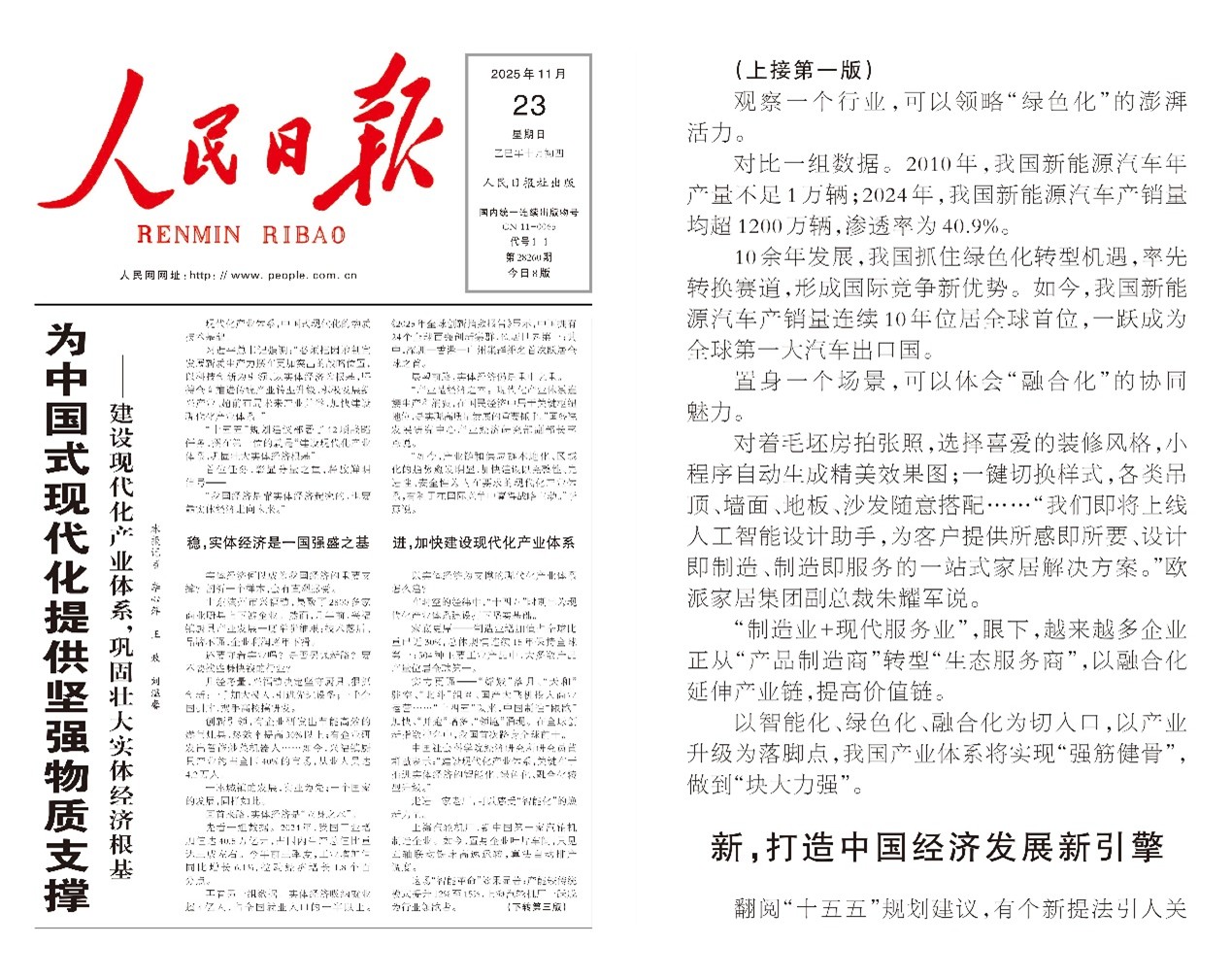
Core Viewpoint - The article emphasizes the importance of building a modern industrial system in China, focusing on "intelligent, green, and integrated" industrial upgrades, with a spotlight on Oppein Home's strategic transformation from a "product manufacturer" to an "ecological service provider" [1][3][4]. Group 1: Industry Transformation - The production of new energy vehicles in China has surged from less than 10,000 units in 2010 to over 12 million units in 2024, achieving a penetration rate of 40.9% [3]. - Oppein Home is set to launch an AI design assistant that will provide a one-stop home furnishing solution, showcasing the integration of manufacturing and modern services [3][8]. - The trend of companies transitioning from "product manufacturers" to "ecological service providers" is gaining momentum, enhancing value chains and extending industrial chains [3][10]. Group 2: Emerging Pillar Industries - The concept of "emerging pillar industries" is introduced, which combines characteristics of both emerging and pillar industries, playing a crucial role in economic growth and requiring high technological content and added value [4][5]. - By 2025, the added value of strategic emerging industries is expected to account for over 17% of GDP, an increase of approximately 5.3 percentage points compared to the "13th Five-Year Plan" [5][6]. - The low-altitude economy is highlighted as a significant example, with a projected market size of 1.5 trillion yuan in 2023, expected to reach 3.5 trillion yuan by 2035 [5][6]. Group 3: Oppein's Strategic Direction - Oppein's integration of AI technology into its design and manufacturing processes is seen as a transformative step, creating a closed-loop system of "design as manufacturing, manufacturing as service" [8][10]. - The company aims to strengthen its foundation in the real economy while promoting deep integration between manufacturing and modern services, contributing to the modernization of China's economy [10][12]. - The recognition by People's Daily of Oppein's transformation path underscores the importance of industry integration and innovation in achieving a robust industrial system [12].

智能装备“向新”记:让机器人打“难工”
2 1 Shi Ji Jing Ji Bao Dao· 2025-11-24 11:35
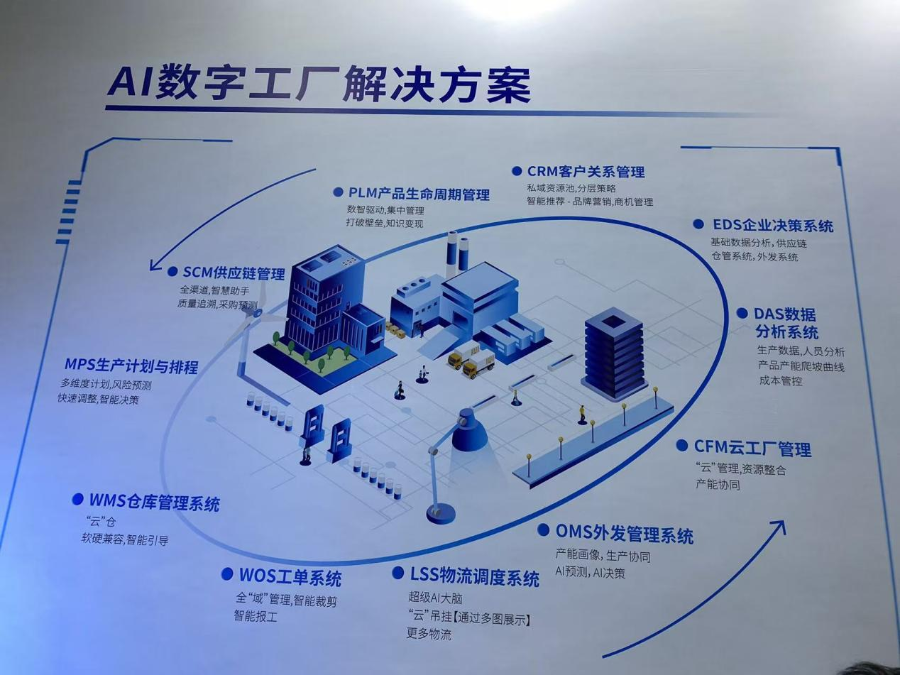
Core Insights - The "Intelligent+" development trend is deeply integrating smart equipment into various industries such as clothing and machinery, facilitating digital transformation in workshops [2][3]. Industry Overview - The 11th Yiwu International Intelligent Equipment Expo showcased 507 leading companies from the global smart equipment industry, presenting over a thousand smart equipment items across various sectors including robotics, smart manufacturing solutions, and advanced material processing [2]. - The expo reflects a shift in the equipment manufacturing industry, where companies are not just selling equipment but are also integrating digital technologies to enhance operational efficiency and safety [2][3]. Technological Advancements - New technologies and products in high-end equipment manufacturing are emerging, with a focus on smart robots, industrial mother machines, and intelligent logistics equipment [3]. - Companies are upgrading their systems to connect directly with Manufacturing Execution Systems (MES), allowing for automated processes and improved production efficiency [3][4]. Smart Manufacturing Solutions - In the clothing industry, a "Digital AI Factory" solution has been developed, enabling automation from design to production, significantly enhancing efficiency [5][6]. - AI software connects machines throughout the production process, allowing for streamlined operations where one supervisor can manage multiple production lines [6]. Robotics and Automation - The industry is increasingly adopting embodied intelligence to address labor-intensive and hazardous tasks, improving both efficiency and worker safety [7]. - Companies like Noli Intelligent Equipment are advancing towards unmanned operations with automated systems that enhance logistics efficiency and safety within factories [9]. Customization and Flexibility - Some companies are offering customizable automation solutions that allow for easy adjustments in packaging and logistics processes, significantly reducing manual labor [10][12]. - The "recipe-based" approach in automation allows for quick changes in production setups, making it easier for factories to adapt to varying product specifications [10].

智能绿色技术引领农机装备高质量发展
Huan Qiu Wang· 2025-11-24 10:13
Core Insights - The Chinese agricultural machinery market is advancing rapidly, driven by government policies and market demand, focusing on modernization and sustainability [1][2][10] Policy Impact - The implementation of the 2025 agricultural machinery scrapping and updating subsidy policy has significantly boosted the market, expanding the types of machinery eligible for subsidies and increasing subsidy amounts [2][3] - The annual value of agricultural machinery updates in China is approximately 300 billion yuan, with a 5% elimination rate leading to around 800,000 small tractors and other machinery being phased out each year [2][3] Market Dynamics - The agricultural machinery market is experiencing a "volume and price increase" trend, with total power exceeding 11 billion kilowatts and a 28% increase in sales of medium and large tractors [3][11] - The "old for new" policy has stimulated demand, with Jiangsu province alone scrapping 110,000 old machines, generating over 15 billion yuan in new purchases [3][11] Technological Advancements - Leading companies are focusing on high-end markets, with innovations such as the CVT continuously variable transmission tractor and lightweight hillside micro-harvesters showing significant sales growth [5][9] - The introduction of smart and green technologies is transforming the industry, with products like AI-powered weeding robots achieving high accuracy in weed identification [9][10] Export Growth - Agricultural machinery exports reached 9.305 billion USD in the first half of 2025, marking a 26.5% increase, with notable growth in markets like Africa and Southeast Asia [10][11] - The export of grain processing and poultry farming machinery also saw a 40% increase, indicating a strong international demand for Chinese agricultural machinery [10] Regional Development - Regional policies have effectively promoted agricultural machinery upgrades, with provinces like Jiangsu and Zhejiang leading in creating industrial clusters and specialized enterprises [2][3] - The mechanization rate in hilly areas has improved significantly, with a 3.5 percentage point increase in comprehensive mechanization rates, showcasing successful local initiatives [13]


华菱钢铁“四化”转型前三季赚25亿 投42亿研发打造一批“隐形冠军”产品
Chang Jiang Shang Bao· 2025-11-24 00:35
Core Viewpoint - The steel industry remains under pressure, yet Hualing Steel (000932.SZ) has achieved stable growth in its operating performance despite the challenging market conditions [2][5]. Financial Performance - In the first three quarters of 2025, Hualing Steel reported revenue of approximately 95 billion yuan, a year-on-year decrease of about 15%, while net profit attributable to shareholders exceeded 2.5 billion yuan, marking a year-on-year increase of approximately 42% [2][4]. - The net profit for the third quarter was 762 million yuan, reflecting a year-on-year growth of about 73% but a quarter-on-quarter decline of 35.8% [2][4]. - The company’s revenue for the first three quarters was 302.3 billion yuan, 328.63 billion yuan, and 319.56 billion yuan for Q1, Q2, and Q3 respectively, with year-on-year declines of 18.4%, 15.52%, and 10.53% [4]. Market Conditions - The steel industry has been in a "winter" since 2022, with many companies facing overall losses, while Hualing Steel has managed to avoid losses and maintain profitability [2][8]. - The decline in net profit in Q3 was attributed to rising prices of raw materials such as iron ore and coking coal, coupled with weak downstream demand and steel prices [2][5]. Strategic Initiatives - Hualing Steel is accelerating its transformation towards "high-end, green, intelligent, and service-oriented" production, focusing on R&D and achieving breakthroughs in key technologies [2][10]. - The company has invested nearly 4.2 billion yuan in R&D in the first three quarters of 2025, with significant achievements in patent authorizations and awards [3][11]. Competitive Positioning - Hualing Steel's ability to maintain profitability amidst market fluctuations is attributed to its strategic focus on high-end manufacturing and differentiated product offerings [10][11]. - The company operates five specialized production bases and has a comprehensive range of steel products, allowing for flexible production adjustments based on market demands [10].

为中国式现代化提供坚强物质支撑——建设现代化产业体系,巩固壮大实体经济根基
Ren Min Ri Bao· 2025-11-23 02:45
Core Viewpoint - The article emphasizes the importance of building a modern industrial system as the material and technological foundation for Chinese-style modernization, highlighting the need for innovation and the strengthening of the real economy [1][5]. Group 1: Importance of the Real Economy - The real economy is identified as the cornerstone of national strength, with a focus on its role in supporting economic growth and employment [3][4]. - In 2024, China's industrial added value reached 40.5 trillion yuan, accounting for about 30% of GDP, with a year-on-year growth of 6.1% in the first three quarters [4]. - The real economy employs over 400 million people, representing more than half of the national employment population [4]. Group 2: Modern Industrial System Construction - The construction of a modern industrial system is crucial for connecting production and consumption, serving as a key pivot in the national economy for achieving high-quality development [5][6]. - The manufacturing sector's added value accounts for nearly 30% of the global total, maintaining the world's largest scale for 15 consecutive years [7]. - The shift towards intelligent, green, and integrated transformations in the real economy is essential for building a modern industrial system [7][10]. Group 3: Emerging Pillar Industries - The article introduces the concept of emerging pillar industries, which combine characteristics of both emerging and pillar industries, playing a significant role in economic growth [12][16]. - By 2025, the added value of strategic emerging industries is expected to exceed 17% of GDP, an increase of approximately 5.3 percentage points from the end of the 13th Five-Year Plan [16]. - The development of new industries such as low-altitude economy is highlighted, with a projected market size of 1.5 trillion yuan in 2023, potentially reaching 3.5 trillion yuan by 2035 [18]. Group 4: Future Outlook - The article stresses the need to optimize traditional industries while proactively planning for future industries, which are seen as potential strategic emerging industries [19]. - The traditional industries currently account for about 80% of the added value in manufacturing, with an estimated market space of 10 trillion yuan to be added in the next five years [19]. - Strengthening the foundation of the real economy and accelerating the construction of a modern industrial system will lay a solid material foundation for Chinese-style modernization [19].