
耐心资本

Search documents
投中信息杨晓磊:创投市场拐点已至
中国基金报· 2025-11-30 07:55
Core Viewpoint - The private equity market in China has reached a turning point, with optimism for the future, particularly towards 2026, as the venture capital market has emerged from its low point [2]. Fundraising and Exit Improvements - Significant improvements have been observed in both fundraising and exit activities, with new fund establishments and investment amounts increasing by 10% to 20% year-on-year for the first three quarters of 2024. Additionally, exit scales have surged by over 100% due to the recovery of the secondary market [5]. Increased Long-term Capital Supply - There has been a notable increase in long-term capital supply, with "patient capital" from social security funds, insurance funds, and Asset Investment Companies (AIC) enhancing market liquidity. Since September 2024, five major banks have established 99 AIC funds with a total scale of 198 billion yuan [8]. Concentration of Funds in Technology Innovation - Funds, including AIC and local technology innovation funds, are increasingly concentrated in the technology innovation sector. There are concerns among fund managers regarding whether the industry can support such a large influx of capital and if there are enough high-quality early-stage technology companies to invest in [8]. Cautious Approach of Insurance Capital - Despite the rising proportion of state-owned capital, the scale of insurance capital investment has decreased year-on-year. Insurance capital has become more cautious in its investment strategies, typically entering after initial rounds and focusing on later stages once performance becomes evident [8]. Performance Comparison with the U.S. - The performance realization rate in China's venture capital sector is higher than that in the U.S. The "performance realization degree" indicator shows that the cash return to book value ratio is favorable in China compared to the U.S. [10]. Impact of Economic Cycles on Fund Performance - The macroeconomic cycle and policy direction have a direct impact on fund performance. Generally, early-established funds show better total return multiples (TVPI) compared to newer funds, with the period from 2014 to 2017 showing overall better performance than previous years [12]. Role of State Capital - Large state-owned funds, such as social security and national innovation funds, align well with the characteristics of the industry and serve as a stable long-term funding source, acting as a "ballast" for the development of the venture capital market [12].


北京高质量发展指数全国领先,经济、创新、治理维度贡献度较高
Xin Jing Bao· 2025-11-28 12:32
Group 1 - The "Beijing High-Quality Development Blue Book (2025)" indicates that Beijing's high-quality development index is leading nationwide, with a growth from 0.710 in 2017 to 0.860 in 2023, representing a 21.13% increase and an average annual growth rate of 3.25% [1] - Economic, innovation, and governance dimensions significantly contribute to Beijing's high-quality development, with a strong foundation in advanced factors [1] - In terms of economic dimension, the labor productivity in Beijing is projected to reach 444,000 yuan per person in 2024, ranking first among all provinces and cities [1] - The innovation dimension highlights that technological innovation is crucial for high-quality development, with Beijing's R&D expenditure intensity expected to be 6.58% in 2024, maintaining the top position nationwide [1] - Governance reforms, particularly in the Zhongguancun Demonstration Zone, are central to Beijing's high-quality development, with over 50 pilot reform policies fully implemented [1] Group 2 - The "Beijing New Quality Productivity Development Research Report (2025)" shows that Beijing's new quality productivity development level is leading nationally, with an average annual growth rate of approximately 6.3% [2] - The "Beijing Patient Capital Development Research Report (2025)" reveals a steady growth trend in the patient capital development index, reaching 0.6039 in 2023, a 43.82% increase compared to 2019 [2] - The supporting role of new quality productivity and patient capital in Beijing's high-quality development is continuously strengthening [2]
2500亿目标!辽宁力拓创投新版图
Huan Qiu Wang· 2025-11-28 03:52
Core Viewpoint - The Liaoning Provincial Government has issued the "Implementation Opinions on Promoting the High-Quality Development of Private Equity Investment Funds," which includes 22 targeted measures to empower the industry and optimize the innovation ecosystem, aiming for a fund subscription scale of over 180 billion yuan by the end of 2027 and over 250 billion yuan by the end of 2030 [1][4]. Group 1 - The "Chuangtou Liaoning" initiative has evolved from a slogan into actionable steps, with capital flowing into the region as local enterprises in advanced sectors like integrated circuits, robotics, biomedicine, and new materials enhance Liaoning's reputation [4]. - The core of the Opinions is to guide capital to "effectively gather," focusing on strengthening investment institutions and directing funds into innovative technology enterprises in Liaoning [4][5]. - Liaoning aims to cultivate diversified investment entities, encouraging the development of venture capital from research institutions, innovation platforms, and corporate venture capital [4]. Group 2 - The Opinions emphasize the development of "patient capital" to support long-term investments in hard technology, allowing insurance funds and venture capital institutions to issue bonds to broaden funding sources [4][5]. - The management of government investment funds will be optimized, with differentiated management for venture capital and industrial investment funds, and an increase in the profit-sharing ratio for provincial angel funds [5]. - The Opinions propose to streamline domestic and international listing and merger channels for enterprises, encourage the establishment of merger funds, and enhance the functionality of equity trading markets [5][6]. Group 3 - Analysts note that the policy measures address the entire chain of private equity funds, particularly the introduction of patient capital and error tolerance mechanisms tailored for hard technology investments, which are seen as forward-looking and attractive [5][6]. - The initiative aims to create a virtuous cycle of "technology-industry-finance" by precisely connecting capital with Liaoning's strong industrial base and educational resources [6].
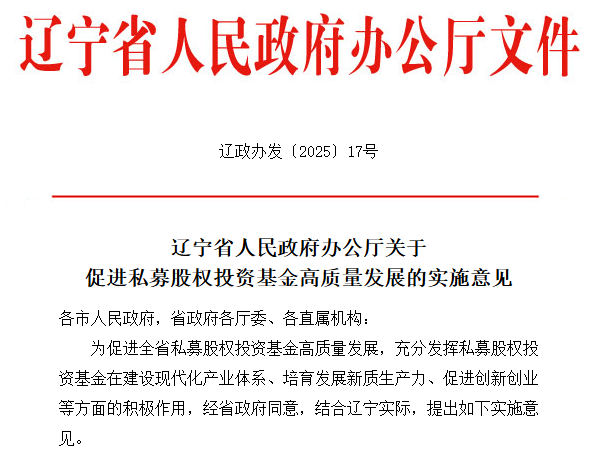
辽宁吹响创投“集结号”:22条举措精准发力,力争2500亿元基金认缴规模
Zheng Quan Shi Bao· 2025-11-27 12:30
Core Viewpoint - Liaoning Province has launched 22 specific measures to promote the high-quality development of private equity investment funds, aiming to enhance the financial support for technological innovation and establish a robust investment ecosystem by 2027 and 2030 [1][2]. Group 1: Development Goals - By the end of 2027, the province aims to form a multi-level, diversified, and full-cycle private equity investment fund system, with a target of exceeding 180 billion yuan in subscribed capital [1]. - By the end of 2030, the subscribed capital for various funds is expected to surpass 250 billion yuan, significantly contributing to the province's high-quality development [1]. Group 2: Investment Focus - The new policy emphasizes not only attracting more capital but also directing it towards the right industries, particularly original and leading technological innovation enterprises in Liaoning [2]. - The initiative encourages the participation of research institutions and innovation platforms in venture capital, promoting corporate venture capital (CVC) development to accelerate core technology breakthroughs and industrial transformation [2]. Group 3: Regional Development - Shenyang and Dalian are designated to leverage their economic and financial advantages to create a nationally influential regional private equity investment institution cluster, aiming for double-digit annual growth in fund subscriptions [3]. - The policy highlights the importance of developing patient capital, supporting insurance institutions to invest in venture capital funds, and optimizing risk factors for eligible insurance companies [3]. Group 4: Industry Alignment - The policy stresses enhancing the connection between private equity investment institutions and key industry clusters, facilitating collaboration between upstream and downstream enterprises [4]. - It aims to utilize educational and research resources to improve the interaction between innovation resources and private equity investment institutions [4]. Group 5: Risk Management - To foster a "willing to invest" environment, the policy reinforces risk tolerance and error-correction mechanisms, optimizing the evaluation system for government investment funds [5]. - It establishes a differentiated management mechanism for venture capital and industrial investment funds, allowing for higher government contribution ratios for venture capital funds [6]. Group 6: Exit Strategies - The policy outlines measures to streamline exit channels for funds, promoting domestic and international listing and acquisition opportunities for invested enterprises [6]. - It encourages the establishment of acquisition funds by government and state-owned funds to broaden market exit channels for private equity investment institutions [6]. Group 7: Market Liquidity - The initiative promotes the development of secondary market funds (S funds), supporting government investment funds in initiating S funds and encouraging various financial institutions to invest [7]. - Overall, the policy aims to create a comprehensive ecosystem for private equity investment funds, ensuring directed investments and clear exit strategies [7].
辽宁吹响创投“集结号”:22条举措精准发力,力争2500亿元基金认缴规模
证券时报· 2025-11-27 12:25
Core Viewpoint - The article discusses the implementation of 22 specific measures by the Liaoning provincial government to promote the high-quality development of private equity investment funds, aiming to enhance the financial support for technological innovation in the region [1][2]. Group 1: Development Goals - By the end of 2027, Liaoning aims to establish a multi-level, sector-specific, and full-cycle private equity investment fund system, with a target of exceeding 180 billion yuan in subscribed capital [1]. - By the end of 2030, the target for subscribed capital is set to exceed 250 billion yuan, significantly contributing to the province's high-quality development [1]. Group 2: Capital Aggregation - The government emphasizes not only attracting more capital but also ensuring it is directed towards the right industries, particularly original and leading technological innovation enterprises in Liaoning [2]. - The plan includes fostering diversified investment entities and encouraging participation from research institutions and innovation platforms in venture capital [2]. Group 3: Patient Capital Development - The article highlights the need for "patient capital" to support technology companies, allowing insurance institutions to invest in venture capital funds under market principles [3]. - It also mentions the support for qualified venture capital institutions to issue corporate bonds and technology innovation bonds to broaden funding sources [3]. Group 4: Risk Tolerance and Error Correction Mechanisms - To create an environment conducive to investment, Liaoning is enhancing risk tolerance and error correction mechanisms, optimizing the evaluation system for government investment funds [5]. - The government aims to establish a differentiated management mechanism for venture capital and industrial investment funds, allowing for higher government contribution ratios in venture capital funds [5]. Group 5: Exit Strategies and Market Functionality - The article discusses optimizing exit channels for funds, including facilitating domestic and international listings and mergers for invested enterprises [7]. - It also emphasizes the importance of enhancing the functionality of equity trading markets to improve services related to equity investment exits [7]. Group 6: Overall Policy Environment - Overall, the measures outlined in the article aim to improve the policy environment and management systems for private equity investment funds, with specific quantitative targets set for capital growth [8].

辽宁发布两项重磅政策,促进私募股权基金与政府投资基金高质量发展
FOFWEEKLY· 2025-11-27 10:07
Core Viewpoints - The article discusses two significant policies released by the Liaoning Provincial Government aimed at promoting the high-quality development of private equity investment funds and government investment funds, emphasizing the importance of these funds in fostering innovation, entrepreneurship, and the modernization of the industrial system in Liaoning [2][10]. Group 1: Overall Requirements - The policies are guided by Xi Jinping's thoughts and aim to implement the spirit of the 20th National Congress of the Communist Party of China, focusing on creating a multi-level, diverse, and comprehensive private equity investment fund system by the end of 2027, with a target of raising over 180 billion yuan in subscribed capital [4][12]. - By 2030, the goal is to exceed 250 billion yuan in subscribed capital, significantly contributing to the province's high-quality development [4]. Group 2: Strengthening Investment Institutions - The policies encourage the cultivation of diverse investment entities, promoting investment in original and leading technology innovation enterprises in Liaoning through policy incentives [5]. - The development of regional private equity investment institution clusters in Shenyang and Dalian is prioritized, aiming for a double-digit annual growth in fund subscriptions [5]. - Financial institutions are urged to collaborate with private equity funds to innovate financial services, including loan and direct investment combinations [5]. Group 3: Expanding Fundraising Channels - Government investment funds are to play a guiding role, with plans to expand their scale through various initiatives, including the establishment of provincial venture capital guiding funds [6]. - The policies emphasize attracting national-level funds to set up special funds in Liaoning, enhancing collaboration in due diligence, project research, and post-investment management [6]. - The development of patient capital is encouraged, with support for insurance institutions to invest in venture capital funds targeting strategic emerging industries [6]. Group 4: Fund Management and Operation - The policies aim to standardize the operation of government investment funds, promoting the integration and optimization of existing funds [8]. - A mechanism for investment linkage and profit-sharing is to be established, encouraging market-oriented participation from various levels of government [8]. - The establishment of a risk tolerance and exemption mechanism is proposed to foster a more innovative investment environment [8]. Group 5: Fund Exit Channels - The policies advocate for facilitating the listing and acquisition processes for invested enterprises, aiming to broaden exit channels for private equity investment institutions [9]. - Enhancements to the equity trading market's functionality are planned to improve services related to equity investment exits [9]. - The development of secondary market funds (S funds) is encouraged to expand investment exit options [9]. Group 6: Building a Healthy Ecosystem - A comprehensive management mechanism for promoting the high-quality development of private equity investment funds is to be established, ensuring collaboration among various departments [8][16]. - The policies highlight the importance of utilizing policy tools to support the development of private equity investment funds, including tax incentives for venture capital entities [8][16]. - Strengthening industry supervision and enhancing credit environments for private equity investment institutions are emphasized to ensure healthy industry growth [8][16].

西部风投“黑马”,为何总能押中“硬科技”赛道?
Mei Ri Jing Ji Xin Wen· 2025-11-27 08:58
Core Insights - Chengdu Industrial Investment has achieved remarkable returns on its investments, with the drone project yielding 30-40 times returns and the Haiguang Information project exceeding 100 times returns [1][2][3] - The company has developed a unique investment methodology over nearly a decade, focusing on long-term patience and professional judgment in the hard technology sector [1][21] - The firm positions itself as an "industrial partner," emphasizing a "patient capital" approach that allows for a complete investment cycle of "dare to invest, able to succeed, and willing to exit" [1][24] Investment Performance - Chengdu Industrial Investment's investment in Zhongwu Drone began in 2014 with an initial investment of 60 million yuan, which has now grown significantly, with a current market value of approximately 3.132 billion yuan [3][9][17] - The company has successfully navigated the challenges of the hard technology sector, where most investments typically result in losses, making its achievements noteworthy [2][3] Strategic Initiatives - The launch of the "Chengdu Investment 28 Plan" aims to systematize and platformize investment logic, seeking to cultivate the next successful projects similar to Zhongwu Drone and Haiguang Information [1][19] - The plan is part of a broader strategy to establish a 100 billion yuan future industry fund by 2025, focusing on a comprehensive investment lifecycle from seed stage to IPO [19][20] Market Context - The drone industry in Chengdu has seen significant growth, with over 500 companies involved across the entire supply chain, generating revenues exceeding 6 billion yuan [16][17] - Chengdu aims to become the "first city of industrial drones" and a center for low-altitude economy in Western China, reflecting the region's commitment to developing its aerospace industry [16][17] Investment Philosophy - Chengdu Industrial Investment's approach is characterized by a long-term commitment to supporting local industries, with a focus on risk-sharing and benefit-sharing through equity ties with companies [24][25] - The firm emphasizes a "lead enterprise + supporting" investment model, which allows for rapid local industry support and stable market space for complementary businesses [25][26]



陕西出招!鼓励上市公司合规开展市值管理
Zhong Guo Zheng Quan Bao· 2025-11-27 08:44
陕西省委金融委员会办公室微信公众号11月27日消息,陕西省出台《关于深化资本市场改革助力陕西高 质量发展的若干措施》,共16条。 若干措施提出,每年遴选发布、动态调整省级上市后备企业名单500家以上,精选50家A档、符合国家 和陕西省战略需求、突破关键核心技术的优质科技型企业进行一对一服务、重点培育。 若干措施明确,鼓励上市公司合规开展市值管理,综合运用股份增持和回购等各类手段提升合理估值水 平。 要点概览 支持优质A股上市公司以"A+H"股形式在港交所实现二次上市 争取在陕西设立社保科创基金 积极争取国家创业投资引导基金来陕西展业 建立耐心资本监测和统计制度 鼓励上市公司合规开展市值管理 坚决打击逃废债和变相举债 综合运用兼并重组、司法重整等手段化解风险 支持科技型企业上市融资 聚焦促进科技-产业-金融良性循环,若干措施提出,加强上市后备企业的联合培育,支持科技型企业上 市融资,夯实区域股权市场塔基功能。 具体来看,加强省级上市后备企业的动态管理和培育服务,对"三项改革"成果孵化科技型企业上市开展 梯度培育,将有潜力的科技企业纳入省级上市后备企业名单,每年遴选发布、动态调整省级上市后备企 业名单500家以上 ...
践行“耐心资本”赋能科创
Jing Ji Wang· 2025-11-27 08:13
Group 1 - The core viewpoint of the articles highlights the increasing involvement of bank wealth management subsidiaries in the IPO and financing of high-performance GPU chip companies like Moore Threads, showcasing a diverse approach to building "patient capital" [1][2] - Moore Threads has received approval for its IPO, with several bank wealth management products participating in the strategic allocation, indicating strong interest from financial institutions [1] - Ningyin Wealth Management has actively engaged in new stock subscriptions, achieving a 96% success rate in 25 attempts this year, reflecting a robust investment research system and a focus on supporting the real economy and technological innovation [2] Group 2 - The articles emphasize the importance of "technology finance" in China's financial landscape, particularly in supporting the modernization process and the construction of a strong financial nation [3] - Bank wealth management subsidiaries are increasingly investing in private equity funds to support key industries identified by national strategies, thus evolving into "patient capital" [3] - Beiyin Wealth Management has established a long-term mechanism for "investment-loan linkage" to provide stronger support for the innovation and development of small and medium-sized enterprises, with significant investments in hard technology industries [3]
陕西:争取在陕设立社保科创基金 建立耐心资本监测和统计制度
Zheng Quan Shi Bao Wang· 2025-11-27 05:41
Core Viewpoint - Shaanxi Province has introduced sixteen measures to deepen capital market reforms to support high-quality development in the region [1] Group 1: Financing and Capital Market Utilization - Encouragement for listed companies to utilize diverse financing tools in the capital market, including rights issues, bond issuance, and securitization products for refinancing [1] - Support for listed companies to effectively conduct mergers and acquisitions, establishing a project matching mechanism for M&A [1] Group 2: Investment and Fund Establishment - Efforts to establish a social security science and technology innovation fund in Shaanxi and actively seek national venture capital guidance funds to operate in the province [1] - Introduction and cultivation of patient capital from banking institutions, promoting the expansion of equity investment pilot programs for financial asset investment companies (AIC) across the province [1] - Establishment of a mechanism for insurance capital to enter Shaanxi, supporting insurance funds in setting up private equity venture capital funds [1] - Creation of a monitoring and statistical system for patient capital [1]