
ESG

Search documents
《企业可持续披露准则第1号——气候(试行)》印发,绿债净融资额显著下降:ESG月报(2025年12月-2026年1月)-20260120
Huachuang Securities· 2026-01-20 08:44
Investment Rating - The report does not explicitly state an investment rating for the industry Core Insights - The issuance of the "Corporate Sustainability Disclosure Standards No. 1 - Climate (Trial)" aims to standardize corporate sustainability information disclosure and promote sustainable development in economic, social, and environmental aspects [8][10] - Green loans in China have maintained a high growth rate of over 20% for the past five years, with a balance of 43.51 trillion yuan as of Q3 2025, reflecting a year-on-year increase of 22.9% [13] - The report highlights the importance of collaboration between technology giants and clean energy initiatives to meet climate goals, as emphasized in an open letter urging companies like Amazon and Google to power their data centers with clean energy [14][15] Industry Development Dynamics Policy Dynamics - The "Corporate Sustainability Disclosure Standards No. 1 - Climate (Trial)" was released on December 25, 2025, to regulate corporate sustainability disclosures [8] - The National Development and Reform Commission encourages the integration of national computing hubs with clean energy bases to enhance infrastructure and promote modernization [11] Industry Hotspots - The People's Bank of China reported that green loans have consistently grown at over 20% annually, with a balance of 43.51 trillion yuan as of Q3 2025, outpacing overall loan growth by 16.4 percentage points [13] - An open letter published in the Indianapolis Star called for major tech companies to utilize clean energy for their data centers to achieve climate targets [14] - The "2025 China Enterprise ESG Top 100" list was released, showcasing leading companies in finance and consumer sectors that are integrating sustainability into their core strategies [16][17] Industry Practices - The World Wildlife Fund (WWF) and Yili's brand Jindian have collaborated for nearly a decade to promote sustainable practices in the dairy industry, focusing on wetland protection and grassland restoration [18][19] - BMW Group aims to reduce lifecycle carbon emissions by at least 60 million tons by 2035, with a focus on localized green innovation in the Chinese market [20] Institutional and Expert Perspectives - Wang Zhongmin, former vice chairman of the National Social Security Fund, stated that AI's future is tied to ESG, emphasizing the need for green energy in AI development [21] - Vuk Jeremic, chairman of the Center for Sustainable Development, highlighted the importance of multilateral cooperation for achieving global sustainability goals amid geopolitical challenges [22] ESG Capital Market Dynamics Index Performance - As of January 18, 2026, most major ESG indices outperformed the market, with the Sci-Tech ESG Index rising by 17.6% [23] Public Funds - There are approximately 65 ESG-themed public funds with a total net asset of 36.3 billion yuan as of January 18, 2026, with one new fund launched in December and January [25] Bonds - As of January 18, 2026, there are 2,750 ESG bonds with a total balance of 39,355 billion yuan, with a significant decline in net financing due to increased repayment amounts [29][32] Bank Wealth Management - There are 582 ESG-themed bank wealth management products, with 100 new products launched in December and January [35]
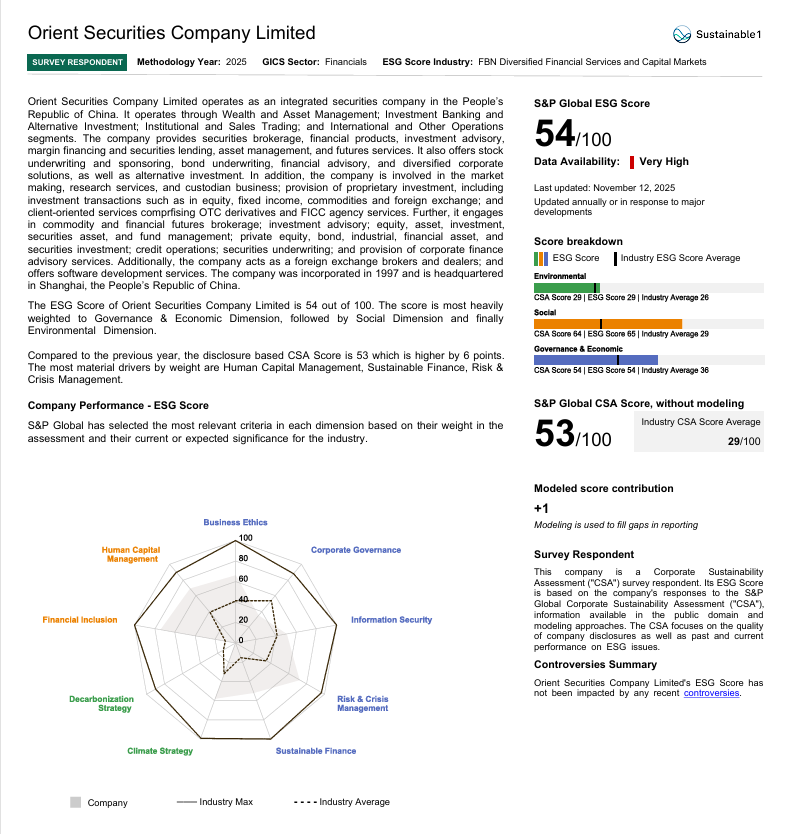
深耕可持续发展 东方证券标普CSA得分实现新突破
Zhong Guo Zheng Quan Bao· 2026-01-20 05:07
Group 1 - S&P Global has awarded Dongfang Securities a Corporate Sustainability Assessment (CSA) score of 53 for 2025, the highest score among Chinese securities firms published to date [1][2] - The CSA score reflects Dongfang Securities' commitment to ESG principles and its leadership in sustainable finance and risk management [1][2] - The company has established a board-level committee to oversee the implementation of ESG goals and policies, enhancing its governance structure [2] Group 2 - Dongfang Securities is integrating sustainable development into its corporate strategy, focusing on optimizing its ESG risk management system and promoting responsible investment [2] - The company is actively engaged in green operations, reducing carbon emissions, and contributing to social welfare and rural revitalization efforts [2] - Recent disclosures include updates to its ESG risk management and responsible investment statements, improving governance transparency [2]

深耕可持续发展 东方证券收获中国证券公司标普CSA最高得分
Zhong Guo Jin Rong Xin Xi Wang· 2026-01-20 04:49
Core Insights - S&P Global has awarded Dongfang Securities the highest score among Chinese securities firms in its Corporate Sustainability Assessment (CSA), achieving a score of 53 for the year 2025 [1][7]. Group 1: ESG Performance - The steady improvement in Dongfang Securities' CSA score reflects the industry's recognition of the company's commitment to ESG principles and its leadership in sustainable finance and risk management [7][8]. - The company has established a board-level committee focused on strategy and sustainability to oversee the implementation of ESG goals and policies [8]. Group 2: Strategic Integration - Dongfang Securities aims to integrate sustainable development deeply into its corporate strategy, promoting the idea of "Enjoying a Better Life" [7][8]. - The company is actively enhancing its ESG risk management system and focusing on responsible investment, aligning ESG efforts with core business operations [8]. Group 3: Operational Practices - The company is committed to reducing operational carbon emissions and is involved in social welfare and rural revitalization efforts, contributing to the consolidation of poverty alleviation achievements [8]. - Recent disclosures include updates to its ESG risk management and responsible investment statements, enhancing the transparency and regulatory compliance of its governance framework [8].

华联控股2026年1月20日跌停分析
Xin Lang Cai Jing· 2026-01-20 03:31
Group 1 - The core viewpoint of the news is that Hualian Holdings (SZ000036) experienced a significant drop, hitting the limit down price of 5.61 yuan, with a decline of 9.79%, resulting in a total market value of 7.889 billion yuan and a circulating market value of 7.874 billion yuan as of the report date [1][2]. Group 2 - The decline in Hualian Holdings' stock price is attributed to several factors, including internal operational pressures, with a net profit decrease of 4.73% and a revenue decline of 2.45% in the first three quarters of 2025. The real estate subsidiary, Jinghengtai, continues to incur losses, and the net cash flow from operating activities is negative [2]. - The company is facing uncertainty in its transformation efforts, particularly regarding the acquisition of a 100% stake in an Argentine lithium mine, which is still pending compliance review and requires approval from both Argentina and Canada, posing a risk of failure [2]. - A significant block trade occurred on January 14, 2026, at a price of 6.50 yuan, reflecting a discount rate of -6.07%, which negatively impacted market sentiment and investor confidence. Additionally, a decline in the company's ESG rating in Q4 2025 indicates sustainability issues, increasing operational costs and affecting stock performance [2].

我国金融领域首部ESG评价国家标准正式落地,我国修订条例高质量推进自然保护区建设
GUOTAI HAITONG SECURITIES· 2026-01-20 03:10
Investment Rating - The report does not explicitly provide an investment rating for the industry Core Insights - The establishment of China's first national ESG evaluation standard in the financial sector marks a significant step towards supporting the country's green development strategy and enhancing the quality of the bond market [5][9] - The revised Natural Protection Zone Regulations aim to provide legal support for high-quality development of natural reserves, emphasizing ecological protection and sustainable resource use [10][13] - The joint measures by the Ministry of Civil Affairs and other departments focus on fostering the elderly care service sector, promoting high-quality development in the silver economy [14][15] Policy Trends - The national ESG evaluation framework (GB/T 46912-2025) has been officially released and will be implemented starting April 1, 2026, providing a structured approach for ESG evaluation in the financial sector [5][6] - The revised Natural Protection Zone Regulations will enhance the management and protection of natural reserves, ensuring ecological integrity while allowing for sustainable development [10][13] - The Ministry of Civil Affairs and other departments have issued measures to cultivate elderly service providers, focusing on brand building, market integration, and technological empowerment [14][15] Industry Trends - The establishment of the Global South Sustainable Development Research Center at Shanghai Jiao Tong University aims to promote sustainable development practices and knowledge sharing among Southern countries [16][19] - The National Forestry and Grassland Administration announced a target to complete 12.7 million acres of land greening by 2025, with current forest coverage at 25.09% [20][23] International Events - A joint statement between China and Canada supports bilateral investment and trade in both clean and traditional energy sectors [24] - Three Chinese cities have been recognized in the UN's list of "20 Cities Towards Zero Waste," highlighting their leadership in waste reduction and sustainable management [25] Corporate Dynamics - Anta Group has achieved a significant upgrade in its MSCI ESG rating to "AA" and received the highest "A" rating from CDP for climate change performance, reflecting its commitment to sustainability [26][27] - China General Nuclear Power Corporation won the "Outstanding ESG Award" at the 9th China Excellence IR Awards, recognizing its strong ESG governance practices [28] - Qilu Expressway was awarded both "Top 100 ESG Companies" and "Top 100 IRM Companies," showcasing its commitment to ESG principles and investor relations management [29][30]
冬季达沃斯论坛开幕,呼吁全球秉持“对话精神”,与会嘉宾规格创纪录
Xin Lang Cai Jing· 2026-01-20 01:36
Core Insights - The 56th World Economic Forum Annual Meeting, known as the "most expensive annual meeting in the world," commenced on January 19, 2023, with the theme "A Spirit of Dialogue," gathering over 3,000 elites from 130 countries to promote dialogue among various sectors [1][3][7] Group 1: Participation and Government Involvement - This year's meeting is expected to set a record for government participation, with approximately 400 officials, including nearly 65 heads of state and government, 55 economic and finance ministers, 33 foreign ministers, 34 trade and industry ministers, and 11 central bank governors [3][9] - The participation of leaders from the G7, including six leaders such as Trump, marks a historic breakthrough, alongside unprecedented involvement from leaders of emerging economies [3][9] Group 2: Key Themes and Discussions - The forum will address five key areas: competitive geopolitical and economic environments, macroeconomic conditions, investment in human capital, long-term value creation in natural resources, climate, food, and water, and responsible deployment of artificial intelligence [10][11][12] - The focus on macroeconomic conditions aims to explore new growth drivers, with artificial intelligence and other cutting-edge technologies at the core of discussions [11] - Investment in human capital will cover the entire value chain, including skills training, education, healthcare systems, and pension systems, which are crucial for unlocking new growth potential [11][12] Group 3: ESG Initiatives - The Sina Finance ESG Rating Center offers 14 ESG services, including information, reports, training, and consulting, to help listed companies promote ESG concepts and enhance sustainable development performance [1][6][13] - The center aims to establish a suitable ESG evaluation standard system for China, promoting the development of ESG investment in the asset management industry [6][13]

2026世界经济论坛年会开幕
Xin Lang Cai Jing· 2026-01-20 01:25
Group 1 - The Sina Finance ESG Rating Center offers 14 ESG services, including information, reports, training, and consulting, to help listed companies promote ESG concepts and enhance their sustainable development performance [1][3] - The World Economic Forum 2026 Annual Meeting opened in Davos, Switzerland, on January 19 and will last until January 23, with approximately 3,000 participants from nearly 130 countries and regions discussing multiple topics [1][3] - The theme of this year's meeting is "the spirit of dialogue," focusing on five key global challenges, including how to cooperate in a competitive world, how to unleash new growth drivers, and how to scale innovative technologies [1][3] Group 2 - The Sina Finance ESG Rating Center is the first Chinese ESG professional information and rating aggregation platform, dedicated to promoting sustainable development, responsible investment, and the value of ESG (Environmental, Social, and Governance) principles [2][4] - The center aims to advance the development of China's ESG initiatives and improve the establishment of ESG assessment standards and corporate ratings [2][4] - Sina Finance has launched multiple ESG innovation indices to provide more options for investors interested in corporate ESG performance and has established the China ESG Leaders Organization Forum to promote the development of ESG investment in China's asset management industry [2][4]
聚焦ESG与商业创业发展 第11届ECI国际数字创新节香港站论坛举行
Xin Hua Cai Jing· 2026-01-19 23:11
Group 1 - The 11th ECI International Digital Innovation Festival was held in Hong Kong, focusing on how ESG principles can be integrated into business innovation and global development strategies in the digital age [1] - Hong Kong's regulatory bodies have maintained an open and inclusive attitude towards financial innovation, which has encouraged active participation in fintech, including the development of Web 3.0 and asset tokenization [1] - Alibaba's representative emphasized the importance of independent thinking and human judgment in the interaction with AI, highlighting that these factors significantly influence outcomes [1] Group 2 - The Blue Ocean Path Sustainable Development Research Institute was officially launched, aiming to deeply study the ESG ecosystem and innovate sustainable value [2] - The research institute will focus on three main research directions: "ESG-driven new paradigms for brand globalization," "localized innovation for sustainable development," and "cross-cultural ESG strategies and trust-building" [2]

Fidelity Sustainable High Yield ETF (FSYD US) - Portfolio Construction Methodology
ETF Strategy· 2026-01-19 20:51
Core Insights - The Fidelity Sustainable High Yield ETF (FSYD) employs an investment framework focused on USD high-yield corporate bonds, integrating bottom-up credit selection with sustainability criteria to avoid issuers with significant ESG controversies [1] Group 1: Investment Strategy - The ETF targets issuers with improving sustainability practices while avoiding those involved in prohibited activities [1] - Analysts assess business risk, financial policy, cash-flow coverage, asset protection, and covenant strength, including downside recovery analysis and catalysts [1] Group 2: Portfolio Construction - Portfolio construction aims to balance carry with resiliency, diversifying across industries, issuers, and rating buckets [1] - Position sizing is determined by conviction, liquidity, and expected loss, with limits to mitigate single-name and sector concentration [1] Group 3: Risk Management - The management team favors seasoned, covenant-sound bonds and avoids structurally weak structures unless compensation is adequate [1] - Cash and short-duration instruments are utilized to provide flexibility during market dislocations [1] Group 4: Rebalancing Strategy - Rebalancing is conducted to realize relative-value rotations across ratings and maturities, reducing exposure when fundamentals weaken or liquidity risk increases [1]

iShares ESG Advanced High Yield Corporate Bond ETF (HYXF US) - Portfolio Construction Methodology
ETF Strategy· 2026-01-19 20:07
Core Insights - The iShares ESG Advanced High Yield Corporate Bond ETF (HYXF US) targets USD high yield corporate bonds while adhering to strict ESG standards [1] Group 1: Index Construction - The underlying index is the Bloomberg MSCI US High Yield Choice ESG Screened Index, which excludes energy and issuers that do not meet defined ESG criteria [1] - Eligibility criteria for bonds include a minimum of USD 400 million par outstanding, fixed-rate USD denomination, at least 1 year remaining maturity, and non-default speculative-grade ratings [1] - Additional MSCI screens require issuers to have an MSCI ESG Rating of at least BB and exclude those involved in controversial sectors such as tobacco, firearms, and fossil fuels [1] Group 2: Portfolio Management - Constituents of the index are market value weighted with a 2% issuer cap, and any excess is redistributed pro rata [1] - The index undergoes monthly rebalancing at month-end, with additions and deletions based on parent index actions while adhering to ESG and size constraints [1] Group 3: Analytics and Insights - For further exploration of HYXF, the ETF analytics platform provides institutional-grade insights, including performance and risk metrics, correlations, sensitivities, and factor exposure [1]