个人超级智能

Search documents
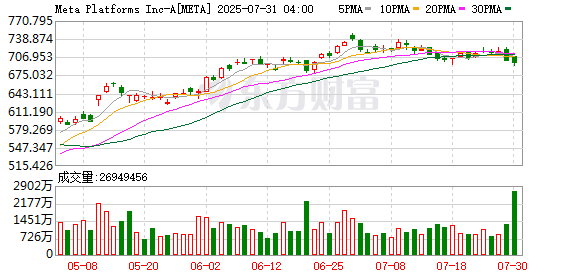
小扎改口不开源,Meta股价暴涨12%
量子位· 2025-07-31 04:23
Core Viewpoint - Meta's recent financial results exceeded expectations, with revenue of $47.52 billion and net income of $18.3 billion, leading to a significant stock price increase of 12% [2][10][16]. Financial Performance - Meta's Q2 revenue grew by 22% year-over-year, reaching $47.52 billion, surpassing the expected $44.8 billion [10]. - Net income increased by 36% year-over-year to $18.3 billion [10]. - Advertising revenue remains the primary source of income, with ad impressions through applications increasing by 11% [11]. - Operating income rose by 38% to $20.44 billion, with an operating margin of 43% [12]. - Reality Labs continues to incur losses, with a Q2 operating loss of $4.53 billion, totaling nearly $70 billion in losses since 2020 [12]. Strategic Focus - Meta is shifting its strategy towards AI, emphasizing the development of "personal superintelligence" and a cautious approach to open-source initiatives [3][21]. - The company plans to increase capital expenditures from a previous lower limit of $64 billion to $66 billion, with total expenditures projected between $114 billion and $118 billion for the year [17][18]. - Meta's CEO, Mark Zuckerberg, highlighted the importance of AI in recent business decisions, including high-profile recruitment efforts [18]. Vision for AI - Zuckerberg's vision emphasizes personal empowerment through superintelligence, aiming to make this technology accessible to everyone rather than focusing solely on automation of valuable work [22][44]. - The integration of technology into daily life is a key focus, with devices like smart glasses envisioned as primary computing tools [24][45]. - The company acknowledges potential security risks associated with superintelligence and plans to manage these risks carefully while being selective about open-source content [26][46]. Market Reception - The market has shown confidence in Meta's AI investments, as evidenced by the stock price surge following the financial report [9][16]. - Despite the ambitious vision, there are concerns regarding the clarity and feasibility of Zuckerberg's plans for superintelligence, with critics questioning the specifics of how these goals will be achieved [37][39].



刚刚,扎克伯克发文正式告别“默认开源”!网友:只剩中国 DeepSeek、通义和 Mistral 还在撑场面
猿大侠· 2025-07-31 04:09
Core Viewpoint - Meta CEO Mark Zuckerberg envisions "personal superintelligence," where individuals can leverage AI to achieve personal goals, while also indicating a shift in the company's AI model release strategy to better manage associated risks [1][12]. Group 1: Shift in Open Source Strategy - Zuckerberg's recent statements reflect a significant change in Meta's approach to open source AI, moving from a strong commitment to open sourcing models to a more cautious stance on what should be open sourced [2][6]. - In 2024, Zuckerberg expressed a commitment to open source AI, stating that Meta would create a long-term sustainable platform, but by 2025, he emphasized the need for careful management of risks associated with open sourcing [2][11]. - The shift from being a "radical open source advocate" to a "cautious selective open source" approach introduces uncertainty for the future of AI open sourcing, particularly benefiting companies that remain in the open source camp, especially in China [6][9]. Group 2: Financial and Strategic Investments - Meta has invested $14.3 billion in AI, marking a departure from the default open source model, as the company focuses on developing closed-source models to enhance commercial control [11][12]. - The company is restructuring its AI division into "Meta Superintelligence Labs" and has recruited top talent from leading AI firms, indicating a strategic pivot towards closed-source development [12][14]. - Reports suggest that Meta has paused testing of its latest open source model "Behemoth" to concentrate on developing a new closed-source model, reflecting a significant strategic shift [12][13]. Group 3: Future Directions and Product Integration - Zuckerberg's vision includes integrating "personal superintelligence" into consumer products like augmented reality glasses and virtual reality headsets, positioning these devices as primary computing tools for users [14]. - A company spokesperson reiterated that while Meta remains committed to open source AI, it also plans to train closed-source models in parallel, indicating a dual approach to AI development [15].

扎克伯格:个人超级智能很快降临,眼镜是AI理想终端
Hu Xiu· 2025-07-31 02:03
Core Insights - Meta's CEO Mark Zuckerberg announced a new AI strategy focused on "personal superintelligence," which aims to enhance individual capabilities rather than replace them [1][2][6] - The company is investing heavily in AI, establishing a dedicated Superintelligence Lab and increasing R&D spending by up to $3.5 billion this year [3][6] - Meta's approach contrasts with the prevailing AGI (Artificial General Intelligence) narrative, emphasizing individual empowerment through technology [2][6][9] Investment and Financial Implications - Meta's recent quarterly results exceeded market expectations, providing confidence for its substantial investments in AI and technology [1][6] - The company has accumulated losses of $60 billion in its Reality Lab division, yet the recent performance has shifted market sentiment positively [6] - Meta's total investment in AI infrastructure is projected to be around $70 billion this year, indicating a strong commitment to this strategic direction [6][11] Product Development and Market Position - The personal superintelligence will be integrated across Meta's product lines, including Facebook, Instagram, WhatsApp, and augmented reality devices [1][6] - Zuckerberg envisions AI glasses or headsets becoming the primary personal computing platform, similar to smartphones [5][10] - Meta is adjusting its open-source strategy to mitigate risks associated with superintelligence, indicating a more cautious approach moving forward [4][10] Strategic Differentiation - Zuckerberg's vision for superintelligence is distinct from other industry leaders, focusing on empowering individuals rather than centralizing control [2][9] - The company aims to redefine the AI landscape by prioritizing personal agency and the ability to shape one's own future with technology [9][11] - Meta's strategy includes a significant talent acquisition effort from competitors like OpenAI, Google, and Apple, signaling a competitive stance in the AI space [2][6]
刚刚,扎克伯克公开信:Meta不会开源全部模型
机器之心· 2025-07-31 01:24
Core Viewpoint - Meta's CEO Mark Zuckerberg is aggressively recruiting top AI researchers from competitors and is sharing his vision for superintelligence, indicating significant advancements in AI development are imminent [2][3][12] AI Development and Strategy - Meta has observed signs of self-improvement in its AI systems, although progress is currently slow. The development of superintelligence is seen as approaching [2][7] - The company is shifting its approach to releasing AI models, emphasizing the need to balance the benefits of superintelligence with potential safety risks. This includes a cautious approach to open-sourcing content [3][11] - Zuckerberg has previously indicated that if the functionality of AI models changes significantly, Meta may reconsider its commitment to open-sourcing [4][5] Competitive Landscape - Meta's Llama series of open models is positioned as a key differentiator against competitors like OpenAI and Google DeepMind. The goal is to create open-source AI models that are as effective as closed-source alternatives [3][6] - The decision to keep models closed-source by competitors is driven by the desire for greater control over monetization. Meta's business model, primarily reliant on internet advertising, allows for a different approach [6] Vision for Superintelligence - Zuckerberg envisions a future where superintelligence enhances human capabilities, enabling individuals to pursue their personal goals and aspirations [9][10] - The company believes that personal superintelligence will empower individuals, contrasting with views that advocate for centralized control over superintelligence [10][11] Future Investments and Expectations - Meta plans to invest up to $72 billion in AI infrastructure by 2025, indicating a strong commitment to developing the necessary resources for superintelligence [12] - Following the announcement, Meta's stock price increased significantly, reflecting positive market sentiment towards the company's AI strategy [12]

Meta业绩超预期、指引强劲,上调全年资本支出下限,盘后大涨10%
美股IPO· 2025-07-30 23:54
Core Insights - Meta's Q2 revenue reached $47.52 billion, significantly exceeding market expectations, with earnings per share at $7.14, also above forecasts [1][4][5] - Strong advertising revenue and lower-than-expected losses in Reality Labs contributed to a projected Q3 revenue of $47.5 to $50.5 billion, higher than analyst estimates [1][3][5] - The company raised its 2025 capital expenditure lower limit from $64 billion to $66 billion, indicating confidence in its advertising business to support aggressive AI investments [1][7][8] Financial Performance - Revenue: Q2 revenue was $47.52 billion, surpassing analyst expectations of $44.83 billion [4] - Earnings per Share: Q2 EPS was $7.14, significantly higher than the expected $5.89 [5] - Advertising Revenue: Q2 advertising revenue was $46.5 billion, exceeding the forecast of $44.07 billion [5] - Reality Labs Losses: Q2 losses for Reality Labs were $4.5 billion, better than the anticipated $4.8 billion loss [5] Business Outlook - Revenue Guidance: Meta expects Q3 revenue to be between $47.5 billion and $50.5 billion, with a midpoint above analyst estimates of $46.2 billion [5] - Capital Expenditure: Projected 2025 capital expenditures are now estimated to be between $66 billion and $72 billion [7][8] AI Investment Strategy - Increased Spending: Meta plans to further increase capital expenditures next year, driven by investments in talent, infrastructure, data centers, and energy to compete in the evolving AI landscape [7][8] - Infrastructure Costs: The primary driver of spending growth will be infrastructure costs, including accelerated depreciation and increased operational costs [8] - Talent Acquisition: Meta is aggressively recruiting top AI researchers with substantial compensation packages, including offers reaching up to $1 billion [11][12] AI Development Challenges - Internal Challenges: The development of advanced AI faces challenges such as employee turnover and frequent organizational restructuring [9] - Competitive Landscape: Competitors are also increasing spending to capture market share as AI usage becomes more prevalent among consumers and businesses [12][13] Product Development - Smart Glasses: Meta is actively entering the smart glasses market, launching products like Ray-Ban Meta and Oakley Meta glasses, as part of its "personal superintelligence" strategy [14] - Reality Labs Losses: Reality Labs has incurred cumulative losses nearing $70 billion since late 2020, with Q1 losses reported at $4.2 billion [14][15]

盘后大涨12%!MetaQ2业绩超预期、指引强劲,上调全年资本支出下限
Hua Er Jie Jian Wen· 2025-07-30 23:46
Core Insights - Meta Platforms reported strong Q2 earnings, exceeding revenue expectations and providing robust guidance for Q3, leading to a post-market stock surge of 12% [1][2] - The company continues to invest heavily in AI, supported by its stable advertising revenue, indicating confidence in future growth [4][8] Financial Performance - Q2 Revenue: $47.516 billion, surpassing analyst expectations of $44.83 billion [1] - Q2 Earnings Per Share: $7.14, significantly above the expected $5.89 [1] - Family of Apps Revenue: $47.15 billion, exceeding market expectations of $44.403 billion [1] - Reality Labs Revenue: $370 million, slightly below the market expectation of $383 million [1] - Daily Active Users (DAUs): 3.48 billion, a 6% year-over-year increase [1] Guidance and Capital Expenditure - Q3 Revenue Guidance: Expected between $47 billion and $50.5 billion, with the midpoint above analyst estimates of $46.2 billion [2] - 2025 Capital Expenditure Guidance: Expected to be between $66 billion and $72 billion, up from a previous lower estimate of $64 billion [2][4] Investment in AI - Meta is increasing capital expenditures primarily for infrastructure, talent acquisition, and operational costs related to AI [5][6] - The company is restructuring its AI division into "Meta Superintelligence Labs" to enhance its AI capabilities [8] - Significant recruitment efforts are underway, with offers reaching up to $1 billion for top AI talent [8][9] Market Position and Competition - Meta's competitors, including Alphabet, are also increasing their capital expenditures to capture market share in the AI space [9][10] - The AI competition is characterized by rapid advancements and significant capital investment, likened to past technology races [10] Product Development - Meta is actively developing smart glasses and other AI-related products as part of its "personal superintelligence" strategy [10][11] - The company has reported a significant increase in sales for its Ray-Ban Meta smart glasses, with a threefold increase expected by mid-2025 [11]
孤注一掷!小扎本人回应天价挖人策略!顶尖人才更在乎 GPU 支配权!不是我针对谁,能挖的地方就五六个!可劲造泰坦集群
程序员的那些事· 2025-07-24 03:36
Core Viewpoint - Meta is aggressively recruiting top AI talent, emphasizing the importance of computational resources and small teams over high salaries in attracting researchers [1][2][11]. Group 1: Recruitment Strategy - Meta's recruitment strategy focuses on attracting top researchers by offering them the opportunity to work with minimal team members and maximum computational power [2][11]. - The company aims to ensure that it can connect with all top researchers in the industry for potential collaborations in the future [4][65]. - Meta's recruitment is not targeted against specific competitors but is part of a broader strategy to build a strong AI research team [4][65]. Group 2: Vision for AI - Meta's vision for "personal superintelligence" aims to empower individuals by addressing their daily concerns, such as relationships and creativity, rather than just productivity [4][6][21]. - This vision contrasts with other companies like OpenAI and Google, which focus on broader, centralized AI solutions [4][13][19]. - The company believes that AI will evolve in various directions and does not subscribe to a "winner-takes-all" mentality [6][13]. Group 3: Capital Expenditure Strategy - Meta is investing heavily in building one of the largest computational clusters globally, funded entirely by its cash flow, which provides a competitive advantage [5][44]. - The company is constructing multiple multi-gigawatt data centers, with the Hyperion project expected to expand to 5GW in the coming years [47][50]. - Meta's approach to building data centers has evolved to be more efficient, utilizing innovative methods to expedite construction [46][44]. Group 4: Future of AI Development - The company is witnessing early signs of "self-similarity" in its models, indicating significant advancements in AI capabilities [10][34]. - Meta's focus on developing AI technologies is expected to lead to transformative changes in both user-facing products and internal software development processes [32][33]. - The integration of AI into everyday life, such as through smart glasses, is seen as a key area for future development [24][30].

扎克伯格:我相信AI,所以不惜一切代价,投入数千亿美元,打造最强算力和团队
硬AI· 2025-07-16 07:01
Core Viewpoint - Meta is redefining the future of superintelligence with a focus on "personalized super intelligence," aiming to empower billions of users rather than just enhancing enterprise productivity [2][10] Group 1: Investment in AI Infrastructure - Meta is investing thousands of billions in building massive computing clusters, with the largest project, Hyperion, nearing the size of Manhattan [2][3] - The company is constructing multiple gigawatt-scale data centers, with the Prometheus and Hyperion clusters expected to exceed 1 gigawatt, and Hyperion set to expand to 5 gigawatts in the coming years [3][4][15] - Meta's strong business model supports these investments, allowing the company to fund these large-scale projects independently without external financing [4][14][16] Group 2: Talent Acquisition Strategy - Meta is engaged in a fierce competition for top talent, with a focus on hiring 50 to 70 elite researchers to build a high-performing team [4][8] - The company is willing to offer substantial compensation packages, although specific figures reported may not be entirely accurate [4][8][16] - The strategy emphasizes having a small, highly skilled team with maximum GPU resources, which is seen as a strategic advantage in attracting top talent [4][8][16] Group 3: Vision for AI Interaction - Zuckerberg believes AI glasses will become the optimal form of interaction with AI, potentially becoming essential for cognitive enhancement [4][12][13] - These glasses will be capable of observing daily life and providing real-time information, enhancing personal relationships and cultural engagement [12][13] Group 4: Future Outlook on Superintelligence - There are varying opinions on when superintelligence will be realized, with estimates ranging from three to seven years; however, Zuckerberg is optimistic about its potential readiness in two to three years [5][7] - The company aims to leverage its substantial computing power to support the development of superintelligence, which is expected to significantly impact both company operations and broader societal functions [6][10][14]

扎克伯格:我相信AI,所以不惜一切代价,投入数千亿美元,打造最强算力和团队
Hua Er Jie Jian Wen· 2025-07-16 06:08
Core Insights - Meta is redefining the future of super intelligence with a focus on "personalized super intelligence" aimed at billions of users, contrasting with competitors' enterprise-level AI applications [1][2] - The company is investing unprecedented capital, amounting to thousands of billions, in building large-scale computing clusters, with the Hyperion project nearing the size of Manhattan [1][2] - Meta's strategy emphasizes attracting top talent, with a competitive market for researchers, and a focus on maximizing GPU resources with a lean team [2][6] Group 1: AI Vision and Strategy - Meta's vision of personalized super intelligence aims to empower individuals rather than solely focusing on economic automation, which is the trend among other tech giants [1][7] - The company believes that while addressing significant issues is important, people are often more concerned with simpler aspects of their lives [1][7] - The goal is to provide this power directly to users, aligning with Meta's values of enhancing personal experiences [1][7] Group 2: Infrastructure Investment - Meta is constructing multiple gigawatt-scale data centers, with the Prometheus and Hyperion clusters expected to exceed 1 gigawatt, and Hyperion set to expand to 5 gigawatts in the coming years [2][11] - The scale of these projects is significant, with the Hyperion site comparable in size to a substantial portion of Manhattan [2][11] - The company has a robust business model to support these investments, allowing it to self-fund without relying on external financing [2][11] Group 3: Talent Acquisition and Market Competition - The competition for top talent in AI is intense, with Meta willing to invest heavily to secure a small number of elite researchers [2][6] - While reports suggest compensation packages could reach $100 million to $200 million, the specifics may be exaggerated, but the market remains highly competitive [2][6] - Meta's strategy focuses on having the highest GPU resources per researcher, which is seen as a strategic advantage in attracting talent [12] Group 4: Future Outlook - There are varying opinions on when super intelligence will be realized, with estimates ranging from three to seven years; however, Meta is optimistic about a two to three-year timeline [3][5] - The company is committed to investing heavily in building the strongest team possible to capitalize on this potential [3][5] - Meta envisions AI glasses as the optimal form of interaction with AI, potentially becoming essential for cognitive enhancement in daily life [2][9]
年薪2亿!比肩C罗的华人AI大神究竟是谁?
Xin Lang Cai Jing· 2025-07-16 01:03
Group 1 - Meta has hired AI engineer Ruoming Pang with a total compensation exceeding $200 million, surpassing the salary of Apple's CEO Tim Cook and approaching that of soccer star Cristiano Ronaldo [2][4][5] - The compensation package for Pang includes a base salary, signing bonus, and a significant portion tied to company stock performance, which is common in tech companies [4][5] - Meta's aggressive hiring strategy is linked to the establishment of its "Super Intelligence Lab," aimed at creating advanced artificial intelligence [5][7] Group 2 - Meta plans to invest billions in AI infrastructure, research, and talent acquisition, having already recruited over ten researchers from OpenAI and other tech firms [7][8] - The competition for AI talent has intensified, with other tech companies like NVIDIA and Google also actively recruiting top engineers [7][14] - Meta's focus on a select group of elite AI engineers indicates a strategic approach to talent acquisition rather than a broad recruitment effort [14] Group 3 - Ruoming Pang has a distinguished background, having worked at Google for 15 years and leading significant AI projects, including the development of advanced speech recognition systems [11][13] - Pang's transition from Apple to Meta was influenced by challenges faced by his team at Apple, including delays in product development [13] - The current talent landscape in Silicon Valley shows a stark contrast between the high demand for AI experts and the layoffs occurring in non-AI sectors [16]