主动权益投资

Search documents
从稳健到创收:银行理财的"分红时代"悄然开启
点拾投资· 2025-08-07 11:00
Core Viewpoint - The continuous decline in risk-free interest rates poses new challenges for bank wealth management, prompting companies like Xingyin Wealth Management to innovate in their investment strategies to meet public demand for returns [1][2]. Group 1: Investment Strategy and Performance - Xingyin Wealth Management has launched the "Alpha 2" product, which has achieved an absolute return of 18.9% since its inception on March 27, 2023, with a cash dividend of 0.03 yuan per unit, representing a distribution ratio of approximately 2.54% [1]. - The "Alpha 1" product managed by investment manager Li Feng has delivered an impressive absolute return of 22.189% from June 14, 2024, to July 30, 2025, showcasing the effectiveness of its unique low-valuation value investment strategy [2]. - Xingyin Wealth Management has established a proactive equity investment team, differentiating itself from traditional bank wealth management practices that often rely on fund-of-funds (FOF) and outsourcing [2][6]. Group 2: Team and Research Development - The proactive equity investment team at Xingyin Wealth Management was built over five years, focusing on creating a self-reliant research and investment system, which includes a diverse product matrix covering various risk levels [6][7]. - The team is led by experienced professionals, including Li Feng, who has a strong background in finance and investment, and is supported by analysts with diverse academic backgrounds [7][8]. - The investment team employs advanced technologies such as quantitative analysis and artificial intelligence to enhance decision-making processes [7]. Group 3: Investment Framework and Methodology - Li Feng has developed a comprehensive PB-ROE investment framework that integrates value, cycle, and growth, aiming to provide a more nuanced approach to equity valuation [13]. - The framework emphasizes the importance of low valuation to mitigate human biases in investment decisions, reflecting a more rational investment attitude [13]. - The investment strategy also incorporates a lifecycle approach to pricing, allowing for a more dynamic assessment of companies' operational cycles and growth potential [13][14]. Group 4: Long-term Value Creation - Xingyin Wealth Management is committed to creating long-term value for clients, aligning its investment strategies with the evolving regulatory landscape and market conditions [18][19]. - The recent cash dividend from the Alpha 2 product exemplifies the company's focus on enhancing client experience and meeting their liquidity needs while delivering strong investment performance [18]. - The company believes that sustainable growth in bank wealth management can only be achieved by integrating the underlying operational chain and focusing on long-term client value [19].


富达基金周文群:主动权益投资一直是富达的强势领域
Zhong Zheng Wang· 2025-08-05 13:35
Core Viewpoint - Fidelity's active equity investment remains a strong area, supported by a vast research network and a robust investment culture [1] Group 1: Research and Investment Culture - Fidelity International has nearly 500 professional research personnel across 18 global research centers, with fund managers averaging about 20 years of industry experience and researchers averaging 11 years [1] - The continuous exchange and interaction among different asset classes contribute to Fidelity's advantages in active equity [1] Group 2: Technological Empowerment - Fidelity's proprietary Insight system is a significant advantage, serving as a powerful internal research platform developed over decades [1] - The Insight system enables real-time connection to global research resources, allowing fund managers in Shanghai to access first-hand information from researchers in various regions [1] - The system includes various tools for stock screening, fundamental monitoring, and portfolio construction and management, providing strong support for fund managers [1]
主动权益基金强势回归 最牛基金收益率超过被动产品34%
Zheng Quan Shi Bao· 2025-07-09 21:58
Core Insights - Active equity funds have significantly outperformed passive index funds this year, with the best-performing active fund achieving nearly 100% returns, surpassing the highest index fund by nearly 34 percentage points [1][2] - The strong performance of active equity funds is attributed to the ongoing structural market trends, allowing fund managers to leverage their stock-picking abilities [1][4] Performance Comparison - As of July 8, all top ten performing equity funds are active products, primarily focused on Hong Kong stocks, pharmaceuticals, and the Beijing Stock Exchange [2] - The average return for ordinary stock funds is 9.06%, while stock index funds average 6.29%, indicating a clear advantage for active funds [3] Market Trends - The success of active equity funds is linked to favorable market conditions, particularly in sectors like pharmaceuticals and Hong Kong stocks, where active managers have demonstrated superior stock selection [4] - A diverse range of active funds, including those focused on dividends and cyclical stocks, have also shown strong performance [4][5] Future Outlook - Fund managers anticipate multiple investment opportunities across various sectors in the second half of the year, driven by domestic growth policies and a supportive liquidity environment [6] - Key investment themes include technology, new consumption, and cyclical dividend stocks, with specific focus areas such as AI applications and agricultural recovery [6][7]
基金公司主动权益中长期投资业绩大比拼
Zhong Guo Ji Jin Bao· 2025-07-02 16:22
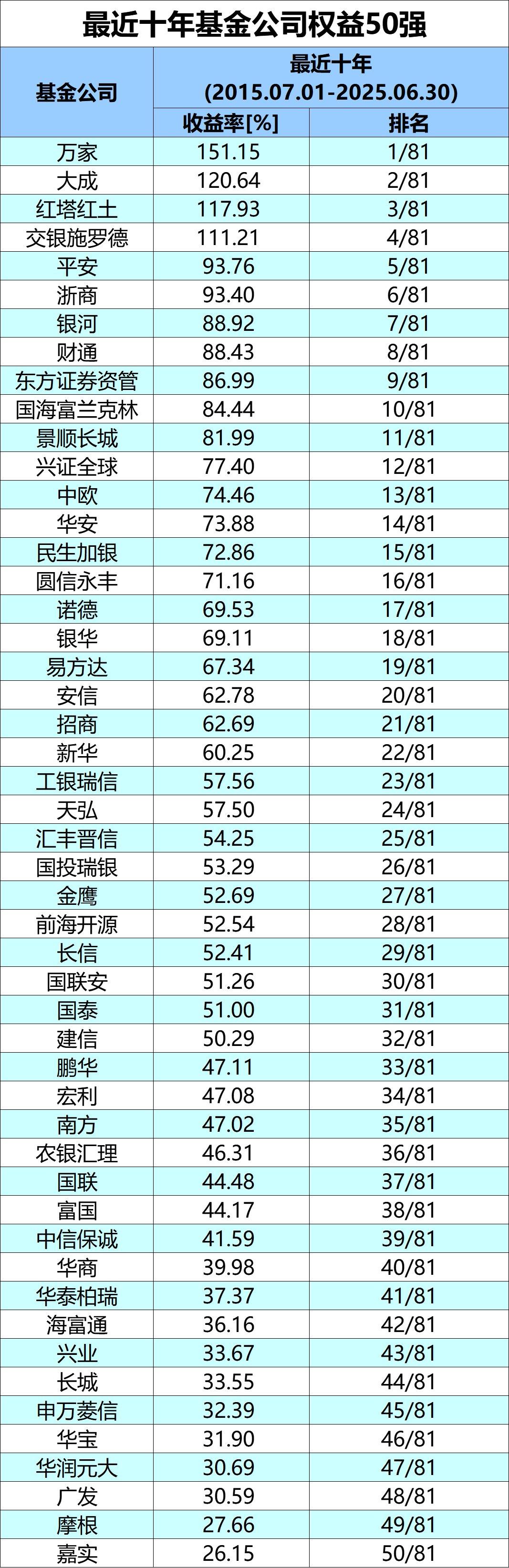
Core Insights - The report highlights the performance of fund companies in active equity investment over various time frames, revealing the top performers in the A-share market [1][2]. Long-term Performance (10 Years) - The top three fund companies over the last decade (from July 1, 2015, to June 30, 2025) are: - Wanji Fund with a return of 151.15%, ranking first among 81 companies - Dacheng Fund with a return of 120.64%, ranking second - Hongta Hongtu with a return of 117.93%, ranking third [2][3][5]. Medium-term Performance (5 Years) - For the five-year period (from July 1, 2020, to June 30, 2025), the leading fund companies are: - Jinyuan Shun'an with an average return of 152.27%, ranking first among 137 companies - Guojin Fund with a return of 94.55%, ranking second - Zhongtai Securities Asset Management with a return of 94.46%, ranking third [7][8]. Short-term Performance (3 Years) - In the three-year period (from July 1, 2022, to June 30, 2025), the top performers are: - Huarun Yunda with an average return of 34.65%, ranking first among 156 companies - Jinyuan Shun'an with a return of 33.61%, ranking second - Guojin with a return of 23.92%, ranking third [12][14]. Recent Performance (First Half of 2025) - In the first half of 2025, the best-performing fund companies include: - Zhonghang Fund with a return of 23.01% - Hongtu Innovation with a return of 22.10% - Hengyue with a return of 21.23% [17][18][20]. Performance Comparison by Company Size - The average returns of large, medium, and small fund companies over the last ten years show that large and medium companies significantly outperform small companies, with medium companies averaging 67.85% and large companies averaging 56.16% [5][6].
聚焦均衡配置与选股能力 迎接公募基金高质量发展——专访中金基金权益部基金经理丁杨
Zheng Quan Ri Bao· 2025-06-13 16:17
Core Viewpoint - The China Securities Regulatory Commission's recent action plan aims to shift the public fund industry from a focus on scale to a focus on returns, impacting the active equity investment ecosystem and requiring fund managers to adapt their strategies [1] Group 1: Impact of the Action Plan - The action plan strengthens the constraints of performance benchmarks, leading to a shift away from strategies that heavily deviate from benchmarks towards a more balanced allocation across sectors and styles [2] - Fund managers will need to enhance their stock selection capabilities, as the focus will shift towards matching portfolios with benchmarks, allowing for clearer demonstration of their ability to generate excess returns [2][3] - The plan presents significant opportunities for Fund of Funds (FOF) and fund advisory businesses, enabling active equity fund managers to concentrate on in-depth stock research while advisory firms can leverage their expertise in asset allocation [2] Group 2: Stock Selection as a Key Competence - The ability to generate long-term excess returns is crucial for fund managers, with stock selection being the most stable and sustainable core competency, aligning with the plan's emphasis on investor interests and long-term value [3] - Historical trends indicate that even in high-growth sectors, only companies with core technological advantages and strong management can provide sustainable returns, highlighting the risks of short-term strategies focused on single sectors [3] Group 3: Finding Investment Opportunities - Fund managers should enhance their tracking of individual stock fundamentals, ensuring effective pricing and proactive investment when positive changes occur in quality growth stocks [4] Group 4: The Irreplaceability of Active Management - Despite discussions on the potential replacement of active equity funds by index-enhanced or quantitative funds, active management is expected to maintain a vital role in the asset management industry due to its advantages in tracking short-term economic changes and conducting in-depth research [5] - The core competencies of active management will focus on high-frequency tracking of corporate dynamics and deep valuation assessments, distinguishing it from quantitative strategies and ensuring continued excess returns for investors [5]
交银施罗德基金困局:三年缩水超千亿元,权益类产品规模“腰斩”
Hua Xia Shi Bao· 2025-05-29 01:05
Core Viewpoint - The article highlights the significant decline in the management scale and performance of China’s Jiao Yin Schroder Fund, which has faced challenges in recent years, leading to a loss of its previous status as a leading fund manager in the industry [2][3][5]. Group 1: Management Scale - Jiao Yin Schroder Fund's management scale has decreased to approximately 4687 billion yuan, down from a peak of 5960.85 billion yuan in June 2022, marking a decline of over 1274 billion yuan compared to three years ago [3][4]. - In the first quarter of 2025, the total scale of 133 products was 4686.65 billion yuan, reflecting a decrease of 687.57 billion yuan, or 12.79%, from the end of 2024 [3][4]. Group 2: Profit Decline - The net profit of Jiao Yin Schroder Fund has dropped to 8.79 billion yuan in 2024, a decrease of 26.81% compared to 12.01 billion yuan in 2023, marking the third consecutive year of profit decline [5][6]. - The fund's total assets were reported at 83.84 billion yuan, with net assets of 71.35 billion yuan as of the end of 2024 [5]. Group 3: Fund Performance - Various types of funds managed by Jiao Yin Schroder have experienced a downward trend, with stock funds decreasing from 79.98 billion yuan in Q1 2023 to 32.02 billion yuan in Q1 2025 [6]. - Mixed funds have seen a significant drop from 2027.52 billion yuan at the end of 2021 to 872.98 billion yuan in Q1 2025, representing a 57% decline [6]. Group 4: Fund Manager Performance - The performance of the "Jiao Yin Three Swordsmen," the prominent fund managers, has deteriorated, with their managed funds showing negative returns over the past three years [8][9]. - For instance, He Shuai's managed fund has a three-year return of -26.74%, ranking 2494 out of 2946 in its category [8].

解码主动权益投资新趋势:新模式、消费复苏与港股机遇成热议焦点
Xin Hua Cai Jing· 2025-05-23 09:29
Core Insights - The 12th Fortune Forum focused on new models of active equity investment in the A-share market, emphasizing consumer dynamics and the resilience of the Hong Kong stock market [1] - Key speakers provided forward-looking insights on investment strategies, industry allocation, and market positioning to instill confidence and vitality in the market [1] Group 1: A-share Market Insights - The A-share market is transitioning from a "stock economy" to a "new model," with Q1 2025 marking a turnaround in profit growth after four years of decline [2] - The core drivers of this reversal include low inventory levels triggering a replenishment cycle, companies operating with less burden, and a recovery in the real estate chain due to a rebound in second-hand housing [2] - Return on Equity (ROE) has significantly improved from its bottom, supported by a decrease in expense ratios offsetting operational pressures, and a recovery in asset turnover and leverage [2] - The market sentiment is expected to improve significantly due to the narrative of China's industrial transformation, including breakthroughs in AI and high-end manufacturing [2] Group 2: Consumer Sector Opportunities - The consumer sector is showing structural investment opportunities, with current price-to-earnings (PE) ratios at near ten-year lows and institutional holdings at a bottom [3] - Catalysts for a rebound in the consumer sector include a peak in household savings rates, improved income expectations, and the re-emergence of wealth effects [3] - Investment opportunities include traditional consumer leaders with stable dividends and new consumption trends such as domestic brand growth and service consumption upgrades [3] - The second half of 2025 may present a recovery window for the consumer sector due to supportive consumption policies and a favorable profit base effect [3] Group 3: Hong Kong Market Resilience - Despite facing foreign capital outflow pressures, the Hong Kong stock market shows resilience supported by continuous inflows from southbound funds and increased company buybacks [4] - The Hang Seng Index has achieved a 12% annualized return in RMB terms over the past three years, highlighting the market's value proposition [4] - A GARP (Growth at a Reasonable Price) strategy is recommended, focusing on high-growth sectors like consumer and technology, stable cash flow assets, and companies with low leverage and high governance standards [4][5] Group 4: Long-term Investment Strategy - The company emphasizes a fundamental approach to investment, selecting stocks based on strong earnings and favorable market conditions to achieve sustainable long-term returns [5] - The company has achieved a cumulative return of 953.86% over nearly two decades for its active equity products, positioning itself among industry leaders [5] - Continuous enhancement of professional investment capabilities is crucial for capturing certainty in investment opportunities amid global changes [5]
“国家队”、私募、外资都在买!股票型基金规模再创新高
券商中国· 2025-04-04 06:55
Core Viewpoint - The public fund market in China has seen significant growth in 2024, with institutional investors increasing their holdings in equity funds, particularly through ETFs, while individual investors continue to dominate in money market funds [1][4][6]. Group 1: Institutional Investor Trends - Institutional investors increased their total holdings in public funds by 3.5 trillion units compared to the end of 2023, with over 40% of their holdings in equity funds, marking a nearly 12 percentage point increase from the end of 2022 [2][5]. - The total size of equity funds rose from 1.88 trillion units at the end of 2022 to 3.03 trillion units by the end of 2024, representing a growth rate of 61% [4]. - The share of equity funds held by institutional investors grew from 5.67 trillion units at the end of 2022 to 12.8 trillion units by the end of 2024, a 126% increase [4][5]. Group 2: ETF Investment - Institutional investors have significantly increased their equity fund holdings primarily through ETFs, participating in market dips and rebounds [6][7]. - In 2024, major ETFs such as Huatai-PB CSI 300 ETF and E Fund CSI 300 ETF saw net subscriptions exceeding 10 billion units, with institutional investors accounting for nearly 80% of the net inflows [8][10]. - The largest ETF, Huatai-PB CSI 300 ETF, had an institutional ownership increase from 66.04% at the end of 2023 to 83.58% by the end of 2024 [10][11]. Group 3: Shift from Active to Passive Funds - There has been a notable decline in institutional interest in actively managed equity funds, with 40 active funds experiencing net redemptions exceeding 1 billion units in 2024 [12]. - The shift towards passive investment strategies is evident, as passive funds surpassed active equity funds in A-share market capitalization for the first time in history [11]. - Only 11 actively managed funds received over 1 billion units in net subscriptions from institutional investors in 2024, indicating a preference for ETFs and a reduced reliance on actively managed funds [13].