亚太共同体

Search documents
APEC“中国年”广州启幕,湾区精彩不断闪耀世界
Nan Fang Du Shi Bao· 2026-02-01 16:00
作为中国2026年主场外交的重要节点,广州担负本场重要国际会议可以说有底气、有实力,不仅从从容 容,而且游刃有余。 过去一年,广州不仅作为十五运会的主赛区,向世界呈现出广州"简约、安全、精彩"高质量承办重大赛 事的能力,广州连续主办广交会的水准也已经有目共睹。以第138届广交会为例,广州从硬件到软件, 从贸易对接到消费体验,不断创新便利化服务,向世界交出满意答卷。为保障会议圆满成功,广州遵 循"简洁、高效、节俭"原则推进各项筹备。致力于国际一流标准的全流程服务,广州还特别推出"APEC 广州一卡通",方便参会代表体验公共交通、游览公园与文博场馆;在酒店配套外币兑换、离境退税等 服务,力求让每位来宾感到宾至如归。 2月1日,APEC2026年第一次高官会及相关会议在广州盛大开幕,来自成员经济体、秘书处、工商咨询 理事会等约1000名代表齐聚羊城,紧扣"建设亚太共同体,促进共同繁荣"的年度主题与"开放、创新、 合作"三大优先领域,全面启动各领域合作,为年底的领导人非正式会议奠定基础。这也是APEC"中国 年"的首场正式活动。 APEC"中国年"的首场正式活动落地广州,意蕴深长。广州和深圳作为粤港澳大湾区这一超级城 ...
2026年将开展超百场招商活动 推动广州与APEC经济体共建合作园区
Nan Fang Ri Bao Wang Luo Ban· 2026-01-30 08:42
Group 1 - The APEC first senior officials' meeting and related events will be held in Guangzhou from February 1 to 10, 2026, with over 1,000 representatives expected to attend [1] - The meeting will focus on the theme "Building a Community of the Asia-Pacific for Common Prosperity" and three priority areas: openness, innovation, and cooperation [1] - More than 70 meetings and related activities will cover topics such as trade and investment, economic and technological cooperation, digital economy, and food security [1] Group 2 - Guangzhou has established a service guarantee mechanism for major diplomatic activities, with a leadership team overseeing the preparation work [2] - Each delegation will have a dedicated reception team and access to professional translators in eight languages [2] - The city has planned five themed city tour routes for representatives to experience local culture and innovation [2] Group 3 - Guangzhou has attracted nearly $120 billion in foreign investment from APEC economies, accounting for 82.8% of the city's total foreign investment [3] - The city has invested in 2,684 non-financial projects in APEC economies, with a total investment amount of $24.72 billion, representing 81% of the city's total [3] - Over 2,000 enterprises from Guangzhou will participate in 150 overseas exhibitions in APEC economies this year, promoting cooperation and investment opportunities [3]
APEC第三十二届贸易部长会议5月在苏州举办
Xin Lang Cai Jing· 2026-01-15 22:30
Core Viewpoint - The 32nd APEC Trade Ministers' Meeting will be held in Suzhou, Jiangsu Province, in May 2026, marking China's third time hosting APEC events, focusing on significant trade issues in the Asia-Pacific and globally [1][2]. Group 1: Event Details - The APEC Trade Ministers' Meeting will play a crucial role in the APEC cooperation process, preparing for the informal APEC leaders' meeting in November [1]. - The meeting will emphasize themes of "China Year" and "Building a Community in the Asia-Pacific for Common Prosperity," focusing on openness, innovation, and cooperation [1]. Group 2: Objectives and Focus Areas - Key areas of cooperation will include regional economic integration, the construction of the Asia-Pacific Free Trade Area, support for the multilateral trading system, digital cooperation, and the development of a green economy [1]. - The meeting aims to create a more open regional economic environment and inject stronger momentum into economic growth in the Asia-Pacific and globally [1]. Group 3: Significance of Suzhou - Suzhou is recognized as a historical and cultural city, as well as a forefront of China's opening-up, combining rich historical heritage with modern international appeal [2]. - Hosting the trade ministers' meeting in Suzhou is expected to leave a distinct mark on the "China Year" of APEC [2].
中国驻韩国大使:推动中韩关系乘势而上、更好发展
Xin Lang Cai Jing· 2025-12-23 23:14
Group 1 - The visit of President Xi Jinping to South Korea from October 30 to November 1 marks a significant diplomatic action following the successful conclusion of the 20th Central Committee's Fourth Plenary Session, highlighting a new chapter in China's major country diplomacy [1] - Xi's visit is notable as it is his first state visit to South Korea in 11 years, reflecting the high importance placed on this relationship by both nations [2] - During the APEC informal leaders' meeting, Xi emphasized the need for cooperation and shared opportunities in the Asia-Pacific region, advocating for inclusive economic globalization and the construction of a community in the Asia-Pacific [3] Group 2 - The meeting between Xi and South Korean President Lee Jae-myung resulted in a series of important consensus agreements, focusing on strengthening strategic communication, deepening mutually beneficial cooperation, and enhancing national sentiments [2][4] - The two leaders' discussions are expected to lead to improved bilateral relations, with both sides expressing a commitment to manage differences and promote a cooperative strategic consensus [4] - The upcoming APEC meeting in Shenzhen in November next year was announced by Xi, which received enthusiastic applause, indicating a positive outlook for future cooperation [3]
推动中韩关系乘势而上、更好发展(大使随笔)
Ren Min Ri Bao· 2025-12-23 22:31
Group 1 - The visit of President Xi Jinping to South Korea from October 30 to November 1 marks a significant diplomatic action following the successful conclusion of the 20th Central Committee's Fourth Plenary Session, highlighting a new chapter in China's major country diplomacy [1] - Xi's visit is the first state visit to South Korea in 11 years, indicating the high importance placed on this relationship by both sides, with South Korea welcoming Xi with the highest honors [2] - During the APEC informal leaders' meeting, Xi emphasized the need for cooperation and shared opportunities in the Asia-Pacific region, advocating for inclusive economic globalization and the construction of a community in the Asia-Pacific [3] Group 2 - The meeting between Xi and South Korean President Lee Jae-myung resulted in a series of important agreements, focusing on strengthening strategic communication, deepening mutually beneficial cooperation, and enhancing national sentiments [2][4] - The two leaders discussed the importance of managing differences and fostering a strategic consensus for mutual benefit, particularly in light of China's upcoming "14th Five-Year Plan" [4] - The visit also included a significant meeting between the Chinese and U.S. presidents, which contributed to stabilizing major power relations and boosting global confidence [3]
相约深圳 明年APEC"中国年"将有何亮点
Yang Shi Wang· 2025-12-15 20:55
Group 1 - The APEC informal senior officials' meeting recently held in Shenzhen marks the beginning of the "China Year" for APEC, with the leaders' informal meeting scheduled for November 18-19, 2026 [1][8] - APEC is the highest-level, broadest, and most influential economic cooperation mechanism in the Asia-Pacific region, having reduced the average tariff level from 17% to 5% over 30 years, benefiting ordinary people's lives [3][5] - The theme for APEC 2026, proposed by China, is "Building a Community of the Asia-Pacific for Common Prosperity," focusing on three priority areas: openness, innovation, and cooperation [6][8] Group 2 - The "China Year" is expected to host around 300 events, including three senior officials' meetings in Guangzhou, Shanghai, and Dalian, and approximately 10 specialized ministerial meetings starting in May [8] - There is a significant emphasis on exploring opportunities in artificial intelligence to enhance productivity and improve sectors like education and healthcare [8] - Shenzhen, as the host city, symbolizes China's commitment to deepening reforms and expanding high-level opening-up, showcasing its transformation from a small town to a modern international city [10]


亚太经合组织“中国年”值得期待(和音)
Ren Min Ri Bao· 2025-12-13 22:20
Core Viewpoint - China's commitment to providing new opportunities for the Asia-Pacific and the world through its modernization achievements is a firm choice, and the APEC "China Year" is highly anticipated [1] Group 1: APEC "China Year" and Its Significance - The 2026 APEC informal senior officials' meeting will be held in Shenzhen, marking China's third time hosting APEC and highlighting its emphasis on regional cooperation and responsibility [1] - The theme of "Building an Asia-Pacific Community and Promoting Common Prosperity" reflects China's long-term vision for sustainable development in the region, receiving high praise from various parties [1] Group 2: Priorities and Activities for APEC Cooperation - The high-level meeting has unanimously agreed to focus on "Openness, Innovation, and Cooperation" as the three priority areas for next year's collaboration, which are essential for addressing current development challenges [2] - Approximately 300 activities are planned for the APEC "China Year," covering various sectors such as trade, digital economy, transportation, tourism, and energy [2] - Key events include an informal leaders' meeting scheduled for November 18-19, 2026, in Shenzhen, along with a business leaders' summit and a dual ministerial meeting [2] Group 3: China's Role in Asia-Pacific Cooperation - China's historical contributions to APEC, such as the "Shanghai Consensus" and "Beijing Agenda," demonstrate its leadership in regional cooperation and commitment to multilateralism and free trade [3] - The recent central economic work conference emphasized the importance of opening up and promoting win-win cooperation across multiple sectors, reinforcing China's role as a driving force in regional collaboration [3] - China aims to share market, investment, and innovation opportunities with regional partners, enhancing trade and investment liberalization and facilitating regional economic integration [3]
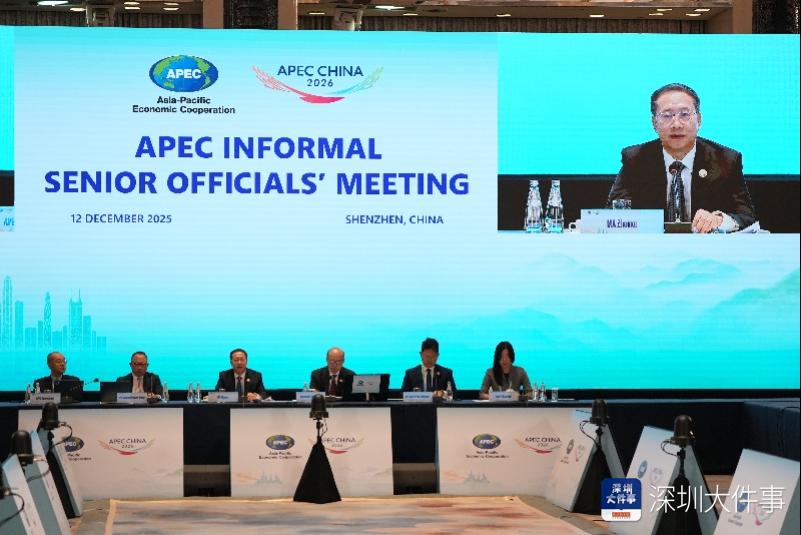
亚太经合组织非正式高官会在深圳举行(APEC中国年:开放 创新 合作)
Ren Min Ri Bao· 2025-12-12 22:00
Core Viewpoint - The 2026 APEC informal senior officials' meeting held in Shenzhen marks the beginning of the "China Year" for APEC, emphasizing China's commitment to building an Asia-Pacific community and enhancing regional cooperation for growth and prosperity [1]. Group 1: Meeting Highlights - The meeting was attended by nearly 200 representatives from APEC member economies, the secretariat, observers, academia, and the business community [2]. - The Chinese government expressed its willingness to collaborate with all parties to strengthen economic cooperation in the Asia-Pacific region and unlock growth potential [1]. Group 2: Key Themes and Priorities - The theme for the 2026 APEC meeting, proposed by China, is "Building an Asia-Pacific Community for Common Prosperity," with three priority areas identified: openness, innovation, and cooperation [1]. - The meeting received strong support from participants for China's role in hosting the 2026 APEC meeting and for the overall success of the "China Year" [1].
亚太经合组织第三十三次领导人非正式会议将于2026年11月18日至19日在深圳举行(APEC中国年:开放 创新 合作)
Ren Min Ri Bao· 2025-12-12 22:00
Group 1 - The APEC 33rd Leaders' Informal Meeting will be held in Shenzhen, Guangdong Province, from November 18 to 19, 2026, marking the beginning of the "China Year" for APEC [1] - The theme for APEC cooperation in the coming year has been established as "Building the Asia-Pacific Community and Promoting Common Prosperity," which received high praise and unanimous approval from all parties [1] - China has identified three priority areas for APEC cooperation: "Openness, Innovation, and Cooperation," which are seen as essential for the prosperity of the Asia-Pacific region and resonate with the demands of all parties involved [1] Group 2 - Approximately 300 events are expected to be held throughout the "China Year," with activities taking place in various cities across China [2] - The Leaders' Informal Meeting in Shenzhen will be accompanied by a Business Leaders' Summit and a dual ministerial meeting on diplomacy and trade [2] - Three high-level meetings will be held in Guangzhou, Shanghai, and Dalian in February, May, and August, respectively, along with around 10 specialized ministerial meetings or high-level events starting in May, covering various fields such as trade, digital economy, and energy [2]
2026年APEC会议主题:建设亚太共同体,促进共同繁荣
Nan Fang Du Shi Bao· 2025-12-12 16:28
Core Points - The 2026 APEC informal senior officials' meeting will be held in Shenzhen, Guangdong Province, on December 11-12, 2025, marking the beginning of the "China Year" for APEC [1] - Chinese Vice Minister Ma Zhaoxu emphasized the importance of building an Asia-Pacific community and advancing practical cooperation in areas such as free trade, connectivity, digital economy, and artificial intelligence [3] - The meeting participants expressed strong support for China's efforts in hosting the 2026 APEC meeting and agreed on the theme "Building an Asia-Pacific Community, Promoting Common Prosperity" along with three priority cooperation areas: openness, innovation, and collaboration [5] Group 1 - The APEC logo for the 2026 "China Year" was unveiled, featuring a visual element centered around the mythical bird Kunpeng, symbolizing unity and cooperation among the 21 member economies [7] - The logo's design, consisting of 21 interwoven wings, represents the diverse yet interdependent nature of APEC member economies and the significance of building an Asia-Pacific community [7] - The meeting was attended by nearly 200 representatives from APEC member economies, the secretariat, observers, academia, and the business community, highlighting the importance of collaboration in the region [8]