全球配置

Search documents
管理规模超513亿元!贝莱德建信理财论道下半年组合配置
券商中国· 2025-07-19 02:03
Core Viewpoint - The article highlights the significant growth of foreign-controlled joint wealth management companies in China, particularly in a low-interest-rate environment, leveraging global resources and local strategies to outperform the industry average in asset management growth [1]. Group 1: Company Performance - BlackRock Jianxin Wealth Management has demonstrated remarkable growth, doubling its asset scale nearly every year since its inception, growing from an initial team of 5 and 2.6 billion yuan in assets to over 51.3 billion yuan and 240,000 clients [2][3]. - The company aims to double its management scale again in 2024, indicating strong confidence in future growth [3]. Group 2: Fixed Income Strategy - The fixed income market is experiencing a unique split, with current conditions characterized by strong expectations but weak realities, leading to compressed yield spreads [5]. - The company is focusing on short-term debt management strategies to enhance returns, given the current low yield environment and the expectation of continued liquidity support from the People's Bank of China [5][6]. Group 3: Equity Market Outlook - The company expresses caution regarding equity assets, noting a lack of strong buying signals across asset classes, including gold, while maintaining a long-term investment perspective [7]. - The U.S. stock market is highlighted as having solid fundamental support, despite slightly high valuations, with expectations for strong earnings in the AI sector [7]. Group 4: Pension Business - BlackRock Jianxin Wealth Management is uniquely positioned in the pension finance sector, being the only joint wealth management company with dual qualifications for "pension wealth management pilot" and "personal pension product issuance" [9]. - The company has launched three pension products, including the first 10-year pension wealth management product, which has shown promising returns and risk management metrics [10][12]. Group 5: Risk Management and Global Strategy - The company emphasizes the importance of aligning risk with target clients in pension product design, aiming to prevent short-term volatility from causing investor redemptions [12]. - The application of BlackRock's global investment strategies in their products aims to enhance returns while managing risk effectively [12].


喜报!实盘组合半年收益已超越去年1年成绩!(睿定投等全球配置组合的周复盘&发车份数)
老徐抓AI趋势· 2025-07-17 12:54
Market Overview - Global stock markets showed mixed performance last week, with A-shares and Hong Kong stocks rising over 1%, while U.S. stocks gained 0.75%. Germany saw a 0.36% increase, but Japan and India experienced declines. Vietnam's market was particularly strong, with a weekly increase of 4.88% [2] - The bond market experienced a general pullback, with both Chinese and U.S. bonds declining. Gold saw a rebound of 1.25% [2] Investment Strategies Province Debt - The "Province Debt" strategy, a pure bond portfolio, experienced some pullback but maintained a positive yield, with a cumulative return of 1.05% for 2025. The bond market has been on an upward trend for years, leading to lower yield expectations, making this year's adjustments expected [3][5] Smart Global Investment - The "Smart Global Investment" strategy, which covers major global markets, rose by 1.01% last week, achieving a cumulative return of 7.94% for 2025, surpassing last year's return of 7.87% [6][9] Lazy Balanced Investment - The "Lazy Balanced Investment" strategy focuses on a balanced stock-bond allocation, emphasizing risk control and stable returns. It recorded a weekly gain of 0.54%, with a cumulative return of 5.74% for 2025, also exceeding the performance of 2024 [10][12] Performance Summary - The "Province Debt" strategy is characterized by steady growth, suitable for conservative investors [5] - The "Smart Global Investment" strategy demonstrates the advantages of global allocation, maintaining a focus on structural opportunities despite market adjustments [9] - The "Lazy Balanced Investment" strategy provides opportunities for accumulation during market pullbacks, making it ideal for long-term investors [12] Recommendations - Investors are encouraged to participate through a systematic investment approach to lock in long-term benefits. The current investment combinations have sufficient limits and flexible fund arrangements [13][14]
【私募调研记录】永安国富调研物产环能
Zheng Quan Zhi Xing· 2025-07-11 00:13
Group 1 - The core viewpoint of the news is that Yong'an Guofu recently conducted research on a listed company, focusing on its operational performance and future strategies [1] - The company Wuchan Huaneng is projected to achieve an operating income of 3.135 billion yuan in 2024, with the heating business contributing the highest revenue at 65% [1] - In 2024, Wuchan Huaneng plans to maintain a dividend payout ratio of 45.32%, with total cash dividends over the next three years expected to be no less than 40% of the net profit after deducting non-recurring gains and losses [1] Group 2 - Wuchan Huaneng's heating supply includes 8.6338 million tons of steam, 1.519 billion kWh of electricity, 29.46 billion m³ of compressed air, and 77.42 million tons of sludge disposal [1] - The company has a high-temperature, high-pressure circulating fluidized bed boiler with low nitrogen combustion and self-desulfurization capabilities, meeting ultra-low emission standards [1] - Wuchan Huaneng aims to deepen strategic cooperation with coal resource providers and downstream customers, while promoting tire pyrolysis technology to enhance the circular economy [1]

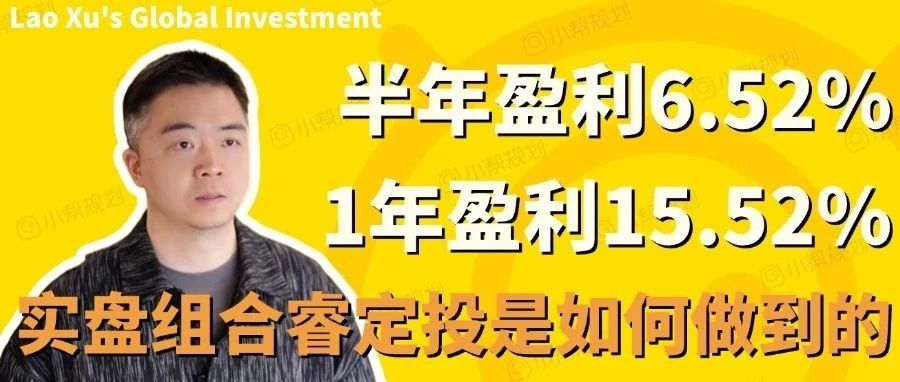
半年盈利6.52%,1年盈利15.52%,实盘组合睿定投是如何做到的?(含跟车新玩法发布)
老徐抓AI趋势· 2025-07-10 21:17
Core Viewpoint - Global allocation and disciplined execution remain the few reliable methods for ordinary investors to navigate through market fluctuations and steadily increase wealth [2][24]. Group 1: Performance Review - The actual performance of the "Rui Global Investment" for the first half of 2025 was +6.52%, with a one-year return of +15.52%, which is rated 80 out of 100 by the company [4][6]. - Other investment combinations also performed well, with the "Lazy Balanced" combination returning +4.90% and the "U.S. Stock Combination" returning +11.16% [6]. - The "Rui Global Investment" outperformed mainstream indices, maintaining positive returns despite market volatility, indicating a robust multi-asset rotation strategy [7][8]. Group 2: Investment Strategy - The strategy of "Rui Global" focuses on global asset allocation, allowing for opportunities in various markets, such as AI leaders in the U.S. and positive returns from Vietnam when A-shares decline [11]. - Low correlation among asset classes, such as bonds and gold not moving in tandem with the stock market, helps to dilute risk at the portfolio level, leading to a more stable net value curve [12]. Group 3: Investment Plans - The company outlines two investment plans: a 10-year doubling plan with an expected annualized return of at least 7% and a plan to accumulate 5 million yuan through weekly investments [13]. - A structured approach to financial security is emphasized, with recommendations for education, medical, emergency, and retirement funds to be secured before pursuing higher-risk investments [14]. Group 4: Follow-up Investment Options - The "Follow Car" feature allows investors to automate their investment strategy, buying more when undervalued and reducing purchases or pausing when overvalued [15]. - Investors are advised to allocate 80% of their funds to the "Rui Global Investment" for stability, while the remaining 10-20% can be directed towards a market of choice for potential growth [15]. Group 5: Community and Support - A service group is available for investors to ask questions and receive updates on their investment performance, ensuring ongoing support [20][21]. - The company encourages investors to take action now to benefit from compound interest over time, highlighting the importance of starting small and being consistent [24].
老徐主理组合复盘:睿定投 省心债 懒人均衡"三大组合半年再创新高,如何搭上全球增长快车?"
老徐抓AI趋势· 2025-07-05 05:29
Group 1 - The overall performance of global markets remains strong, with Japan leading the gains while Hong Kong shows relatively weaker performance [1] - The A-share market, represented by the CSI 300, increased by 2.03%, while the Hang Seng Index rose by 1.62% [2] - The Nikkei 225 in Japan saw a significant increase of 5.56%, indicating robust market activity [2] Group 2 - The "Rui Ding Tou Global Version" achieved a weekly return of 1.9%, with a cumulative return of 6.52% for the year [4] - The strategy of global diversified allocation has led to positive returns for two consecutive years, with expectations of reaching an annualized return of 10% this year [5] - The "Lazy Balanced" portfolio recorded a weekly return of 1.28%, with a cumulative return close to 5% for the year, effectively balancing risk and reward [10] Group 3 - The "Sheng Xin Debt" portfolio experienced a slight pullback due to market fluctuations but has maintained a cumulative return of 0.97% since 2025 [8] - The expected annual return for the bond market is projected to be around 2% to 2.5%, which is considered satisfactory [8] - The "Lazy Balanced" portfolio is designed for those seeking a balance between equity and debt, allowing for flexibility during market volatility [10] Group 4 - All three investment combinations have achieved positive returns over the past two years, demonstrating the effectiveness of global allocation strategies [12] - The company encourages new investors to start with small amounts and engage in long-term investment to experience the benefits of global diversification [12] - The company emphasizes the importance of global allocation as a strategy to mitigate risks and seize opportunities [16]

老徐主理组合复盘:睿定投 省心债 懒人均衡"三大组合半年再创新高,如何搭上全球增长快车?"
老徐抓AI趋势· 2025-07-05 00:44
Core Viewpoint - The global market has shown strong performance, with Japan leading the gains while Hong Kong's performance is relatively weaker [1] Market Performance Summary - A-shares (CSI 300) increased by 2.03%, while the Hang Seng Index rose by 1.62% - The US Nasdaq 100 saw a significant increase of 3.77%, and the German DAX rose by 2.75% - Japan's Nikkei 225 had the highest gain at 5.56%, while India's Sensex 30 increased by 2.09% - Vietnam's Ho Chi Minh Index rose by 2.02% [2] Investment Products Performance Rui Ding Investment Global Version - The Rui Ding Investment Global Version achieved a return of 1.9% this week, with a cumulative return of 6.52% for the year - The product has consistently delivered positive returns for two consecutive years and aims for an annualized return of 10% this year [4] Shengxin Bond - The Shengxin Bond combination experienced a slight pullback due to market fluctuations but has a cumulative return of 0.97% since 2025 - Expected annual returns for 2023 and 2024 are around 3%, with a target of 2% to 2.5% being considered good [7] Lazy Balanced Combination - The Lazy Balanced combination recorded a return of 1.28% this week, with a cumulative return close to 5% for 2025 - The strategy involves flexible adjustments during market volatility, allowing for both growth and defensive positioning [10] Long-term Performance Validation - All three investment combinations have achieved positive returns over the past two years, demonstrating the effectiveness of global diversification strategies - The company encourages new investors to start with small amounts and engage in long-term investment to experience the benefits of global allocation [12][17]

国寿资产首只全球配置产品成立
news flash· 2025-06-30 04:16
Group 1 - The core viewpoint of the article is the establishment of China Life Asset Management's first global allocation product, named "China Life Asset - Chuangyuan FOF2518 Asset Management Product" [1] - The product is positioned with a "fixed income +" FOF strategy as its core focus [1]

本周精华总结:美元之外的新通道:稳定币在跨境支付中的角色变化
老徐抓AI趋势· 2025-06-15 03:40
Core Viewpoint - The article discusses the rising popularity of stablecoins, which are blockchain-based digital currencies pegged to traditional currencies like the US dollar, highlighting their mechanisms and advantages over traditional financial systems [3][4]. Summary by Sections Nature of Stablecoins - Stablecoins, such as USDC and USDT, are designed to maintain a 1:1 value with the US dollar by backing each issued coin with equivalent assets, typically short-term US Treasury bonds [3]. - This mechanism ensures that stablecoins are not "air coins" without real asset backing, providing a sense of security and stability in their value [3]. Advantages of Stablecoins - Stablecoins leverage blockchain technology, which significantly enhances the efficiency of cross-border transactions, reducing transfer times from 1-3 days via the SWIFT network to under 10 minutes [4]. - Transaction fees are drastically lowered from 1-8% to approximately 0.1%, making stablecoins a cost-effective alternative for payments [4]. - They operate 24/7 and offer a degree of anonymity, with the potential to integrate smart contracts for automated payments, similar to existing payment systems like Alipay [4]. Current Use and Future Potential - Currently, stablecoins are primarily used for small payments due to existing security risks, especially in large transactions [4]. - In the long term, stablecoins are viewed as a potential disruptive force in cross-border payments, akin to the revolutionary impact of AI on traditional industries and smartphones on feature phones [4].

本周精华总结:A股 & H股:调整周期或近尾声,关注潜在反转信号
老徐抓AI趋势· 2025-06-15 03:39
Group 1 - The overall attitude towards A-shares and H-shares is changing due to significant challenges in the Chinese economy, including negative inflation data and slowing export growth [2] - A-shares have been in a continuous adjustment phase for eight months since October 8 of the previous year, indicating a difficult market environment [2] - Current A-share valuations are at the 55th percentile, which is not significantly cheaper compared to the Nasdaq at the 58th percentile, leading to a cautious outlook [2] Group 2 - Future movements of A-shares could either be a decline followed by a rise or a direct reversal upwards, with strategies prepared for both scenarios [3] - The Hong Kong stock market is closely related to A-shares and has recovered from previous declines, nearing new highs, but is currently at the 70th percentile in terms of valuation, indicating high market expectations [3]

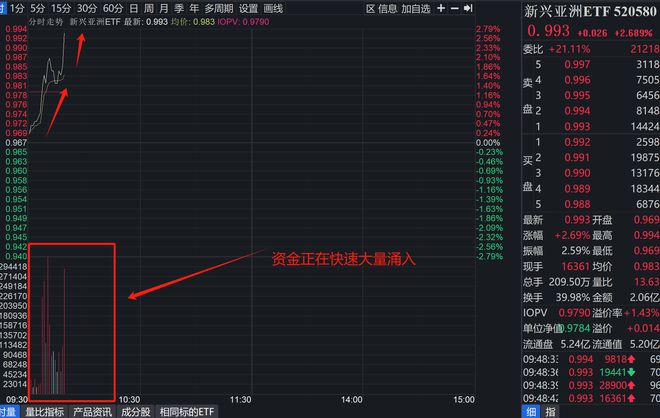
新兴亚洲ETF(520580)涨近2.5%!全球配置已成“必选项”
Jin Rong Jie· 2025-04-28 02:10
Group 1 - The AI competition between China and the US is intensifying, with the NITRD "Artificial Intelligence Action Plan" highlighting the irreconcilable nature of this rivalry, leading to accelerated de-globalization [1] - The Emerging Asia ETF (SH520580) has seen a significant increase, rising nearly 2.5% at the opening on April 28, driven by a surge of capital inflow [1][3] - Global trade growth is projected to slow to 1.2% in 2024, the lowest in a decade, with the risks of single markets becoming unsustainable [3] Group 2 - Emerging Asian markets are becoming strategic high grounds for global capital due to their regional economic integration, industrial capabilities, and resilient internal growth [3][5] - The Emerging Asia ETF has increased by 12% since April 8, with an average daily trading volume of 600 million yuan, reflecting strong investor interest [3][4] - ASEAN is expected to attract a 23% increase in foreign investment in 2024, with over 60% of investments focused on electronics, automotive, and new energy sectors [5] Group 3 - The demographic advantages of India and Indonesia, with a median age of 28.4 years and a population of 1.4 billion in India and 280 million in Indonesia, are expected to drive growth in e-commerce, fintech, and healthcare sectors [6] - Asian central banks are actively intervening to stabilize markets against dollar fluctuations, with India reducing interest rates by 50 basis points by 2025 [6] - The Emerging Asia ETF is strategically focused on leading companies in the four emerging countries, benefiting from trends in digital India and manufacturing upgrades [6][7] Group 4 - The ETF's underlying index has a low correlation of around 0.3 with US and A-shares, which can significantly reduce volatility when included in investment portfolios [7] - The ETF offers opportunities for premium arbitrage through T+0 trading mechanisms and the newly launched margin trading options, indicating substantial potential for returns [7]