基准利率

Search documents
【环球财经】吉尔吉斯斯坦央行维持基准利率11%不变
Xin Hua Cai Jing· 2026-01-27 08:29
公告指出,受全球食品和原材料市场波动、吉税率调整和内需增长等因素影响,吉央行将基准利率保持 在11%的水平。 (文章来源:新华财经) 公告说,2025年,吉实际国内生产总值增长11.1%,经济增长主要由建筑业和服务业带动。居民实际收 入增长、资金净流入增加以及消费信贷活跃支撑了吉国内消费需求。 截至2026年1月16日,吉尔吉斯斯坦年化通胀率为9.4%,吉央行货币信贷政策的优先事项仍是确保通胀 率回落至5%至7%的中期目标水平。 新华财经比什凯克1月27日电 吉尔吉斯斯坦国家银行网站27日发布公告说,该银行董事会决定,自27日 起维持基准利率11%不变。 ...
巴基斯坦央行维持基准利率在10.50%不变,市场预估为10.00%
Xin Lang Cai Jing· 2026-01-26 11:15
每经AI快讯,1月26日消息,巴基斯坦央行维持基准利率在10.50%不变,市场预估为10.00%。 每经AI快讯,1月26日消息,巴基斯坦央行维持基准利率在10.50%不变,市场预估为10.00%。 ...
巴克莱:1月FOMC会议大概率维持基准利率不变
Sou Hu Cai Jing· 2026-01-26 08:45
在随后的新闻发布会上,巴克莱预计美联储主席鲍威尔将强化FOMC不急于降息的信息。若被问及近期 的行政当局施压,鲍威尔或重申打算"继续履行参议院批准其担任的职务",既保持选项开放,也暗示其 在5月15日后可能继续以理事身份留在FOMC。 上证报中国证券网讯(记者 汪友若)1月26日,巴克莱研究团队发布关于本周美联储议息会议的展望观 点。巴克莱预计联邦公开市场委员会(FOMC)将维持利率在3.50%至3.75%区间不变,并释放不急于进 一步降息的信号。 目前巴克莱维持基准情形预测,即FOMC将于2026年6月和12月进行两次25基点的降息。 ...

哈萨克斯坦央行维持基准利率于18%不变,符合预期
Xin Lang Cai Jing· 2026-01-23 13:09
Core Viewpoint - The National Bank of Kazakhstan has maintained the benchmark interest rate at 18%, aligning with expectations, due to high inflation and strong domestic demand pressures [1] Group 1: Monetary Policy - The central bank's decision to keep the interest rate unchanged is a response to ongoing high inflation, projected to reach 12.3% by 2025 [1] - The bank anticipates that the interest rate will remain elevated into the first half of 2026 [1] Group 2: Economic Indicators - High inflation and robust domestic demand are cited as significant pressures influencing the central bank's monetary policy decisions [1]
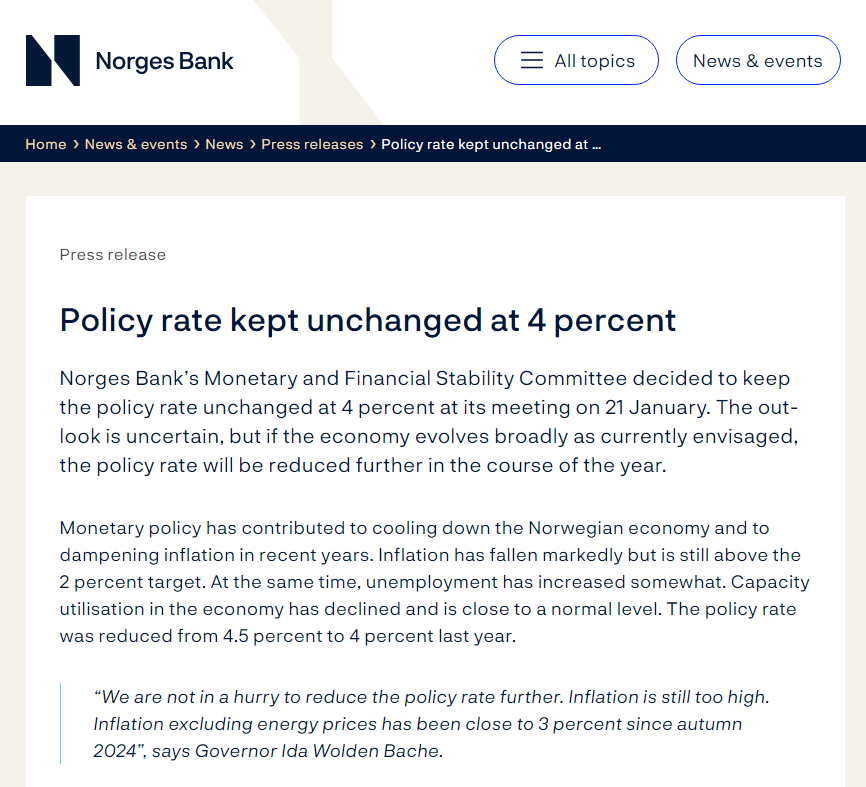
挪威央行维持基准利率不变 暗示不急于降低借贷成本
Xin Lang Cai Jing· 2026-01-22 10:08
来源:上海证券报·中国证券网 挪威央行政策声明截图 上证报中国证券网讯 挪威央行1月22日宣布,将基准利率维持在4%的水平不变。该央行继续暗示不急于降低借贷成本,因 为通胀仍然过高,令人不安。自2024年秋季以来,该国不包括能源价格在内的通货膨胀率已接近3%。 来源:上海证券报·中国证券网 挪威央行政策声明截图 上证报中国证券网讯 挪威央行1月22日宣布,将基准利率维持在4%的水平不变。该央行继续暗示不急于降低借贷成本,因 为通胀仍然过高,令人不安。自2024年秋季以来,该国不包括能源价格在内的通货膨胀率已接近3%。 ...

印尼央行按兵不动 连续四个月维持基准利率4.75%
Sou Hu Cai Jing· 2026-01-21 11:19
中新社雅加达1月21日电(记者 李志全)印度尼西亚央行21日宣布,将基准利率维持在4.75%,同时保持存 款利率3.75%和贷款利率5.50%不变。 这是印尼连续第四个月将基准利率维持在4.75%,符合市场普遍预期。印尼央行上一次降息是在2025年 9月。 印尼央行行长佩里·瓦吉约当天在新闻发布会上表示,在全球不确定性加剧的背景下,这一决定旨在维 护印尼盾汇率稳定,并通过强化货币政策和宏观审慎政策的传导效应,保持宏观经济稳定。 尽管继续维持利率水平,但佩里·瓦吉约重申,未来下调利率的空间依然充足。任何降息举措,都将以 2026年至2027年通胀预期稳定在2.5%±1%目标区间内,并有利于推动更高经济增长为前提。 作为东南亚最大经济体,印尼2025年整体通胀率为2.92%,核心通胀率为2.38%。印尼央行认为,当前 通胀水平仍处于较低区间。 印尼央行预计,2026年印尼经济增长率将处于4.9%至5.7%区间,主要由国内需求增长所支撑。佩里·瓦 吉约指出,政府各类刺激政策的实施效果仍需进一步提升,以促进居民消费并扩大就业。(完) ...
英国2025年12月通胀率升至3.4% 未来仍存回落空间
Sou Hu Cai Jing· 2026-01-21 09:47
Core Viewpoint - The UK consumer price index (CPI) rose by 3.4% year-on-year in December 2025, a slight increase from 3.2% in November, but the market believes this short-term fluctuation does not affect the overall downward trend of inflation [1] Group 1: Inflation Data - The rise in inflation in December was primarily driven by an increase in tobacco taxes and a surge in demand for flights during the Christmas holiday [1] - The service sector inflation rate increased from 4.4% in November to 4.5%, aligning with market expectations, while manufacturing product prices remained stable, indicating no widespread inflationary pressure [1] Group 2: Future Inflation Expectations - Despite the monthly increase, the UK currently has the highest inflation rate among the G7 countries, but there is a clear expectation for a decline in the future [1] - The Bank of England's Governor Bailey indicated that as one-off factors like rising utility costs drop out of the annual comparison, the inflation rate is expected to approach the central bank's 2% target by April or May 2026 [1] Group 3: Economic Predictions - Economists generally agree with this assessment, with PwC economist D'Souza stating that the December inflation rise is merely a "small hurdle" and does not deviate from the path of price stability [1] - Experts from the National Institute of Economic and Social Research predict that the Bank of England may implement a rate cut in the first half of this year, provided geopolitical conditions remain stable [1] - Current market expectations suggest that the Bank of England may implement 1 to 2 rate cuts in 2026, each by 25 basis points, following a reduction of the benchmark interest rate to 3.75% in December 2025 [1]
【环球财经】2025年12月澳大利亚经济活动领先指数增长率上升 2026年GDP增速预计为2.4%
Xin Hua Cai Jing· 2026-01-21 03:20
Core Viewpoint - The Westpac-Melbourne Institute Leading Index of Economic Activity for Australia shows a slight increase in the six-month annualized growth rate, indicating a continuation of economic recovery into 2026, although the momentum remains weak compared to previous strong growth periods [1][2]. Economic Activity Index - The six-month annualized growth rate of the index rose from a revised 0.2% in November to 0.42% in December 2025 [1]. - The index's growth has accumulated an increase of 0.38 percentage points since mid-2025, moving from 0.04% in June to 0.42% in December [2]. Contributing Factors - The increase in the index is primarily driven by rising commodity prices in Australian dollars and a rebound in residential construction approvals [2]. - The commodity price index rose by 5.4% in the second half of 2025, mainly influenced by increases in gold and copper prices [2]. Economic Forecast - Westpac forecasts a 2.4% growth for the Australian economy in 2026, which is close to the trend level [1]. - The upcoming Reserve Bank of Australia monetary policy meeting is expected to maintain the current benchmark interest rate, with sensitivity to inflation risks noted [2].
罗马尼亚央行将基准利率维持在6.50%
Mei Ri Jing Ji Xin Wen· 2026-01-19 13:06
每经AI快讯,1月19日消息,罗马尼亚央行将基准利率维持在6.50%,符合市场预期。 ...
DR001跃升核心指标,央行锚定隔夜利率释放何种信号?
第一财经· 2026-01-18 14:29
Core Viewpoint - The People's Bank of China (PBOC) is shifting its focus from the 7-day repurchase rate (DR007) to the overnight repurchase rate (DR001) as the primary benchmark for monetary policy, indicating a potential change in how market interest rates are managed and communicated [3][4][5]. Group 1: Transition from DR007 to DR001 - The PBOC has replaced DR007 with DR001 as the representative interest rate in its monetary policy reports since 2025, suggesting a significant policy shift [5]. - DR001 is increasingly seen as a more relevant indicator for market practices, as investors predominantly use overnight rates for transactions, leading to a disconnect between policy signals and market behavior [4][5]. - The volatility of DR001 has decreased compared to DR007, making it a more effective tool for conveying monetary policy signals [4][6]. Group 2: Market Liquidity and Policy Implications - The introduction of temporary overnight reverse repurchase tools has created a new interest rate corridor, stabilizing DR001 within a defined range and reducing its volatility [6][7]. - The PBOC's emphasis on guiding overnight rates to align with policy rates aims to maintain stable liquidity in the market, which is crucial for supporting the real economy and capital markets [7]. - Recent data shows that DR001 has been consistently lower than the policy rate, indicating a balanced and loose funding environment in the interbank market [7].