科技创新与产业创新融合

Search documents
技术大咖转岗,转出新天地
Si Chuan Ri Bao· 2026-01-27 21:11
Core Insights - The article discusses the advancements in innovation and technology in Sichuan province, highlighting the integration of technological and industrial innovation as a key focus for development during the 14th Five-Year Plan period. Group 1: Innovation and Investment - The province's R&D expenditure is expected to reach approximately 150 billion yuan, representing a growth of over 40% compared to 2020 [3] - The transaction value of technology contracts has surpassed 260 billion yuan, doubling since 2020 [3] - The proportion of revenue from high-tech industries in the province's industrial sector increased from 31.9% in 2020 to 40.9% [4] Group 2: Infrastructure and Platforms - The number of national innovation platforms in Sichuan has increased to 205, including the only national laboratory in the western region and 28 national key laboratories [4] - The province is accelerating the construction of 10 national large scientific devices [4] Group 3: Key Technologies and Market Integration - Significant breakthroughs have been made in key core technologies, with a focus on integrating technological innovation with market needs [5][12] - The company Buffalo Robotics has shifted its focus from pure R&D to market-oriented sales, indicating a strategic pivot to enhance product promotion and market presence [5][7] Group 4: Product Development and Iteration - Buffalo Robotics has developed an upgraded lower limb exoskeleton robot, which includes new functionalities for rehabilitation, such as single-leg training for stroke patients [6][10] - The company has implemented a feedback loop from market interactions to inform product iterations, resulting in over 20 new features in their latest product [11] Group 5: Government Support and Policy Framework - The provincial government has introduced various policies to support innovation in fields such as brain-computer interfaces and robotics, facilitating the establishment of research centers and promoting technology commercialization [12][13] - The province has seen a significant increase in high-tech enterprises, reaching 19,000, which is 2.4 times the number in 2020 [8] Group 6: Market Expansion and New Products - Buffalo Robotics launched its first consumer product, a personal assistive exoskeleton, aimed at expanding its market reach beyond medical institutions [14] - The company is transitioning from small-scale testing to large-scale production of this consumer product, indicating a strategic move to capture new market segments [14]


高技术产业销售收入同比增长13.9%
Xin Lang Cai Jing· 2026-01-27 18:56
Group 1 - The core viewpoint of the articles highlights the accelerated integration of technological innovation and industrial innovation in China by 2025, with significant growth in high-tech industries and enhanced conversion of scientific achievements [1][2] - In 2025, the sales revenue of high-tech industries in China is projected to increase by 13.9% year-on-year, with high-tech manufacturing and high-tech services growing by 10.1% and 16.6% respectively [1] - Key sectors such as lithium-ion battery manufacturing, service robots, industrial robots, and biopharmaceuticals show remarkable sales growth, with increases of 25.1%, 60.7%, 17.4%, and 7.7% respectively [1] Group 2 - The sales revenue of the scientific and technological service industry is expected to rise by 20.4% year-on-year, indicating a stronger application of scientific achievements [1] - The sales revenue of knowledge-intensive industries, particularly those focused on intellectual property, is projected to grow by 10.7%, reflecting an increase in the conversion of technological achievements [1] - The transaction amount of technology contracts nationwide is anticipated to grow by 19.1% year-on-year, indicating active innovation elements and accelerated aggregation [1] Group 3 - In terms of the integration of digital technology and the real economy, the sales revenue of core digital economy industries is expected to increase by 9.4% year-on-year [2] - The manufacturing of digital products and digital technology applications are projected to grow by 9.4% and 13.8% respectively, reflecting rapid development in digital industrialization [2] - The amount spent by enterprises on digital technology is expected to rise by 9.6%, with manufacturing sector spending increasing by 10.4%, indicating an upgrade in industrial digitalization [2]
广东东莞:大科学装置引领科技与产业融合创新
Zhong Guo Xin Wen Wang· 2026-01-27 17:58
Group 1 - Dongguan is leveraging its advantages in large scientific facilities, new research institutions, and R&D investment to accelerate the integration of technological and industrial innovation [1] - The China Spallation Neutron Source (CSNS) serves as a core platform for the Guangdong-Hong Kong-Macao Greater Bay Area, promoting collaboration in research and talent development [1] - The CSNS has successfully completed over 300 user experiments since the launch of the multi-physics spectrometer, which is China's first neutron total scattering spectrometer [1] Group 2 - Neutron scattering technology developed from the CSNS has been successfully applied in optimizing lithium battery performance and irradiating electronic devices [2] - The second phase of the CSNS will include new experimental terminals that will expand research into new semiconductor materials and advanced lithography technologies [2] - Dongguan's 3D printing and intelligent manufacturing research center has successfully conducted in-situ printing tests, addressing challenges in real-time monitoring of material changes during 3D printing [2] Group 3 - Dongguan aims to enhance infrastructure connectivity and regulatory mechanisms, with a projected import and export value of over 33 billion RMB for the airport center project by 2025 [2]
2025年我国科技创新与产业创新融合发展加快
Xin Lang Cai Jing· 2026-01-27 16:54
Group 1 - The core viewpoint of the article highlights the accelerated integration of technological innovation and industrial innovation in China by 2025, with significant growth in strategic emerging industries and enhanced conversion of scientific achievements [1][2] Group 2 - In strategic emerging industries, sales revenue in high-tech industries is projected to grow by 13.9% year-on-year in 2025, with high-tech manufacturing and high-tech service industries increasing by 10.1% and 16.6% respectively [1] - Key sectors such as lithium-ion battery manufacturing, service robots, industrial robots, and biopharmaceuticals are expected to see remarkable sales revenue growth of 25.1%, 60.7%, 17.4%, and 7.7% respectively [1] Group 3 - The sales revenue of China's scientific and technological service industry is anticipated to increase by 20.4% year-on-year, while knowledge-intensive industries related to intellectual property are expected to grow by 10.7% [1] - The total transaction amount of technology contracts nationwide is projected to rise by 19.1% in 2025, indicating a stronger application of scientific achievements [1] Group 4 - In the integration of digital technology and the real economy, the sales revenue of core digital economy industries is expected to grow by 9.4% year-on-year, with digital product manufacturing and digital technology application industries increasing by 9.4% and 13.8% respectively [2] - The amount spent by enterprises on digital technology is projected to increase by 9.6%, with manufacturing sector spending on digital technology rising by 10.4% [2] Group 5 - Traditional industries are accelerating their transformation and upgrading, with automation being a key focus area; spending on automation equipment in traditional sectors such as petrochemicals, steelmaking, and ironmaking is expected to grow by 17.3%, 11.7%, and 12.7% respectively [2]
国家税务总局税收大数据发布 2025年我国科技创新与产业创新融合加快
Zheng Quan Ri Bao· 2026-01-27 16:25
Group 1 - The core viewpoint of the news is that by 2025, the integration of technological innovation and industrial innovation in China is accelerating, showcasing significant growth in strategic emerging industries and enhanced technology transfer [1][2][3] Group 2 - Strategic emerging industries are becoming a new engine for economic growth, with high-tech industry sales expected to increase by 13.9% year-on-year in 2025, driven by sectors like lithium-ion battery manufacturing, service robots, industrial robots, and biopharmaceuticals, which are projected to grow by 25.1%, 60.7%, 17.4%, and 7.7% respectively [1] - The sales revenue of the scientific and technological service industry is anticipated to grow by 20.4% year-on-year in 2025, indicating a stronger emphasis on the application of scientific achievements [2] - The digital economy's core industries are expected to see a sales revenue increase of 9.4% year-on-year in 2025, reflecting rapid development in digital industrialization [2] - Traditional industries are accelerating their transformation and upgrading, with significant increases in the procurement of automation equipment in sectors like petrochemicals and steel production, with year-on-year growth rates of 17.3%, 11.7%, and 12.7% respectively [2] Group 3 - The acceleration of the integration of technological and industrial innovation is expected to enhance total factor productivity, promote high-quality economic development, optimize industrial structure, and foster a virtuous cycle of employment and investment [3] - The data reflects solid achievements in China's self-reliance in technology and the cultivation of new productive forces, supported by precise policy empowerment [3]
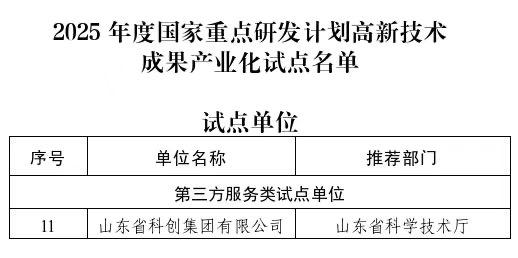
山东科创成功入选国家重点研发计划高新技术成果产业化试点单位
Qi Lu Wan Bao· 2026-01-27 10:12
Core Viewpoint - The Ministry of Industry and Information Technology has officially announced the list of key national R&D program pilot projects for high-tech achievement industrialization for 2025, with Shandong Kexin being selected for both pilot achievements and pilot units [1]. Group 1: Pilot Project Details - The pilot project is a significant initiative by the Ministry to implement the integration of technological innovation and industrial innovation, focusing on seven fields including advanced manufacturing and new materials, with 67 pilot achievements identified [3]. - A total of 108 pilot units have been selected, categorized into four types: regional, industrial implementation, third-party service, and financial service [3]. Group 2: Shandong Kexin's Role - Shandong Kexin is the only service sector institution from Shandong province to be selected, among 19 nationwide, highlighting the recognition of its efforts in technology service and achievement transformation [3]. - This selection signifies the acknowledgment of Shandong Kexin's practices in promoting deep integration of technological and industrial innovation, enhancing confidence in development [3]. Group 3: Future Plans - Shandong Kexin plans to strictly adhere to pilot requirements, focusing on concept verification, small-scale testing, and pilot platforms, while optimizing services for small and medium-sized enterprises in the province [3]. - The company aims to streamline the technology achievement transformation service chain, providing comprehensive support for the industrialization of high-tech achievements and contributing to the construction of a modern industrial system and economic development in the province [3].
税收数据显示:我国科技成果转化力度持续提升
Sou Hu Cai Jing· 2026-01-27 07:56
Core Insights - In 2025, China's research and technology service industry is projected to see a sales revenue growth of 20.4% year-on-year, with knowledge-intensive industries, particularly in intellectual property (patents), expected to grow by 10.7% [1] - The integration of technological innovation and industrial innovation is accelerating, with significant growth in strategic emerging industries and deepening integration of digital technology with the real economy [1][2] Group 1: Industry Growth - High-tech industry sales revenue is expected to grow by 13.9% year-on-year in 2025, with high-tech manufacturing and high-tech services growing by 10.1% and 16.6% respectively [1] - The core industries of the digital economy are projected to see a sales revenue increase of 9.4%, with digital product manufacturing and digital technology application industries growing by 9.4% and 13.8% respectively [1] Group 2: Digital Transformation - Enterprises' procurement of digital technology is expected to increase by 9.6% year-on-year, with manufacturing sector procurement growing by 10.4%, indicating an upgrade in industrial digitalization [1] - The data reflects a solid achievement in China's self-reliance in technology and the cultivation of new productive forces, contributing to high-quality development [2]
税收数据显示:2025年我国科技创新与产业创新融合发展加快
Yang Shi Xin Wen· 2026-01-27 03:30
Group 1 - The core viewpoint of the articles highlights the accelerated integration of technological innovation and industrial innovation in China by 2025, showcasing significant growth in strategic emerging industries and advancements in technology transfer [1][2] Group 2 - Strategic emerging industries are experiencing robust growth, with high-tech industry sales revenue projected to increase by 13.9% year-on-year in 2025. High-tech manufacturing and high-tech service sectors are expected to grow by 10.1% and 16.6% respectively [1] - Key sectors such as lithium battery manufacturing, service robots, industrial robots, and biopharmaceuticals are showing remarkable sales growth, with increases of 25.1%, 60.7%, 17.4%, and 7.7% respectively [1] Group 3 - The conversion of scientific and technological achievements is gaining momentum, with sales revenue in the scientific research and technical service industry expected to rise by 20.4% year-on-year in 2025. Knowledge-intensive industries are projected to see a 10.7% increase in sales revenue [1] - The national technology contract transaction amount is anticipated to grow by 19.1%, indicating a stronger application of technological achievements [1] Group 4 - The integration of digital technology with the real economy is deepening, with core digital economy industries expected to see a sales revenue increase of 9.4% in 2025. Digital product manufacturing and digital technology application sectors are projected to grow by 9.4% and 13.8% respectively [2] - Enterprises are increasing their procurement of digital technology, with a year-on-year growth of 9.6%, and manufacturing sector procurement expected to rise by 10.4% [2] Group 5 - Traditional industries are accelerating their transformation and upgrading, particularly in automation, with significant increases in procurement of automation equipment in sectors like petrochemicals, steelmaking, and ironmaking, showing growth rates of 17.3%, 11.7%, and 12.7% respectively [2]
邓勇:大湾区轨道交通不能只算“里程账”,更要算“创新账”
Nan Fang Du Shi Bao· 2026-01-27 01:02
Group 1 - The core theme of the discussions at the Guangdong Provincial Political Consultative Conference was to strengthen the deep integration of technological innovation and industrial innovation to achieve greater breakthroughs in building a vibrant and internationally competitive first-class bay area and world-class city cluster [1][2] - The focus on rail transit should shift from merely measuring mileage to emphasizing the value of innovation elements, such as the commuting of research personnel across cities [2][3] - Recommendations include establishing a unified rules and standards system to facilitate the flow of elements across regions and enhance the integration of hard and soft infrastructure [3][4] Group 2 - Key areas for breakthrough during the 14th Five-Year Plan period include overcoming hidden barriers to element flow, upgrading soft and hard facilities in tandem, and fostering deep industrial collaboration [3][5] - The construction of an industrial collaborative platform is essential, integrating resources from upstream and downstream enterprises to promote cross-industry fusion [4][5] - Emphasis on developing core technologies and promoting green development principles is crucial for leading enterprises in the marine economy [5][6] Group 3 - Building a technology innovation ecosystem led by enterprises and market-oriented is vital, focusing on breaking down barriers in the innovation chain, industry chain, capital chain, and talent chain [5][6] - The establishment of a specialized pilot and transformation platform is necessary to accelerate the conversion of common technological achievements [6][7] - The integration of artificial intelligence into various industries can enhance operational efficiency and create new industrial pathways, particularly in infrastructure [7]
天津“十四五”约束性指标全部完成
Xin Lang Cai Jing· 2026-01-26 09:43
Core Insights - The Tianjin government has reported solid progress in high-quality development since the start of the 14th Five-Year Plan, achieving all key targets set in the planning outline [1][2]. Economic Performance - Tianjin's GDP has averaged a growth rate of 4.4% over the past five years, with public budget revenue steadily increasing [2]. - The proportion of strategic emerging industries in the city's industrial sector has exceeded 30%, and the added value of the service industry has surpassed 1 trillion yuan [2]. - Per capita disposable income for residents has grown by an average of 5% annually, while energy consumption per unit of GDP has decreased, meeting all binding targets [2]. Collaborative Development - The collaborative development among Beijing, Tianjin, and Hebei has shown significant momentum, with improved mechanisms for cooperation and more efficient allocation of resources [2]. - Over 80 central enterprises have expanded their operations in Tianjin, and more than 1,000 quality enterprises have integrated into key industrial chains [2]. - The capacity of the Beijing-Tianjin intercity railway has increased by over 50% in the past five years [2]. Innovation and Industry - The integration of technological and industrial innovation has accelerated, with the Tianjin High Education Science and Technology Innovation Park emerging as a new hub for innovation [2]. - There are over 12,500 national technology-based small and medium-sized enterprises in Tianjin, with eight industries surpassing 100 billion yuan in scale [2]. - The service sector has contributed over 70% to economic growth [2]. Reform and Governance - Comprehensive reforms and opening-up initiatives have progressed significantly, with over 100 national-level pilot reform projects being implemented [3]. - The Tianjin Free Trade Zone has ranked among the top three in the country for institutional innovation for five consecutive years [3]. - The number of state-owned enterprises has seen an average profit growth of 11.1% annually, and there are now 88 listed companies in the city [3]. Urban Development and Social Welfare - Urban governance and public welfare have improved, with over 400 kilometers of new rail transit lines and 32 urban renewal projects completed [3]. - The average annual concentration of PM2.5 has decreased by 25% compared to 2020, and the number of good air quality days has increased to 281 [3]. - A total of 228,700 new primary and secondary school places have been created, and 95,600 units of affordable rental housing are under construction [3].