
类脑计算

Search documents
国产类脑大模型适配国产沐曦GPU!长序列推理提速超百倍,仅用2%数据匹敌主流模型
量子位· 2025-09-11 10:19
Core Insights - The article discusses the development of SpikingBrain-1.0, a brain-inspired large model that aims to reduce the computational costs associated with long sequence reasoning [1][2]. Group 1: Model Architecture and Performance - SpikingBrain-1.0 leverages a brain-like information processing mechanism, achieving linear/near-linear complexity, which significantly enhances speed for long sequences. For instance, it shows a 26.5x speed improvement on a 1M length sequence compared to mainstream models [2][18]. - The model is designed to be compatible with domestic GPU clusters, indicating the feasibility of creating a new ecosystem for non-Transformer large models in China [2][28]. - The architecture includes SpikingBrain-7B and SpikingBrain-76B, which utilize a linear (mixed) model structure and a hybrid linear MoE model, respectively [10][14]. Group 2: Theoretical Foundations - The research team has established that complex endogenous dynamics in spiking neurons can mathematically equate to combinations of simpler spiking neurons, suggesting the potential for smaller networks to replace larger ones [5][6]. - A new approach based on "endogenous complexity" is proposed, aiming to integrate the rich dynamical characteristics of biological neurons into model development [7][8]. Group 3: Efficiency and Training - SpikingBrain-1.0 demonstrates significant training efficiency for long sequences, achieving comparable performance to many open-source Transformer models with only about 2% of the data [18]. - The model supports multi-card parallel inference and can handle up to 4M length sequences, with substantial acceleration in time-to-first-token (TTFT) compared to standard attention mechanisms [21][22]. Group 4: Future Directions - The team aims to further explore the relationship between endogenous dynamics of neurons and foundational AI operators, seeking to bridge neuroscience and artificial intelligence [28]. - The model is expected to provide significant efficiency advantages in scientific tasks involving long sequences, such as complex multi-agent simulations and molecular dynamics [28].


高性能计算群星闪耀时
雷峰网· 2025-08-18 11:37
Core Viewpoint - The article emphasizes the critical role of high-performance computing (HPC) in the development and optimization of large language models (LLMs), highlighting the synergy between hardware and software in achieving efficient model training and inference [2][4][19]. Group 1: HPC's Role in LLM Development - HPC has become essential for LLMs, with a significant increase in researchers from HPC backgrounds contributing to system software optimization [2][4]. - The evolution of HPC in China has gone through three main stages, from self-developed computers to the current era of supercomputers built with self-developed processors [4][5]. - Tsinghua University's HPC research institute has played a pioneering role in China's HPC development, focusing on software optimization for large-scale cluster systems [5][11]. Group 2: Key Figures in HPC and AI - Zheng Weimin is recognized as a pioneer in China's HPC and storage fields, contributing significantly to the development of scalable storage solutions and cloud computing platforms [5][13]. - The article discusses the transition of Tsinghua's HPC research focus from traditional computing to storage optimization, driven by the increasing importance of data handling in AI applications [12][13]. - Key researchers like Chen Wenguang and Zhai Jidong have shifted their focus to AI systems software, contributing to the development of frameworks for optimizing large models [29][31]. Group 3: Innovations in Model Training and Inference - The article details the development of the "Eight Trigrams Furnace" system for training large models, which significantly improved the efficiency of training processes [37][39]. - Innovations such as FastMoE and SmartMoE frameworks have emerged to optimize the training of mixture of experts (MoE) models, showcasing the ongoing advancements in model training techniques [41][42]. - The Mooncake and KTransformers systems have been developed to enhance inference efficiency for large models, utilizing shared storage to reduce computational costs [55][57].


我科学家研发新一代神经拟态类脑计算机
Ren Min Ri Bao· 2025-08-15 21:46
Core Insights - Zhejiang University has launched a new generation of neuromorphic brain-like computer named "Darwin Monkey" or "Wukong" [1] - The computer is based on specialized neuromorphic chips, supporting over 2 billion pulse neurons and over 100 billion synapses, closely resembling the scale of a macaque monkey's brain [1] Neuromorphic Computing - Neuromorphic computing applies the working mechanisms of biological neural networks to computer system design, aiming to create low-power, highly parallel, efficient, and intelligent computing systems [1] - "Wukong" is equipped with 960 Darwin 3rd generation neuromorphic computing chips developed in collaboration with the ZheJiang University and the ZhiJiang Laboratory [1] - Each chip supports over 2.35 million pulse neurons and hundreds of millions of synapses, along with a dedicated instruction set for brain-like computing and an online learning mechanism [1] Technological Breakthroughs - "Wukong" has achieved breakthroughs in key technologies such as large-scale neural interconnection and integration architecture [1]
多突触神经元模型问世,国内团队打造类脑计算新引擎,登上《自然·通讯》
机器之心· 2025-08-15 03:29
Core Viewpoint - The rapid development of artificial intelligence (AI) technology is accompanied by increasing concerns over high energy consumption, leading to the exploration of Spiking Neural Networks (SNNs) as a more biologically plausible and energy-efficient computational paradigm [2][3]. Summary by Sections Current Challenges in SNNs - There is a lack of a spiking neuron model that effectively balances computational efficiency and biological plausibility, which is a key limitation for the development and application of SNNs [3]. - Existing spiking neuron models, such as Leaky Integrate-and-Fire (LIF), Adaptive LIF (ALIF), Hodgkin-Huxley (HH), and Multi-compartment models, primarily focus on simulating neuronal dynamic behavior and assume single-channel connections between neurons, leading to information loss in spatiotemporal tasks [3][9]. Introduction of Multi-Synaptic Firing Neuron Model - A new spiking neuron model called Multi-Synaptic Firing (MSF) neuron has been proposed, which can encode spatiotemporal information simultaneously without increasing computational delay or significantly raising power consumption [5][10]. - The MSF neuron model is inspired by the biological phenomenon of "multi-synaptic connections," allowing a single axon to establish multiple synapses with different firing thresholds on the same target neuron, a feature observed in various biological brains [9]. Theoretical and Experimental Findings - Theoretical analysis shows that the MSF neuron is a universal and more refined abstraction of neurons, with traditional LIF neurons and classic ReLU neurons being special cases under specific parameters, revealing the intrinsic connection between ANNs and SNNs [10]. - The study provides an optimal synaptic threshold selection scheme and an alternative parameter optimization criterion to avoid gradient vanishing or explosion issues during the training of deep SNNs, enabling scalability without performance degradation [10][13]. Performance and Applications - Experimental results demonstrate that the MSF neuron can simultaneously encode spatial intensity distribution and temporal dynamics through independent frequency and temporal coding methods, outperforming traditional LIF neurons in various benchmark tasks [13]. - In tasks involving continuous event streams, SNNs built on MSF neurons even surpassed ANNs with the same network structure, showcasing higher energy efficiency [13][14]. - The MSF neuron model has been successfully deployed on domestic neuromorphic hardware platforms, validating its compatibility in real-world scenarios such as event-driven object detection in autonomous driving [14][15]. Future Directions - The research team aims to explore the application potential of MSF neurons in a broader range of tasks, contributing to the advancement of AI technology towards more intelligent, green, and sustainable development [19].
告别Transformer,重塑机器学习范式:上海交大首个「类人脑」大模型诞生
机器之心· 2025-08-13 09:29
Core Viewpoint - The article discusses the introduction of BriLLM, a new language model inspired by human brain mechanisms, which aims to overcome the limitations of traditional Transformer-based models, such as high computational demands, lack of interpretability, and context size restrictions [3][8]. Group 1: Limitations of Current Models - Current Transformer-based models face three main issues: high computational requirements, black-box interpretability, and context size limitations [6][8]. - The self-attention mechanism in Transformers has a time and space complexity of O(n²), leading to increased computational costs as input length grows [7]. - The internal logic of Transformers lacks transparency, making it difficult to understand the decision-making process within the model [7][8]. Group 2: Innovations of BriLLM - BriLLM introduces a new learning mechanism called SiFu (Signal Fully-connected Flowing), which replaces traditional prediction operations with signal transmission, mimicking the way neural signals operate in the brain [9][13]. - The model architecture is based on a directed graph, allowing all nodes to be interpretable, unlike traditional models that only provide limited interpretability at the input and output layers [9][19]. - BriLLM supports unlimited context processing without increasing model parameters, allowing for efficient handling of long sequences [15][16]. Group 3: Model Specifications - BriLLM has two versions: BriLLM-Chinese and BriLLM-English, with non-sparse model sizes of 16.90 billion parameters for both languages [21]. - The sparse version of the Chinese model has 2.19 billion parameters, while the English version has 0.96 billion parameters, achieving a parameter reduction of approximately 90% [21]. - The model's design allows for the integration of multiple modalities, enabling it to process not just language but also visual and auditory inputs [25][26]. Group 4: Future Prospects - The team aims to develop a multi-modal brain-inspired AGI framework, which will integrate perception and motion [27]. - BriLLM has been selected for funding under Shanghai Jiao Tong University's "SJTU 2030" plan, which supports groundbreaking research projects [27].

中芯国际产能供不应求;传SK海力士HBM4大幅涨价;传三星DDR4停产延后…一周芯闻汇总(8.4-8.10)
芯世相· 2025-08-11 06:46
Key Events - Trump announced that the U.S. will impose approximately 100% tariffs on chips and semiconductors [7] - WSTS reported that the global semiconductor market size is expected to grow by 18.9% year-on-year in the first half of 2025, reaching $346 billion [10] - SMIC's Zhao Haijun stated that the capacity shortage will last at least until October this year [7][14] - Samsung is reportedly extending its DDR4 production plan until December 2026 [7][18] - SK Hynix has significantly raised the pricing for HBM4 [7][19] Industry Trends - The Chinese government is pushing for breakthroughs in key brain-machine interface chips, focusing on high-speed, low-power signal processing [9] - Shanghai is accelerating the development of specialized chips for embodied intelligence [9] - The global semiconductor sales in Q2 2025 are projected to reach $179.7 billion, with a year-on-year growth of nearly 20% [11] Company Updates - SMIC reported Q2 revenue of $2.21 billion, a 16% year-on-year increase, with a capacity utilization rate of 92.5% [13][14] - Hua Hong Semiconductor achieved a Q2 revenue of $566 million, with a gross margin of 10.9% [13] - Samsung is investing in a new 1c DRAM production line, aiming for a monthly capacity of 150,000 to 200,000 wafers by mid-next year [15] Market Dynamics - The average trading price of PC DRAM products has increased for four consecutive months, with July's price reaching $3.90, a 50% month-on-month increase [19] - The advanced IC substrate market is expected to reach $31 billion by 2030, driven by AI and other emerging applications [11] Technological Advancements - Zhejiang University announced a breakthrough in neuromorphic computing with the launch of a new generation of brain-like computers, supporting over 2 billion neurons [21]


“达尔文猴”出笼!中国类脑计算机颠覆AI底层逻辑
Jin Tou Wang· 2025-08-06 06:19
Core Insights - The world's first brain-like computer, "Darwin Monkey," has been unveiled by Chinese engineers, consisting of over 2 billion artificial neurons, aiming to advance brain-inspired artificial intelligence (AI) [1] - The system is built on 960 Darwin 3 brain-like computing chips, capable of generating over 100 billion synapses, marking a significant step towards achieving more advanced brain-like intelligence [1] - The Darwin Monkey has successfully completed tasks such as content generation, logical reasoning, and mathematics using a large brain-like model developed by a pioneering Chinese AI company [1] Group 1 - The Darwin Monkey's neural and synaptic resources can simulate various animal brains, including macaques, mice, and zebrafish, potentially advancing brain science research [1] - Neuromorphic computing, also known as brain-like computing, draws inspiration from the brain's neural networks and processing capabilities to achieve more efficient information processing [1] - The system's ability to simulate cognitive functions like decision-making, learning, and memory can lead to faster and more adaptive problem-solving, as well as more advanced AI systems [1] Group 2 - The Darwin 3 chip, developed in collaboration between Zhejiang University and Zhejiang Provincial Laboratory, supports over 2.35 million spiking neurons and hundreds of millions of synapses, featuring a dedicated brain-like computing instruction set and online learning mechanism [2] - Under typical operating conditions, the system consumes approximately 2000 watts of power, showcasing its low power consumption [2] - The director of the National Key Laboratory of Brain-Machine Intelligence at Zhejiang University stated that the large-scale, high parallelism, and low power characteristics of the Darwin Monkey will provide a new computing paradigm for existing computing scenarios [2]
浙大发布神经拟态类脑计算机“悟空”
Hang Zhou Ri Bao· 2025-08-06 03:27
Core Insights - The launch of the Darwin Monkey (悟空) represents a significant advancement in neuromorphic computing, achieving over 2 billion neurons and marking China's position at the international forefront of this technology [1][2] - The system is designed to address high energy consumption and computational demands of existing deep networks and large models, providing a new computational paradigm [2] Group 1: Technology and Features - The Darwin Monkey consists of 15 blade-type neuromorphic servers, each integrating 64 Darwin 3rd generation neuromorphic chips, closely mimicking the neuron count of a macaque brain [1] - The system operates at approximately 2000 watts under typical conditions, showcasing its low power consumption capabilities [1] - A new generation Darwin neuromorphic operating system has been developed to optimize resource management and enable efficient concurrent scheduling of neuromorphic tasks [1] Group 2: Applications and Implications - The system can perform intelligent tasks such as logical reasoning, content generation, and mathematical problem-solving through the DeepSeek application [1] - It serves as a simulation tool for neuroscientists, allowing for the modeling of various animal brains, thus providing new experimental methods while reducing the need for real biological experiments [2] - The capabilities of the system are expected to accelerate the development of general artificial intelligence by leveraging its brain-like operational mechanisms and surpassing human brain processing speeds [2]
浙大打造全球最大类脑计算机,拥有20亿个神经元,接近猕猴大脑规模,能运行DeepSeek
量子位· 2025-08-04 07:00
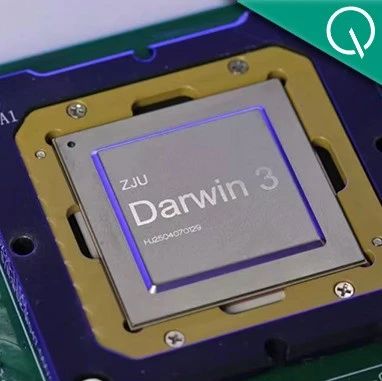
Core Viewpoint - Zhejiang University has developed the world's largest neuromorphic computer, "Darwin Monkey (悟空)," which utilizes the third-generation brain-like chip Darwin 3, featuring over 2 billion spiking neurons and 100 billion synaptic connections, significantly advancing artificial intelligence and neuroscience modeling capabilities [1][2][19]. Group 1: Computer Specifications - The "Darwin Monkey" computer is built on the Darwin 3 chip, which supports over 2 billion spiking neurons, closely approaching the neuron count of a macaque brain [1][6]. - Each Darwin 3 chip can handle over 2.35 million spiking neurons and hundreds of millions of synapses, utilizing a 24x24 two-dimensional node grid architecture for efficient inter-node communication [6][8]. - The chip operates on an event-driven architecture, activating only when necessary, which reduces power consumption to as low as 5.47 picojoules per synaptic operation [13]. Group 2: Technological Innovations - Darwin 3 features a specialized instruction set architecture (ISA) that includes 10 main instructions for efficient processing of various spiking neuron models and learning rules [9][10]. - The chip employs an innovative connection representation mechanism that significantly compresses storage requirements while enhancing the maximum fan-in and fan-out capabilities by 1024 and 2048 times, respectively [11]. - The integration of 2.5D advanced packaging technology allows for the direct packaging of 64 Darwin 3 chips on a single 12-inch wafer, improving interconnect speed and reducing power consumption [18]. Group 3: Applications and Implications - The "Darwin Monkey" has successfully deployed intelligent applications, including DeepSeek, and has simulated various animal brains, providing new tools for neuroscience research [19][23]. - This computer not only serves as a foundation for AI development but also offers neuroscientists a means to explore brain mechanisms, potentially reducing reliance on biological experiments [23][24]. - The capabilities of the "Darwin Monkey" are expected to surpass human brain computational speeds, supporting future research in brain-like artificial intelligence [24].
影响市场重大事件:央行继续实施好适度宽松的货币政策,发展人民币离岸市场
Mei Ri Jing Ji Xin Wen· 2025-08-04 00:06
Group 1: Monetary Policy and Economic Support - The People's Bank of China emphasizes the continuation of a moderately loose monetary policy to support economic growth, including lowering the reserve requirement ratio and utilizing various monetary policy tools to maintain ample liquidity [1] - The central bank plans to reduce policy interest rates and structural monetary policy tool rates to lower financing costs in the financial market [1] Group 2: Currency Internationalization - The People's Bank of China aims to cautiously advance the internationalization of the Renminbi, enhancing its use in trade and optimizing policies for domestic enterprises listed abroad [2] - Development of the offshore Renminbi market is prioritized to create stable liquidity supply channels [2] Group 3: Taxation on Bond Interest - Starting from August 8, 2025, the Ministry of Finance and the State Taxation Administration will reinstate VAT on interest income from newly issued government bonds, local government bonds, and financial bonds [3] - Interest income from bonds issued before this date will remain exempt from VAT until maturity [3] Group 4: Digital Transformation in Manufacturing - Eight departments have released a plan for the digital transformation of the machinery industry, aiming for widespread application of smart technologies by 2027, with 50% of enterprises achieving a maturity level of two or above in smart manufacturing [4] - By 2030, the goal is for major enterprises to complete a round of digital transformation, with 60% achieving a maturity level of two or above [4] Group 5: Financial Services for SMEs - The People's Bank of China in Guangdong has issued a plan to enhance financial services for the digital transformation of small and medium-sized enterprises, focusing on four areas and fifteen measures [5] - The plan includes strengthening financial support for digital transformation and improving the quality of financial services in key sectors [5] Group 6: Robotics and AI Development - The 2025 World Robot Conference will showcase over 1,500 exhibits from more than 200 domestic and international robotics companies, with over 100 new products being launched, nearly double the number from the previous year [9] - China is recognized as a global leader in humanoid robotics, with significant advancements in core technologies and a substantial increase in industrial robot market sales [10] Group 7: Neuromorphic Computing - Zhejiang University has announced a breakthrough in neuromorphic computing with the launch of the "Wukong" computer, featuring over 2 billion pulse neurons and a power consumption of approximately 2000 watts [11] - This development represents a significant step towards creating low-power, high-efficiency computing systems modeled after the human brain [11]