
药品集采

Search documents
华润双鹤:部分药品在国家组织集采药品协议期满品种接续采购中拟中选
Ge Long Hui· 2026-02-10 09:08
Core Viewpoint - The company, China Resources Double Crane (华润双鹤), is participating in a national procurement process for drugs whose agreements have expired, with some of its products expected to be selected in this procurement [1][2]. Group 1: Company Performance - In the first three quarters of 2025, the sales revenue for Valsartan and Hydrochlorothiazide tablets was 426 million yuan, accounting for 5.14% of total revenue [1]. - Sales revenue for Nifedipine Controlled Release Tablets was 138 million yuan, representing 1.67% of total revenue [1]. - Sales revenue for Enoxaparin Sodium Injection was 119 million yuan, making up 1.43% of total revenue [1]. - Sales revenue for Nifedipine Sustained Release Tablets (II) was 108 million yuan, which is 1.30% of total revenue [1]. - Sales revenue for Irbesartan Dispersible Tablets was 79 million yuan, accounting for 0.95% of total revenue [1]. Group 2: Industry Context - The procurement process is expected to stabilize or further reduce prices, providing medical institutions with greater choice among selected suppliers, which helps ensure continuity in clinical medication and reduces risks associated with drug switching due to centralized procurement [2]. - Although the selection may lead to a decrease in overall sales amounts, it is anticipated to solidify existing market shares, with the company likely to enhance its market share due to its brand influence and reliable supply capabilities [2].

宣泰医药:熊去氧胆酸胶囊拟中选国家药品接续采购
Zhi Tong Cai Jing· 2026-02-10 07:45
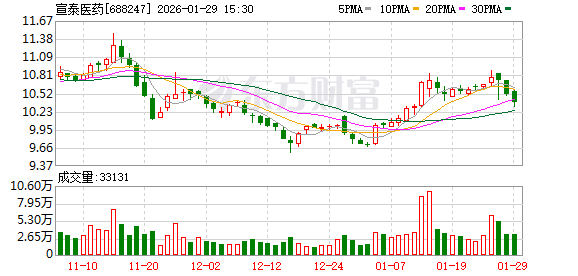
Core Viewpoint - The company Xuantai Pharmaceutical (688247.SH) has announced its participation in the national centralized procurement for the continuation of products whose agreements have expired, with its product ursodeoxycholic acid capsules expected to be selected in this procurement process [1] Group 1: Procurement Participation - The company has submitted an application for the national centralized procurement for the first to eighth batches of products whose agreements have expired [1] - The procurement office released the proposed selection results on February 10, 2026, indicating that the company's product is likely to be selected [1] Group 2: Market Impact - The procurement process prioritizes the use of selected drugs by medical institutions, ensuring the completion of the agreed purchase volume [1] - If the company signs procurement contracts and implements them, it will help expand the sales scale of its products, increase market share, and enhance brand influence [1] - This development is expected to have a positive impact on the company's future operating performance [1]

灵康药业:2025年营收3.65亿元,净利润预亏1.27亿元
Xin Lang Cai Jing· 2026-02-06 08:13
Core Viewpoint - Lingkang Pharmaceutical expects to achieve an annual revenue of approximately 365 million yuan in 2025, representing a year-on-year decline of about 3.89% [1] Revenue Summary - The company's revenue, after excluding related income, is projected to be around 345 million yuan, reflecting a year-on-year decrease of approximately 6.64% [1] Profit Summary - The net profit attributable to the parent company's owners is estimated to be around -127 million yuan, indicating a year-on-year reduction in losses of about 2.88% [1] - The non-recurring net profit is expected to be around -147 million yuan, showing a year-on-year reduction in losses of approximately 18.41% [1] Performance Drivers - The performance changes are primarily attributed to the transition period of the new and old procurement standards for anti-infection products, price reductions for winning varieties, intensified competition in cardiovascular products, low capacity utilization, and significant growth in revenue from pharmaceutical agency and distribution businesses [1]

双鹭药业理财投资损失拖累业绩,董事长承诺“自掏腰包”弥补损失
Xin Lang Cai Jing· 2026-02-02 16:59
Core Viewpoint - Double-Helix Pharmaceutical (002038) is expected to continue incurring losses in 2025, with a projected net profit loss of between -200 million to -290 million yuan, representing a year-on-year decline of 170.03% to 291.54% [3][4] Group 1: Financial Performance - The company reported a net profit loss of approximately -74.07 million yuan in 2024, marking a shift from profit to loss [3] - The expected non-recurring losses for 2025 are estimated to reduce net profit by about 200 million yuan, significantly impacting overall financial performance [5] - The sales revenue for 2024 was approximately 660 million yuan, a year-on-year decrease of 35.15% [3] Group 2: Sales and Margins - Sales gross margin decreased by about 10% due to a decline in product prices, which was influenced by centralized procurement policies [4] - The company's major product line, anti-tumor and immune regulation products, generated sales of 276 million yuan, accounting for 42.69% of total sales, with a year-on-year decline of 27.69% [4] Group 3: Investment and Financial Losses - The company faced significant investment losses, particularly from financial assets, which have become a critical factor affecting its performance [6] - Chairman Xu Mingbo has voluntarily committed to cover the irrecoverable portion of investment losses, with an initial payment of 50 million yuan to the company [5] Group 4: Strategic Response - The company plans to accelerate the launch of new products and strengthen its marketing network to adapt to changes in the pharmaceutical market due to procurement policies [5]



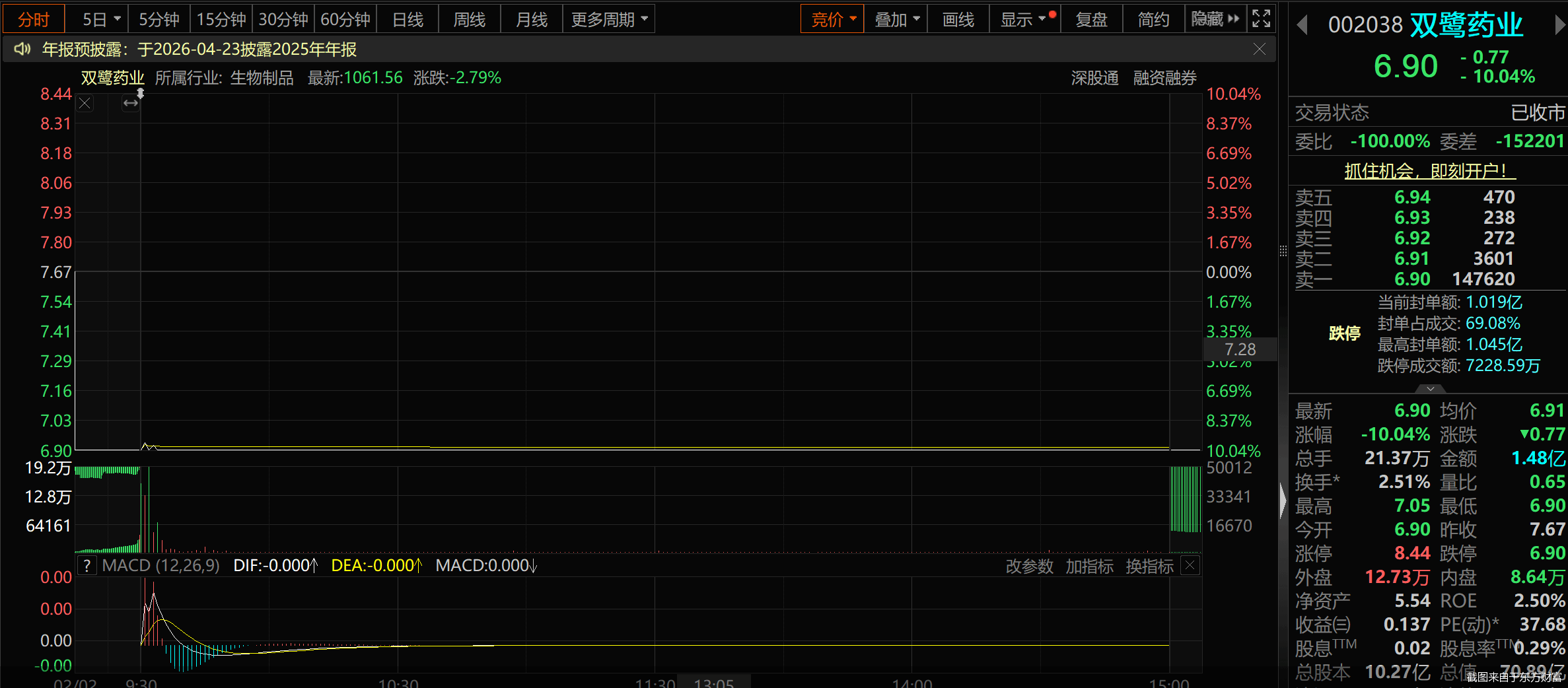
跌停!理财投资损失拖累业绩,双鹭药业董事长承诺“自掏腰包”弥补损失
Sou Hu Cai Jing· 2026-02-02 12:20
Core Viewpoint - The company, Shuanglu Pharmaceutical, is expected to continue incurring losses in 2025, with a projected net profit loss of between -200 million to -290 million yuan, representing a significant increase in losses compared to the previous year [1][3]. Financial Performance - In 2024, Shuanglu Pharmaceutical reported an operating income of approximately 660 million yuan, a year-on-year decrease of 35.15%, and a net profit loss of about -74.07 million yuan, marking a shift from profit to loss [3]. - The projected net profit for 2025 is expected to decline by 170.03% to 291.54% compared to the previous year, with a forecasted non-recurring net profit loss of -40 million to -70 million yuan, a decrease of 148.58% to 185.02% year-on-year [3][4]. Sales and Margins - The company experienced a sales gross margin decline of approximately 10% due to a decrease in product prices, which was influenced by the implementation of centralized drug procurement policies [4][5]. - The sales revenue of the company's primary product line, anti-tumor and immune regulation products, fell by 27.69% in 2024, contributing to the overall revenue decline [5]. Investment Losses - Non-recurring losses, including confirmed investment losses and changes in fair value of financial assets, are expected to reduce net profit by approximately 200 million yuan in 2025 [6]. - The chairman, Xu Mingbo, has voluntarily committed to cover any irrecoverable investment losses, with an initial payment of 50 million yuan to the company [6]. Strategic Response - The company plans to accelerate the launch of new products and strengthen its marketing network to adapt to changes in the pharmaceutical market due to procurement policies [5]. - Shuanglu Pharmaceutical is also evaluating its investment losses and has made significant provisions for asset impairment to mitigate the impact on net profit [6].
万邦德医药控股集团股份有限公司2025年度业绩预告
Zhong Guo Zheng Quan Bao - Zhong Zheng Wang· 2026-01-30 23:22
登录新浪财经APP 搜索【信披】查看更多考评等级 二、与会计师事务所沟通情况 本次业绩预告未经会计师事务所审计,公司已就业绩预告有关事项与会计师事务所进行预先沟通,公司 与会计师事务所在业绩预告方面不存在重大分歧。 三、业绩变动原因说明 1、公司受国家药品、医疗器械招标、集采政策持续推进的影响,集采覆盖区域的进一步扩大,公司相 关产品集采后价格下降明显,行业市场竞争加剧,在第十批国家集采中有产品未能中标,造成公司利润 大幅度下降。 本公司及董事会全体成员保证信息披露的内容真实、准确、完整,没有虚假记载、误导性陈述或重大遗 漏。 一、本期业绩预计情况 1、业绩预告期间:2025年1月1日至2025年12月31日。 2、业绩预告情况:预计净利润为负值 单位:万元 ■ 本次业绩预告是公司财务部门初步测算的结果,具体财务数据以公司披露的《2025年年度报告》为准。 敬请广大投资者谨慎决策,注意投资风险。 特此公告。 万邦德医药控股集团股份有限公司 董事会 2026年1月31日 2、公司由仿制药向创新药战略发展转型升级,加速创新药全球研发力度,研发投入加大。 3、公司创新药国际化制剂车间、原料药基地、中非医疗科技园国际 ...

万邦德:2025年全年预计净亏损9,000万元—17,000万元
2 1 Shi Ji Jing Ji Bao Dao· 2026-01-30 09:19
南财智讯1月30日电,万邦德发布2025年度业绩预告,预计2025年全年归属于上市公司股东的净利润 为-17,000万元—-9,000万元;预计2025年全年归属于上市公司股东的扣除非经常性损益的净利润 为-18,000万元—-10,000万元。业绩变动原因说明:1、公司受国家药品、医疗器械招标、集采政策持续 推进的影响,集采覆盖区域的进一步扩大,公司相关产品集采后价格下降明显,行业市场竞争加剧,在 第十批国家集采中有产品未能中标,造成公司利润大幅度下降;2、公司由仿制药向创新药战略发展转 型升级,加速创新药全球研发力度,研发投入加大;3、公司创新药国际化制剂车间、原料药基地、中 非医疗科技园国际化标准的器械车间投入大,投入使用的固定资产折旧增加,但尚未形成规模效应; 4、报告期内,高分子产品生产厂区整体异地搬迁,影响医疗器械产品的生产与市场供应。 ...
宣泰医药:预计2025年净利润同比下降57.65%至64.71%
Ge Long Hui· 2026-01-29 08:17
格隆汇1月29日丨宣泰医药(688247.SH)公布,经财务部门初步测算,预计2025年年度实现归属于母公司 所有者的净利润4,507.00万元至5,408.00万元,同比下降57.65%至64.71%。预计2025年年度归属于母公 司所有者的扣除非经常性损益的净利润为2,961.00万元至3,553.00万元,同比下降68.82%至74.02%。 报告期内,公司归属于母公司所有者的净利润和归属于母公司所有者的扣除非经常性损益的净利润出现 下滑,主要基于以下原因:1、随着国内药品集采政策持续推进,公司部分产品价格下降明显,利润空 间收窄。在海外市场,部分产品面临行业竞争加剧以及关税政策调整等因素,导致公司相关产品在海外 市场的销售额与盈利水平同比下滑。2、公司基于谨慎性原则,按照《企业会计准则》的相关规定,对 相关的应收账款、存货、商誉等计提了减值损失,对当期净利润产生了负面影响。 ...
宣泰医药:2025年净利润同比预降57.65%~64.71%
Mei Ri Jing Ji Xin Wen· 2026-01-29 08:05
每经AI快讯,宣泰医药(688247)1月29日发布2025年业绩预告,预计2025年度公司实现归母净利润4507 万元至5408万元,同比下降57.65%至64.71%。报告期内,随着国内药品集采政策持续推进,公司部分 产品价格下降明显,利润空间收窄。在海外市场,部分产品面临行业竞争加剧以及关税政策调整等因 素,导致公司相关产品在海外市场的销售额与盈利水平同比下滑。 (文章来源:每日经济新闻) ...
浙江尖峰集团股份有限公司2025年年度业绩预告
Xin Lang Cai Jing· 2026-01-27 19:59
Core Viewpoint - Zhejiang Jianfeng Group Co., Ltd. anticipates a significant increase in net profit for the year 2025, while also forecasting a substantial decrease in net profit after excluding non-recurring gains [2][4]. Group 1: Performance Forecast - The company expects to achieve a net profit attributable to shareholders of approximately 460 million yuan for the year 2025, representing an increase of about 352.01 million yuan, or 325.97% compared to the previous year [2][4]. - The forecasted net profit attributable to shareholders after excluding non-recurring gains is approximately -215 million yuan, indicating a decrease of about 311.62 million yuan, or 322.53% year-on-year [2][4]. Group 2: Previous Year Performance - In the previous year, the total profit was approximately 201.20 million yuan, with a net profit attributable to shareholders of about 107.99 million yuan, and a net profit after excluding non-recurring gains of approximately 96.62 million yuan [6]. Group 3: Reasons for Performance Changes - The significant increase in net profit is primarily due to the equity method accounting for Tian Shili Biological Pharmaceutical Industry Group Co., Ltd., which sold its equity assets, resulting in substantial non-recurring gains [8]. - The decrease in net profit after excluding non-recurring gains is attributed to reduced demand in the cement industry and declining prices and sales in the pharmaceutical sector, influenced by policies such as drug procurement and price reductions [9][10].
