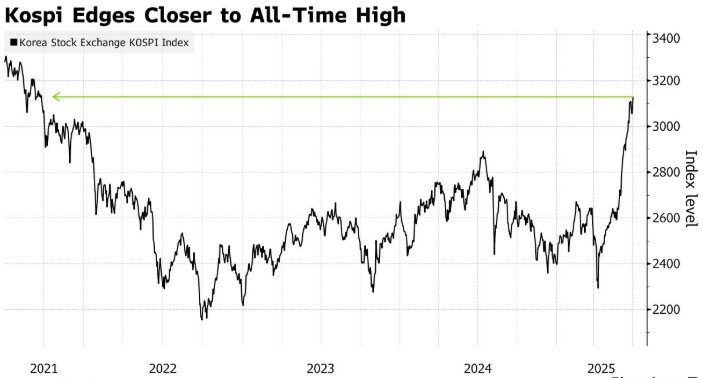
韩国折价

Search documents
年内累涨55%!韩国股市突破3700点历史新高,哪些因素在推动?
Di Yi Cai Jing· 2025-10-16 06:39
Group 1 - The KOSPI index in South Korea has reached a historical high of 3700 points, with a year-to-date increase of 55% [1] - Key sectors driving the KOSPI index include automotive, electronics, and industrial equipment, with notable stock price increases for Samsung Electronics, SK Hynix, Hyundai Motor, and Kia Motors [1] - The surge in the South Korean stock market is largely attributed to positive developments in the AI sector, particularly a strategic partnership between AMD and OpenAI involving significant GPU deployment [1] Group 2 - The International Monetary Fund (IMF) has raised South Korea's growth forecast for 2025 from 0.8% to 0.9%, citing the flexibility of the private sector as a contributing factor [2] - The U.S. Treasury Secretary indicated that trade negotiations with South Korea are nearing completion, which may further support market confidence [2] Group 3 - Foreign investors have shown strong interest in the South Korean stock market, with total trading volume reaching approximately 8890.1 billion USD in the first eight months of the year [3] - The South Korean stock market is diversified across various sectors, with telecommunications, technology, and industrials each accounting for about 20% of the market [3] - The market is expected to benefit from a favorable environment characterized by low interest rates, low oil prices, and rising semiconductor prices, with predictions of the KOSPI index potentially surpassing 4000 points in the medium to long term [3] Group 4 - The Australian ASX/S&P 200 index has also reached a historical high, driven by similar AI trends, with a notable project involving renewable energy-powered AI data centers [4] - Firmus Technologies is collaborating with CDC Data Centers and NVIDIA on a significant project in Australia, which involves an investment of 45 billion AUD (approximately 29 billion USD) [4]
今年大涨的韩股要动“财阀利益”,改革下一步:“注销”库存股,消灭“泡菜折价”
Hua Er Jie Jian Wen· 2025-10-01 07:23
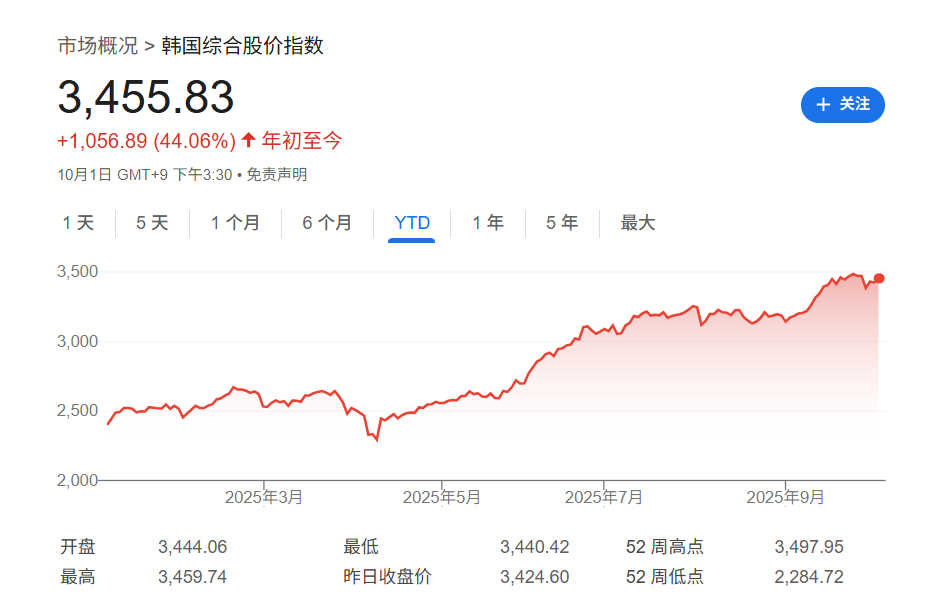
Core Viewpoint - The South Korean government is preparing to implement a significant reform by mandating companies to cancel their treasury stocks, aiming to eliminate the long-standing "Korean discount" in the market [1][3]. Group 1: Legislative Developments - The ruling Democratic Party's lawmaker Park Hong Bae indicated that the National Assembly is likely to pass a key bill by the end of this year, which will require listed companies to cancel their treasury stocks [1]. - The details of the legislation are expected to be finalized before submission to the National Assembly's standing committee in November, with a final vote anticipated in December [1]. Group 2: Market Impact - The anticipated reform has become a crucial driver for the rise in the South Korean stock market, with the Kospi index increasing by 1% today, marking a year-to-date gain of 44%, the best performance among major global indices [1]. - The government's ambitious target of reaching "Kospi 5000 points" implies a further 45% increase from the current level, with the cancellation of treasury stocks seen as a vital step towards achieving this goal [1]. Group 3: Treasury Stocks and Valuation - Treasury stocks, which are shares repurchased by companies and held indefinitely in South Korea, are viewed as a temporary tool in other markets but have been criticized for diluting key valuation metrics like earnings per share (EPS) [3]. - According to analyst Lee Kyung-yeon, treasury stocks currently account for approximately 3.1% of the total market capitalization of Kospi-listed companies, and their cancellation could lead to an average EPS increase of 3.2% for these companies [3]. Group 4: Focus on Chaebols - Large South Korean conglomerates, known as chaebols, are significant holders of treasury stocks, which can be used to consolidate management control during critical situations [4]. - Notably, the stock ownership of treasury shares is substantial among some chaebols, with Lotte Group holding 32.5% and SK Group holding 24.8% of their total shares as treasury stocks [4]. Group 5: Market Reactions - The market's response to the impending regulatory changes has been polarized, with some companies, like LG Group, proactively agreeing to cancel their treasury stocks, which has been positively received by investors [5]. - Conversely, other companies have expressed opposition, arguing that the legislation could weaken their defenses against hostile takeovers, increasing their risks in the capital market [5]. - Analysts have noted the dual nature of the situation, suggesting that while the bill could boost investor sentiment and help narrow the "Korean discount," hasty enforcement might lead to unintended negative consequences [5].

估值刚创新高,韩国总统李在明称“韩股仍然严重低估”,但“资本利得税”交给国会来定
Hua Er Jie Jian Wen· 2025-09-11 03:53
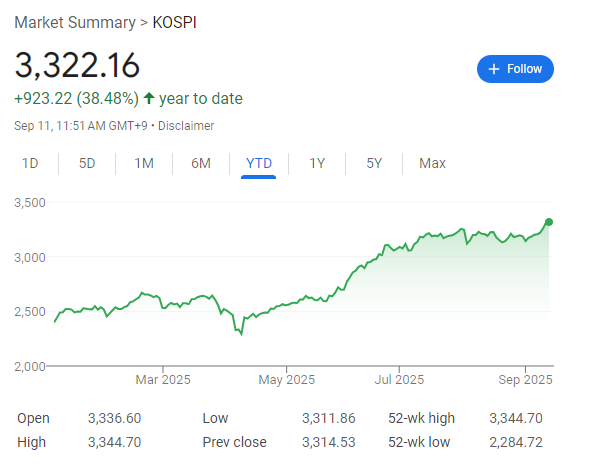
Core Viewpoint - The South Korean KOSPI index reached a historic high of 3314.53 points, surpassing the previous record set in July 2021, but President Yoon Suk-yeol's ambiguous comments on capital gains tax reform disappointed investors, leading to a reduction in market gains [1][5]. Group 1: Market Performance - The KOSPI index closed at 3314.53 points, marking a new all-time high, with an intraday peak of 3317.77 points [1]. - The index has risen approximately 38% this year, making it one of the best-performing indices globally, driven by corporate governance reforms and the global AI boom [1]. Group 2: Government Policy and Investor Sentiment - President Yoon Suk-yeol stated that the controversial capital gains tax reform proposal will be submitted to the National Assembly, failing to meet investor expectations for a complete withdrawal of the plan [1][5]. - The original proposal aimed to lower the capital gains tax threshold for individual shareholders from 5 billion KRW to 1 billion KRW, which faced strong resistance from retail investors and triggered a sell-off [1][5]. - Yoon acknowledged that the proposal has raised doubts about the government's commitment to revitalizing the stock market, suggesting that if the market is harmed, lowering the threshold may not be necessary [3][5]. Group 3: Market Reactions and Future Outlook - The market reacted negatively to the President's statement, with the KOSPI index erasing earlier gains of 0.9% and narrowing to a 0.2% increase [1]. - Analysts noted that the lack of a direct cancellation of the proposal has left the market disappointed, as it prolongs uncertainty that has been weighing on the stock market since late July [5]. - Since President Yoon took office on June 4, there has been a net inflow of foreign capital into the South Korean stock market amounting to 10.16 trillion KRW, reflecting investor expectations for reforms [5].
李在明改革炸了!韩国财阀要栽?打破财阀垄断,股价剑指5000点!
Sou Hu Cai Jing· 2025-08-23 13:50
Group 1 - The core viewpoint is that the election of Lee Jae-myung as South Korea's president has led to a significant rebound in the stock market, with the KOSPI index rising from 2698.97 points to 3147.75 points, a 16.6% increase within two months, compared to lower growth rates in Japan and the US [1] - The "Korean discount" issue, where the market performance is significantly lower than the fundamental value of companies, is a major challenge for the South Korean stock market, with a price-to-book ratio of 0.98 compared to 1.5 in Japan and 2.3 in Taiwan [2] - The dominance of chaebols (large family-owned business conglomerates) in the economy leads to policies favoring founding families, resulting in a governance structure that often neglects the interests of minority shareholders [4] Group 2 - Recent cases, such as the Samsung Group's manipulation of stock prices for control transfer and LG Chem's IPO, highlight the weaknesses in corporate governance in South Korea, where family wealth increases at the expense of shareholder value [6][4] - The Lee Jae-myung government has proposed reforms to enhance corporate governance, including amendments to the Commercial Act that require boards to act in the interests of all shareholders, potentially changing investor sentiment and attracting more capital to the stock market [8] - Successful implementation of these reforms could alleviate pressure on the real estate market by redirecting investment from real estate to the stock market, which has seen significant price increases in recent years [10]
韩国人,大量涌入中国股市
36氪· 2025-08-13 00:25
Core Viewpoint - The article discusses the increasing interest of South Korean investors in the Chinese stock market, highlighting a shift in investment preferences due to various economic factors and the performance of different markets [4][10][41]. Group 1: Investment Trends - As of July 25, 2023, China has surpassed Japan and the EU to become the second-largest overseas stock market for South Korean investors, based on trading volume [4][5]. - The cumulative trading volume of the Chinese stock market, including Hong Kong and A-shares, reached $57.64 billion, ranking second only to the U.S. market [5]. - South Korean investors show a preference for Hong Kong stocks over A-shares, focusing on technology and consumer sectors [6][10]. Group 2: Notable Stocks - The top ten net purchased stocks by South Korean investors as of July 25, 2025, are all Hong Kong stocks, with Xiaomi Group-W and BYD Company Limited leading with net purchases exceeding $1 billion [7][8]. - Other notable stocks include Ningde Times and Alibaba, indicating a strong interest in technology and consumer goods [8][9]. Group 3: Market Dynamics - The enthusiasm for Chinese stocks is partly driven by the volatility in the U.S. market and a desire for diversified investment strategies [10][12]. - In February 2025, South Korean investors pushed trading volumes in the Chinese market to $782 million, a 179% increase from the previous month, marking the highest level since August 2022 [14]. - The average return of Chinese stock funds in South Korea was 43.56% over six months, significantly outperforming domestic and U.S. stock funds [17]. Group 4: Broader Economic Context - The shift towards overseas investments, including in China, reflects a broader trend of South Koreans seeking alternatives due to stagnant domestic economic conditions and rising real estate prices [25][32]. - The average return of the South Korean stock market over the past decade was only 5%, compared to 10% for China and 13% for the U.S., contributing to the growing interest in foreign markets [40][41]. Group 5: Regulatory and Political Factors - Recent political changes in South Korea, including the new administration's commitment to reform the stock market, aim to enhance its attractiveness and reverse the "Korean discount" phenomenon [42][43]. - The government's focus on improving market conditions may further encourage local investors to consider both domestic and international opportunities [42][43].



韩国人,大量涌入中国股市
虎嗅APP· 2025-08-10 13:24
Core Viewpoint - The article discusses the increasing interest of South Korean investors in the Chinese stock market, highlighting a shift in investment strategies due to market conditions and the pursuit of higher returns [4][11][20]. Group 1: Investment Trends - As of July 25, 2023, China has surpassed Japan and the EU to become the second-largest overseas stock market for South Korean investors, with a cumulative trading volume of $5.63 billion [5][4]. - In 2025, the cumulative trading volume of the Chinese stock market is projected to reach $4.08 billion, indicating a growing trend in South Korean investments [5]. - South Korean investors have shown a preference for Hong Kong stocks over A-shares, with significant net purchases in companies like Xiaomi and BYD, each exceeding $100 million [8][10]. Group 2: Market Dynamics - The net inflow of funds into Chinese stock funds reached 654 billion KRW in the past three months, with a notable 273.9 billion KRW in April alone, reflecting a sustained interest [13][14]. - The average return of Chinese stock funds in Korea was 43.56% over six months, significantly higher than the returns from Korean and US stock funds, which were 1.6% and 13.08% respectively [16]. - The shift in focus towards Chinese stocks is partly driven by the volatility in the US market, prompting South Korean investors to diversify their portfolios [16][17]. Group 3: Socioeconomic Factors - The rising interest in overseas markets, including China, is influenced by stagnant domestic economic conditions, such as a declining job market and low-interest rates, leading to a search for alternative investment opportunities [24][26]. - A survey indicated that 31% of respondents view stocks as the most favorable investment method, surpassing real estate for the first time since 2006, reflecting a significant change in investment preferences [26][27]. - The number of active stock trading accounts in South Korea reached 69.3 million by the end of 2023, indicating a widespread engagement in stock trading among the population [27][28]. Group 4: Regulatory and Market Environment - The South Korean government is taking steps to enhance the attractiveness of the domestic stock market, aiming to address the "Korean discount" phenomenon and encourage investment [29]. - Despite the focus on overseas markets, South Korean investors still maintain a significant interest in the US market, with 96% of offshore trading volume attributed to US stocks as of July 2023 [17][18].

暴涨33%!韩国股市今年全球最强,外资汹涌买入
Hua Er Jie Jian Wen· 2025-07-27 04:27
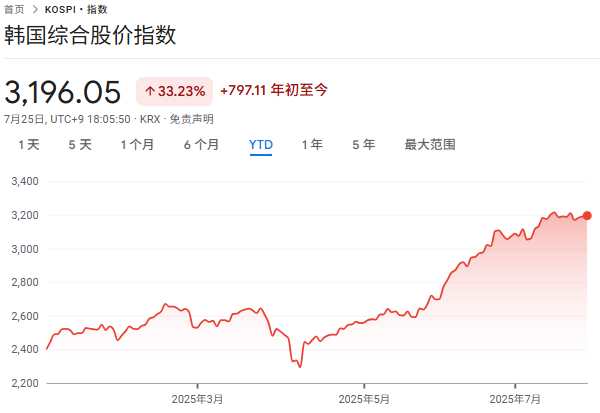
Group 1 - Foreign capital has significantly flowed into the South Korean stock market, with the KOSPI index rising over 3% this year and the total market capitalization surpassing $2 trillion for the first time in three years, making it one of the strongest stock markets globally [1][8] - In July alone, foreign net inflows into the South Korean stock market exceeded $3 billion, far surpassing the total for the previous two months, driven by substantial corporate governance reforms initiated by the South Korean government [4][8] - The South Korean government's reform aims to weaken the excessive control of chaebols (large family-owned business conglomerates) over listed companies, enhance corporate valuations, and strengthen the rights of minority shareholders to attract global investors [5][8] Group 2 - A key legislative amendment was passed this month, requiring company board members to be legally accountable to all shareholders rather than just serving the interests of controlling shareholders [6] - Upcoming reforms will focus on optimizing the board election mechanism and reducing the proportion of treasury shares, which are shares repurchased by the company but not canceled [6][8] - The legislative body plans to vote on measures including the introduction of cumulative voting and limiting the power of major shareholders over the audit committee, which would empower minority shareholders to elect representatives that reflect their interests [7][8] Group 3 - These reforms are seen as a sincere effort by South Korea to address the concerns of minority shareholders, drawing attention from international investors [8] - Major global investment banks have raised their ratings on the South Korean stock market since early June, reflecting increased confidence in the government's commitment to resolving the "Korean discount" issue [8] - Despite the clear direction of reforms, there is strong opposition from large enterprises, with 77% of listed companies expressing concerns that the amendments to the Commercial Act could impact business development [9]
“韩特估”终结“泡菜折价”?摩根大通看韩国股市“两年内涨50%”
Hua Er Jie Jian Wen· 2025-07-13 04:09
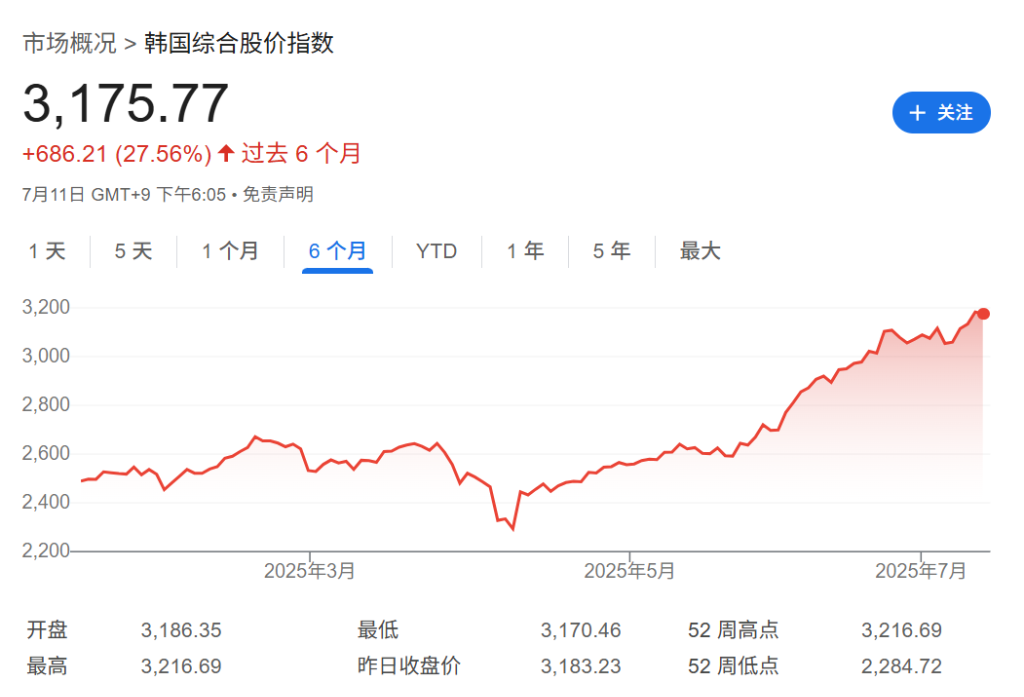
Group 1 - The core viewpoint of the report is that the Kospi index in South Korea is expected to rise over 50% within two years, potentially reaching the 5000-point mark, following a strong performance this year [1][3]. - Morgan Stanley upgraded the rating of South Korean stocks from neutral to overweight, citing President Yoon Suk-yeol's commitment to governance reforms and his goal to elevate the Kospi index to 5000 points during his five-year term [3][4]. - The optimism is fueled by the expectation of governance reforms aimed at addressing the "Korea Discount," which refers to the lower valuation of South Korean companies compared to global peers due to concerns over corporate governance and policy risks [4][5]. Group 2 - Despite the strong market performance, foreign investment remains cautious, with lower buying activity compared to early 2024, indicating that investors are seeking better entry points [5]. - The report suggests that as long as the reform process remains on track, investors should consider increasing their holdings during any market volatility, as global interest in the South Korean market is rising [5].
韩国将严厉打击非法股票交易
Bei Jing Shang Bao· 2025-07-09 16:37
Group 1 - South Korea's three major financial institutions have decided to establish a "Joint Task Force for Combating Stock Price Manipulation" by the end of this month [1][2] - The task force will conduct joint investigations into significant manipulation cases and enforce a "one violation, lifetime delisting" principle for unfair trading practices [2] - The KOSPI index reached its highest closing level in nearly four years, closing at 3133.74 points, with a trading volume of 6.373 billion shares and a total transaction value of 12.5 trillion KRW [2] Group 2 - President Lee Jae-myung's administration aims to boost the stock market, which has faced significant challenges, including a power vacuum and substantial foreign capital outflows [2][3] - Key initiatives include corporate governance reforms, a supplementary budget of at least 30 trillion KRW to stimulate consumption, and significant investments in AI and semiconductor industries [3] - The government plans to invest 100 trillion KRW in AI development and infrastructure, aiming to create a large language model and open-source it [3] Group 3 - The current administration is seen as making historic commitments to shareholder rights, addressing the root causes of the "Korean discount" in the market [4] - Previous attempts by past presidents to resolve shareholder issues have been largely ineffective, with only 14% of companies participating in voluntary value enhancement plans [4] - The proposed amendments to the Commercial Act will clarify the fiduciary duties of directors to shareholders, contrasting with the current law that prioritizes the interests of major shareholders [4] Group 4 - South Korea lifted its ban on "naked short selling" on March 31, 2023, which had been illegal and was previously enforced to stabilize the market during the pandemic [5] - The Financial Services Commission has imposed significant penalties on BNP Paribas and HSBC for repeated violations of short-selling regulations, totaling 2.03 million USD [5] - Following the discovery of large-scale illegal short-selling operations, the Financial Services Commission decided to ban short selling in the stock market until June 2024, with severe penalties for illegal profits [6]
韩国公司治理改革法案本周有望通过 股市创近四年新高
智通财经网· 2025-07-01 03:50
Group 1 - The South Korean stock market experienced significant gains, becoming one of the best-performing markets in Asia, driven by expectations of the revised Commercial Law being passed in parliament [1][4] - Shares of major South Korean holding companies, including SK, Hanwha, and LS, rose by at least 11%, contributing to a nearly 2% increase in the KOSPI index, reaching its highest level in nearly four years [1][4] - The change in stance by the main opposition party, the People Power Party, to support the ruling party's reform proposal reflects a shift in market sentiment and highlights recent cases of shareholder rights violations [1][4] Group 2 - Under President Lee Jae-myung's leadership, the ruling Democratic Party is working to amend the Commercial Law to extend board members' fiduciary duties to all shareholders, aiming to improve corporate governance standards and enhance stock market returns [4] - The recent rise in the South Korean stock market coincides with optimistic economic data, including a rebound in exports due to record-high semiconductor sales, providing a boost to the trade-dependent economy [4] - Foreign investors became net buyers of KOSPI stocks after four consecutive days of declines, with local funds also participating in buying, indicating renewed interest in the market [4] - Year-to-date, the KOSPI index has risen approximately 30%, primarily due to optimistic sentiment regarding corporate governance reforms, compared to a 12% increase in the MSCI Asia-Pacific index during the same period [4]