
ADC药物

Search documents
映恩生物-B(9606.HK):ADC联用IO2.0进度领先 新平台峥嵘初露
Ge Long Hui· 2025-11-19 11:39
Core Insights - The company, Ying'en Biotech, recently held a R&D day to update on several pipeline developments and progress in their clinical trials [1][2]. Group 1: Pipeline Developments - Ying'en Biotech is advancing in IO 2.0 combination therapies, with three ADCs (DB-1303, DB-1311, DB-1305) partnered with BioNTech, currently in four global clinical trials, all of which have completed the first patient enrollment [1]. - DB-1311 is exploring treatment potential in small cell and non-small cell lung cancer under various conditions, while DB-1303 is covering different HER2 expression levels in breast cancer [2]. - DB-1305 is progressing the fastest, with early efficacy and safety data expected to be released at the 2025 AACR, showing a low overlapping toxicity rate of only 4.5% among 67 patients with advanced/metastatic solid tumors [2]. Group 2: New Drug Candidates - The second dual-antibody ADC, DB-1419, has been introduced, utilizing an innovative target combination and a self-developed toxin, P1003, with a DAR of 8, showing superior tumor suppression effects in preclinical studies compared to B7-H3 ADC [2]. - DB-1317, a new member of the DITAC platform, shows significant drug potential in gastrointestinal tumors, with ADAM9 expression being 20 times higher than HER2 and 3 times higher than CLDN18.2 in these cancers [3]. Group 3: New Toxin Mechanism - The new toxin DUP5 from the DUPAC platform has been revealed to block the translation initiation of oncogenic mRNA through its action on the eIF4F complex, demonstrating broad-spectrum anti-tumor activity [3]. Group 4: Financial Outlook - Due to the company's extensive layout and leadership in IO 2.0 combinations, along with the continuous introduction of new molecules, the target price has been raised to 496.89 HKD based on DCF valuation, maintaining a "buy" rating [3].
百利天恒:iza-bren治疗晚期食管鳞癌III期临床试验期中分析达到主要终点
Zhong Zheng Wang· 2025-11-18 07:28
Core Insights - BaiLi TianHeng announced the successful interim analysis of its first-in-class EGFR×HER3 dual antibody ADC (iza-bren) in a Phase III clinical trial for esophageal squamous cell carcinoma, achieving both progression-free survival (PFS) and overall survival (OS) primary endpoints [1][2] - The drug has been included in the breakthrough therapy list by the National Medical Products Administration (NMPA) and is expected to submit a pre-market communication application soon, with commercialization anticipated in the domestic market next year [2] Group 1 - The interim analysis of study BL-B01D1-305 showed that iza-bren demonstrated statistically significant benefits in PFS and OS compared to chemotherapy, indicating major clinical benefits [2] - This marks the first ADC drug to achieve dual positive results in a Phase III clinical study for esophageal cancer treatment [1] - Iza-bren has previously shown excellent data in early clinical trials for advanced esophageal squamous cell carcinoma and has been published in the prestigious journal Nature Medicine [2] Group 2 - BaiLi TianHeng focuses on addressing unmet clinical needs in the global biopharmaceutical frontier, particularly in the field of tumor macromolecule therapy, and aims to become a multinational pharmaceutical company (MNC) with global commercialization capabilities by 2029 [3] - The company has established R&D centers in both the US and China, responsible for early product development and subsequent clinical research [3] - BaiLi TianHeng has developed a leading innovative drug R&D platform with global rights and independent intellectual property, including the HIRE-ADC platform, GNC platform, SEBA platform, and HIRE-ARC platform [3]
百利天恒ADC药物治疗晚期食管鳞癌三期临床试验期中分析达到主要终点,或明年商业化落地
Xin Lang Cai Jing· 2025-11-18 00:57
Core Viewpoint - Baili Tianheng (688506.SH) announced that its self-developed, globally pioneering EGFR×HER3 dual-targeted ADC (iza-bren) has achieved dual primary endpoints of progression-free survival (PFS) and overall survival (OS) in a Phase III clinical trial for esophageal squamous cell carcinoma (ESCC) [1] Group 1: Clinical Trial Results - The independent data monitoring committee (iDMC) determined that the drug met the predefined interim analysis criteria for both PFS and OS [1] - This marks the first ADC drug to achieve positive results for both PFS and OS in a Phase III clinical study for esophageal cancer [1] Group 2: Market Potential - China accounts for 53.7% of global esophageal cancer patients, with a five-year survival rate of less than 6% for advanced ESCC patients, indicating a significant clinical need [1] - The indication has been included in the list of breakthrough therapies by the National Medical Products Administration (NMPA) [1] Group 3: Future Plans - Baili Tianheng plans to submit a pre-market communication application to the NMPA soon, with expectations for commercialization in China next year [1]
全球首创靶向FRαADC药物爱拉赫 获常规批准 华东医药肿瘤创新治疗领域再下一城
Zheng Quan Ri Bao Wang· 2025-11-17 13:15
Core Insights - Huadong Medicine's first-in-class drug, Somatuximab Injection (ELAHERE), has transitioned from conditional approval to regular approval by the National Medical Products Administration (NMPA) for treating FRα-positive platinum-resistant ovarian cancer (PROC) [1][2][3] - This approval marks a significant milestone in the drug's clinical research and establishes a solid foundation for its long-term commercialization in the Chinese market [1][2] Drug Details - Somatuximab Injection targets folate receptor alpha (FRα), which is highly expressed in ovarian cancer, and is composed of an FRα-binding antibody, a cleavable linker, and the cytotoxic agent DM4 [2] - The drug's regular approval is based on positive results from the pivotal Phase III clinical trial MIRASOL [2] Market Context - Ovarian cancer, often referred to as the "king of women's cancers," poses significant treatment challenges due to late diagnosis, high recurrence rates, and low survival rates [2] - In 2022, there were approximately 61,100 new cases and 32,600 deaths from ovarian cancer in China, with a five-year survival rate of only about 40% [2] Commercialization and Sales - ELAHERE has achieved sales revenue exceeding 45 million yuan from January to September 2025, with successful early sales in the domestic market [3] - The drug is expected to quickly penetrate the domestic market due to Huadong Medicine's established commercialization system and channel advantages [3] Innovation Pipeline - Huadong Medicine is focusing on innovation in oncology, endocrinology, and autoimmune diseases, with over 90 innovative drug pipeline projects currently in progress [4] - The company has received six marketing approvals for innovative drugs by October 2025, indicating strong future growth potential [4] Financial Performance - From January to September 2025, Huadong Medicine's pharmaceutical industrial segment reported a significant revenue increase of 62%, totaling 1.675 billion yuan from innovative products and agency services [5] - The company has demonstrated strong market performance with its CAR-T product and other innovative drugs, reflecting its effective commercialization strategy [5][6]

股价暴涨209.24%!Day One2.85亿美元收购Mersana Therapeutics,获得一款B7-H4 ADC
美股IPO· 2025-11-14 00:37
Core Viewpoint - Day One Biopharmaceuticals announced the acquisition of Mersana Therapeutics for $285 million, significantly impacting Mersana's stock price, which surged by 209.24% following the news [2]. Group 1: Acquisition Details - The acquisition allows Day One to enhance its oncology portfolio by adding Emi-Le, a potential first-line monotherapy for patients with adenoid cystic carcinoma (ACC), an aggressive cancer with unmet medical needs [4]. - The deal includes an immediate cash offer of $25 per share for Mersana's common stock, plus a non-tradable contingent value right (CVR) that could total up to $30.25 per share, bringing the total cash consideration to $55.25 per share, with an overall transaction value of approximately $285 million [7]. Group 2: Product and Market Potential - Emi-Le is a B7-H4-directed antibody-drug conjugate (ADC) that shows measurable anti-tumor activity in patients with ACC, which is characterized by high expression of B7-H4 [3][4]. - The drug is positioned for accelerated clinical development due to its innovative design and the clear patient population it targets, which currently lacks approved therapeutic options [4][6]. Group 3: Strategic Implications - The acquisition is expected to create significant growth and value opportunities for Day One, leveraging its existing R&D expertise and commercial capabilities to address rare and life-threatening cancers across all age groups [6].



超200亿美元重磅炸弹独步全球,百利天恒(02615)港股“C位出道”
智通财经网· 2025-11-11 01:02
Core Viewpoint - The recent IPO of BaiLi Tianheng in the Hong Kong market is expected to fill a gap in the ADC drug sector, driven by technological advancements, surging demand, and supportive policies [1][2]. Group 1: IPO Details - BaiLi Tianheng plans to launch its H-share global public offering with a base issuance of 8,634,300 shares, including 863,500 shares for public sale in Hong Kong [1]. - The price range for the shares is set between 347.50 HKD and 389.00 HKD, with trading expected to commence on November 17 [1]. - The H-shares are eligible for inclusion in the Stock Connect program on the listing date [1]. Group 2: Strategic Partnerships and Market Position - The IPO has attracted significant interest from major investors, including Goldman Sachs, JPMorgan, and notable cornerstone investors like Bristol-Myers Squibb (BMS) [2][3]. - BaiLi Tianheng's strong market position is attributed to its robust ADC drug development, independent global clinical capabilities, and innovative commercialization strategies [2]. - The partnership with BMS involves a groundbreaking deal worth 8.4 billion USD for the ADC product Iza-bren, marking a significant milestone in the ADC sector [3][4]. Group 3: Product Development and Clinical Trials - Iza-bren is the first-in-class dual-target ADC drug, currently in Phase III clinical trials, showing promising efficacy with a 55% overall response rate in late-stage cancer patients [5][6]. - The drug's potential peak sales could exceed 20 billion USD, indicating a strong commercial outlook [5][6]. - BaiLi Tianheng is also advancing another ADC, T-Bren, which has shown superior efficacy and safety compared to competitors, with a clinical objective response rate of 82.2% [7][8]. Group 4: Financial Strength and Future Prospects - As of June 30, BaiLi Tianheng had over 5 billion CNY in cash reserves, bolstered by a recent 3.764 billion CNY A-share placement and potential future payments from BMS [12]. - The company is positioned for significant growth in the global market, with a focus on building a comprehensive R&D and commercialization framework [10][11]. - The overall market sentiment towards innovative biopharmaceuticals is improving, with BaiLi Tianheng expected to be a key player in the sector [13].
默沙东联手Blackstone,7亿美元加速科伦博泰生物-B(06990)授权产品Sac-TMT的全球开发
智通财经网· 2025-11-04 12:59
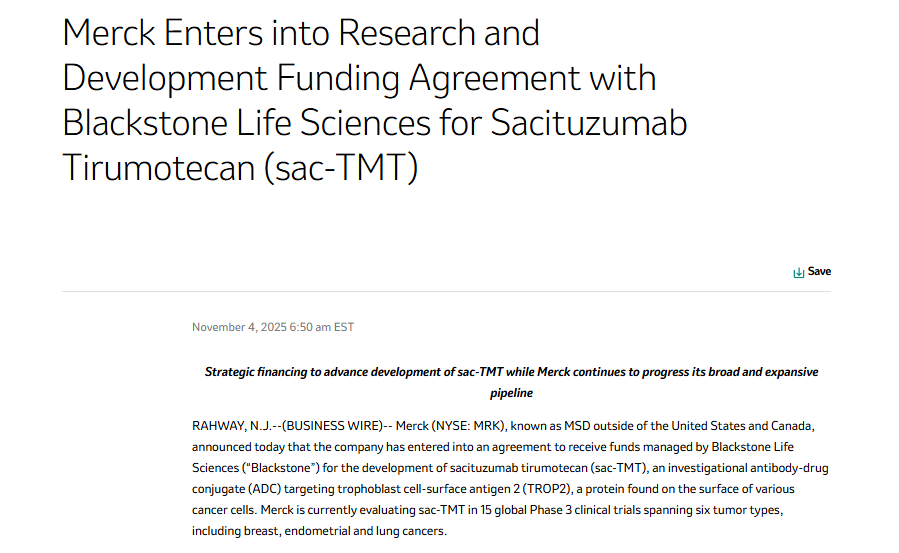
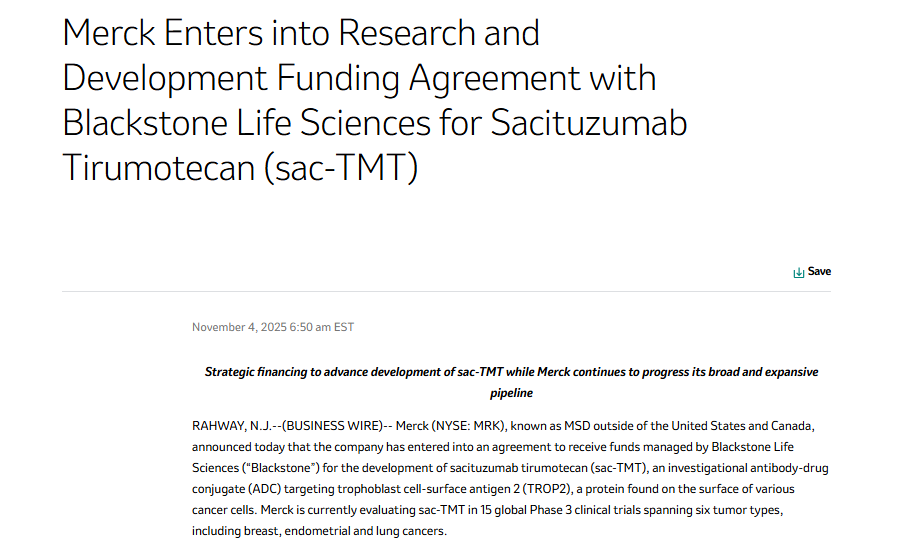
Core Insights - Merck has initiated a rare financing move by securing $700 million from Blackstone for the global development of sac-TMT, a significant ADC product, indicating the company's strong commitment to this asset [1][4]. Group 1: Financing and Strategic Importance - The financing will be used for the global development of sac-TMT, with Merck retaining control over its development, production, and commercialization decisions [1]. - This financing reflects Merck's high regard for sac-TMT, which has already gained attention in the industry since its licensing from Keren Biotechnology [1][4]. - Merck's CFO highlighted that this agreement will allow the company to fully leverage the potential of sac-TMT, emphasizing its importance in the company's broader product development strategy [5]. Group 2: Clinical Development and Market Potential - Merck is conducting 15 global Phase III clinical trials for sac-TMT across various cancer types, including lung, breast, and gastric cancers [5]. - The upcoming release of nine Phase III clinical trial data between 2027 and 2029 is expected to validate sac-TMT's significant market potential and solidify its core position in Merck's pipeline [5]. - Sac-TMT has shown promising results, including approvals in China and recognition at the ESMO conference, where it received multiple awards, highlighting its breakthrough efficacy in treating non-small cell lung cancer [4][5]. Group 3: Blackstone's Role and Market Outlook - Blackstone's investment reflects its strategic insight in the biopharmaceutical sector, having previously supported successful therapies, indicating confidence in sac-TMT's potential [6]. - The collaboration is expected to accelerate the global development of sac-TMT, positioning it as a cornerstone product in cancer treatment with vast market opportunities [6].

默沙东联手Blackstone,7亿美元加速科伦博泰生物-B授权产品Sac-TMT的全球开发
Zhi Tong Cai Jing· 2025-11-04 12:58
Core Insights - Merck has initiated a rare financing move by securing $700 million from Blackstone for the global development of sac-TMT, a promising ADC drug, indicating the company's strong commitment to this asset [1][4][5] Group 1: Financing and Strategic Importance - The financing agreement allows Merck to retain control over the development, production, and commercialization of sac-TMT while leveraging future revenue rights [1] - This financing elevates the importance of sac-TMT within Merck's pipeline, especially as the company faces the impending patent cliff of its blockbuster drug Keytruda [4][5] Group 2: Clinical Development and Market Potential - Merck is conducting 15 global Phase III clinical trials for sac-TMT across various cancer types, including lung, breast, and gastric cancers, showcasing its extensive development strategy [5] - The upcoming release of nine Phase III trial data between 2027 and 2029 is expected to validate sac-TMT's potential in the global market, solidifying its role as a cornerstone in Merck's oncology portfolio [5] Group 3: Blackstone's Investment Insight - Blackstone's investment reflects its strategic vision in the biopharmaceutical sector, drawing parallels to its previous successful investments, such as the siRNA therapy that became a core asset for Novartis [6] - The collaboration with Merck highlights Blackstone's recognition of sac-TMT's potential and its willingness to support the acceleration of its global development [6]
君实生物前三季度营收增长42%,特瑞普利单抗国内销售连续6季度增长
Sou Hu Wang· 2025-10-28 13:37
Core Insights - Junshi Biosciences (688180.SH/1877.HK) reported a continuous increase in commercial revenue and accelerated R&D of differentiated innovative pipelines, showcasing improved sustainable operational capabilities [1][2]. Financial Performance - For the first three quarters, Junshi Biosciences achieved operating revenue of 1.806 billion yuan, a year-on-year increase of 42.06%, while narrowing its net loss to 596 million yuan, a reduction of 35.72% [1]. - In Q3 alone, the company recorded operating revenue of 637 million yuan, reflecting a year-on-year growth of 31.40% [2]. Product Performance - The core product, Tuoyi® (Tremelimumab), generated sales of 1.495 billion yuan in the first three quarters, marking a 40% year-on-year increase [2]. - Tuoyi® has seen six consecutive quarters of sequential growth since 2024, driven by enhanced sales efficiency and the inclusion of more indications in medical insurance [2]. Global Expansion - As of the end of Q3, Tuoyi® has been approved for marketing in over 40 countries and regions across four continents, including major markets like the U.S. and EU, with ongoing expansion into emerging regions [2][6]. - The global commercialization network has been established through partnerships with companies like Coherus and Dr. Reddy's, covering over 80 countries [2][6]. R&D and Pipeline Development - Junshi Biosciences is focusing on next-generation therapies, with high-potential pipelines such as JS207 (PD-1/VEGF), JS212 (HER3/EGFR dual antibody ADC), and JS015 (DKK1 monoclonal antibody) advancing rapidly [2][8]. - The company has developed over 50 drug candidates, including four commercialized products and nearly 30 in clinical stages, indicating strong product iteration capabilities [8]. Clinical Achievements - At the recent ESMO conference, Tuoyi® was highlighted for its combination therapy with ADC drug Vadisizumab, achieving significant clinical results, including an overall survival extension to 31.5 months compared to traditional chemotherapy [5][6]. - The company has also received positive results from its ongoing studies, including the registration study for JS005 (anti-IL-17A monoclonal antibody) in treating moderate to severe plaque psoriasis, which is expected to lead to a market application [11]. Strategic Initiatives - In September 2025, Junshi Biosciences launched an equity incentive plan with performance targets, reflecting strong confidence in future performance [3]. - The company is actively exploring combination therapies for its products, enhancing its competitive edge in the oncology market [9][10].

营收净利双升!华东医药三季报出炉,创新药迎里程碑式进展,核心管线成果密集兑现
Quan Jing Wang· 2025-10-27 11:44
Core Insights - The company reported steady revenue and profit growth for the first three quarters of 2025, with total revenue reaching 32.664 billion yuan, a year-on-year increase of 3.77%, and net profit attributable to shareholders of 2.748 billion yuan, up 7.24% [1] - Significant investment in R&D was noted, with expenditures rising to 2.186 billion yuan, a 35.99% increase, indicating a strong commitment to innovation [1] - The company’s innovative products are increasingly contributing to revenue, with sales from innovative products reaching 1.675 billion yuan, a substantial growth of 62% year-on-year [2] Financial Performance - For the first nine months of 2025, the pharmaceutical industrial segment achieved revenue of 11.045 billion yuan, a growth of 11.10%, and net profit of 2.475 billion yuan, up 15.62% [2] - In Q3 2025, the segment reported revenue of 3.728 billion yuan, a 14.95% increase, and net profit of 894 million yuan, an 18.43% rise [2] - The company maintained a resilient operational performance despite increased R&D investments, with quarterly revenue and profit showing a consistent upward trend [1] Product Development and Innovation - The company has made significant advancements in its core therapeutic areas, including endocrine, oncology, and autoimmune diseases, with over 90 innovative drug pipeline projects underway [4] - The ADC drug pipeline has shown promising progress, with several candidates receiving IND approvals in both China and the U.S. [5] - The company is preparing for negotiations regarding national medical insurance and commercial insurance for three innovative products, aiming to enhance drug accessibility and drive sales growth [3] Market Position and Strategy - The company has established a strong market presence with its CAR-T product, achieving significant order volumes that exceed previous year's totals [2] - The company’s innovative drug candidates are positioned to address various conditions, including diabetes and cancer, with several products nearing market entry [6][7] - The industrial microbiology segment has also shown robust growth, with a 28.48% increase in revenue, indicating a diversified growth strategy [9] Future Outlook - The company aims to continue its focus on research-driven, patient-centered approaches to foster sustainable high-quality growth [11] - The medical aesthetics business is expected to enhance its brand effect and core competitiveness through a global product matrix [10] - The ongoing development of innovative products and the expansion of market access are anticipated to provide solid momentum for future performance [11]