AI音乐

Search documents
人类不会再有周杰伦
虎嗅APP· 2025-12-17 13:42
Core Viewpoint - The rise of AI singer "Daitouzheng" signifies a shift in the music industry, where algorithms are reshaping the relationship between music, artists, and audiences, leading to a decline in the traditional role of singers [5][6]. Group 1: Acceptance of AI Music Platforms - The rapid acceptance of platforms like "Soda Music" is attributed to their algorithmic recommendation systems, which effectively capture user preferences and optimize music suggestions [9]. - The algorithm's low decision-making cost results in high accuracy in recommendations, creating a seamless listening experience for users [9]. Group 2: Industry Competition Dynamics - The focus of competition in the music app industry has shifted from music libraries and copyrights to the ability to effectively push songs to users [10]. - Music is being fragmented into easily shareable media formats, making algorithm-driven recommendations the primary method of music discovery [10]. Group 3: Impact on Music Creators - AI is expected to first impact low-budget music needs, such as background music for short videos and advertisements, rather than top-tier artists [11]. - Emerging artists who rely on unique musical styles and talents may struggle to gain visibility in an algorithm-dominated landscape [11]. Group 4: The Role of Platforms - Platforms are becoming the primary beneficiaries of AI-generated content, as they can provide abundant, low-cost music while keeping users engaged [13]. - The future of music may see a decline in the need for traditional artists, raising questions about the value of human creativity in music [13]. Group 5: Cultural Implications of Algorithm-Driven Music - The algorithm-driven music landscape may lead to a loss of shared musical experiences and collective memories, as users increasingly consume personalized content [15][16]. - While algorithms enhance efficiency, there is a concern about the diminishing space for spontaneity and originality in music consumption [17]. Group 6: The Future of Music Experience - The challenge lies in balancing the efficiency of algorithms with the need for unexpected and original experiences in music [19]. - The goal is to ensure that music remains impactful and transformative, rather than merely accessible [19].


从冷门歌手到热门金曲,AI音乐成了?
Tai Mei Ti A P P· 2025-12-11 06:37
Core Insights - The rise of AI-generated music has transitioned from novelty to mainstream, with significant engagement on platforms like Bilibili and Douyin, where related content has garnered millions of views [1][2] - AI music has evolved from simple imitation to a more sophisticated creation process, utilizing deep learning models to generate original compositions across various genres [2][4] - The commercial potential of AI music is being realized, with notable success stories such as the AI song "Walk My Walk," which has generated substantial revenue through streaming platforms [7][9] Group 1: AI Music Development - AI music has undergone a "full-stack upgrade," moving from basic imitation to complex creation involving composition, arrangement, and lyrics generation [2][5] - New AI music generation models, such as Suno V3 and Mureka, allow users to create high-quality music quickly and across different genres [4][5] - The emergence of various AI tools has transformed the music production landscape, enabling a one-stop creative platform for users [5][6] Group 2: Commercialization and Market Dynamics - The direct monetization of AI music is evident, with platforms like Spotify providing revenue opportunities for artists based on streaming numbers [7][9] - AI-generated artists are gaining attention from record labels, leading to increased valuations and contracts for AI music creators [9][11] - Despite the potential, the domestic market for AI music remains conservative, with challenges in monetization and platform policies limiting revenue generation for creators [11][13] Group 3: Challenges and Future Outlook - The AI music industry faces significant challenges, including copyright issues and a supply-demand imbalance, with an overwhelming number of songs generated but limited consumer willingness to pay [25][26] - Technical limitations in AI music generation, particularly in non-Latin languages like Chinese, hinder broader acceptance and usability [28][29] - Optimism remains among industry professionals regarding the future of AI music, with expectations that it will lower creative barriers and enhance musical diversity [29]

速递|AI音乐黑马Klay融资千万美元签约三大唱片公司,不做歌曲生成做“歌曲改编”
Z Potentials· 2025-12-03 04:05
Core Insights - Klay, an AI music startup, has signed licensing agreements with major record labels including Universal Music Group, Warner Music Group, and Sony Music, making it the first AI startup to partner with all three [1][2] - The agreements allow Klay to use the record labels' music libraries to train its AI and support a streaming music application set to launch in the coming months [3][4] Group 1: Company Overview - Klay aims to reshape how users interact with existing music by allowing them to modify the sound of popular songs while keeping the lyrics intact [3][4] - The application will enable users to create personalized remixes, distinguishing Klay from competitors like Suno and Udio, which focus on generating entirely new songs [4][11] Group 2: Market Position and Competition - Klay faces significant competition from established players like Spotify and AI giants such as OpenAI, as well as other startups like Suno and Udio, which have recently settled legal disputes with major labels [5][7] - Despite the competitive landscape, Klay's unique approach and partnerships with major labels position it as a potential leader in the AI music space [2][5] Group 3: Funding and Development - Since its inception, Klay has raised approximately $10 million from small investors, including FJ Labs and the E14 Fund, and is looking to secure further funding following its recent agreements [7][8] - The company is actively recruiting experienced industry professionals to strengthen its team and enhance its technological capabilities [9][10] Group 4: Future Prospects - Klay's founders believe that their service will attract both core users who frequently engage with music and casual listeners who enjoy browsing playlists, leveraging AI's ability to provide endless music variations [11][12] - The founders express a desire to address controversies surrounding AI in creative arts and aim for significant consumer acceptance and success [13]

AI歌手开始霸榜了
3 6 Ke· 2025-11-28 10:48
Core Insights - AI-generated songs are dominating music charts, with multiple AI tracks occupying the top spots on platforms like Spotify and Billboard, indicating a significant shift in the music industry landscape [1][4][6]. Group 1: AI in Music Charts - On November 21, 2025, the top three spots on Spotify's Global Viral 50 were occupied by AI-generated songs, showcasing their rising popularity [1]. - The AI artist Xania Monet made history by reaching the Billboard R&B radio chart, while the AI song "Walk My Walk" topped the country music digital sales chart, marking a first for AI songs [2][4]. Group 2: Industry Reactions and Concerns - Industry insiders express skepticism about the rise of AI songs, suggesting potential capital manipulation behind the trend, yet acknowledge the reality of AI competing with human artists [3][4]. - The AI artist Breaking Rust achieved a number one position on the Billboard Country Digital Song Sales chart with only 3,000 downloads, raising questions about the authenticity and motivations behind such successes [8]. Group 3: Public Reception and Engagement - AI-generated music is gaining acceptance among listeners, with a YouTube channel dedicated to AI music amassing over 35.9 million subscribers in just a year and a half, surpassing many established artists [10]. - Comments on AI-generated songs indicate a mix of enthusiasm and surprise from listeners, reflecting a growing comfort with AI in music creation [12]. Group 4: Industry Adaptation and Future Considerations - Music industry leaders are beginning to establish guidelines for AI-generated content, with Warner Music announcing a partnership with AI music company Suno to ensure the use of licensed models [18][21]. - There are calls within the industry to differentiate between human-created and AI-generated music, suggesting the need for separate categories in awards and charts to protect the integrity of human artistry [21].


AI音乐杀向深水区
Xi Niu Cai Jing· 2025-11-28 02:28
Core Insights - The music industry is undergoing a transformation driven by AI technologies, with major tech companies competing to establish their presence in this evolving landscape [2][3][10] - The generative AI music market is projected to reach $2.795 billion by 2030, with a compound annual growth rate of 30.4% from 2024 to 2030 [3][9] Group 1: AI Reshaping the Music Industry - AI is revolutionizing every aspect of the music industry, from creation and production to distribution and consumption, fundamentally altering the traditional music value chain [3][4] - Major players in the Chinese market, including Migu, ByteDance, Tencent, and NetEase Cloud Music, are intensifying their AI initiatives to capture a share of the lucrative generative AI music market [3][4] Group 2: Company Strategies and Innovations - Migu has introduced user-friendly AI music creation features, allowing users to generate personalized video ringtones easily [4] - ByteDance's strategy leverages its extensive product ecosystem, integrating its music platform with TikTok to enhance user engagement and reduce acquisition costs [4][5] - Tencent Music Entertainment Group launched "Qixing Star AI Singing/AI Song Creation," enabling users to create music with minimal effort, thus lowering the barriers to professional music production [5][6] - NetEase Cloud Music focuses on enhancing user experience through its "AI Tuning Master," which allows for personalized sound adjustments based on song characteristics [6][7] Group 3: Challenges and Market Dynamics - The rise of AI music raises complex copyright issues, as the collaborative nature of AI-generated music complicates ownership and originality [8][9] - Despite challenges, investment in AI music is surging, with companies like Suno securing significant funding, indicating strong market interest [9] - The competition in the music industry is shifting from merely acquiring existing market share to creating new value through innovative AI tools [10]

《技能五子棋》血洗全网,AI神曲正在入侵你的耳朵
3 6 Ke· 2025-11-27 08:26
Core Insights - The article discusses the rise of AI-generated music, highlighting the viral success of the song "Skills Gobang" and its connection to AI music creation tools [2][4][8] Group 1: AI Music Creation - AI is significantly lowering the barriers to music creation, allowing non-professionals to produce songs easily [8][9] - Platforms like Suno and DeepSeek are enabling users to create high-quality music with minimal effort, transforming the music industry landscape [8][9] - The latest version of Suno offers studio-level sound quality, while Udio allows for style transfer in music production [8][9] Group 2: Viral Success and Cultural Impact - "Skills Gobang" became a cultural phenomenon, dominating social media and resonating with the youth's desire for shared experiences [2][4][15] - The song's catchy phrases and simple melodies make it suitable for short video formats, contributing to its viral nature [14][15] - The success of AI-generated songs like "Seven Days Lover" illustrates the potential for rapid content creation and commercialization in the music industry [11][14] Group 3: Controversies and Challenges - The rise of AI music has sparked debates about copyright and competition, with some traditional musicians expressing concerns over the legitimacy of AI-generated content [15] - Despite claims of proper licensing and rights, the controversy surrounding AI music creation continues to grow, affecting creators like Yang Ping [15] - The article emphasizes that the essence of music lies in emotional connection rather than just technical creation, highlighting the importance of human experience in music [15][16]

“神曲印钞机”轰鸣:从一首赚200万到一首赔2万
投中网· 2025-11-21 08:22
Core Insights - The article discusses the transformation of the music industry in China, highlighting the rapid growth of companies like Hai Kui Music and Kua Jing Music, which have significantly increased their revenue and employee count in a short period. Hai Kui Music achieved an annual output value of 600 million yuan and expanded from 29 to 500 employees within five years [4][5]. - Tencent Music Entertainment (TME) plays a crucial role in this transformation, forming alliances with numerous music companies and achieving a revenue growth of 20.6% to 8.46 billion yuan in Q3 2025, with a net profit increase of 27% [5][6]. - The rise of short videos has reshaped the music landscape, leading to a market where online music platforms capture more market share, while traditional record companies face existential threats [6][8]. Group 1: Industry Dynamics - The music industry is experiencing a shift from content creation to traffic generation, with platforms and artists focusing on producing catchy, viral songs to capture audience attention [16][17]. - The proliferation of music content has led to a saturation of the market, with platforms like QQ Music losing users to competitors that leverage short video and recommendation algorithms [18][20]. - The average revenue per thousand plays on domestic platforms is around 1 yuan, significantly lower than the 20-50 yuan seen on international platforms, indicating a challenging financial environment for artists [34]. Group 2: Challenges for Artists - Independent musicians face increasing pressure as the cost of music production remains high while revenue from streaming diminishes, leading to a situation where many artists are "losing money" on their creations [24][26]. - The industry is caught in a cycle of homogenization and low quality, with a significant increase in the number of demos submitted, making it harder for unique voices to stand out [27][28]. - The emergence of AI in music production poses a new challenge, as it can generate popular songs at a lower cost, further complicating the landscape for human artists [28]. Group 3: Future Outlook - Despite the challenges, there is a belief that the music industry will eventually find a balance between high-quality content and mass appeal, as companies like TME and NetEase Music invest in supporting original artists [42][46]. - The article suggests that the current environment may lead to a bifurcation in the music scene, with one side focusing on algorithm-driven hits and the other on traditional, high-quality music production [32][44]. - Optimism remains among some artists who continue to pursue their passion for music, believing that the market will eventually reward quality over quantity [46][48].


“神曲印钞机”轰鸣:从一首赚200万到一首赔2万
创业邦· 2025-11-20 10:31
Core Insights - The article discusses the rapid growth and transformation of the music industry in China, highlighting the success of companies like Hai Kui Music and TME (Tencent Music Entertainment) as they adapt to the rise of short video platforms and market demands [5][6][7]. Group 1: Company Growth and Performance - Hai Kui Music has grown from 29 employees to 500 in five years, generating an annual output value of 600 million [5]. - TME's revenue increased by 20.6% to 8.46 billion yuan in Q3 2025, with a net profit surge of 27%, marking eight consecutive quarters of double-digit growth [6]. - Chengdu's Kuaijing Music has seen a 47.7% year-on-year revenue growth in the first eight months of the year, making it one of the fastest-growing music industry regions in China [5]. Group 2: Industry Transformation - The music industry is undergoing a significant transformation due to the rise of short videos, leading to a market reshuffle where online music platforms are capturing more market share [7][9]. - Independent musicians and industry professionals are experiencing both opportunities and challenges in this changing landscape, with the emergence of "earworm" songs that generate substantial revenue for music companies [9][10]. Group 3: Challenges Faced by Musicians - Many independent musicians are struggling financially, with some reporting that their earnings from streaming are insufficient to cover production costs, leading to a situation where they are "losing money to make music" [25][34]. - The average revenue per thousand streams on domestic platforms is around 1 yuan, significantly lower than the 20-50 yuan seen on international platforms, creating a challenging environment for music creators [34]. Group 4: Market Dynamics and Consumer Behavior - The influx of new music content has not translated into listener engagement, with a significant portion of new releases going unheard, as older songs still dominate streaming platforms [29][32]. - The article notes a dichotomy in the music industry, where low-quality, mass-produced songs are prevalent, while high-quality music struggles to find an audience [32][44]. Group 5: Future Outlook - Despite the challenges, there is optimism among some industry players about the future of Chinese music, with ongoing efforts to improve the industry structure and support for quality content creation [45][47].

星空华文1.15亿元押注AI音乐 核心IP《中国好声音》停播 收入连续六期下滑、深陷亏损泥潭
Xin Lang Zheng Quan· 2025-11-17 06:25
Core Viewpoint - The company, 星空华文, is attempting a strategic shift towards AI music through a joint venture, aiming to revitalize its business amidst declining core IP value and financial losses [1][4]. Group 1: Joint Venture and Investment - The company announced a joint venture with 北京无界音场文化传媒有限公司 to establish an AI music company, with an investment of 115 million yuan for a 32% stake [1]. - The joint venture partner will invest 244 million yuan, holding a 68% stake, indicating a significant control over the new venture [1]. Group 2: Industry Challenges - The AI music sector faces multiple challenges, including unclear copyright laws regarding AI-generated content, leading to frequent infringement disputes [2]. - Data monopolies and a shortage of cross-disciplinary talent in AI and music creation hinder innovation for smaller companies [2]. - The standardization of AI-generated music may threaten niche genres and traditional cultural expressions, impacting the artistic quality of music [2]. Group 3: Financial and Operational Risks - The company reported a revenue of only 59.035 million yuan and a net loss of 11.002 million yuan as of mid-2025, raising concerns about cash flow with the new investment [2]. - The joint venture's structure, with the partner holding 68% control, may limit the company's influence on business direction and resource integration [2]. - The competitive landscape is tough, with major players like Tencent Music and NetEase Cloud Music dominating the AI music space, making it difficult for the company to establish a foothold [2]. Group 4: Brand Image and Market Perception - The company is still dealing with negative public sentiment from the "李玟事件," which may affect the market acceptance of its new business initiatives [3]. - The fallout from this incident has damaged the company's brand image, potentially impacting partner confidence and collaboration opportunities [3]. Group 5: Historical Context and Previous Attempts - The company has experienced a significant decline from its peak, with a notable drop in revenue and market value following the "李玟事件," which led to a 50% drop in stock price and a market cap loss of nearly 26 billion HKD [4]. - Previous diversification attempts, such as ventures into the metaverse and short dramas, have not yielded substantial results, highlighting the challenges of successful transformation [5][6]. - The current shift to AI music aligns more closely with the company's traditional content strengths, but it must navigate significant challenges in balancing technological innovation with artistic quality [6].
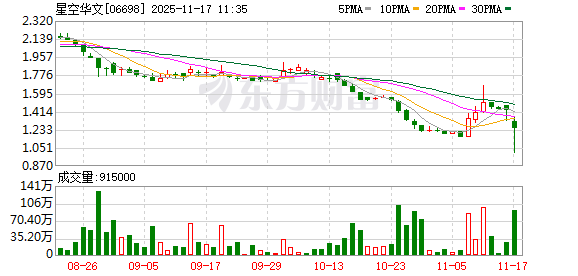
星空华文一度放量大跌30%
Di Yi Cai Jing· 2025-11-17 03:34
Core Viewpoint - The stock of Starry Sky Chinese (06698.HK) experienced a significant drop, falling over 30% at one point and closing down more than 14% with a trading volume exceeding one million Hong Kong dollars following the announcement of a joint venture in the AI music business [2]. Group 1: Company Announcement - On November 14, Starry Sky Chinese announced that its indirect wholly-owned subsidiary, Shanghai Jiuwu Yisheng, signed a joint venture agreement with partners to establish a company focused on AI music operations [2]. - According to the joint venture agreement, Shanghai Jiuwu Yisheng will invest 115 million yuan, with 320,000 yuan allocated as registered capital and 115 million yuan designated for capital reserves [2]. - The joint venture partners will invest 244 million yuan, with 680,000 yuan as registered capital and 244 million yuan for capital reserves, resulting in Shanghai Jiuwu Yisheng holding a 32% stake and the partners holding 68% [2].