腾讯音乐

Search documents
腾讯控股(00700):游戏业务增速超预期,AI应用投入持续加大
CMS· 2026-03-23 01:37
Investment Rating - The report maintains a "Strong Buy" investment rating for Tencent Holdings [6] Core Insights - The company's game business growth exceeded expectations, with a significant increase in AI application investments across various sectors [6] - Tencent's Q4 2025 revenue reached 194.4 billion CNY, a year-on-year increase of 13%, while the Non-IFRS net profit was 64.7 billion CNY, up 17% year-on-year [1][6] - The report forecasts revenue growth for 2026-2028, estimating revenues of 833.4 billion, 915 billion, and 994.9 billion CNY, with adjusted net profits of 279.3 billion, 308.5 billion, and 339.5 billion CNY respectively [6] Business Segment Summaries 1. Online Gaming Business - In Q4 2025, the domestic gaming revenue was 38.2 billion CNY, a 15% year-on-year increase, while overseas gaming revenue reached 21.1 billion CNY, a 32% increase [10][16] - The growth was driven by new game launches and strong performances from established titles like "Honor of Kings" and "PUBG MOBILE" [10][16] 2. Social Networking Business - The social networking segment generated 30.6 billion CNY in Q4 2025, a 3% year-on-year increase, primarily from music subscription services and video live streaming [19] - The number of paid music subscribers rose to 127 million, a 5.3% increase year-on-year, with a paid rate of 24.1% [19] 3. Marketing Services Business - The marketing services segment reported revenue of 41.1 billion CNY in Q4 2025, an 18% year-on-year increase, driven by AI-enhanced advertising capabilities [25] - The introduction of the AIM+ intelligent advertising product matrix has improved advertising efficiency and effectiveness [26] 4. Financial Technology and Enterprise Services - This segment achieved revenue of 60.8 billion CNY in Q4 2025, an 8% year-on-year increase, with significant contributions from financial services and cloud services [32] - Tencent Cloud has achieved scalable profitability, benefiting from rising AI demand and improvements in PaaS and SaaS offerings [32] 5. Profitability and AI Ecosystem Development - The company reported a gross profit of 108.3 billion CNY in Q4 2025, a 19% increase year-on-year, with a gross margin of 56% [38] - Tencent continues to invest heavily in AI, enhancing its capabilities across various applications, including gaming and advertising [39][40]

腾讯控股(00700):——腾讯控股(0700.HK)2025Q4财报点评:整体表现稳健,年内加大AI投入
Guohai Securities· 2026-03-22 14:04
Investment Rating - The report maintains a "Buy" rating for Tencent Holdings [1] Core Insights - Tencent's overall performance remains robust, with a significant increase in AI investments planned for the year [3][11] - The company reported Q4 2025 revenue of 194.4 billion RMB, a year-over-year increase of 13%, and a quarter-over-quarter increase of 0.8% [7][12] - Operating profit for Q4 2025 was 60.3 billion RMB, up 17% year-over-year but down 5% quarter-over-quarter [7][12] - Net profit attributable to shareholders was 58.3 billion RMB, reflecting a 14% year-over-year increase but an 8% decrease quarter-over-quarter [7][12] Summary by Relevant Sections Overall Performance - The company achieved a gross margin of 56% in Q4 2025, up from 52% in the same period last year [19][22] - The increase in gross margin is attributed to strong performance in domestic gaming and AI-driven demand for high-margin revenue sources [22] Operational Data - WeChat's monthly active users (MAU) reached 1.418 billion, a 2% year-over-year increase [8][13] - The number of registered accounts for paid value-added services reached 267 million, also a 2% year-over-year increase [8][13] Revenue Breakdown - Value-added services revenue grew by 14% year-over-year to 89.9 billion RMB, accounting for 46% of total revenue [30] - Gaming revenue increased by 20% year-over-year to 59.3 billion RMB, with domestic market revenue at 38.2 billion RMB (up 15%) and international market revenue at 21.1 billion RMB (up 32%) [30][31] - Marketing services revenue rose by 17% year-over-year to 41.1 billion RMB, driven by AI-enhanced advertising capabilities [39][40] - Financial technology and enterprise services revenue grew by 8% year-over-year to 60.8 billion RMB, with cloud services revenue increasing by 22% [42][43] Profitability Forecast - The report projects revenue for 2026-2028 to be 837.9 billion RMB, 924.1 billion RMB, and 1,007 billion RMB respectively, with Non-IFRS net profit expected to be 283.5 billion RMB, 323.2 billion RMB, and 358 billion RMB [11][44] - The target market capitalization for Tencent's various businesses is set at 5.8 trillion RMB, corresponding to a target price of 720 HKD per share [11][44]
腾讯音乐-SW(01698.HK)拟3月16日审议2025年第四季度及全年业绩
Ge Long Hui· 2026-02-10 10:23
Core Viewpoint - Tencent Music Entertainment Group's board will review and vote on the unaudited financial results for the fourth quarter and full year ending December 31, 2025, on March 16, 2026 [1] Group 1 - The board meeting is scheduled for March 16, 2026 [1] - The financial results to be discussed include the unaudited performance for the three months and the full year ending December 31, 2025 [1]
腾讯控股_ 所有目光都聚焦于人工智能发展
2026-01-26 02:49
Summary of Key Points from the Conference Call Transcript Company Overview - **Company**: Tencent Holdings Limited - **Industry**: Technology and Internet Services Core Insights and Arguments - **Investment Theme**: The investment theme for Tencent entering 2026 is characterized as "fundamentals plus optionality" with resilient core engines (WeChat ecosystem, advertising, and gaming) [1][14] - **AI Narrative Impact**: The impact of the artificial intelligence narrative on stock price direction is expected to outweigh earnings upgrades, indicating a potential undervaluation of AI in Tencent's stock price [1][14] - **Cautious Approach**: Tencent's management has historically taken a cautious and integrated approach to platform transformation, prioritizing reliability, compliance, and ecosystem fit before scaling generative AI initiatives [1][14] - **Execution and Market Fit**: If Tencent demonstrates clear execution and product-market fit in 2026, it could create upside optionality for the stock [1][14] Financial Performance and Forecasts - **Q4 2025 Revenue Expectations**: Total revenue is expected to be CNY 193.7 billion, a year-on-year growth of 12%, aligning with market expectations [7] - **Net Profit Forecast**: Adjusted net profit for Q4 2025 is projected at CNY 65.6 billion, corresponding to an adjusted net profit margin of 34%, which is a 2 percentage point increase year-on-year [7] - **Earnings Per Share (EPS)**: Adjusted EPS for Q4 2025 is anticipated to be CNY 7.13, slightly above market consensus [7] Adjustments and Changes - **Advertising Revenue Downgrade**: The year-on-year growth rate for advertising revenue for Q4 2025 has been revised down from 19% to 16% due to a weak macro environment and consumer spending [1][7] - **Financial Technology and Enterprise Services**: The growth forecast for financial technology and enterprise services revenue has been reduced to 8% for Q4 2025, attributed to weak consumer trends and changes in fee structures [1][7] Valuation and Price Target - **Target Price**: The target price for Tencent is maintained at HKD 750, based on a 21x P/E ratio for 2026, positioned at the high end of the current market consensus for leading internet stocks [14][18] - **Earnings Adjustments**: Adjusted EPS for 2026 has been slightly reduced by 1%, reflecting the overall revenue adjustments [8][20] Risks and Considerations - **Downside Risks**: Potential risks include tighter regulations in the gaming market, continued macroeconomic slowdown, and inability to sustain successful mobile game launches [19] - **Upside Opportunities**: Positive factors could include improved macro conditions supporting advertising growth and policy support for cloud and enterprise services [19] Additional Important Information - **Market Performance**: The stock has shown a year-to-date absolute performance of 0.6% and a 12-month performance of 55.5% [13] - **Market Capitalization**: Tencent's total market capitalization is approximately USD 735.87 billion [13] - **Analyst Ratings**: The stock is rated as "Overweight" by analysts, indicating expected performance above the average total return of covered stocks [28] This summary encapsulates the key points from the conference call, focusing on Tencent's strategic positioning, financial forecasts, valuation, and associated risks.

腾讯控股:4Q广告预期稳健增长,AI小程序加码布局-20260120
HTSC· 2026-01-20 07:25
Investment Rating - The report maintains a "Buy" rating for Tencent with a target price of 792 HKD [6][5][28] Core Insights - Tencent is expected to achieve a revenue growth of 13% year-on-year in Q4 2025, with adjusted net profit increasing by 16% to 643 billion RMB. The revenue growth is driven by gaming, advertising, and fintech, with expected increases of 16%, 20%, and 9% respectively [1][5][24] - Key catalysts for Tencent in the medium term include the launch of multiple new games, improvements in advertising efficiency due to AI, and the introduction of AI tools for mini-program development on WeChat [1][3][4] Summary by Sections Gaming Business - Tencent's gaming revenue is projected to grow by 16% in Q4, with the new game "Counter-Strike: Future" expected to generate 3.5 to 7 billion RMB in its first year. The game fills a gap in the PVE shooting genre and has already attracted over 10 million players shortly after launch [2][12][16] Advertising Business - Advertising revenue is anticipated to increase by 20% in Q4, driven by budget increases from long-tail advertisers and efficiency gains from AI. WeChat's advertising capabilities are evolving, with new features enhancing social commerce [4][19] Fintech and AI Mini-Programs - Fintech revenue is expected to grow by 9%, supported by a robust performance in social retail. AI mini-programs are projected to expand significantly in 2026, with a 108% increase in monetization scale and a 75% rise in eCPM in 2025 [3][19] Financial Forecast and Valuation - Revenue forecasts for Tencent have been slightly adjusted downwards for 2025-2027, with expected adjusted net profits of 263.1 billion, 299.4 billion, and 342.5 billion RMB respectively. The target price corresponds to a PE ratio of 21.6 for 2026 [5][24][28]
腾讯控股(00700):4Q广告预期稳健增长,AI小程序加码布局
HTSC· 2026-01-20 06:42
Investment Rating - The report maintains a "Buy" rating for Tencent with a target price of 792 HKD [6][5][28] Core Insights - Tencent's revenue for Q4 2025 is expected to grow by 13% year-on-year, with adjusted net profit projected to increase by 16% to 643 billion RMB [1] - Key growth drivers include the launch of multiple new games, improved advertising efficiency through AI, and enhanced support for AI mini-programs on WeChat [1][3][4] - The gaming segment is anticipated to see a 16% increase in revenue, while advertising revenue is expected to rise by 20% [2][4] Summary by Relevant Sections Gaming Business - Tencent's gaming revenue for Q4 is projected to grow by 16%, with the new game "Counter-Strike: Future" expected to generate 35-70 billion RMB in its first year [2][12] - The game fills a gap in Tencent's PVE shooting game offerings and has already achieved over 10 million players shortly after launch [2][12][16] Financial Technology - Financial technology revenue is expected to grow by 9%, driven by a slowdown in social retail growth [3] - AI mini-programs are anticipated to enhance e-commerce and local services, with significant growth expected in 2026 [3][19] Advertising Revenue - Advertising revenue is projected to increase by 20%, driven by budget increases from long-tail advertisers and efficiency improvements from AI [4] - WeChat's advertising capabilities are evolving, with new features aimed at enhancing social commerce [4][19] Profit Forecast and Valuation - Revenue forecasts for Tencent have been slightly adjusted downwards for 2025-2027, with adjusted net profit estimates also revised [5][24] - The target price of 792 HKD corresponds to a PE ratio of 21.6 for 2026, reflecting a slight decrease from previous estimates [5][28][30]
汽水音乐狙击网易云音乐:以“AI野路子”的名义
3 6 Ke· 2026-01-12 02:35
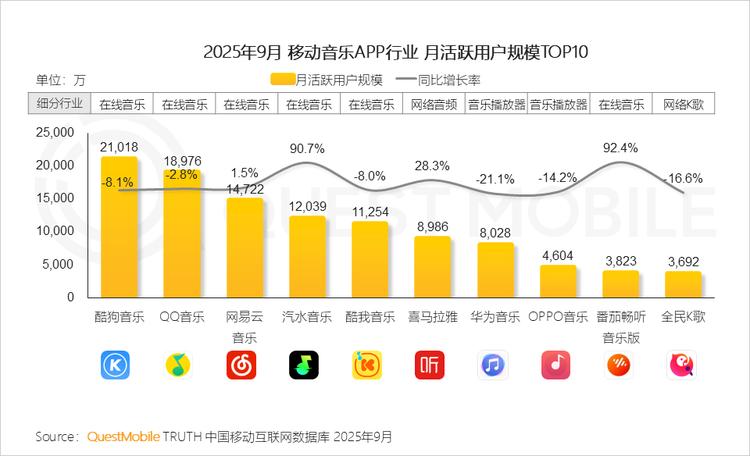
Core Insights - The rise of Qishui Music, a music app without exclusive big-name artists or popular variety show soundtracks, is challenging established players like NetEase Cloud Music, with monthly active users reaching 120 million and a year-on-year growth of over 90% [2][4] - The integration of AI-generated music has significantly contributed to this growth, with AI artists like "Dazhuzhen" gaining popularity on platforms like Douyin, indicating a potential for even higher user engagement [4][8] Group 1: Market Dynamics - The traditional online music industry has operated under a "copyright is king" principle, where companies like Tencent Music and NetEase Cloud Music invest heavily in exclusive content to retain users [13][14] - The emergence of AI-generated music disrupts this model, as it allows for the mass production of appealing songs, diminishing the value of exclusive copyrights [15][20] - Qishui Music's business model, which relies on free listening and ad monetization, contrasts with the subscription-based models of Tencent and NetEase, positioning it advantageously in the current market [20][22] Group 2: AI Integration - The recent advancements in AI music generation tools, such as Suno's V5 version, have enabled the creation of consistent AI artists, addressing previous limitations in sound quality and artist identity [8][9] - The ecosystem of Douyin and Qishui Music allows for music to serve as a functional component of short video content, emphasizing emotional engagement over traditional artist recognition [10][11] - AI's ability to produce high-frequency, emotionally resonant music segments aligns perfectly with the demands of short video platforms, leading to rapid user acquisition for Qishui Music [9][12] Group 3: Competitive Landscape - The competitive landscape is shifting, with traditional music companies struggling to adapt to the new AI-driven model, reminiscent of Nokia's decline in the face of disruptive technology [17][22] - Both Tencent and NetEase are cautiously exploring AI music but face challenges in balancing user expectations and copyright concerns, while Qishui Music embraces AI without such constraints [20][25] - The success of Qishui Music illustrates a broader trend where companies leverage AI to bypass traditional barriers, fundamentally altering the rules of competition in the music industry [23][26]


图解丨北水加仓小米超10亿港元,连续4日卖出中国移动
Ge Long Hui· 2026-01-08 11:47
Group 1: Investment Trends - Net purchases included Xiaomi Group at 1.072 billion, Tencent Holdings at 863 million, SMIC at 563 million, Alibaba at 350 million, and Goldwind Technology at 130 million [1] - Net sales included the Tracker Fund at 6.284 billion, Hang Seng China Enterprises at 2.878 billion, Southern Hang Seng Technology at 1.288 billion, China Mobile at 732 million, and Hua Hong Semiconductor at 413 million [1] - Southbound funds have recorded six consecutive days of net purchases for Xiaomi, totaling 4.6844 billion HKD, and five consecutive days for Alibaba, totaling 2.46627 billion HKD [1] Group 2: Stock Performance - Alibaba-W saw a decline of 2.3% with a net purchase of 311 million and a transaction volume of 5.722 billion [4] - Tencent Holdings experienced a drop of 1.4% with a net purchase of 585 million and a transaction volume of 2.263 billion [4] - Goldwind Technology increased by 2.7% with a net purchase of 130 million and a transaction volume of 1.797 billion [4] Group 3: Company Insights - Tencent Holdings is viewed positively for its monetization capabilities among moderate to heavy users, despite short-term competition concerns in the music sector [5] - SMIC's acquisition of 49% of the shares in SMIC North is expected to positively impact both short-term and long-term shareholder value, with a projected increase in net profit of over 120 million USD by 2026 [5] - Alibaba's recent communication indicates significant progress in its Taobao Flash Sale initiative, with a clear strategy for market share growth and increased investment [5] Group 4: Analyst Ratings - Daiwa has upgraded Goldwind Technology's rating to "Outperform" with a target price raised to 17 HKD [6]




我的年度歌手是“陌生人”? 网易云年度报告遭质疑数据“注水”
Xin Lang Cai Jing· 2025-12-29 08:52
Core Viewpoint - NetEase Cloud Music's 2025 annual listening report has sparked controversy among users who question the accuracy of the data presented, with many claiming discrepancies in their listening habits and the reported statistics [2][11]. User Feedback and Concerns - Users have expressed dissatisfaction with the annual report, claiming it includes songs they have never listened to and misrepresents their listening history, leading to frustration and confusion [4][13]. - Some users reported that the customer service responses felt automated and unhelpful, with complaints about the inability to modify the generated annual summary [4][13]. Official Response - NetEase Cloud Music's customer service stated that the data for the 2025 annual report is collected from January 1 to December 20 and includes all valid listening data across platforms, emphasizing that the report cannot be modified once generated [5][14]. - The company has introduced an upgrade allowing users to manually adjust their "Artist of the Year," "Song of the Year," and "Album of the Year" from the top five in each category, although the original data remains unchanged [5][14]. Financial Performance - NetEase reported a net income of 28.4 billion yuan for Q3 2025, a year-on-year increase of 8.2%, while the net income for NetEase Cloud Music reached 2 billion yuan, reflecting a decline of 1.8% year-on-year, marking the fourth consecutive quarter of revenue decline for the music service [6][15]. Market Competition - The competitive landscape for online music platforms is intensifying, with Tencent Music reporting a total revenue of 8.46 billion yuan in Q3 2025, a year-on-year increase of 20.6%, and a net profit of 2.48 billion yuan, up 27.7% [7][16]. - New entrants like Soda Music are rapidly gaining market share, with active users reaching 12 million, surpassing competitors and closing in on NetEase Cloud Music's 14.7 million active users [7][16]. Industry Challenges - Traditional online music platforms like Tencent Music and NetEase Cloud Music face significant threats from free music platforms, which, despite lacking premium content, attract a large user base [8][17]. - Analysts emphasize the importance of music copyright in the competitive landscape, noting that NetEase has struggled to keep pace with Tencent in this area, highlighting the need for innovative content strategies to remain relevant [8][17].


比亚迪、腾讯等“链主”们,把整条产业链带到了招聘会
2 1 Shi Ji Jing Ji Bao Dao· 2025-12-28 01:11
Group 1 - The recruitment event "Million Talents Gathering in Nanyue" held in Shenzhen attracted over 12,000 students from more than 1,700 universities, with 6,500 quality job positions released by 1,825 key employers [1][3] - A highlight of the event was the establishment of the "Chain Master Enterprise Zone," where major companies like BYD, Gree, Tencent, and Xpeng showcased their recruitment needs alongside over 80 supply chain enterprises, creating a collaborative recruitment model [1][4] - The event allowed job seekers to gain a comprehensive understanding of the entire industry chain, from major players to supporting manufacturers, enhancing their ability to find suitable positions [1][4] Group 2 - In the Greater Bay Area, 41.4% of recruitment positions were from medium and large enterprises with over 500 employees, significantly higher than the national average of 33.3% [3] - BYD's chairman revealed that the company has recruited over 50,000 fresh graduates in the past three years, with 70% being master's and doctoral graduates [3] - The recruitment strategy reflects a shift from individual efforts to collaborative approaches, leveraging the influence of leading companies to attract talent to smaller firms [4][6] Group 3 - Guangdong's economy, being the largest in China, has a diverse industrial base that continuously attracts high-quality talent across various sectors [6][7] - The region is focusing on emerging industries like new energy vehicles, with companies like BYD leading the way in innovation and talent acquisition [7] - The "Million Talents Gathering in Nanyue" initiative aims to attract 1 million college graduates to work and start businesses in Guangdong, supported by competitive salaries and policies [8] Group 4 - Guangdong has implemented a comprehensive policy package to support graduates, including subsidies for employment, entrepreneurship, and housing, as well as expedited residency processes for talent [8] - The initiative has already seen significant participation, with over 5000 recruitment events held and more than 110,000 talents choosing Guangdong for their careers [8]