
General Artificial Intelligence (AGI)

Search documents
这家百人“作坊”,凭什么年入70亿,还成了OpenAI的“御用陪练”?
3 6 Ke· 2025-08-02 00:03
Core Insights - Surge AI, a company with only 110 employees, achieved over $1 billion in annual revenue in 2024, surpassing industry leader Scale AI, which has over a thousand employees and backing from Meta [1][21] - Surge AI is initiating its first round of financing, aiming to raise $1 billion with a potential valuation of $15 billion [1][3] Industry Overview - The data annotation industry is likened to a "feeding" process for AI models, where raw data is transformed into a format that AI can understand [4] - Traditional models, exemplified by Scale AI, rely on a large workforce to handle massive amounts of data, which can lead to quality issues and inefficiencies [5][6] Surge AI's Unique Approach - Surge AI focuses on high-quality data annotation rather than quantity, emphasizing the importance of human expertise over sheer manpower [3][10] - The company employs a selective hiring process, recruiting the top 1% of annotators, including PhDs and Masters, to ensure high-quality output [11][13] - Surge AI targets high-value tasks in AI training, such as Reinforcement Learning from Human Feedback (RLHF), which significantly impacts model performance [13] Technological Integration - Surge AI has developed an advanced human-machine collaboration system that enhances efficiency and quality, allowing a small team to process millions of high-quality data points weekly [15][17] - The platform integrates machine learning algorithms to detect errors and streamline the annotation process, resulting in a productivity rate nearly nine times that of Scale AI [17] Mission and Vision - The founder, Edwin Chen, emphasizes a mission-driven approach, stating that the company is not just about profit but about nurturing Artificial General Intelligence (AGI) [18][19] - Surge AI positions its annotators as "parents" of AI, fostering a sense of purpose and commitment among its highly educated workforce [19] Competitive Landscape - Surge AI's revenue in 2024 exceeded that of Scale AI, which reported $870 million, showcasing its competitive edge in the market [21] - The company has established a unique position by redefining the data annotation problem, focusing on quality and human insight rather than traditional labor-intensive methods [25]

大部分AI产品撑不过10年
是说芯语· 2025-08-01 04:23
Core Viewpoint - The current state of AI technology in China is still in its early stages, with significant potential for growth and innovation, but many existing products may not survive long-term due to a lack of understanding of AI's core essence [3][12][15]. Group 1: AI Development and Trends - AI, AGI, and ASI are seen as part of a continuous evolution rather than distinct categories, emphasizing the ongoing enhancement of capabilities [5][9]. - The rapid evolution of AI technology is changing human cognition and behavior, marking a significant shift from earlier, less mature AI applications [6][7]. - The Chinese AI market is characterized by a high level of experimentation, with many companies exploring various AI applications, although many may ultimately fail [15][16]. Group 2: Competitive Landscape - The AI industry is compared to a marathon, indicating that it is still in the early stages and that short-term advantages are not insurmountable barriers for new entrants [17]. - The competition among companies like DeepSeek and Alibaba is fostering rapid technological advancements, with a focus on collaboration and iteration rather than just competition [16][17]. Group 3: Talent and Innovation - The emphasis is on finding suitable talent with innovative potential rather than simply acquiring the most expensive talent, as the latter does not guarantee success in new ventures [20][25]. - The importance of creativity is highlighted as a key challenge in developing AI applications, suggesting that the current bottleneck is not computational power but rather the ability to innovate [19][21]. Group 4: Long-term Outlook - Cloud computing is viewed as a foundational technology with the potential for sustained growth over the next 50-100 years, similar to the electricity industry [22][23]. - The integration of data, models, and computation is transforming business practices, indicating a significant shift in how companies operate [23][24].

全网疯传GPT-5泄露!首次统一GPT和o系列,编程实测demo抢先曝光,下周发布?
量子位· 2025-07-31 04:23
Core Viewpoint - GPT-5 is expected to be released soon, with significant enhancements in capabilities, including multi-modal interactions and advanced programming skills [10][12][31]. Group 1: Release and Features - GPT-5 has been spotted across various platforms, including ChatGPT, MacOS applications, Cursor, and Microsoft Copilot, indicating a broad rollout [2][5][12]. - The model will integrate the capabilities of the GPT series and the o series, allowing for seamless switching between different functionalities without manual intervention [11][14]. - The main model, GPT-5, is reported to have a context window of up to 1 million tokens and can output up to 100,000 tokens, enhancing its performance in long-term dialogues and logical processing [19]. Group 2: Model Variants - GPT-5 will include multiple versions: the main model (codename "nectarine" or "o3-alpha"), GPT-5 mini (codename "lobster"), and GPT-5 nano (codename "starfish") [15][25]. - The mini version, Lobster, is designed specifically for programming tasks, outperforming other models like Claude 4 in complex coding scenarios [22]. - Lobster can quickly generate complete and accurate code with minimal input, making it suitable for managing legacy code and optimizing code structure [22]. Group 3: Performance and Capabilities - GPT-5 is expected to demonstrate superior programming abilities, achieving near-human programmer levels and enabling faster and more precise software development [16]. - The model will support multi-modal capabilities, allowing it to handle text, images, and tool calls simultaneously, enhancing its utility as a versatile assistant [24]. - The nano version, starfish, has been observed in testing but is currently limited to static game interfaces [25][27]. Group 4: Community Reactions and Skepticism - Despite the excitement surrounding GPT-5, there are voices of skepticism regarding its long-term performance and potential limitations, echoing past experiences with model releases [33][35]. - Concerns have been raised about the model's ability to handle complex reasoning tasks and its tendency to produce misleading outputs [35][37]. - Some community members speculate that the leaks about GPT-5 may be part of a marketing strategy by OpenAI to generate hype [39].

【大涨解读】人工智能大模型:AI大模型迎来密集催化,世界人工智能大会即将召开,GPT-5还刚刚确定发布时间
Xuan Gu Bao· 2025-07-25 03:07
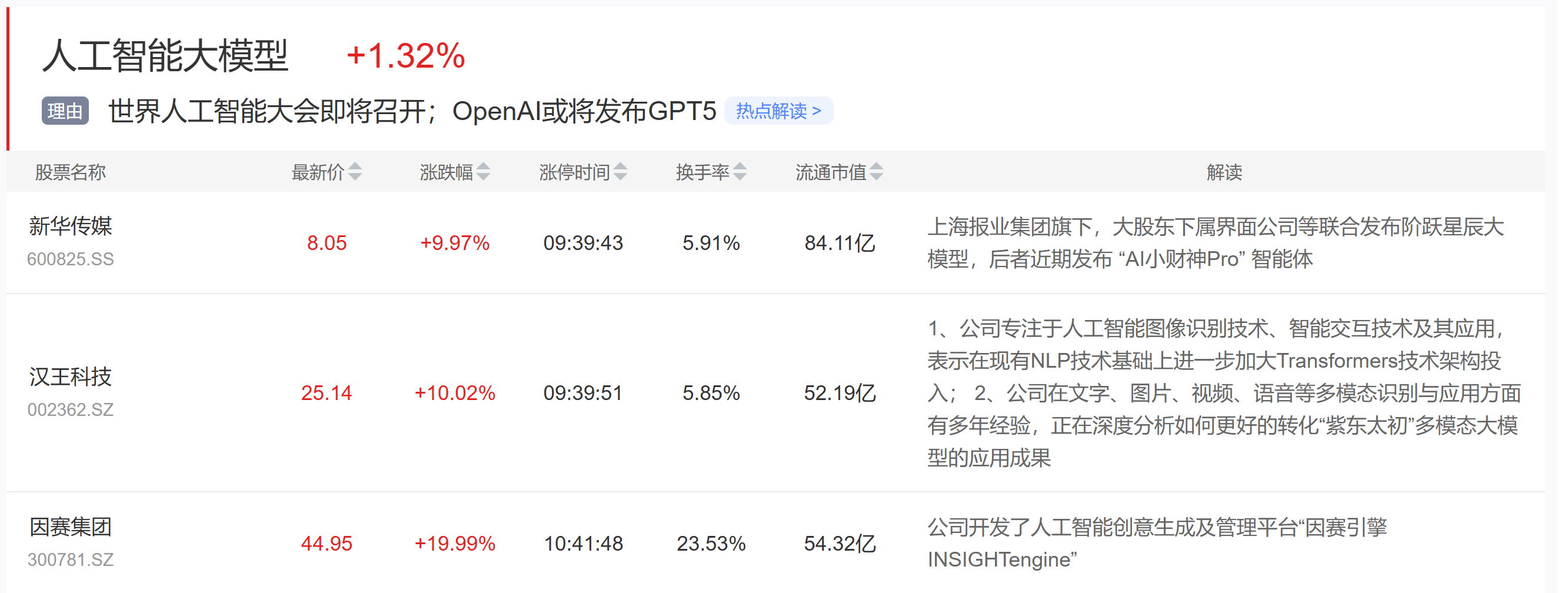
Market Overview - On July 25, the artificial intelligence large model sector showed localized strength, with Hanwang Technology, Zhizhen Technology, and Insai Group hitting the daily limit, while CloudWalk Technology rose over 11% [1] Events - The 2025 World Artificial Intelligence Conference and the High-Level Meeting on Global Governance of Artificial Intelligence will be held on July 26, 2025, at the Expo Center, with Premier Li Qiang set to attend and deliver a speech [2] - OpenAI is reportedly preparing to launch its flagship model GPT-5 in August, along with mini and nano versions, aiming to create a more powerful system that integrates various technologies and ultimately achieve Artificial General Intelligence (AGI) [3] Institutional Insights - The World Artificial Intelligence Conference (WAIC) has become a significant driving force in the global AI ecosystem since its inception in 2018, with the theme for this year emphasizing global AI cooperation and advocating for technology inclusivity [4] - GPT-5 is expected to be a fully multimodal model supporting various input types, which will significantly increase computational demands and drive hardware construction needs [4] - Domestic models such as Doubao Seed 1.6, Alibaba Tongyi Qianwen, and KimiK2 are flourishing, showcasing the efficiency of domestic models, indicating that Chinese large model companies are not lagging behind in terms of technological essence and talent reserves [4]
DeepSeek月均下载量暴跌72.2%!周鸿祎:梁文锋不屑于做APP,他把技术全都开源免费【附大模型行业市场分析】
Qian Zhan Wang· 2025-07-25 01:34
Core Insights - DeepSeek's monthly average downloads significantly dropped from 81.13 million in Q1 2025 to 22.59 million in Q2 2025, a decline of 72.2% [2] - The decline is attributed to user diversion to other applications that have integrated DeepSeek's open-source model, with 59.2% of lost users switching to Baidu App and 38.6% to Doubao App [2] - Major companies like Alibaba, ByteDance, and Baidu have launched cheaper competing APIs, further squeezing DeepSeek's market space [2] Company Overview - DeepSeek, developed by Deep Seek (Hangzhou) Technology Co., is an open-source AI product known for its low cost and high performance, with a training cost of only $6 million using 2048 NVIDIA H800 GPUs [3] - Despite the drop in downloads, DeepSeek's open-source strategy has contributed significantly to the industry's development [3] Industry Context - The AI model cost in China is significantly lower than that of international giants, with DeepSeek-R1's inference cost being about one-thirtieth of OpenAI's operational cost [5] - As of April 2024, approximately 305 large models have been launched in China, with 254 of them having over 1 billion parameters [4] Competitive Landscape - Baidu's Wenxin model 4.5 and X1 have been released, with the former outperforming GPT-4.5 in several tests and having an API call price only 1% of GPT-4.5's [5] - The competitive landscape includes various models such as Alibaba's Tongyi Qianwen, ByteDance's Doubao model, and others, each with unique features and pricing strategies [6] Technological Impact - AI technologies represented by DeepSeek are becoming core drivers of industry innovation, enhancing data integration, multi-modal analysis, and complex scenario simulation [7] - The lightweight nature, performance improvements, and rapid cost reductions of large models are accelerating their development and application in new industrialization [9]


最强人才接连被挖,创业大佬离开 OpenAI 后说了实话:7 周硬扛出 Codex,无统一路线、全靠小团队猛冲
AI前线· 2025-07-16 05:08
Core Insights - The article discusses the recent departure of key researchers from OpenAI to Meta's newly established superintelligence lab, highlighting the competitive landscape in AI research and talent acquisition [1][2][3] - It provides a personal perspective on the internal culture and operational dynamics at OpenAI, emphasizing the unique environment that fosters innovation and rapid project execution [3][4][10] Group 1: OpenAI's Internal Culture - OpenAI operates as a cluster of small teams rather than a centralized organization, allowing for flexibility and rapid execution of projects without a strict roadmap [3][11] - The company has a strong emphasis on bottom-up decision-making, where good ideas can come from any employee, and the focus is on action rather than extensive planning [11][12] - OpenAI's culture encourages a high degree of autonomy among researchers, leading to a dynamic environment where projects can be initiated and developed quickly [12][18] Group 2: Talent Movement and Industry Dynamics - The movement of researchers like Jason Wei and Hyung Won Chung from OpenAI to Meta raises questions about the internal environment at OpenAI and the factors influencing talent retention [1][2] - The article reflects on the competitive nature of the AI industry, particularly among leading firms like OpenAI, Meta, and Google, each pursuing different strategies in the race towards AGI [33] Group 3: Project Execution and Innovation - The Codex project exemplifies OpenAI's ability to deliver significant products in a short timeframe, with the team completing the project in just seven weeks [26][27] - OpenAI's operational model is likened to a research lab, where innovation is prioritized, and the focus is on creating impactful consumer applications while maintaining a commitment to safety and ethical considerations [15][16][18]


AGI离我们还有多远?斯坦福专家:未来五年AI将重塑白领工作
3 6 Ke· 2025-07-15 10:15
Group 1 - The core discussion revolves around the transformative impact of generative AI on enterprises, highlighting three key areas: user experience, application automation, and platform development [2] - SAP has integrated approximately 230 AI features into its applications, with plans to increase this number to 400 by the end of 2025, aiming to enhance productivity and reduce costs [2] - The positioning of AI tools as productivity enhancers rather than mere task augmenters significantly influences their usage frequency among employees [2][4] Group 2 - The concept of Artificial General Intelligence (AGI) is emerging as a significant topic, with expectations of substantial advancements in cognitive tasks relevant to white-collar jobs over the next five years [4][6] - Oren emphasizes the importance of defining AGI and its implications for industries and workforce retraining, as well as the creation of meaningful work opportunities [4][6] - Future technological advancements are expected to include next-generation AI, future data platforms, robotics, quantum computing, and enhanced user experiences, all of which will redefine enterprise operations [6][7]


年薪开到一亿美元!AI巨头疯狂挖人的背后
Zheng Quan Zhi Xing· 2025-07-15 06:02
Group 1 - The core idea of the article highlights the intense competition among tech giants for top AI talent, which has become a strategic resource more valuable than gold [1][2] - Major companies like Meta, Google, Apple, and Musk's xAI are engaging in aggressive recruitment strategies, including exorbitant salaries and team acquisitions [1][4] - The scarcity of top AI talent is underscored, with fewer than 1,000 experts globally being recognized as "top-tier," leading to a significant talent gap in the industry [5][6] Group 2 - Meta has successfully recruited four key researchers from OpenAI, who played crucial roles in developing advanced AI models, indicating a strategic move to enhance its capabilities in general artificial intelligence (AGI) [3][4] - Google has also made headlines by acquiring the core team of AI startup Windsurf for $2.4 billion, further illustrating the trend of mergers and acquisitions to secure talent [4][5] - The competition for AI talent is driven by the need to establish technological barriers and gain a first-mover advantage in a field characterized by high investment and uncertainty [7][8] Group 3 - The recruitment of top AI talent is essential for maintaining innovation speed, as these individuals are key to solving complex problems and pushing the boundaries of model capabilities [8] - Companies are employing defensive strategies to secure talent, recognizing that losing top talent equates to losing the drive for innovation and ultimately their competitive edge [8]

南大等8家单位,38页、400+参考文献,物理模拟器与世界模型驱动的机器人具身智能综述
机器之心· 2025-07-15 05:37
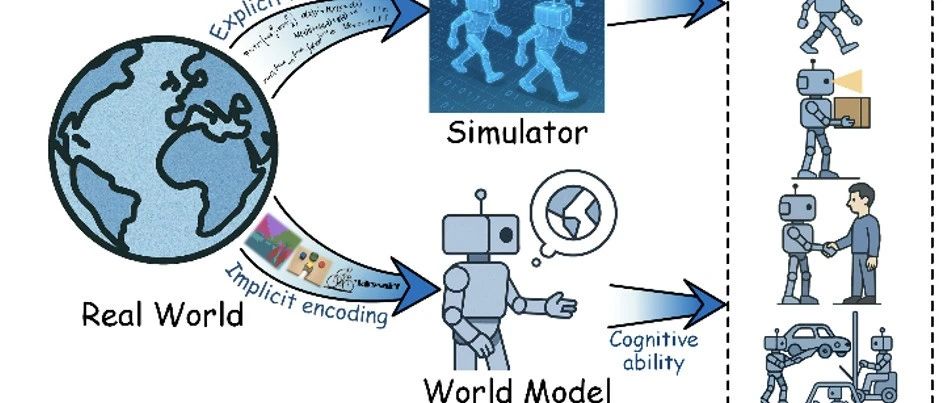
Core Insights - The article emphasizes the significance of "Embodied Intelligence" in the pursuit of Artificial General Intelligence (AGI), highlighting the need for intelligent agents to perceive, reason, and act in the physical world [5] - The integration of physical simulators and world models is identified as a promising pathway to enhance the capabilities of robots, enabling them to transition from mere action execution to cognitive processes [5] Summary by Sections 1. Introduction to Embodied Intelligence - Embodied Intelligence focuses on intelligent agents that can autonomously perceive, predict, and execute actions in complex environments, moving towards AGI [5] - The combination of physical simulators and world models is crucial for developing robust embodied intelligence [5] 2. Key Contributions - The paper systematically reviews the advancements in learning embodied intelligence through the integration of physical simulators and world models, analyzing their complementary roles in enhancing autonomy, adaptability, and generalization of intelligent agents [5] 3. Robot Capability Classification - A five-level capability classification system (IR-L0 to IR-L4) is proposed, covering autonomy, task handling, environmental adaptability, and social cognition [9][10] - IR-L0: Basic execution with no environmental perception - IR-L1: Rule-based response in closed environments - IR-L2: Perceptual adaptation with basic path planning - IR-L3: Human-like collaboration with emotional recognition - IR-L4: Full autonomy with self-generated goals and ethical decision-making [15] 4. Review of Core Robot Technologies - The article reviews the latest technological advancements in legged locomotion, manipulation control, and human-robot interaction [11][16] 5. Comparative Analysis of Physical Simulators - A comprehensive comparison of mainstream simulators (Webots, Gazebo, MuJoCo, Isaac Gym/Sim) is provided, focusing on their physical simulation capabilities, rendering quality, and sensor support [12][18][19] 6. Advances in World Models - The paper discusses representative architectures of world models and their applications, such as trajectory prediction in autonomous driving and simulation-reality calibration for articulated robots [13][20]
李飞飞:高校学生应追逐AI“北极星”问题
Hu Xiu· 2025-07-08 08:15
Core Insights - The article highlights the journey of Fei-Fei Li from her early academic achievements to her current role as CEO of a company, emphasizing her passion for starting from scratch and building innovative solutions in AI [1][2][24]. Group 1: ImageNet and AI Development - ImageNet was conceived around 18 years ago to address the lack of data in AI and machine learning, particularly in computer vision, which was essential for the development of algorithms [4][6]. - The project aimed to download 1 billion images from the internet to create a global visual classification system, which became a cornerstone for training and testing machine learning algorithms [6][7]. - The breakthrough moment for ImageNet came in 2012 with the introduction of AlexNet, which utilized convolutional neural networks (CNN) and significantly reduced the error rate in image recognition tasks [8][10]. Group 2: Vision and Future of AI - Li emphasizes the importance of spatial intelligence for achieving general artificial intelligence (AGI), arguing that without it, AGI remains incomplete [14]. - The evolution of AI has progressed from object recognition to scene understanding and now to generating 3D worlds, which presents a new set of challenges [12][16]. - The integration of language models and visual understanding is seen as a critical area for future research and application, particularly in fields like robotics and the metaverse [20][21]. Group 3: Advice for Students and Researchers - Li advises students to pursue fundamental "North Star" problems in AI that are not necessarily tied to industrial applications, as academic resources have shifted significantly [34][35]. - She encourages interdisciplinary research in AI, particularly in scientific discovery, and highlights the importance of curiosity and problem-solving in graduate studies [38][39]. - The article underscores the need for a new generation of researchers who are fearless and willing to tackle complex challenges in AI [32][33].