
平台经济

Search documents
中国官方就互联网平台价格行为规则公开征求意见
Zhong Guo Xin Wen Wang· 2025-08-23 14:40
中新社北京8月23日电 (记者王恩博)中国国家发改委、国家市场监管总局、国家网信办联合起草的《互 联网平台价格行为规则(征求意见稿)》(下称《行为规则》),于23日向社会公开征求意见。 《行为规则》公开征求意见时间为1个月。公开征求意见结束后,官方将对各方面意见进行深入研究、 充分吸收采纳。文件出台时,将评估论证,根据实际情况留出必要的适应调整期。(完) (文章来源:中国新闻网) 国家发改委有关负责人介绍,《行为规则》坚持促进发展和监管规范并重,事前引导和事中事后监管相 结合,根据现行法律法规规定,保持监管制度的稳定性,着力规范价格行为、推动公开透明、增强各方 协同,保护经营者和消费者合法权益,促进平台经济健康发展。 围绕大数据定价、价格补贴、价格诚信等方面,《行为规则》依法规范平台经营者、平台内经营者价格 行为,对经营者自主定价、价格竞争等提出明确行为规范,营造有序竞争、公平竞争的市场环境。与此 同时,要求平台经营者、平台内经营者严格遵守明码标价规定、提高价格规则透明度、及时公示收费变 更情况,更好接受社会监督。 此外,《行为规则》结合平台经济领域价格行为特点,综合运用有关法律法规关于价格行为的规定,充 分 ...
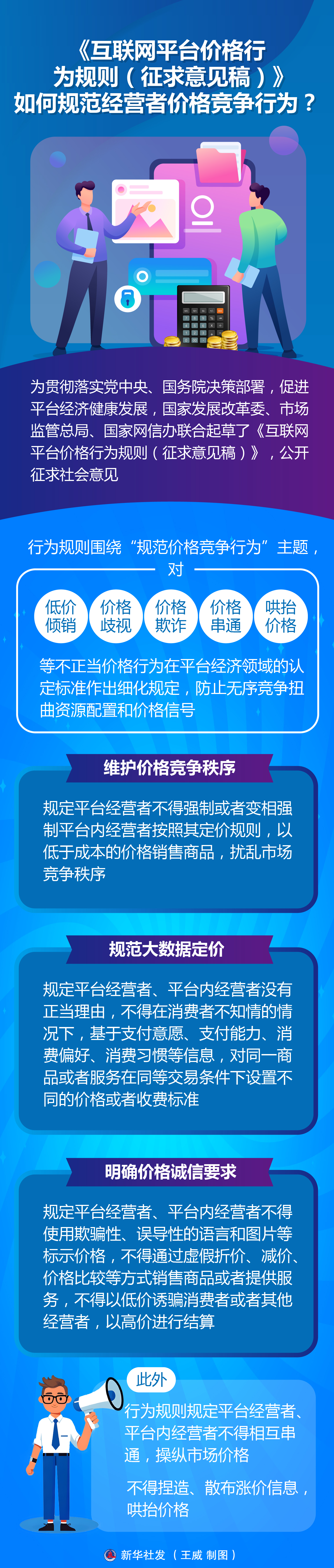
《互联网平台价格行为规则(征求意见稿)》如何规范经营者价格竞争行为?
Xin Hua Wang· 2025-08-23 13:12
规定平台经营者不得强制或者 制平台内经营者按照其定价规 低于成本的价格销售商品,扰 竞争秩序 规范大数据定价 规定平台经营者、平台内经营 正当理由,不得在消费者不知 况下,基于支付意愿、支付能 十九月 - 小 小 - 小 - 小 - 小 - 小 - 《互联网平台价格 为贯彻落实党中央、国务院决策部 平台经济健康发展,国家发展改革 监管总局、国家网信办联合起草 平台价格行为规则(征求意见稿 征求社会意见 行为规则围绕"规范价格竞争行 xt 价格 价格 价格 低价 欺诈 顺销 歧视 間龍 等不正当价格行为在平台经济 定标准作出细化规定,防止无 曲资源配置和价格信号 维护价格竞争秩序 IFF al 新华社发 王威 制图 【纠错】 【责任编辑:王佳宁】 贺佩灯、 消费 列货等信息 , 品或者服务在同等交易条件下 同的价格或者收费标准 明确价格诚信要求 规定平台经营者、平台内经营 使用欺骗性、误导性的语言和 标示价格,不得通过虚假折价 价格比较等方式销售商品或者 务,不得以低价诱骗消费者或 经营者,以高价进行结算 ...

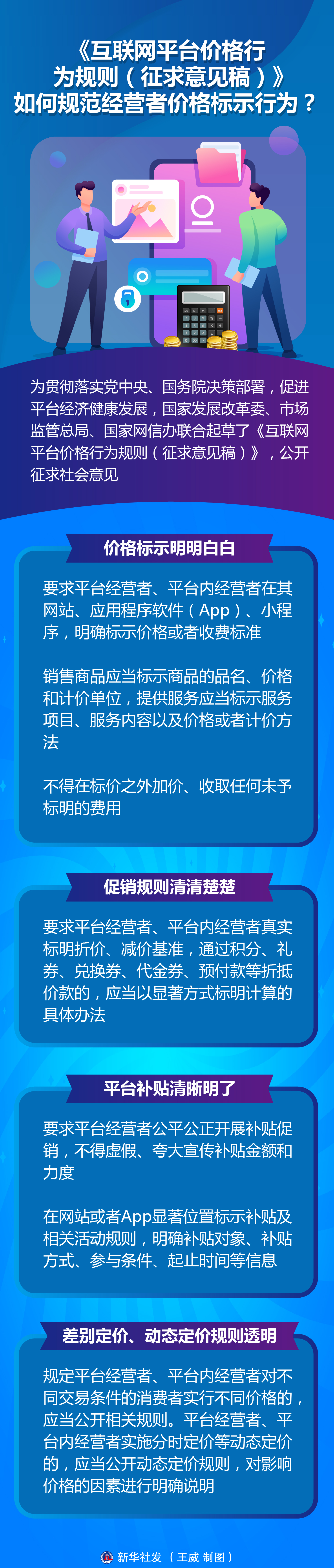
《互联网平台价格行为规则(征求意见稿)》如何规范经营者价格标示行为 ?
Xin Hua Wang· 2025-08-23 13:12
Core Viewpoint - The article discusses the draft rules for pricing behavior on internet platforms, aimed at ensuring fair and transparent pricing practices in the platform economy [3]. Group 1: Pricing Transparency - Platform operators are required to clearly indicate prices or fees for goods and services, including the name and unit of measurement for the products sold [4]. - Additional charges beyond the marked price are prohibited, ensuring that consumers are not misled by hidden fees [6]. Group 2: Promotional Clarity - The rules mandate that any discounts or promotional offers must be clearly marked, including the basis for the discount, such as original prices or conditions for using coupons [8]. - Platforms must provide clear information about subsidies, including the rules of related activities, target beneficiaries, and participation conditions [10]. Group 3: Fair Competition - Platform operators are instructed to conduct sales fairly and not to engage in false or exaggerated advertising regarding subsidy amounts [10]. - The rules also address differential pricing and dynamic pricing, requiring that consumers under the same transaction conditions are treated equally [10].
【财闻联播】最低工资迎来“普调”!全国新增67所推免资格高校
券商中国· 2025-08-23 12:48
Macro Dynamics - As of the end of July, the total installed power generation capacity in China reached 3.67 billion kilowatts, a year-on-year increase of 18.2% [2] - Solar power generation capacity reached 1.11 billion kilowatts, growing by 50.8% year-on-year, while wind power capacity reached 570 million kilowatts, up by 22.1% [2] - The average utilization hours of power generation equipment from January to July were 1,806 hours, a decrease of 188 hours compared to the same period last year [2] Internet Platform Pricing Regulations - The National Development and Reform Commission (NDRC) released a draft for public consultation on the "Internet Platform Pricing Behavior Rules," focusing on regulating price competition behaviors [3] - The rules specify standards for identifying unfair pricing behaviors such as predatory pricing, price discrimination, and price collusion [3] - Platform operators are prohibited from forcing or indirectly forcing sellers to sell below cost, which disrupts market competition [3] Education Sector - The Ministry of Education announced the addition of 67 universities with recommendation exemption qualifications for graduate studies [4][5] - This marks the first time in eight years that the Ministry has initiated the selection of new universities for this program, which allows outstanding undergraduates to bypass entrance exams for graduate studies [4][5] Weather and Emergency Response - The China Meteorological Administration initiated a Level 4 emergency response for major meteorological disasters due to Typhoon "Jianyu," which is expected to affect Hainan Island and move towards northern Vietnam [6] Minimum Wage Adjustments - Multiple regions in China have announced adjustments to their minimum wage standards, with Beijing increasing its monthly minimum wage from 2,420 yuan to 2,540 yuan starting September 1, 2025 [7] - Other provinces, including Hunan, have also revised their minimum wage standards, with new monthly rates set at 2,200 yuan, 2,000 yuan, and 1,800 yuan [7] Financial Institutions - Zhuxuimin has resigned as the chairman of Xinda Aoyuan Fund, with Shang Jian taking over the role [8] - Xuhui's chairman, Xiong Guobing, has also stepped down, with General Manager Qiao Zhen temporarily assuming the chairman's duties [9] Market Data - The Dow Jones Industrial Average reached a new high, rising by 1.89% on August 22, with the S&P 500 and Nasdaq also showing gains [10] - Notable increases were seen in large tech stocks, with Tesla rising over 6% and Intel over 5% [10] - The Nasdaq Golden Dragon China Index rose by 2.73%, with significant gains in companies like Miniso and NIO [11] Company Developments - China Huaneng has established the world's first 5-megawatt commercial-grade perovskite photovoltaic demonstration base in Qinghai Province [12] - CIFI Holdings has made progress in its domestic debt restructuring, with six out of seven bondholders approving the restructuring plan [13] - China Mobile launched its "Computing Network Brain 3.0," integrating advanced models for intelligent task planning in complex environments [14] - The recruitment for a new store by Pang Donglai in Xinxiang saw overwhelming interest, causing the application website to crash [15]
事关平台经济,价格行为将进一步规范
21世纪经济报道· 2025-08-23 12:45
Core Viewpoint - The article discusses the newly proposed "Internet Platform Pricing Behavior Rules" aimed at regulating pricing practices on internet platforms, emphasizing the protection of both platform operators' and consumers' rights while promoting fair competition in the platform economy [1][4]. Group 1: Pricing Behavior Regulations - The "Behavior Rules" consist of seven chapters and 30 articles, focusing on "operator's autonomous pricing," "price marking behavior," "price competition behavior," and "consumer price rights protection" [1]. - The rules prohibit platforms from forcing merchants to lower prices or imposing unreasonable conditions on pricing, ensuring that platform operators and merchants can set prices independently [3][11]. Group 2: Price Marking and Promotion Rules - The rules require clear price marking for goods and services, including delivery fees and additional service charges, and mandate that promotional pricing be transparently communicated to consumers [7][8]. - Platforms must avoid misleading promotional practices, such as false discounts or "fake reductions," and must clearly display the rules and conditions of any promotional activities [8][12]. Group 3: Competition and Consumer Protection - The rules address anti-competitive practices such as predatory pricing, data-driven price discrimination, and price collusion, aiming to maintain a fair competitive environment [10][11]. - Consumer rights are emphasized, particularly regarding the use of algorithms for pricing, ensuring that consumers are informed about pricing changes and have the option to cancel automatic payments [12][13].

事关平台经济,价格行为将进一步规范
2 1 Shi Ji Jing Ji Bao Dao· 2025-08-23 10:59
Core Viewpoint - The "Internet Platform Pricing Behavior Rules (Draft for Comments)" aims to regulate pricing behaviors on internet platforms, addressing issues such as forced promotions, price manipulation, and consumer rights protection, while ensuring compliance with existing laws [1][2][3] Group 1: Pricing Autonomy and Restrictions - The rules emphasize the importance of "operator's pricing autonomy," allowing platform operators and merchants to set prices independently without unreasonable restrictions from the platform [2][4] - It prohibits platforms from forcing merchants to lower prices or impose unreasonable conditions, such as limiting visibility or sales on other platforms [2][4] Group 2: Pricing Transparency and Promotion Rules - The rules require clear pricing practices, including explicit marking of prices, delivery fees, and promotional rules to enhance consumer understanding [5][7] - Platforms must transparently display promotional activities, including the terms and conditions, to prevent misleading practices like false discounts [7][8] Group 3: Competition and Fair Practices - The rules address anti-competitive behaviors such as predatory pricing and price collusion, ensuring that platforms do not disrupt market order or harm competitors [9][10] - It encourages fair competition while regulating practices that violate existing laws, ensuring that long-term free services that benefit innovation are not penalized [10][11] Group 4: Consumer Rights Protection - The rules mandate that platforms notify consumers about automatic renewals and payments, allowing easy cancellation options to protect consumer rights [12] - It emphasizes the need for platforms to provide clear information regarding pricing based on consumer data, preventing unfair pricing practices [10][11]
创新价格治理方式 护航平台经济高质量发展——《互联网平台价格行为规则》解读
Zhong Guo Jing Ji Wang· 2025-08-23 08:05
Core Viewpoint - The platform economy is increasingly recognized as a vital component of China's economic development, providing new opportunities for domestic demand and employment while also raising concerns about pricing behaviors in the market [1][2]. Group 1: Importance of Regulating Platform Pricing Behavior - Regulating pricing behavior in the platform economy is crucial for promoting high-quality development, as it addresses public concerns and establishes a regulatory framework for transitioning from scale expansion to quality enhancement [2][3]. - The pricing behavior in the internet platform sector is characterized by "two-sided market" features and "technology-enabled" attributes, making regulation necessary to protect the rights of both operators and consumers [2][3]. Group 2: Overview of the Pricing Behavior Rules - The "Behavior Rules" consist of 30 articles that provide comprehensive guidelines on pricing practices, including operator pricing autonomy, price marking, competitive pricing behavior, consumer rights protection, and supervision mechanisms [3][4]. - The rules prioritize the autonomy of platform operators in pricing, encouraging innovation and quality improvement while prohibiting practices that manipulate transaction prices through technical means [3][4]. Group 3: Consumer Rights Protection and Transparency - The rules establish clear pricing display requirements to combat information asymmetry, including mandates for transparent pricing mechanisms and the disclosure of differential pricing and promotional activities [4][5]. - Consumer rights are emphasized, with requirements for platforms to clearly present options for automatic payments and renewals, ensuring easy cancellation processes [4][5]. Group 4: Implementation and Collaborative Governance - The implementation of the "Behavior Rules" will require collaboration among various stakeholders, including government, platform operators, and industry associations, to ensure effective governance and compliance [6][7]. - A multi-faceted approach is recommended for the successful execution of the rules, including institutional innovation, technological support, and credit building to create a comprehensive governance ecosystem [7].
《互联网平台价格行为规则》公开征求意见
中国基金报· 2025-08-23 07:30
Core Viewpoint - The rapid development of platform economy in China has played a positive role in empowering the real economy, developing new productive forces, and meeting people's needs, necessitating more detailed regulatory requirements to ensure fair competition and protect the rights of operators and consumers [2] Group 1: Guiding Operators on Pricing - The draft "Internet Platform Pricing Behavior Rules" emphasizes the basic requirements for platform operators and internal operators to set prices autonomously, while regulating the pricing behavior of platform operators [3] - It specifically prohibits platform operators from imposing unreasonable restrictions on the pricing behavior of internal operators, such as limiting traffic, blocking stores, or delisting products or services [3] Group 2: Price Marking Requirements - The rules detail the requirements for clear price marking by platform operators and internal operators, specifying the norms for pricing goods and services [4] - It mandates transparency in promotional pricing, subsidies, differential pricing, dynamic pricing, and auction ranking, allowing for social supervision [4] Group 3: Regulating Price Competition - The rules provide specific standards and regulatory requirements to maintain price competition order and clarify price integrity requirements [6] - They aim to guide operators towards orderly and fair competition in pricing practices [6] Group 4: Collaborative Governance Mechanism - The rules advocate for enhanced collaboration among government departments to form a regulatory synergy and guide industry associations in promoting self-discipline [7] - They encourage platform operators to establish internal compliance management systems to foster a healthy platform ecosystem [7] - The public consultation period for the draft rules is from August 23, 2025, to September 22, 2025, inviting feedback from various stakeholders [7]

规范定价、补贴等行为,三部门就《互联网平台价格行为规则》公开征求意见
Sou Hu Cai Jing· 2025-08-23 03:53
Core Viewpoint - The National Development and Reform Commission, the State Administration for Market Regulation, and the National Internet Information Office have released a draft for public consultation on the "Internet Platform Pricing Behavior Rules," aimed at providing clear guidelines for operators regarding pricing behaviors in the internet economy [1][3]. Group 1: Key Contents of the Draft Rules - The draft rules emphasize guiding operators to set prices independently and legally, clarifying the basic requirements for pricing by platform operators and those within the platform [2]. - It specifies regulations to protect the pricing rights of operators within platforms, prohibiting unreasonable restrictions such as limiting traffic or removing products/services [2]. - The rules detail price marking requirements, mandating clear pricing for goods and services, and ensuring transparency in promotional activities, subsidies, and dynamic pricing [2]. - It aims to regulate price competition behaviors, establishing standards and regulatory requirements to maintain fair competition and price integrity [2]. - The draft encourages a collaborative governance mechanism, enhancing cooperation among government departments and promoting self-regulation within industry associations [2][6]. Group 2: Consumer Protection Focus - A significant feature of the draft is its response to emerging pricing behaviors in the platform economy, aiming to enhance the protection of consumer rights [4]. - It mandates that platform operators must prominently display options and provide easy cancellation methods for certain services, such as automatic renewals and bundled services [5][4]. - Experts believe that strengthening guidance and constraints will benefit both corporate health and long-term industry development [4][6].
《互联网平台价格行为规则》公开征求意见
Xin Hua She· 2025-08-23 02:46
据悉,此次公开征求意见时间为1个月。国家发展改革委、市场监管总局、国家网信办将根据本次公开 征求意见情况,进一步修改完善行为规则,适时印发。行为规则出台时,将为经营者留出必要的适应调 整期。 国家发展改革委有关负责人介绍,行为规则在保护经营者自主定价权的基础上,按照促进发展和监管规 范并重,事前引导和事中事后监管相结合的思路,构建透明、可预期的常态化价格监管机制。根据价格 法、反不正当竞争法、电子商务法、消费者权益保护法等法律法规的现行规定,行为规则从引导经营者 依法自主定价、规范价格标示和价格竞争行为等方面,为经营者提供明确的行为指引,引导经营者自觉 规范价格行为,维护公平竞争市场环境,保护经营者和消费者合法权益,促进平台经济健康发展。 新华社北京8月23日电(记者魏弘毅、魏玉坤)为深入贯彻党中央、国务院决策部署,促进平台经济健 康发展,国家发展改革委、市场监管总局、国家网信办联合起草了《互联网平台价格行为规则(征求意 见稿)》,于23日向社会公开征求意见。 行为规则主要包括四方面内容:一是引导经营者依法自主定价;二是明确经营者价格标示要求;三是规 范经营者价格竞争行为;四是构建协同共治机制。 ...