粮食安全

Search documents
实践故事 | 确保高标准农田建好管好用好
Zhong Yang Ji Wei Guo Jia Jian Wei Wang Zhan· 2025-11-04 00:35
Core Points - The article discusses the implementation and supervision of high-standard farmland construction in Taihe County, Jiangxi Province, emphasizing transparency and community involvement [1][2] - A total investment of 135 million yuan has been allocated for high-standard farmland construction this year, with 595,800 acres already completed [1][2] Group 1: Project Implementation - Taihe County has adopted a collaborative model for high-standard farmland construction, involving government leadership, industry supervision, and active participation from local communities [1] - The construction methods are tailored based on project size, with options for county-level, township-level, or village-level implementation [1] Group 2: Supervision and Accountability - A joint supervision team has been established by the county's disciplinary inspection and supervision commission and the agricultural and rural affairs bureau to ensure proper use of funds and project quality [1][2] - The county has implemented a closed-loop system of "prevention-supervision-evaluation" to address issues promptly and ensure accountability among local officials [2] Group 3: Anti-Corruption Measures - The county's disciplinary body is actively investigating corruption and misconduct related to high-standard farmland projects, including improper interference by officials and fraudulent financial practices [2] - Continuous education and a robust supervision system are in place to ensure comprehensive oversight of village leadership and project execution [2]
新疆,中国新粮仓
3 6 Ke· 2025-11-03 23:19
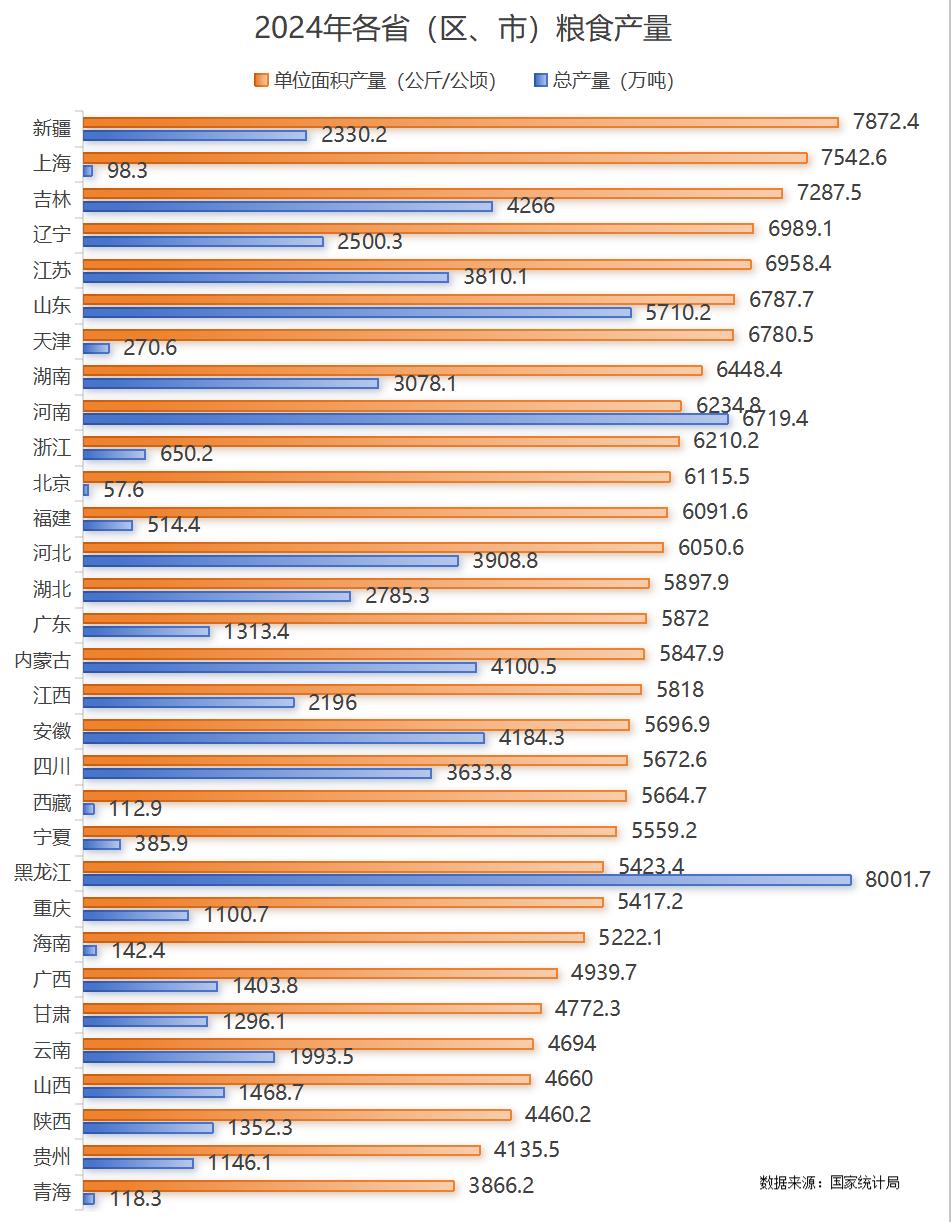
Core Viewpoint - Xinjiang has emerged as a leading grain-producing region in China, achieving the highest grain yield per unit area in 2024, surpassing Shanghai, with a yield of 524.8 kg per mu, which is 33% higher than the national average [6][7][10]. Group 1: Grain Production Achievements - Xinjiang's total grain production exceeded 21.19 million tons in 2023 and reached 23.30 million tons in 2024, marking an increase of 2.11 million tons from the previous year, equivalent to an additional 3 kg of grain per person nationwide [10][11]. - The province has set records for high yields in major crops, with wheat and corn achieving significant milestones in large-scale production [9][10]. - Xinjiang's grain production has increased by 746.8 million tons from 2020 to 2024, accounting for 20.2% of the national increase, the highest in the country [11]. Group 2: Technological Advancements in Agriculture - Modern agricultural practices, including high-standard farmland construction, have transformed Xinjiang's agricultural landscape, with 59.89 million mu of high-standard farmland established, representing 72.8% of the permanent basic farmland [19][21]. - The use of technology, such as satellite navigation for automated planting and smart irrigation systems, has significantly improved efficiency and productivity in farming [30][31]. - The introduction of precision agriculture techniques has led to substantial increases in crop yields, with wheat yields rising from 300 kg to 700 kg per mu in some areas [26][27]. Group 3: Strategic Adjustments in Crop Planting - Xinjiang's agricultural strategy focuses on increasing planting area and yield while optimizing crop structure, with grain planting area reaching 44.4 million mu in 2024, an increase of 2.03 million mu from the previous year [38]. - The province has reduced the planting area for economically beneficial crops like cotton and fruit trees to prioritize grain production, reflecting a commitment to national food security [39][40]. - The adjustments in planting strategies have been guided by the principle of "two increases and one adjustment," emphasizing the importance of food production in the context of global food security challenges [38][40].

藏粮于技增收益
Jing Ji Ri Bao· 2025-11-03 22:37
Core Insights - The article highlights the importance of sweet potatoes in ensuring food security and economic prosperity in Pinggu District, Beijing, emphasizing their transition from a staple food to a profitable and healthy crop [1][2]. Group 1: Agricultural Innovation and Technology - The Pinggu District has made significant advancements in sweet potato seedling technology, producing 112,000 virus-free seedlings and 110,000 pounds of virus-free seed potatoes in 2024, marking a shift towards upstream seed source research [1]. - The district has established a comprehensive industrial chain for sweet potatoes, integrating variety selection, seedling cultivation, and deep processing to enhance product value [1][2]. - Pinggu is focusing on high-standard farmland construction, with 47,900 acres planned from 2021 to 2024, of which 21,200 acres have been completed and 26,700 acres are under construction [2][3]. Group 2: Crop Yield and Food Security - The introduction of high-yield soybean varieties, such as "Zhonghuang 203," has led to record soybean yields of 545 pounds per acre, contributing to food security efforts in the region [2]. - From 2021 to 2024, Pinggu District has achieved a continuous increase in grain harvest area and total output, expanding from 88,700 acres to 138,500 acres and increasing production from 42,500 tons to 57,100 tons [3]. Group 3: Future Development Plans - Pinggu District aims to strengthen its seed industry by addressing key challenges and fostering innovation in crop varieties, while also enhancing farmland quality to secure planting areas for major crops like wheat and corn [4]. - The district plans to promote the integrated development of the entire agricultural industry chain, including seedling production, cultivation, and processing, to ensure stable and abundant grain production [4].
联合国:苏丹超2100万人处于严重粮食不安全状态
Yang Shi Xin Wen· 2025-11-03 20:24
Core Insights - The United Nations report highlights a severe food crisis in Sudan, with over 21 million people facing serious food insecurity, representing approximately 45% of the total population [1] - The report indicates that 375,000 individuals are in the most critical "catastrophe" phase of food security [1] - While some eastern regions of Sudan show signs of improvement, the situation in western areas, particularly Darfur and Kordofan, is worsening due to escalating conflicts [1] Summary by Sections - **Food Insecurity Statistics** - 21.2 million people in Sudan are experiencing severe food insecurity [1] - 375,000 people are classified in the "catastrophe" phase of food security [1] - **Conflict Impact** - Armed conflict between the Sudanese Armed Forces and Rapid Support Forces began on April 15, 2023, in Khartoum and has spread to other regions [1] - The ongoing conflict has resulted in nearly 30,000 deaths and displaced over 12 million people [1] - **Regional Conditions** - Some eastern regions are stabilizing and showing improvement [1] - The western regions, particularly Darfur and Kordofan, are experiencing intensified conflict, exacerbating the food crisis [1]
守护农业“中国芯” 千亿种业安全受关注
Jing Ji Guan Cha Wang· 2025-11-03 06:43
Core Viewpoint - The article emphasizes the critical importance of seed security in China's agricultural sector, highlighting the threats posed by foreign espionage in the collection of genetic data and parent seeds, which jeopardizes national food security and agricultural competitiveness [1][4]. Group 1: Espionage Threats - Foreign intelligence agencies are actively infiltrating China's grain sector to illegally collect genetic data and parent seeds of crops like rice, soybeans, and corn, posing a significant risk to the core competitiveness of China's seed industry and food security [1][4]. - A specific case involved a former general manager of an agricultural technology company who illegally sold five types of parent rice seeds disguised as ordinary seeds to foreign espionage agencies, potentially allowing foreign entities to gain access to China's hybrid rice technology [2][4]. - The illegal collection of parent seeds can lead to the development of competitive crop varieties by foreign powers, which could undermine China's seed market and agricultural development [2][4]. Group 2: Legal and Regulatory Measures - The Chinese government is urged to strengthen laws and regulations, enhance technological defenses, and promote independent innovation to safeguard the seed industry and food security [1][7]. - The revised Seed Law elevates the protection of genetic resources to a national security level, and a hotline has been established to report suspicious seed procurement activities [5][7]. - Experts recommend improving the legal framework, including the Seed Law and Anti-Espionage Law, to increase penalties for the theft of genetic resources and to establish a robust intellectual property protection system for the seed industry [7]. Group 3: Agricultural Development and Innovation - China's seed industry is experiencing rapid growth, with the total output value surpassing 150 billion RMB in 2022, reflecting a year-on-year increase of over 10% [6]. - Leading companies in the sector, such as Longping High-Tech, Beidahuang Group, and Syngenta China, are capturing significant market shares in rice, wheat, and corn [6]. - The government is implementing a comprehensive action plan to promote independent innovation in the seed industry, aiming for self-sufficiency and control over seed sources by 2025 [6].
警惕!田里有间谍
Zhong Guo Ji Jin Bao· 2025-11-03 04:07
Core Viewpoint - The National Security Department reveals that foreign spies are collecting crop gene data in China, posing a serious threat to food security and rural revitalization efforts [1] Group 1: National Security and Agriculture - Seeds are described as the "chips" of agriculture, indicating their critical importance to the agricultural sector [1] - The infiltration of foreign intelligence agencies into China's grain sector has intensified in recent years, highlighting a growing concern for national security [1] - Illegal acquisition of gene data from major crops such as soybeans, corn, and rice is noted as a significant risk to China's food security [1]
警惕!田里有间谍
中国基金报· 2025-11-03 03:44
Core Viewpoint - The article emphasizes the increasing infiltration of foreign espionage agencies into China's agricultural sector, particularly in the collection of crop gene data, which poses a significant threat to food security and rural revitalization efforts [1][3][6]. Group 1: Espionage Activities - Foreign espionage agencies have intensified their efforts to illegally obtain gene data of key crops such as soybeans, corn, and rice, which severely endangers China's food security [1][6]. - A specific incident involved a foreign consulate team conducting unauthorized investigations in a major agricultural area under the guise of "field surveys," demonstrating a high level of counter-surveillance awareness among the team members [3][6]. Group 2: National Security Measures - The National Security Agency is committed to preventing and combating espionage activities targeting China's food security, working alongside relevant departments to protect core research data and genetic resources [6]. - Citizens are encouraged to report any suspicious activities that may threaten food security through designated channels, contributing to the safeguarding of national security [6].

粮食产区“谍影重重” 斩断田间窃密黑手
Zhong Guo Xin Wen Wang· 2025-11-03 01:40
Core Insights - The article emphasizes the critical importance of seed security in agriculture, linking it to national food security and rural revitalization efforts [1] - It highlights the increasing infiltration by foreign espionage agencies into China's agricultural sector, particularly targeting genetic data of key crops like soybeans, corn, and rice [1] Group 1: Espionage Activities - Foreign intelligence agencies are actively attempting to illegally collect core agricultural data and genetic resources from China, posing a significant threat to food security [2] - A specific case involved an individual, Zhu, who was lured by high financial rewards to illegally sell parent seeds to foreign agents, resulting in a prison sentence of 1 year and 6 months for Zhu and various administrative penalties for 17 other involved parties [2] Group 2: Surveillance and Investigation - Reports indicate that foreign agents have been conducting covert investigations in key agricultural regions of China under the guise of "surveys," demonstrating a high level of caution and counter-surveillance tactics [3] - The investigation teams frequently changed transportation methods and used rural routes to avoid detection while gathering information on crop yields and reserves [3] Group 3: National Security Measures - The national security agencies stress the importance of safeguarding food security as a vital component of national stability and social order, committing to combat espionage activities targeting agricultural resources [4] - Citizens are encouraged to report any suspicious activities that may threaten food security through designated channels, reinforcing community involvement in national security efforts [4]
公安机关全链条守护粮食安全
Liao Ning Ri Bao· 2025-11-03 01:09
Core Insights - The article highlights a significant crackdown on the production and sale of counterfeit seeds, with a case valued over 1 million yuan recognized as one of the nine typical cases threatening food security nationwide [1] - The provincial police have adopted a "zero tolerance" approach to combat crimes related to agricultural resources, focusing on protecting black soil, which is crucial for agriculture [1][2] Group 1: Law Enforcement Actions - Four suspects were arrested and three criminal dens were dismantled, effectively deterring the activities of those involved in the production and sale of counterfeit agricultural products [1] - The police have established a comprehensive monitoring and early warning platform utilizing technology, which has led to over 120 precise alerts this year, improving response speed by 60% [1] Group 2: Collaborative Efforts - The police have collaborated with various administrative departments and engaged grassroots personnel to gather intelligence on counterfeit agricultural products, addressing farmers' concerns [2] - Special campaigns such as "Grain Security Defense Battle" and "Clean Soil for Grain" have been organized to dismantle multiple criminal gangs and improve the agricultural resource market environment [2] Group 3: Public Awareness and Education - During the recent National Grain Security Awareness Week, the police actively educated farmers on identifying counterfeit agricultural products, aiming to create a comprehensive protective network for food security [2]
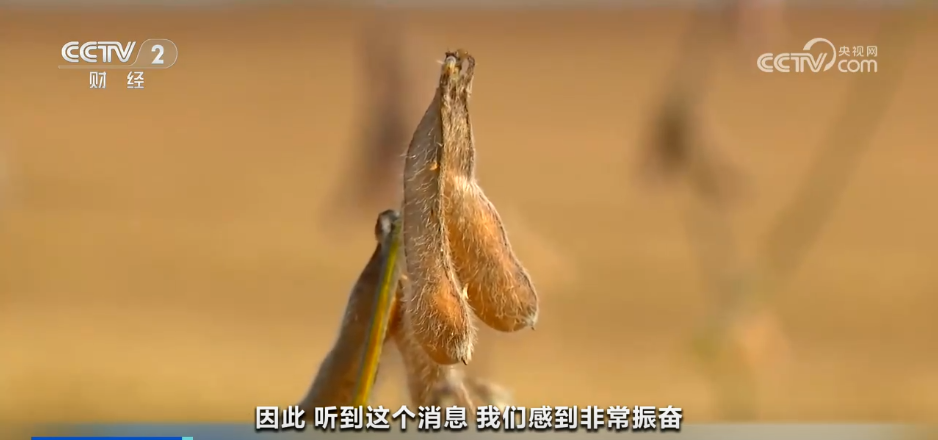
中美就扩大农产品贸易达成共识 美国豆农如释重负
Yang Shi Wang· 2025-11-02 09:55
Core Viewpoint - The recent China-U.S. trade talks in Kuala Lumpur have led to a consensus on expanding agricultural product trade, which has relieved American soybean farmers who are hopeful for renewed purchases from Chinese companies [1][3]. Group 1: Trade Agreements - Specific measures for the expansion of agricultural trade between China and the U.S. have not yet been disclosed by the Chinese side [3]. - It remains unclear whether the agricultural trade will require renegotiation or if China will resume large-scale imports of other U.S. agricultural products [3]. Group 2: Impact on U.S. Farmers - Leaders from the American Soybean Association and the American Soybean Export Council noted that while the trade agreement has not been signed and important details are still undisclosed, the news is still positive for farmers [5]. - In 2024, the total value of U.S. soybean exports is projected to be approximately $24.5 billion, with orders from China exceeding $12.5 billion [7].