全国统一大市场建设

Search documents
国家发改委:研究制定全国统一大市场建设条例
Zheng Quan Shi Bao Wang· 2025-12-13 11:18
人民财讯12月13日电,据国家发改委消息,12月12至13日,全国发展和改革工作会议在北京召开。国家 发展改革委党组书记、主任郑栅洁作工作报告,委党组成员出席会议。会议强调,进一步全面深化改 革。研究制定全国统一大市场建设条例,协同推进"准入、场景、要素"一体化改革。持续抓好招商引 资、招标投标等方面重点问题整治,坚决破除各类壁垒障碍。更大力度发展民营经济,大力推动民营经 济促进法配套制度建设。 ...
财政部:保持必要的财政赤字、债务总规模和支出总量,提高政策精准性和有效性
智通财经网· 2025-12-13 07:15
智通财经APP获悉,据财政部消息,12月12日,财政部党组书记、部长蓝佛安主持召开党组会议,传达 学习中央经济工作会议精神,研究财政部门贯彻落实工作。会议指出,按照中央经济工作会议部署安 排,明年政策取向上,要坚持稳中求进、提质增效,发挥存量政策和增量政策集成效应,加大逆周期和 跨周期调节力度,提升宏观经济治理效能。财政部门要准确把握明年经济工作的总体要求和政策取向, 保持必要的财政赤字、债务总规模和支出总量,提高政策精准性和有效性。用好用足各类政府债券资 金,发行超长期特别国债,持续支持"两重"建设、"两新"工作。 原文如下: 财政部党组召开会议传达学习中央经济工作会议精神 12月12日,财政部党组书记、部长蓝佛安主持召开党组会议,传达学习中央经济工作会议精神,研究财 政部门贯彻落实工作。 会议认为,这次的中央经济工作会议,是党的二十届四中全会之后中央召开的一次重要会议。习近平总 书记在会议上发表的重要讲话,全面总结2025年经济工作,深刻分析当前国内外形势,系统部署2026年 工作,具有很强的战略性、思想性、指导性,既举旗定向、指明"十五五"开局路径,又谋篇布局、擘画 明年抓落实重点,为做好财政工作指明了 ...
韩文秀:下更大的气力推进解决拖欠企业账款问题
Bei Jing Shang Bao· 2025-12-13 04:51
Core Viewpoint - The Chinese government aims to deepen the construction of a unified national market and address the issue of overdue payments to enterprises, as stated by Han Wenxiu, Deputy Director of the Central Financial Office, during the 2025-2026 China Economic Annual Conference [1] Group 1: Market Regulation and Competition - The government plans to continue standardizing enterprise-related law enforcement and address issues of excessive competition [1] - There will be a comprehensive application of regulatory measures such as standard guidance and price enforcement to establish a market order characterized by quality and fair pricing [1] Group 2: State-Owned and Private Sector Reforms - A further deepening of the state-owned enterprise reform plan will be developed and implemented [1] - The government will enhance supporting regulations for the promotion of the private economy [1] - There is a strong commitment to resolving overdue payments to enterprises and preventing future occurrences of such issues [1]
事关明年居民收入增长、“两新”政策实施,韩文秀最新发声
2 1 Shi Ji Jing Ji Bao Dao· 2025-12-13 04:34
Group 1 - The core message emphasizes the need to address overdue corporate payments and prevent future occurrences, while promoting a unified national market and fair competition [1] - The government aims to optimize the implementation of the "two new" policies, granting local authorities more autonomy [1][2] - The focus is on enhancing consumer spending through initiatives like the "old-for-new" policy and increasing the supply of quality goods and services [2] Group 2 - The government plans to synchronize income growth with economic growth, maintaining stability in employment and prices [3] - There is a commitment to expand both exports and imports, fostering sustainable foreign trade development [4] - A proactive fiscal policy will be maintained, ensuring necessary fiscal deficits and debt levels while supporting domestic demand [5] Group 3 - The government has made progress in risk mitigation in key areas, including the orderly replacement of local government hidden debts and the completion of housing delivery tasks [7] - China's GDP is projected to reach approximately 140 trillion yuan this year, with major economic indicators performing better than expected [7][8] - The government emphasizes the importance of innovation and technology in driving industrial upgrades and creating new growth points [2][8] Group 4 - The government outlines five essential principles for economic work under new circumstances, focusing on maximizing economic potential, combining policy support with reform, and ensuring effective management [6][8] - There is a strong emphasis on investing in both physical and human capital to enhance overall development and well-being [8] - The government aims to strengthen its own economy to better respond to external challenges and enhance its competitive position globally [8]
中国经济年会:推进解决拖欠企业账款问题 坚决防止前清后欠
Yang Shi Xin Wen· 2025-12-13 03:48
Core Viewpoint - The Chinese government aims to deepen the construction of a unified national market and address the issue of overdue payments to enterprises [1] Group 1: Market Regulation - The government will continue to standardize law enforcement related to enterprises and address issues of excessive competition [1] - Regulatory measures will include the use of standards and price enforcement to create a market order characterized by quality and fair competition [1] Group 2: State-Owned Enterprises and Private Sector - There will be a formulation and implementation of further reforms for state-owned enterprises [1] - The government plans to improve supporting regulations for the promotion of the private economy [1] Group 3: Payment Issues - A significant focus will be placed on resolving overdue payments to enterprises, with a commitment to prevent future occurrences of such issues [1]
中央经济工作会议,这些提法意涵深刻
Xin Hua Wang· 2025-12-12 19:29
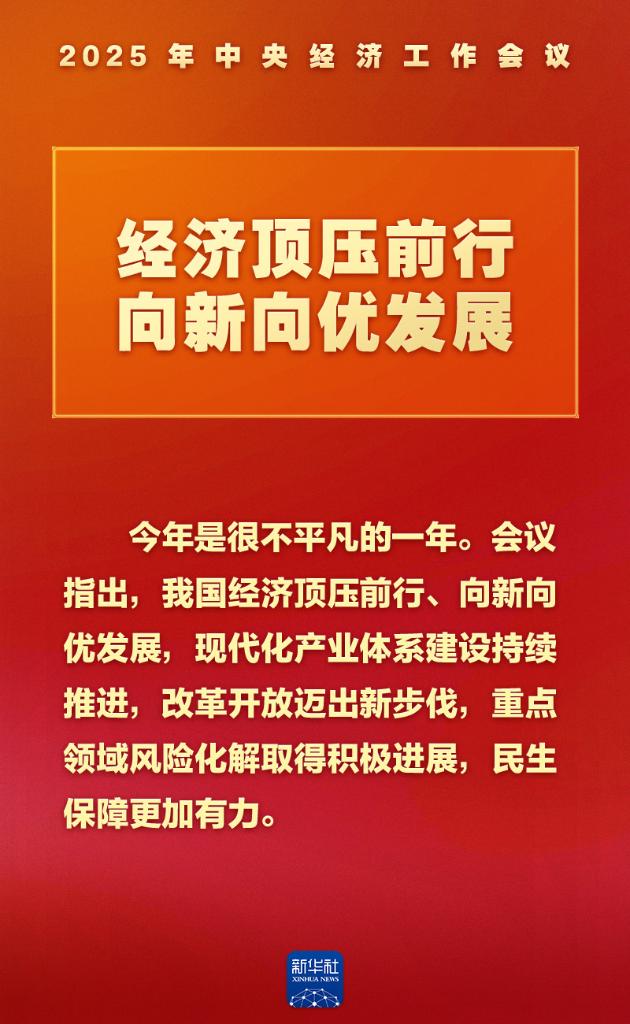
中央经济工作会议12月10日至11日在北京举行。会议总结2025年经济工作,分析当前经济形势,部 署2026年经济工作。 会议这些提法意涵深刻。 2025 年 中 央 经 济 工 作 会 议 经济顶压前行 向新向优发展 今年是很不平凡的一年。会议 指出,我国经济顶压前行、向新向 优发展,现代化产业体系建设持续 推进,改革开放迈出新步伐,重点 领域风险化解取得积极进展,民生 保障更加有力。 部非社 ASS 2025 年 中 央 经 济 工 作 会 议 "五个必须" 会议认为,通过实践,我们对做 好新形势下经济工作又有了新的认识 和体会: 必须充分挖掘经济潜能 必须坚持政策支持和改革创新并举 必须做到既"放得活"又"管得好" 必须坚持投资于物和投资于人紧密结合 必须以苦练内功来应对外部挑战 凯华时 ASS 2025 年 中 央 经 济 工 作 会 议 些持稳中求进 墙质增效 会议指出, 明年经济工作 在政策取向上,要坚持稳中求 进、提质增效,发挥存量政策 和增量政策集成效应,加大逆 周期和跨周期调节力度,提升 宏观经济治理效能。 部非社 AS 2025 年 中 央 经 济 工 作 会 议 SE IF E W 积极 ...

人民日报评论员:用好优势,不断巩固拓展经济稳中向好势头
Xin Hua She· 2025-12-12 15:00
Core Viewpoint - The article emphasizes the importance of leveraging advantages to continuously consolidate and expand the stable and positive momentum of China's economy, as highlighted in the Central Economic Work Conference [2]. Economic Performance - China's economy is projected to reach approximately 140 trillion yuan, with international organizations raising their growth forecasts for 2025 [2]. - The contribution rate of China's economy to global growth has remained stable at around 30% over the past five years, despite external challenges [3]. Industrial Strength - China has established the world's largest and most comprehensive industrial system, which is crucial for sustainable development [4]. - The manufacturing value added is expected to account for nearly 30% of the global total by 2024, maintaining the largest scale in the world for 15 consecutive years [4]. Market Potential - The retail sales of consumer goods are projected to increase from 39.1 trillion yuan in 2020 to 48.3 trillion yuan in 2024, with an average annual growth rate of 5.5% [5]. - China's domestic market, supported by over 1.4 billion people and the largest middle-income group globally, is rapidly becoming the largest consumer market [5]. Strategic Focus - The focus for the upcoming year includes utilizing the advantages of the socialist system, large-scale market, complete industrial system, and rich talent resources to ensure high-quality economic development [3][6]. - The strategy emphasizes expanding domestic demand and enhancing the adaptability of supply and demand in the consumer market [5].
中央经济工作会议,这些部署值得关注
Xin Hua Wang· 2025-12-12 14:54
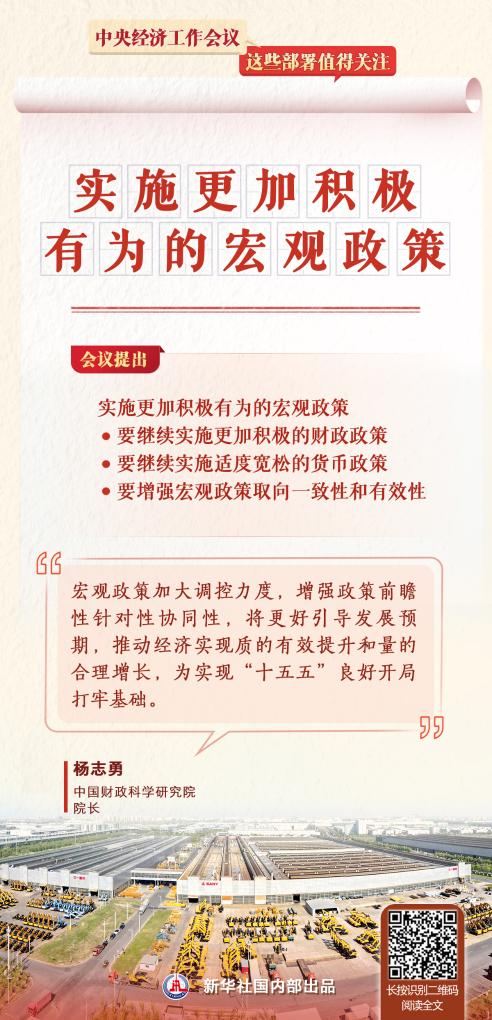
Group 1 - The Central Economic Work Conference was held from December 10 to 11, 2025, to summarize economic work and analyze the current economic situation, while deploying plans for 2026 [1] - The conference emphasized the implementation of more proactive macro policies, including a continuation of active fiscal policies and moderately loose monetary policies, to enhance the consistency and effectiveness of macro policies [2] - The conference highlighted the need to clear unreasonable restrictions in the consumption sector to unleash service consumption potential, which is crucial for accelerating the construction of a new development pattern and achieving high-quality development [4] Group 2 - The conference proposed measures to stabilize investment and effectively stimulate private investment by expanding access, addressing bottlenecks, and strengthening guarantees to create a stable and predictable environment for private enterprises [5] - A nationwide unified market construction regulation will be formulated to address "involution" competition, ensuring that the construction of a unified national market is legally grounded and promoting more mature and defined systems [6] - The conference called for deepening reforms in the foreign investment promotion system to steadily expand institutional openness, leveraging China's large market to attract global resources and enhance economic innovation and competitiveness [7] Group 3 - Support for major economic provinces to take the lead in driving economic growth by stabilizing investment, consumption, and exports, ensuring smooth industrial and supply chains, and contributing to national economic growth while reducing regional disparities [8]
说法丨三个身边案例,看司法护航经济发展
Ren Min Wang· 2025-12-12 13:16
Group 1 - The Central Economic Work Conference emphasizes the need to deepen the construction of a unified national market and to formulate regulations to address "involution-style" competition, highlighting the issues of local protectionism and monopolistic practices that harm fair competition [1] - Strengthening antitrust trials and breaking local protectionism are crucial for facilitating economic circulation and supporting the construction of a unified national market [1] Group 2 - The conference proposes promoting win-win development for platform enterprises, operators, and workers, encouraging flexible employment personnel to participate in employee insurance [2] - The rise of new employment forms such as ride-hailing and food delivery presents unique challenges in the relationship between platform companies and workers, necessitating judicial wisdom to address these issues [2] Group 3 - The conference stresses the importance of prioritizing people's livelihoods and ensuring safety in production, disaster prevention, and food and drug safety [3] - Recent public concerns regarding food safety and fraud highlight the need for increased enforcement against illegal activities in the food sector [4] Group 4 - A case in Shanghai revealed a vendor selling duck meat disguised as beef, raising questions about the penalties for such fraudulent practices and the role of judicial authorities in addressing food safety violations [5]
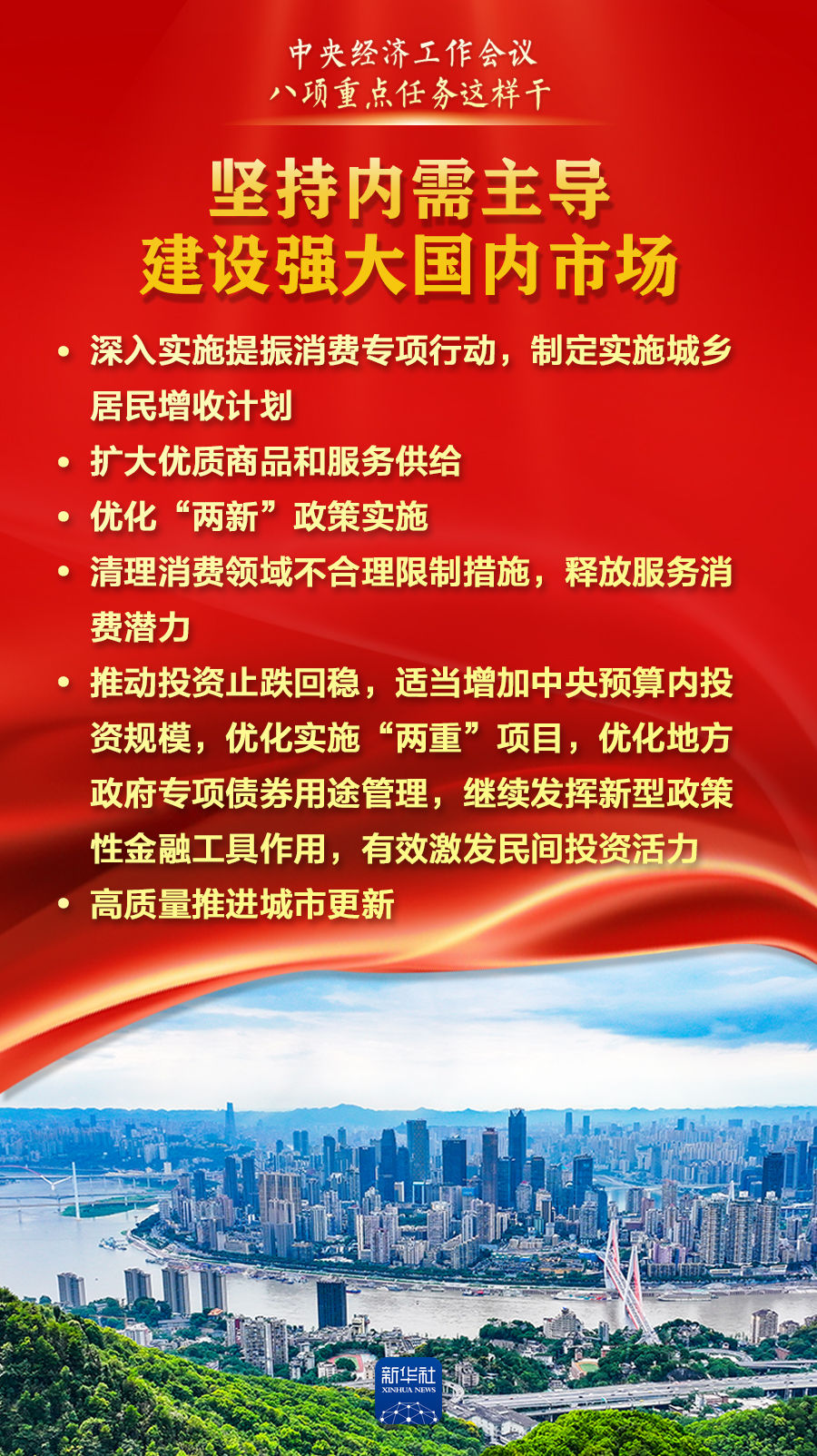
中央经济工作会议丨八项重点任务这样干!
Xin Hua She· 2025-12-12 13:07
Core Viewpoint - The Central Economic Work Conference held on December 10-11 in Beijing outlined eight key tasks for economic work in the coming year, focusing on fostering new growth drivers, enhancing high-quality development, and promoting coordinated and sustainable growth. Group 1: New Growth Drivers - Accelerate the cultivation and expansion of new driving forces for economic growth, including the development of a comprehensive plan for education, technology, and talent [4] - Establish international technology innovation centers in Beijing (Jing-Jin-Ji), Shanghai (Yangtze River Delta), and the Guangdong-Hong Kong-Macao Greater Bay Area [4] - Strengthen the role of enterprises in innovation and improve the intellectual property protection system in emerging fields [4] Group 2: Reform and High-Quality Development - Formulate a national unified market construction regulation and address "involution" competition [7] - Implement further reforms for state-owned enterprises and improve supporting regulations for the private economy [7] - Expedite the clearance of overdue payments owed to enterprises [7] Group 3: Open Cooperation - Promote multi-field cooperation and win-win outcomes, including expanding pilot reforms for market-oriented factors [10] - Gradually advance institutional openness and expand the scope of autonomous service sector openings [12] - Encourage the development of digital and green trade, and deepen reforms in foreign investment promotion mechanisms [12] Group 4: Coordinated Development - Promote urban-rural integration and regional collaboration, focusing on urbanization centered around county towns and comprehensive rural revitalization [14] - Ensure food production and maintain reasonable prices for essential agricultural products [14] - Strengthen coordination among key urban agglomerations and enhance cross-administrative cooperation [14] Group 5: Green Transformation - Advance energy-saving and carbon reduction transformations in key industries [16] - Develop a national energy strategy and accelerate the construction of a new energy system [16] - Implement comprehensive solid waste management actions and enhance environmental protection efforts [16] Group 6: People-Centric Approach - Implement actions to stabilize and expand employment for key groups, including college graduates and migrant workers [18] - Adjust the layout of educational resources to increase the supply of high school and quality college admissions [18] - Optimize centralized drug procurement and deepen reforms in medical insurance payment methods [18] Group 7: Risk Management - Focus on stabilizing the real estate market with city-specific policies to control growth and reduce excess [20] - Promote long-term care insurance systems and enhance support for vulnerable groups [20] - Ensure safety in production, disaster prevention, and food and drug safety [20]