碳中和

Search documents
中国积极发展核电,服装企业雅戈尔也入局了
Di Yi Cai Jing· 2026-01-22 05:13
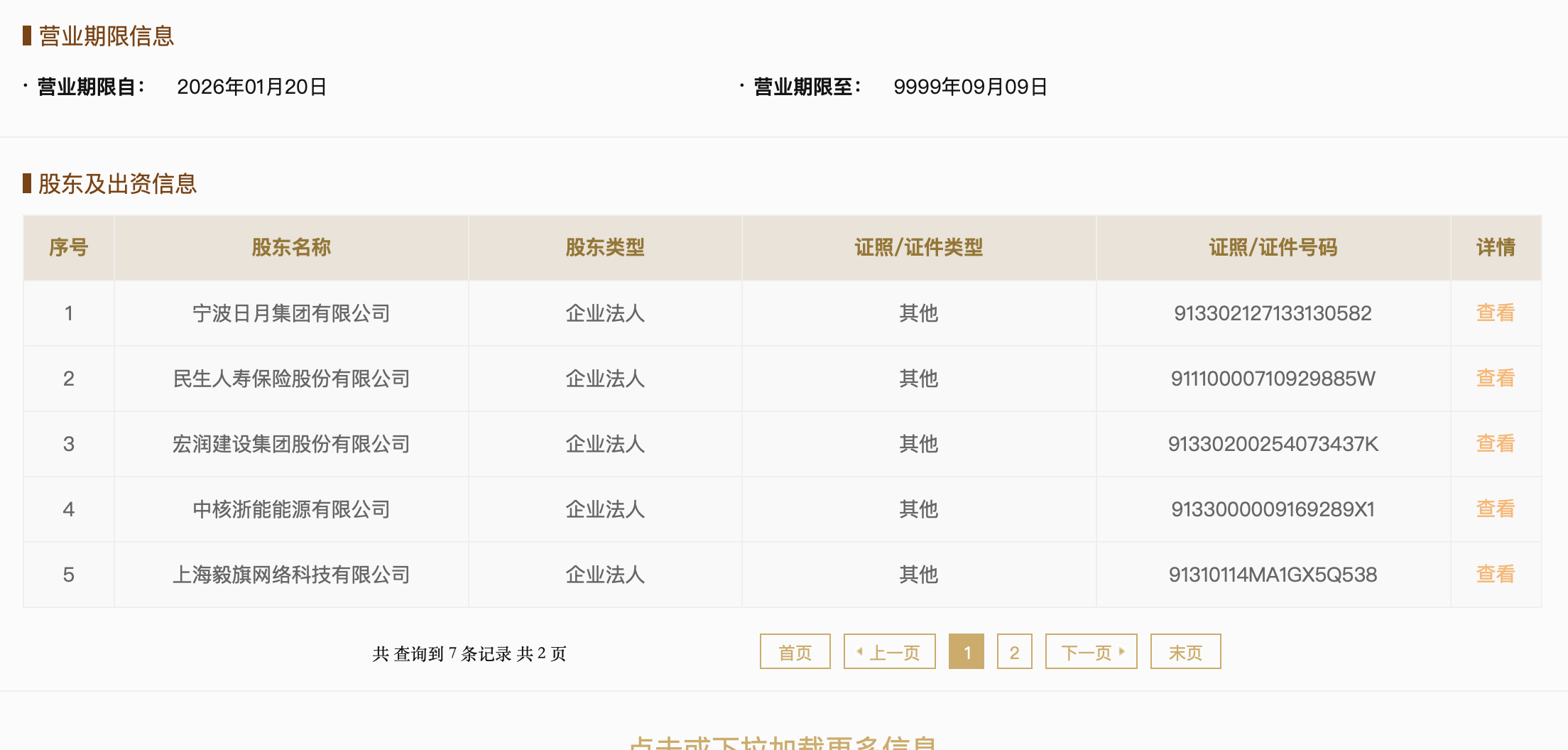
Core Viewpoint - The domestic nuclear power sector is experiencing steady growth, with favorable policies encouraging private enterprises like Youngor Group to enter the industry [1][4]. Company Summary - Youngor Group has officially registered as a shareholder in China Nuclear (Xiangshan) Nuclear Energy Co., Ltd., with a capital contribution of 214.25 million yuan, making it the third-largest shareholder [1][3]. - The other major shareholders include state-owned enterprises and private companies, indicating a shift towards increased private sector involvement in nuclear power [1][4]. Industry Summary - The Chinese government has been promoting policies to encourage private capital in the nuclear power sector, which has traditionally been dominated by state-owned enterprises [4]. - The global nuclear power generation is expected to reach a ten-year high in 2024, with projections indicating that the installed capacity will exceed 900 million kilowatts by 2050, effectively doubling current levels [4]. - From 2022 to 2025, China plans to approve 10 nuclear reactor units annually, with a total investment exceeding 800 billion yuan for 41 units, reflecting a robust growth trajectory in the nuclear sector [4].


全球首个双堆耦合核能综合利用项目开工 打造低碳转型“中国方案”
Zhong Guo Zhi Liang Xin Wen Wang· 2026-01-22 03:59
Group 1 - The core achievement in China's nuclear energy sector is the commencement of concrete pouring for the first nuclear power unit at the Jiangsu Xuwei Nuclear Energy Heating Power Plant, marking a significant step towards the integration of nuclear energy with the petrochemical industry [1] - This project is the world's first large-scale coupling of pressurized water reactors and high-temperature gas-cooled reactors, and it represents a shift in China's nuclear energy focus from primarily electricity generation to diversified supply [1][2] - The plant is expected to supply 32.5 million tons of industrial steam annually and generate over 11.5 billion kilowatt-hours of electricity, significantly reducing coal consumption and carbon dioxide emissions [2] Group 2 - The project will provide high-quality low-carbon industrial steam to the Lianyungang petrochemical industry base, supporting the green transition of the Yangtze River Delta region [2] - China Nuclear Group emphasizes the importance of green development and has a strong commitment to clean energy, with 27 operational nuclear power units and 18 under construction or approved, totaling a capacity of 46.859 million kilowatts [3] - The company is actively promoting the comprehensive utilization of nuclear energy in various sectors, including regional heating, industrial steam supply, seawater desalination, and hydrogen production [3]

《分布式能源规划员》(综合能源服务方向)培训通知丨系列培训
中国能源报· 2026-01-22 03:46
Core Viewpoint - The article emphasizes the importance of developing distributed energy and integrated energy services as a crucial path towards carbon neutrality, highlighting the need for interdisciplinary talent in energy planning and management [1] Group 1: Training Overview - The training titled "Distributed Energy Planner (Integrated Energy Services Direction)" is organized to address the shortage of professionals skilled in energy planning, conversion, and intelligent control [1] - The training will be conducted online from February 10 to February 13, 2026 [2] - The training is hosted by the Human Resources and Social Security Ministry's Social Security Capacity Building Center and organized by China Energy News Co., Ltd [2] Group 2: Target Audience - The training targets various stakeholders including provincial and municipal power companies, energy groups, and enterprises in the oil and gas sector [2] - It also includes new energy companies (wind, solar, storage), energy service companies, equipment manufacturers, and research institutions [2] - Individuals interested in the fields of new energy, distributed energy, and integrated energy services are encouraged to participate [2] Group 3: Course Outline - The course covers an overview of integrated energy services, including its driving forces and current development status both domestically and internationally [3] - It includes modules on planning comprehensive energy solutions, distributed photovoltaic projects, natural gas distributed energy applications, and smart microgrids [4] - Additional topics include hydrogen energy applications, new energy storage projects, and zero-carbon factory assessments [4] Group 4: Training Costs - The training fee is set at 3600 yuan per person, which includes training materials and certification costs [5] Group 5: Contact Information - For inquiries, contact Yang at 15801248899 or Wang at 15201547047 [6]

福莱特涨2.02%,成交额2.09亿元,主力资金净流入1946.11万元
Xin Lang Cai Jing· 2026-01-22 03:23
Core Viewpoint - The stock of Fuyao Glass has shown a positive trend in recent trading sessions, with a notable increase in share price and market activity, indicating potential investor interest and market confidence in the company’s performance [1]. Group 1: Stock Performance - As of January 22, Fuyao Glass's stock price increased by 2.02%, reaching 16.68 CNY per share, with a trading volume of 209 million CNY and a turnover rate of 0.67%, resulting in a total market capitalization of 39.079 billion CNY [1]. - Year-to-date, the stock has risen by 6.45%, with a 3.28% increase over the last five trading days and a 7.89% increase over the last 20 days, although it has seen a decline of 7.54% over the past 60 days [1]. Group 2: Financial Performance - For the period from January to September 2025, Fuyao Glass reported a revenue of 12.464 billion CNY, reflecting a year-on-year decrease of 14.66%, while the net profit attributable to shareholders was 638 million CNY, down 50.79% year-on-year [2]. - The company has distributed a total of 2.833 billion CNY in dividends since its A-share listing, with 1.750 billion CNY distributed over the past three years [3]. Group 3: Shareholder Information - As of September 30, 2025, Fuyao Glass had 68,300 shareholders, a decrease of 3.88% from the previous period, with an average of 0 shares per shareholder, indicating no change [2]. - Among the top ten circulating shareholders, Hong Kong Central Clearing Limited holds 33.427 million shares, an increase of 4.554 million shares from the previous period, while GF High-end Manufacturing Stock A is a new entrant with 19.418 million shares [3].

用电量屡创新高 我国电力保供的底气从何而来
Yang Shi Xin Wen Ke Hu Duan· 2026-01-22 02:00
Group 1: Electricity Supply Challenges - In 2026, national electricity load reached a winter peak of 1.417 billion kilowatts, marking the first time it surpassed 1.4 billion kilowatts [1] - Winter electricity supply faces unique challenges compared to summer, including water scarcity affecting hydropower, weather impacts on wind and solar energy, and natural disasters like freezing conditions [1] - Despite a lower winter peak load compared to summer, the pressure for stable electricity supply remains significant [1] Group 2: Regional Supply Strategies - Due to the vast geographical differences and varying energy resources across provinces, tailored electricity supply strategies are necessary, leading to the implementation of "one province, one policy" measures [1] Group 3: Electricity Supply Confidence - The confidence in electricity supply stems from significant advancements in power generation capacity and a robust grid infrastructure, including ultra-high voltage transmission systems [2] - Continuous improvements in local distribution networks and the rapid development of microgrids contribute to the reliability of electricity supply [2] Group 4: Energy Structure Trends - Coal power remains a dominant energy source in the short to medium term, despite a gradual decrease in its proportion, supported by the growth of wind and solar energy [3] - The utilization hours of coal power are projected to decrease from 5,500 hours to around 4,400 hours by 2024, with wind and solar contributing approximately 18% of electricity generation [3] Group 5: Role of Electricity in AI Development - The importance of electricity is underscored in the context of AI development, as sufficient energy supply is crucial for supporting AI technologies [4] - The U.S. faces challenges in electricity manufacturing and grid infrastructure, while other countries leverage their manufacturing advantages and robust energy supply to support AI applications [4]
新闻1+1丨屡创新高的用电量,说明了什么?
国家能源局· 2026-01-22 01:43
Core Viewpoint - The article discusses the challenges and strategies for ensuring stable electricity supply during winter, highlighting the increasing electricity demand and the need for tailored solutions across different provinces in China [2][3][4]. Group 1: Winter Electricity Supply Challenges - In 2026, national electricity load reached a winter peak of 1.417 billion kilowatts, marking the first time it surpassed 1.4 billion kilowatts [2]. - Winter electricity supply faces unique challenges compared to summer, including lower water storage for hydropower, weather impacts on wind and solar energy, and difficulties from natural disasters like freezing conditions [2]. Group 2: Provincial Strategies for Electricity Supply - Due to the vast geographical differences and varying energy resources across provinces, a "one province, one policy" approach is necessary for effective electricity supply management [3]. Group 3: Confidence in Electricity Supply - China's electricity supply confidence stems from significant advancements in installed capacity and power generation capabilities, as well as a robust high-voltage transmission network that allows for large-scale resource allocation [4]. Group 4: Energy Structure Changes and Trends - Coal power remains a dominant energy source in the short to medium term, despite a gradual decrease in its share, with projections indicating that coal's contribution will shrink as wind and solar energy capacity increases [5]. Group 5: Future Role of Electricity in AI Competition - The importance of electricity in supporting AI development is emphasized, with a comparison to the U.S. energy landscape, highlighting that while the U.S. has advantages in computing, it lacks a robust electricity infrastructure to support AI advancements [7].
用电量屡创新高 我国电力保供的底气从何而来?
Yang Shi Wang· 2026-01-22 00:50
● 我国电力保供的底气从何而来 蒋德斌:首先,过去这些年电力的发展可以说是跨越式的发展,装机规模、供电能力非常大。其次,我 们的电网有特高压输电,可以大范围、大规模地在全国范围内调配资源,同时500千伏的主网也非常坚 强。各个地方的配网也在得到不断地完善,同时微电网这些年也在飞速发展,所以我们在保供这方面应 该没问题。另外,我们在全国范围内统一调度运行控制电网的水平也非常高,所以是有底气的。 2026年全国用电负荷连续3次创下冬季新高,冬季负荷首次突破14亿千瓦,最高达14.17亿千瓦。面对大 范围寒潮天气,保供保暖如何实现平稳有序?2025年全社会用电量首次突破10万亿千瓦时。电从哪里 来,又用到了哪里去?折射出我国经济社会发展怎样的活力? ● 冬季电力保供有什么难点 中国电力企业联合会统计与数智部副主任 蒋德斌:现在全国用电负荷的特点是双高峰,夏季高峰一般 在7月或8月,冬季高峰一般在12月或1月。冬季和夏季相比,夏峰总体上高于冬峰,夏季高峰去年是 15.08亿千瓦,今年冬峰只有14.17亿千瓦。 冬季保供电跟夏季相比有几个特点。第一,冬季属于枯水期,所以水电储能会受到一定的影响;第二, 气候对风和光的储 ...
中经评论:10万亿千瓦时的信心与动力
Jing Ji Ri Bao· 2026-01-22 00:10
Group 1 - The core point of the article highlights that in 2025, China's total electricity consumption will exceed 10 trillion kilowatt-hours for the first time, reaching 10.4 trillion kilowatt-hours, marking a 5% year-on-year increase, and solidifying China's position as the world's largest electricity consumer [1][2][3] - This electricity consumption level is approximately double that of China's total consumption in 2015 and more than double that of the United States, surpassing the combined annual consumption of the EU, Russia, India, and Japan [1][2] - The growth in electricity demand reflects the robust vitality and quality of China's economy, driven by industrial activities and residential needs, with a significant contribution from high-end manufacturing and emerging technologies [2][3] Group 2 - The increase in electricity consumption is achieved alongside a continuous decline in energy consumption per unit of GDP, indicating more efficient production and higher quality development outcomes [2] - The optimization of industrial structure is evident, with high-end manufacturing sectors such as new energy vehicles and wind power equipment experiencing growth rates exceeding 20% and 30%, respectively [2] - The rapid development of the digital economy and new technologies has led to a surge in electricity demand, particularly in sectors like internet services and charging infrastructure, with year-on-year growth rates exceeding 30% and nearly 50% respectively [2][3] Group 3 - The article emphasizes that the growth in electricity demand does not exacerbate reliance on fossil fuels, as non-fossil energy sources account for over 60% of installed capacity, with wind and solar power leading globally [3] - The trend of decoupling electricity consumption growth from carbon emissions is becoming apparent, with one-third of electricity consumption being green energy [3] - The construction of a new power system is addressing challenges related to the integration of renewable energy sources, supporting China's commitment to carbon neutrality [3] Group 4 - The substantial electricity demand poses challenges for the planning, construction, scheduling, and supply capabilities of the power system, necessitating a robust national energy production and transmission network [4] - Despite the progress, disparities in per capita electricity consumption and regional differences remain, indicating ongoing challenges in achieving balanced development [4] - The article stresses the importance of technological empowerment in addressing these challenges, including advancements in clean energy technologies, energy storage, and smart grid innovations [4]
中金 • 部院联合 | “反内卷”的绿色含义
中金点睛· 2026-01-21 23:36
Core Viewpoint - The article discusses the interplay between "anti-involution" and green transformation in China, emphasizing that while "anti-involution" may temporarily lower clean energy prices, it could ultimately hinder long-term innovation and cost reduction in clean energy sectors [2][5]. Group 1: Impact of Involution on Green Transformation - "Involution" in competition negatively affects green transformation by leading to low-quality, low-profit environments that reduce R&D investments, ultimately delaying the cost reduction of clean energy [2][20]. - The annual average growth rate of carbon emissions increased from 1.3% during the 13th Five-Year Plan to 3% during the first four years of the 14th Five-Year Plan, indicating challenges in achieving carbon peak goals [7]. - The competition intensity in industries such as photovoltaics and cement is high, leading to declining revenue and profit growth, which further exacerbates the issue of overcapacity [9][20]. Group 2: Quantitative Analysis of Anti-Involution - Under ideal conditions, "anti-involution" could reduce the green premium by 8-11 percentage points, with coal prices expected to rise by approximately 23%, increasing coal power costs by about 16% [3][28][31]. - The estimated carbon reduction from "anti-involution" could reach approximately 100 million tons by 2025, accounting for about 0.85% of total carbon emissions, through improved energy efficiency and reduced production in high-carbon industries [4][48]. - The article highlights that the reduction in fixed asset investment could lead to a maximum carbon reduction of 5.5 million tons, emphasizing the importance of controlling inefficient investments [45][48]. Group 3: Policy Recommendations for Synergy - To better leverage the synergy between "anti-involution" and green transformation, policies should focus on enhancing green standards, eliminating outdated capacities, and promoting green consumption [5][49]. - The article suggests that effective implementation of energy efficiency standards and technological innovation is crucial for achieving the desired outcomes of "anti-involution" [37][49]. - The framework of "policy strength-execution challenge" is proposed to assess the effectiveness of "anti-involution" measures across different industries, indicating that stronger policies with fewer execution challenges yield better results [49].

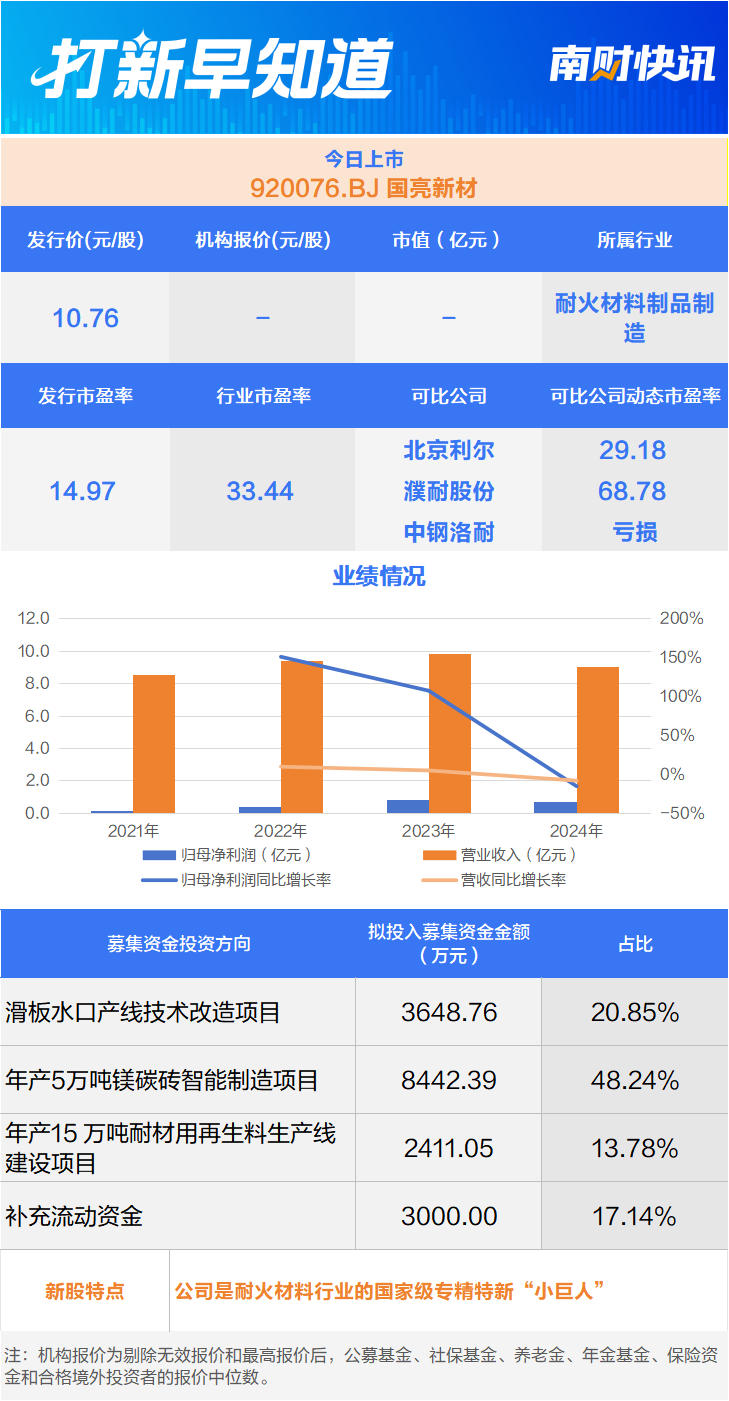
国家级“小巨人”,耐火材料行业龙头今日上市丨打新早知道
2 1 Shi Ji Jing Ji Bao Dao· 2026-01-21 23:05
Core Viewpoint - Guoliang New Materials (920076.BJ) has successfully listed on the Beijing Stock Exchange, specializing in high-temperature industrial refractory materials and providing comprehensive solutions in this sector [1] Group 1: Company Overview - Established in 2002, Guoliang New Materials is located in Tangshan, Hebei Province, a key steel production base in China [1] - The company has deep expertise in the refractory materials industry, holding 5 provincial scientific and technological achievement certificates, 33 invention patents, and 52 utility model patents [5] - Guoliang New Materials has been recognized as a national "specialized, refined, distinctive, and innovative" small giant enterprise and was included in the key "small giant" list in August 2025 [5] Group 2: Financial and Project Information - The company has planned several projects, including: - A technological transformation project for the sliding water outlet production line with an investment of 364.88 million, representing a 20.85% increase [4] - An intelligent manufacturing project for 50,000 tons of magnesium-carbon bricks with an investment of 844.24 million, showing a 48.24% increase [4] - A construction project for a production line of 150,000 tons of recycled materials for refractory materials with an investment of 241.11 million, reflecting a 13.78% increase [4] - Supplementary working capital of 300 million, indicating a 17.14% increase [4] - Research and development investments from 2022 to the first half of 2025 are as follows: - 43.50 million in 2022 - 48.86 million in 2023 - 44.83 million in 2024 - 23.99 million in the first half of 2025 [5] Group 3: Market Position and Client Relationships - Guoliang New Materials has established long-term partnerships with several well-known steel companies, including Delong Steel, Donghai Special Steel, and Shougang Group, leveraging its technological and regional advantages [5] - The company is expanding its overseas market presence, targeting regions such as Russia and Vietnam [5]