
元宇宙

Search documents
华尔街见闻早餐FM-Radio|2025年12月5日
Sou Hu Cai Jing· 2025-12-04 23:31
Company and Industry Insights - Meta plans to cut its metaverse budget by up to 30%, indicating a significant reduction in its previous strategic focus on this area [16] - Nvidia's GB200 NVL72 system claims to enhance the performance of open-source AI models by up to 10 times, as the company faces competition from Google and Amazon in the AI chip market [13] - Nvidia's lobbying efforts have successfully led to the U.S. Congress potentially rejecting the AI chip export restriction bill, which would have limited its sales to certain overseas markets [14] - The European Union is set to launch a new plan aimed at breaking down financial service barriers to create a unified capital market, targeting the 33 trillion euro household savings [13] - Japan's central bank is expected to raise interest rates for the first time since January, which has led to a surge in long-term bond yields [11][12] - The AI chip market is projected to see a significant increase in production, with reports suggesting that the output of AI chips may double next year [8] - Micron Technology is exiting the consumer storage business to focus on AI storage chips, which could leave a significant gap in the consumer storage market [24]



美股计算机硬件大涨,闪迪涨近10%,万物新生涨近9%,加密货币超10万人爆仓
2 1 Shi Ji Jing Ji Bao Dao· 2025-12-04 23:25
Group 1: Stock Performance - Meta's stock rose by 3.4%, with a pre-market increase of over 7%, marking the largest intraday gain since July 31 [2] - Nvidia increased by over 2%, while Amazon and Apple both fell by more than 1% [2] - Significant gains were observed in computer hardware and chip stocks, with SanDisk rising nearly 10% and Hut8 up nearly 7% [2] Group 2: Industry Trends - The storage industry is experiencing a historic price surge, with SanDisk significantly raising NAND flash contract prices by approximately 50% in early November [2] - The Nasdaq Golden Dragon China Index saw a nearly 0.4% increase, with notable gains in computer hardware stocks such as Wanwu Xingsheng and Canadian Solar [3] Group 3: Cryptocurrency Market - International precious metal futures closed mixed, with COMEX gold futures up 0.13% and silver down 1.86% [5] - The cryptocurrency market faced a collective downturn, with Bitcoin dropping below $91,000 and a total liquidation amounting to nearly $320 million [5][7] Group 4: Economic Indicators - The U.S. Labor Department reported a decrease of 27,000 in initial jobless claims, reaching a three-year low of 191,000 [7] - The U.S. labor market continues to face structural pressures, with ongoing challenges in re-employment for job seekers [7] Group 5: Federal Reserve Outlook - The White House's National Economic Council Director indicated a potential 25 basis point rate cut by the Federal Reserve in the next meeting, with an 87% probability of this occurring [8]
X @Bloomberg
Bloomberg· 2025-12-04 23:21
今日必读💰美联储或就下周降息25基点达共识🌌Meta拟将元宇宙预算削减至多30%🔥普京拒绝接受和平计划部分内容获取免费中文电子报《彭博财经早茶》,洞悉全球市场动态。Catch up on what's moving China's markets in our free Chinese language newsletter. https://t.co/ZgHBqJ06gM ...
美股计算机硬件大涨,闪迪涨近10%,万物新生涨近9%,加密货币超10万人爆仓
21世纪经济报道· 2025-12-04 23:20
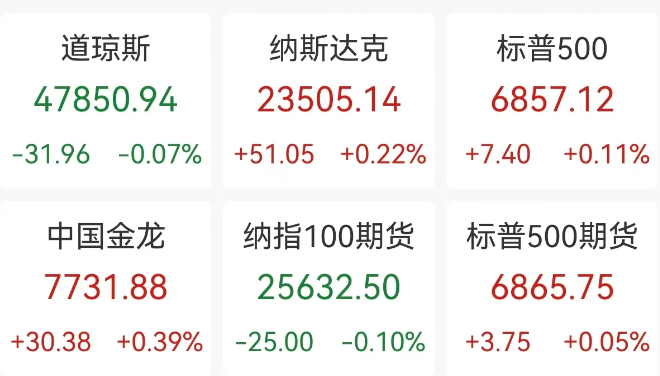
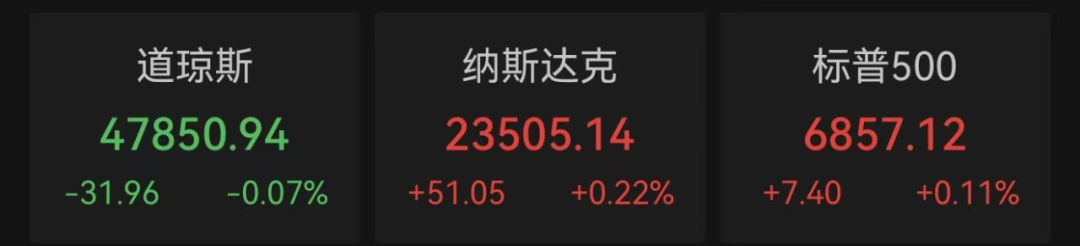
Market Overview - The U.S. stock market showed mixed performance with the Nasdaq and S&P 500 indices rising, while the Dow Jones fell by 0.07% [1] - The Dow Jones closed at 47,850.94, the Nasdaq at 23,505.14, and the S&P 500 at 6,857.12 [2] Technology Sector - Major tech stocks had varied performances; Meta Platforms rose by 3.4%, reaching its highest intraday gain since July 31, while Nvidia increased by over 2%. However, Amazon and Apple both fell by more than 1% [2] - The computer hardware and chip sectors saw significant gains, with SanDisk rising nearly 10% and Dell Technologies increasing by 4% [2] Chinese Stocks - The Nasdaq Golden Dragon China Index increased by nearly 0.4%, with notable gains in companies like Wanwu Xingsheng and Canadian Solar, which rose over 5% [3] - However, some Chinese stocks like Daqo New Energy and BOSS Zhipin experienced declines of nearly 3% and over 2%, respectively [3] Cryptocurrency Market - The cryptocurrency market faced a collective downturn, with Bitcoin dropping below $91,000 and a 24-hour decline of 1.4%. The total liquidation amount exceeded $320 million [4][5] - Ethereum also saw a decrease of 0.86%, while other cryptocurrencies like Solana and XRP experienced declines of 3.64% and 4.92%, respectively [5] Labor Market Data - Recent data from the U.S. Labor Department indicated a decrease in initial jobless claims by 27,000 to 191,000, marking the lowest level in over three years. However, the number of individuals continuing to claim unemployment benefits remains above 1.9 million, indicating ongoing structural pressures in the labor market [5] Federal Reserve Outlook - The White House's National Economic Council Director indicated a potential interest rate cut by the Federal Reserve, with an 87% probability of a 25 basis point reduction in December [6]

音频 | 格隆汇12.5盘前要点—港A美股你需要关注的大事都在这
Ge Long Hui A P P· 2025-12-04 23:17
Group 1 - The U.S. stock market showed mixed results with major indices fluctuating, Meta's stock rising over 3%, and the Chinese concept index increasing by 0.39% [2] - The U.S. Treasury debt has surpassed $30 trillion, doubling since 2018 [2] - The U.S. oil futures rose by over 1.2%, while natural gas prices in New York climbed above $5 [2] - The European retail sales for October increased by 1.5% year-on-year, exceeding expectations, while month-on-month figures remained flat [2] - The number of layoffs reported by Challenger companies in the U.S. for November was 71,300, a decrease of 53.4% month-on-month [2] Group 2 - The Chinese Ministry of Commerce is accelerating the promotion of new consumption formats, models, and scenarios, as well as the construction of an international consumption environment [2] - New regulations for food delivery services have been introduced, prohibiting platforms from forcing merchants to promote or transfer costs [2] - The People's Bank of China conducted a reverse repurchase operation of 1 trillion yuan on December 5 [2] - The Chinese Center for Disease Control reported that the national flu epidemic is currently at a high level of prevalence [2] Group 3 - Cambrian Technology has been reported to plan to double its chip production in an effort to replace NVIDIA products in China, with Bernstein setting a target price of 2,000 yuan for the company [2][3] - The company has stated that media and online information regarding its products, clients, and capacity forecasts are misleading [2] - The stock of Aerospace Electromechanical has been noted to not involve commercial aerospace in its main business [3]
美股科技股多数上涨,META涨超3%
Zhong Guo Zheng Quan Bao· 2025-12-04 23:13
Market Performance - On December 4, U.S. stock indices showed mixed results, with the Dow Jones down 0.07%, the Nasdaq up 0.22%, and the S&P 500 up 0.11% [1] - The U.S. technology sector saw most stocks rise, with META increasing over 3%, NVIDIA up over 2%, and Tesla up over 1% [2][3] Employment Data - The U.S. Department of Labor reported that the number of initial jobless claims for the week ending November 29 was 191,000, the lowest level since September 2022, and below the market expectation of 220,000 [2] Technology Sector Insights - The Nasdaq U.S. Technology Seven Index rose by 0.4%, reflecting positive sentiment in the tech sector [3] - META plans to cut its metaverse division budget by 30% next year, focusing more on generative AI and smart hardware [3] Chinese Market Performance - The Nasdaq Golden Dragon China Index increased by 0.39%, with notable individual stock performances including Lianzhang Portal rising nearly 30% and Wuyou English up nearly 14% [4] Commodity Market Trends - As of December 5, gold prices saw a mild increase, with London spot gold up 0.16% and COMEX gold futures up 0.18% [5] - In contrast, silver prices declined, with London spot silver down 2.34% and COMEX silver futures down 1.78% [5] - International oil prices also rose, with both ICE Brent and NYMEX WTI crude oil increasing by over 1% [5]
消息称Meta拟削减元宇宙预算最多30%
Di Yi Cai Jing· 2025-12-04 23:12
Core Viewpoint - Meta is considering cutting its metaverse project budget by up to 30% as part of its fiscal year 2026 planning, with discussions having taken place at an internal meeting in Hawaii [1] Group 1: Budget Cuts and Financial Strategy - The potential budget reduction is aimed at addressing the long-term losses of Reality Labs, which is Meta's division focused on the metaverse [1] - This significant cut in investment may be accompanied by a new round of layoffs, potentially starting as early as January [1] - Analysts suggest that the company is realigning its cost structure to better match a more moderate revenue outlook [1] Group 2: Market Reaction - Following the news, Meta's stock price increased by 3.43% at market close [1]

【环球财经】欧盟就美国元宇宙平台公司限制性新政启动反垄断调查
Xin Hua She· 2025-12-04 22:50
Core Viewpoint - The European Commission has initiated a formal antitrust investigation into the new restrictions imposed by the Metaverse Platform Company on AI service providers accessing the WhatsApp messaging application, assessing whether this policy violates EU competition regulations [1] Group 1: Investigation Details - The investigation focuses on the new limitations that will take effect from October 2025, which may prevent third-party AI service providers from offering services to users in the European Economic Area via WhatsApp [1] - The Metaverse Platform Company's own AI service, "Meta AI," will still be accessible to users on WhatsApp, raising concerns about potential market dominance abuse [1] Group 2: Regulatory Context - The European Commission's investigation is based on concerns that the new policy could violate EU regulations prohibiting companies from abusing their dominant market position [1] - There is no statutory deadline for the antitrust investigation, and its duration will depend on the complexity of the case, the cooperation of the involved companies, and the exercise of rights by all parties [1]
深夜美股突变,中概股,上扬
Zheng Quan Shi Bao· 2025-12-04 22:41
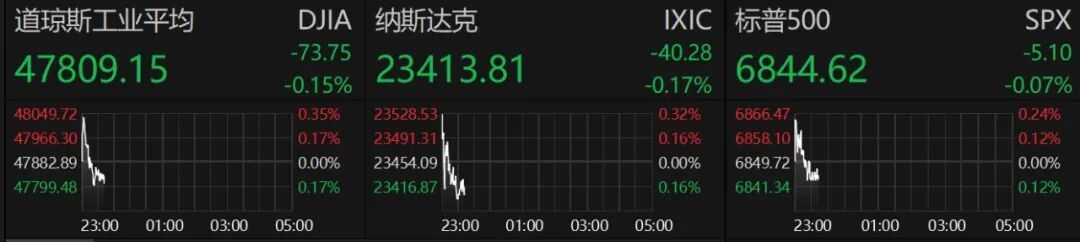
Market Overview - US stock market opened slightly higher on December 4 but turned negative, with the Dow Jones Industrial Average down 73.75 points (-0.15%), Nasdaq down 40.28 points (-0.17%), and S&P 500 down 5.10 points (-0.07%) [1] Company-Specific Developments - Meta Platforms' CEO Mark Zuckerberg announced a significant reduction in resources allocated to the "metaverse" project, which was previously seen as a key future direction for the company [1] - Meta Platforms' stock rose over 4% following the announcement [2] - Nvidia's stock increased nearly 2% as the company, along with Palantir and CenterPoint Energy, announced the development of a new software platform named "Chain Reaction" aimed at accelerating the construction of next-generation AI data centers [2] - Snowflake's stock fell over 9% after the company projected a slowdown in product revenue growth for Q4, attributing this to discounts offered for large long-term contracts [3] - Apple’s stock declined nearly 1% due to reports indicating stagnation in growth for its core revenue source, the App Store [3] - Chinese concept stocks saw a rise, with Tiger Brokers increasing over 3% after reporting Q3 revenue of $175 million, a 73.3% year-over-year increase [3] - NIO and Xpeng Motors stocks rose over 3% following the announcement of a joint development project with Huawei for the X9 super range extender [5] - Bilibili's stock increased nearly 3% as it prepares to launch 13 new games in December, including a long-awaited anime product [5] - Hesai Technology's stock rose over 2% after releasing a new high-performance smart control chip and safety technology for its lidar systems [5]
三大指数涨跌不一 Meta(META.US)涨超3.4%
Zhi Tong Cai Jing· 2025-12-04 22:38
Market Performance - The three major U.S. indices showed mixed results, with the Dow Jones down by 31.96 points (0.07%) to 47850.94, the Nasdaq up by 51.04 points (0.22%) to 23505.14, and the S&P 500 up by 7.40 points (0.11%) to 6857.12 [1] - European indices also saw gains, with the German DAX30 up by 212.58 points (0.90%) to 23895.03, the UK FTSE 100 up by 23.03 points (0.24%) to 9715.10, and the French CAC40 up by 34.61 points (0.43%) to 8122.03 [1] Commodity Prices - Light crude oil futures for January 2026 rose by $0.72 to $59.67 per barrel, a 1.22% increase, while February Brent crude oil futures increased by $0.59 to $63.26 per barrel, a 0.94% rise [2] - Spot gold increased by 0.14% to $4208.73 [4] Cryptocurrency Market - Bitcoin fell by 1.2% to $92310.95, and Ethereum dropped over 1.6% to $3136.99 [3] Macroeconomic Indicators - Initial jobless claims in the U.S. decreased to 191,000, with a four-week moving average dropping to 214,700 [5] - The U.S. Treasury debt surpassed $30 trillion for the first time, growing over 100% since 2018, with total national debt reaching $38.4 trillion [6] - The average rate for a 30-year fixed mortgage in the U.S. fell to 6.19%, the lowest since October of the previous year, leading to a 2.5% increase in mortgage applications [6] Company News - Meta Platforms plans to cut its metaverse budget by up to 30%, indicating a shift in strategy as the anticipated industry competition has not materialized [7] - Apple announced a high-level executive change, with Jennifer Newstead set to become the new General Counsel in March 2026, succeeding Kate Adams [8] - The European Commission is seeking industry feedback on Google's proposed compliance measures to address antitrust issues related to its advertising technology business, which has faced fines of nearly €3 billion (approximately $3.5 billion) [9]