智能体

Search documents
云计算游戏规则变了:百度以“智能优先”破局,率先押注Agent生态
Di Yi Cai Jing Zi Xun· 2025-08-29 08:45
Core Insights - The focus of the cloud computing market has shifted from "resource scale" to "intelligent capability" in the AI-native era, driven by significant advancements in AI models and infrastructure [1][4][19] - Baidu's "Artificial Intelligence +" initiative aims to deeply integrate AI technology across various industries, enhancing quality, efficiency, and innovation [1][2] - Baidu's intelligent cloud strategy emphasizes the need for new infrastructure to support the intelligent economy, positioning AI cloud as a new profit center rather than a cost center [4][7][19] Cloud Infrastructure Developments - Baidu has upgraded its AI infrastructure with the launch of the Baijie AI Computing Platform 5.0 and Qianfan Enterprise AI Development Platform 4.0, enabling lower-cost and more efficient AI product deployment [4][12] - The new platforms focus on enhancing computational efficiency, reducing latency, and improving model training and inference capabilities [10][12] - Baidu's AI cloud services have achieved a market share of 24.6%, maintaining its position as the leading provider in China's AI public cloud service market [18][19] AI Model and Agent Development - The core elements of AI cloud are identified as computing power, models, data, and engineering capabilities, which are essential for supporting the rapid growth of AI applications [8][9] - Baidu's Qianfan platform has been upgraded to support agent development, providing a comprehensive service platform for developers with over 150 models available [14][15] - The introduction of the RFT toolchain significantly reduces the data requirements for model fine-tuning, making it easier for enterprises to enhance model performance [15] Industry Transformation and Future Outlook - The AI-native era is expected to create a "super cycle" in the industry, where the value creation process is fundamentally restructured, leading to new opportunities for businesses [6][19][21] - Baidu's strategic shift from traditional cloud services to AI cloud services is seen as a "change of lane" competition, positioning the company as a leader in the AI cloud sector [19][21] - The integration of AI capabilities into cloud services is viewed as a critical factor for enterprises to drive value creation and operational efficiency [21]


业内首创!L4级智能体母体系统MasterAgent上线通用智能体直接对标Manus
Zhi Tong Cai Jing· 2025-08-29 02:33
Core Insights - The global first L4-level intelligent agent system MasterAgent has achieved a significant upgrade with the launch of the autonomous general intelligent agent "Master Master" [1][3] - MasterAgent has introduced four specialized intelligent agent clusters covering text creation, video generation, website building, and design production, aiming to build a multi-scenario ecosystem [1][4] Group 1 - Since the global limited public testing began on July 29, MasterAgent has attracted widespread attention from the global tech community, enterprise clients, and individual users due to its groundbreaking multi-agent generation and collaboration architecture [3] - The newly released "Master Master" is generated by MasterAgent, integrating multi-modal large models and deep industry knowledge, capable of providing highly precise and executable complete solutions for various work and personal tasks [3][5] - MasterAgent's unique Master Builder and Agent Group dual-engine architecture allows for the rapid generation of customized multi-agent collaborative networks based on user natural language instructions, enabling users to access various professional AI capabilities on a unified platform [3][4] Group 2 - MasterAgent focuses on real user high-frequency needs and business pain points, providing a professional, one-stop, end-to-end task-solving experience [4] - The system has launched four professional intelligent agent clusters: "Textura" for article creation, "Storiva" for story video creation, "Webora" for website building, and "Creavo" for design production, marking a significant step towards scenario-based implementation and building an intelligent agent ecosystem [4] - MasterAgent's self-developed agent generation model allows for the dynamic creation of scenario-based intelligent agent clusters based on user natural language instructions, significantly lowering the development and usage barriers for intelligent agents [4][5] Group 3 - The five preset intelligent agents, including "Master Master," are generated by the MasterAgent system and fine-tuned by the technical team to meet typical "AI+" scenarios, providing comprehensive knowledge and skills to address diverse needs [5] - MasterAgent aims to democratize AI technology, allowing users to generate multi-agent clusters and customize them flexibly, supporting organizations and individuals in training and deploying their exclusive intelligent agent teams [5] - The company plans to deepen collaborations with leading enterprises in legal, medical, and financial sectors to promote the application of "AI+" in vertical fields, building a broad, precise, secure, and trustworthy intelligent agent ecosystem [5]

配齐模型、算力、语料、中试平台等生态要素 下好AI产业高地先手棋 上海AI军团领跑“智能体革命”
Jie Fang Ri Bao· 2025-08-29 01:38
Core Insights - The State Council has issued an opinion on the implementation of the "Artificial Intelligence +" initiative, which is seen as a clear roadmap for AI development in China, particularly benefiting Shanghai's AI enterprises [1] - By 2027, the initiative aims for deep integration of AI across six key areas, with a target of over 70% application penetration of new intelligent terminals and agents, and over 90% by 2030 [1] - The initiative is expected to trigger a productivity revolution, with intelligent agents based on large models playing a central role [1] Group 1: Industry Response - Shanghai AI companies are leading the "intelligent agent revolution," with examples including Shanghai LingShu Intelligent's multi-task intelligent agent being deployed in major state-owned enterprises [2] - The newly established Shanghai AI company, Free Dimension, has launched an AI-powered PPT generation tool, achieving a user base in the millions [2] - MiniMax has introduced a versatile intelligent agent capable of executing complex tasks in a short time, showcasing the rapid advancement of AI capabilities [2] Group 2: Infrastructure and Support - Shanghai aims to achieve an intelligent computing power scale exceeding 100 EFLOPS by the end of 2025, surpassing the combined plans of Beijing and Shenzhen [3] - The city has established the first professional AI corpus company, KuPass, contributing to the construction of vertical corpus databases across five key areas and six industries, with over 1800TB of finished corpus [3] - Shanghai is also building a "pilot training ground" for large model applications, facilitating the sharing of mature solutions and tools across various sectors [3] Group 3: Ecosystem Development - The city has initiated the Global Developer Pioneer Conference (GDC) to foster an open-source ecosystem, with plans to hold the event twice a year starting in 2023 [3] - The opinion emphasizes that "Artificial Intelligence +" is about reconstructing capabilities and changing the underlying logic of social operations, positioning Shanghai as a leader in this transformation [3]
360数字安全科技集团与贵州大数据集团战略合作签约
Zheng Quan Shi Bao Wang· 2025-08-28 12:20
Core Viewpoint - The collaboration between 360 Group and Guizhou Big Data Group aims to enhance the digital economy in Guizhou through the integration of AI and security technologies, establishing a comprehensive data industry ecosystem [1][2][3] Group 1: Strategic Collaboration - 360 Group and Guizhou Big Data Group signed a strategic cooperation agreement to leverage their strengths in "security + AI" technologies, aiming to build a multi-layered data industry ecosystem [2] - The partnership will focus on creating urban and enterprise-level security operation centers, AI application empowerment platforms, and data security service platforms to strengthen Guizhou's critical information infrastructure [2][3] Group 2: AI and Intelligent Agents - 360 Group is developing the "360 Intelligent Agent Factory" to provide enterprises with essential infrastructure and enhanced capabilities for intelligent agents, facilitating their deployment in various industries [3] - The company emphasizes that intelligent agents will play a crucial role in the application of AI, complementing large models by executing tasks and utilizing tools effectively [3][4] Group 3: Security Enhancements - 360 Group aims to address the security challenges posed by intelligent agents by utilizing its expertise in "security + AI" to create a robust security platform, thereby enhancing the overall security capabilities of enterprises [4]

360集团与贵州大数据集团签订战略合作
Zheng Quan Ri Bao Zhi Sheng· 2025-08-28 11:37
Core Viewpoint - The strategic cooperation between 360 Digital Security Technology Group and Guizhou Big Data Group aims to create a comprehensive and multi-layered big data industry ecosystem, leveraging "security + AI" technologies to enhance data security and innovation in Guizhou [1][2]. Group 1 - The cooperation follows the principles of "complementary advantages, collaborative innovation, rooted in Guizhou, and radiating nationwide" [1]. - Both parties plan to establish a long-term innovation complex, develop government-enterprise network data security and AI products, and build security operation centers and data security service platforms [1]. - The core goal is to co-build the "Guizhou Security Brain," utilizing 360's technological advantages in intelligent agents to conduct key technology research and promote the integration of large models with big data platforms [1][2]. Group 2 - Guizhou Big Data Group's leadership emphasizes the importance of deep collaboration in strategic planning, technology systems, and talent teams to efficiently convert technological achievements and support high-quality digital economic development in Guizhou [2]. - The cooperation will adopt a "specialized promotion + checklist management + node-based tackling" approach to accelerate project implementation [2]. - This "security + AI" collaboration is expected to inject strong momentum into Guizhou's digital economy and provide a replicable model for national digital development [2].
AI、数据、算力等四大技术驱动,行业探索“智能体”建设
Huan Qiu Wang Zi Xun· 2025-08-28 06:26
Core Insights - The explosion of AI model applications signals a shift from the digital age to the intelligent agent era, with data resource accumulation and value extraction being key variables affecting enterprise productivity [1] - AI and data technologies can provide comprehensive value enhancement for clients, with AI-generated code reaching up to 50% and AI customer service issue resolution rates hitting 80% [1] - The six core technological factors driving global changes over the next 10 to 20 years are AI, data, computing power, energy, materials, and biotechnology [1] Company Insights - The development of enterprise intelligent agents is categorized into four stages: "tool-based," "process-based," "scenario-based," and "ecosystem-based," reflecting both technological iteration and deep business model transformation [2][3] - The "tool-based" stage focuses on developing single-function intelligent agents for specific tasks, while the "process-based" stage aims to create linear intelligent agents that streamline complete business processes [2] - The "scenario-based" stage emphasizes comprehensive intelligence within specific functional areas, and the "ecosystem-based" stage promotes deep integration of internal resources with upstream and downstream ecosystems [3] Industry Insights - Intelligent agents are currently mature in knowledge Q&A and interactive fields, with potential rapid development in industries requiring extensive data analysis, such as biopharmaceuticals, healthcare, and financial risk control [2] - At the China International Big Data Industry Expo, the company showcased various intelligent solutions, including smart meeting integration and intelligent safety management systems, demonstrating a 60% improvement in inspection efficiency for their showcased solutions [3]
模型、数据、场景,企业级 AI 落地三要素
Sou Hu Cai Jing· 2025-08-27 14:06
Core Insights - The next wave of AI will focus on selling returns rather than tools, emphasizing the importance of enterprise-level AI applications for maximizing profits [2][3] - Successful enterprise-level AI implementation requires three essential elements: models, data, and application scenarios [3][4] Models - The effectiveness of AI models is not solely determined by their size; businesses should select models based on specific scenarios [3] - As businesses mature in their AI journey, they will shift from paying for advanced models to paying for the commercial value generated by these models [3] Data - High-quality data is crucial for AI success; companies must ensure they have integrated and effective data to leverage AI capabilities [4] - Synthetic data can help address initial data shortages, allowing for quicker AI application deployment [4][7] Application Scenarios - The true value of AI models lies in their application scenarios, similar to how electricity's value is realized through its various uses [5] - Companies should prioritize identifying the most suitable business scenarios for AI transformation to achieve rapid deployment [5][8] Industry Developments - Major companies like Huawei and Alibaba Cloud are launching industrial AI solutions that significantly enhance operational efficiency [6][10] - The industrial sector is witnessing a shift towards AI integration, with government support for AI+ industrial software initiatives [8] Intelligent Agents - The industrial sector is characterized by four main types of intelligent agent applications: data governance, knowledge processing, process optimization, and decision support [11][12] - The current applications of intelligent agents are primarily in knowledge-intensive areas, where high-quality data is essential for further development [13]

360集团创始人周鸿祎:人工智能正进入规模化商业化应用时代
Zhong Zheng Wang· 2025-08-27 07:44
Group 1 - The core viewpoint is that artificial intelligence is entering a phase of large-scale commercialization, presenting greater opportunities than the internet [1][2] - The State Council has issued an opinion to promote the deep integration of artificial intelligence with various sectors, aiming to reshape human production and lifestyle [1] - The opinion emphasizes leveraging China's rich data resources and comprehensive industrial system to foster new productive forces and develop new business models [1] Group 2 - The industry has transitioned from a disruptive innovation phase to a period of enhancement and refinement for large models, with diminishing marginal returns on investment [2] - Intelligent agents have emerged as a crucial form of AI application, capable of using various tools and possessing memory, thus enhancing task execution [2] - The opinion supports the widespread application of intelligent agents and sets goals for their adoption rates by 2027 and 2030 [2]
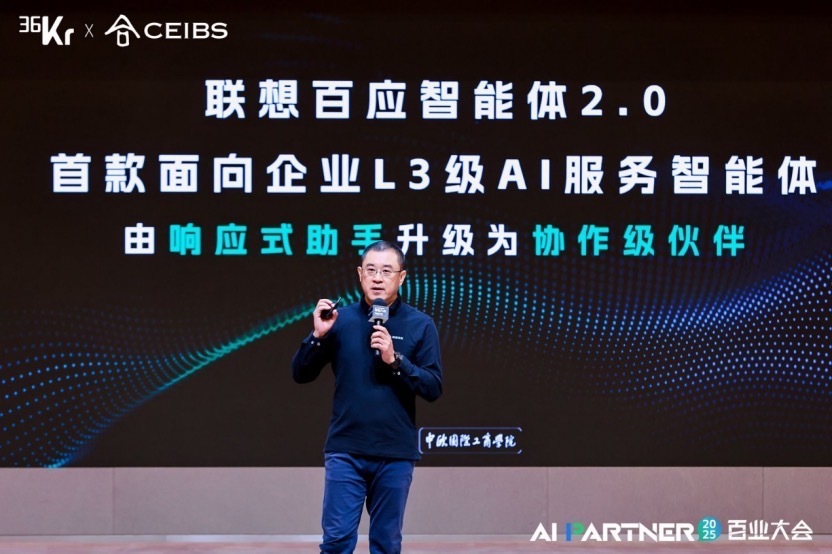
从“响应式”到“协作级”,联想百应智能体2.0开启企业AI服务新范式
3 6 Ke· 2025-08-27 06:02
Core Viewpoint - Lenovo officially launched the Lenovo Baiying Intelligent Agent 2.0, marking the debut of the first L3-level AI service agent for enterprises in China, which transitions AI from a "responsive assistant" to a "collaborative partner" [1][16] Group 1: AI Capabilities and Features - The new Lenovo Baiying Intelligent Agent 2.0 possesses L3-level capabilities, allowing it to deeply integrate into high-frequency business scenarios and dynamically generate decision-making processes [3][11] - The AI operations feature includes a new application called IT Code On, which autonomously plans steps and generates solutions, covering over 200 popular IT tools for end-to-end problem resolution [3][4] - The AI office application, termed "Super Employee," enables users to execute tasks efficiently through natural language commands, covering over 95% of core AI scenarios [4][11] Group 2: Marketing and Design Enhancements - The AI marketing capabilities have been upgraded to allow for "zero-threshold" professional design and communication, enabling users to generate posters and marketing pages through simple dialogue, increasing efficiency by ten times compared to manual methods [5][11] Group 3: Core Technology Upgrades - Lenovo Baiying has implemented five major AI core technology upgrades to address the pain points faced by small and medium-sized enterprises, including proactive task planning and multi-tool integration [7][10] - The five core technology upgrades include AI perception planning, context enhancement, multi-tool invocation, self-generation, and self-iteration, enhancing the agent's proactive, creative, and execution capabilities [10][11][13] Group 4: User Engagement and Future Outlook - The Lenovo Baiying Intelligent Agent 2.0 is available for early access until September 1, with enterprise users receiving eight benefits to support their intelligent transformation [15] - Lenovo aims to continue refining the intelligent agent capabilities, focusing on technology and demand to assist more small and medium-sized enterprises in achieving high-quality development in the AI wave [16]

模型、数据、场景,企业级AI落地三要素丨ToB产业观察
Tai Mei Ti A P P· 2025-08-27 03:45
Core Insights - The next wave of AI will focus on selling returns rather than tools, emphasizing the importance of enterprise-level AI applications for maximizing profits [2][3] Group 1: Key Elements for Enterprise AI Implementation - Successful enterprise-level AI requires three essential components: models, data, and application scenarios [3] - The effectiveness of AI models is not solely dependent on their size; businesses must select appropriate models based on specific scenarios [3] - High-quality data is crucial for AI success, and companies must ensure they have integrated their core data effectively [4] Group 2: Data as a Core Asset - Data is considered a core productivity factor for enterprise AI, and companies must focus on data compliance and quality [4] - Innovative companies are utilizing synthetic data to enhance model training and address initial data shortages [4][8] Group 3: Application Scenarios - The true value of AI models lies in their application scenarios, similar to how electricity's value is realized through its various uses [5][6] - Companies should prioritize identifying the most suitable business scenarios for AI transformation to achieve rapid application deployment [6] Group 4: Industrial AI Applications - Major companies like Huawei and Alibaba Cloud are launching industrial AI solutions that significantly enhance operational efficiency [7] - Specific examples include a 50% improvement in CAE simulation efficiency and a 22% increase in inventory turnover rates for automotive parts [7] Group 5: Government and Industry Support - The government is actively promoting AI integration in industrial software, with initiatives to support pilot projects and product development [9] - As of now, over 30,000 basic intelligent factories have been established in China, covering more than 80% of manufacturing sectors [9] Group 6: Emerging AI Solutions - Companies like Dingjie Zhizhi and Yilide are developing AI-enabled products to streamline design processes and enhance PDM workflows [10][11] - Traditional industries are also adopting AI, with examples like Foxconn's digital twin platform achieving millisecond-level synchronization [11] Group 7: Characteristics of Industrial AI Agents - Industrial AI applications are categorized into four main areas: data governance, knowledge processing, process optimization, and decision support [12] - The focus is on leveraging AI to enhance employee capabilities and streamline complex business processes [13][14]