
企业风险管理

Search documents
Bread Financial (BFH) 2025 Conference Transcript
2025-06-11 18:45
Summary of Bread Financial (BFH) 2025 Conference Call Company Overview - **Company**: Bread Financial (BFH) - **Date of Conference**: June 11, 2025 Key Industry Insights - **Consumer Spending Trends**: Positive trends observed in consumer spending and credit sales, with expectations for an increase in second quarter compared to the first quarter [5][6][10] - **Impact of Natural Disasters**: Anticipated $13 million impact on the non-performing loan (NCL) rate due to hurricane-related accommodations for affected consumers [6][10] - **Credit Quality**: Year-over-year improvement in credit quality, with a noted decrease in the NCL loss rate by 83 basis points in May [10][12] Financial Performance - **Guidance for Full Year**: Confidence in achieving the low end of the guidance at 8% for the year, contingent on June data and tariff resolutions [11][12] - **Bond Tender Offer**: Successful cash tender offer for $150 million of senior notes, with strong demand exceeding $500 million [14][15] - **Capital Management**: Focus on maintaining liquidity and capital levels while being opportunistic with buybacks and debt management [16][60][61] Strategic Transformation - **Company Evolution**: Significant transformation over the past four years, focusing on simplifying operations and enhancing financial discipline [20][21][22] - **Partnership Model**: Emphasis on building strong relationships with retail partners to drive co-branding opportunities and improve customer engagement [24][27] - **Credit Underwriting Improvements**: Shift in credit mix from subprime to higher quality, with subprime now at low 40% of the portfolio [30][31] Competitive Landscape - **Buy Now Pay Later (BNPL) Impact**: BNPL competition is acknowledged, but it primarily affects lower credit tiers, with Bread Financial focusing on prime and near-prime customers [28][29] - **Regulatory Environment**: Recent favorable rulings regarding late fees and pricing changes are expected to provide a tailwind to net interest margin (NIM) and revenues [46][50] Future Outlook - **Strategic Priorities**: Focus on operational excellence, optimizing the balance sheet, and enhancing technology capabilities to drive growth and efficiency [68][70] - **Long-term Goals**: Aim for a return on tangible common equity (ROTCE) target of over 20% through disciplined capital management and growth strategies [68][70] Additional Considerations - **Student Loan Impact**: Monitoring of consumers with student loans shows stable performance, with no significant uptick in delinquencies despite the resumption of payments [39][40][41] - **Market Conditions**: Caution regarding macroeconomic conditions and their potential impact on credit quality and consumer behavior [35][36] This summary encapsulates the key points discussed during the conference call, highlighting Bread Financial's current performance, strategic direction, and outlook in the context of the broader financial services industry.

天马集团打造企业风险管理新范式
Qi Huo Ri Bao Wang· 2025-06-05 16:23
Core Viewpoint - Tianma Group is transforming from a "passive burden" to an "active breakthrough" by leveraging a risk management system that links futures and spot markets, thus navigating the volatility in agricultural product prices [1] Group 1: Company Overview - Tianma Group, established in 2002 in Fuzhou, initially focused on special aquatic feed and has since diversified into various sectors including poultry feed, eel farming, and food processing, creating a complete industrial chain [2] - The company has become a key national agricultural enterprise and a national technology innovation demonstration enterprise, leading the global market share in special aquatic feed [2] Group 2: Market Challenges - The company faces significant price volatility in key feed production materials such as soybean meal, corn, and soybean, influenced by climate, planting area, international trade policies, and supply-demand mismatches [3] - Price fluctuations complicate cost control, inventory management, and supply chain stability, with rising raw material prices increasing procurement costs and potential shortages impacting production [3] Group 3: Futures Market Engagement - Tianma Group began developing its futures risk management system in 2013, establishing a professional futures team and integrating hedging into its operational decision-making [4] - The company utilizes futures markets for risk management by locking in procurement prices for raw materials, thus mitigating the impact of price volatility on operations [5] Group 4: Hedging Strategy - The company employs a hedging strategy that includes direct hedging and basis trading, tailored to various commodities based on production schedules and market analysis [5] - A typical hedging case involved selling corn futures at approximately 2460 CNY/ton and later closing positions at 2390-2430 CNY/ton, successfully reducing potential losses from inventory devaluation [6] Group 5: Risk Management Framework - Tianma Group adheres to a strict hedging business management system, conducting demand assessments and developing detailed hedging plans that require approval from a dedicated leadership group [7] - The internal audit department conducts regular audits of the futures derivatives business to ensure compliance and effective risk management [8] Group 6: Future Directions - The company is exploring collaborations with futures companies for forward trading and standard warehouse receipt trading, aiming to integrate logistics and supply chain management with futures market functionalities [8] - Tianma Group is interested in innovative insurance products linked to temperature indices for aquaculture, indicating a commitment to further risk management exploration [8]
合力构建生态 提升期市服务实体经济质效
Qi Huo Ri Bao Wang· 2025-05-26 18:12
Group 1 - The core viewpoint emphasizes the importance of futures and derivatives in risk management for listed companies, aligning with national strategies and enhancing corporate risk management capabilities [1][2][4] - A training program for senior executives from listed companies was held to improve practical skills in futures hedging and risk management, with participation from over 150 executives from 107 companies [1][4] - The futures market in China has developed significantly over 30 years, providing a robust ecosystem for enterprises to manage risks, with a wide variety of futures products and strong policy support [2][3] Group 2 - Shenzhen has 14 futures companies, serving over 20,000 industrial clients with a trading volume of nearly 5 trillion yuan, and has provided hedging services to 440 companies with a hedging amount exceeding 560 billion yuan [3] - As of April 2024, 87 listed companies in Shenzhen have engaged in hedging activities, representing 20.57% of the total [3][6] - The Capital Market Academy is focused on enhancing the participation of industrial clients in the futures market through targeted training programs [3][4] Group 3 - The integration of futures and spot markets is crucial for sustainable business development, allowing companies to actively manage risks and stabilize operating costs and profits [7] - Effective risk management through futures requires adherence to accounting standards and proper documentation of hedging relationships [7] - Companies are encouraged to enhance their understanding of futures market functions and improve their ability to utilize futures tools through professional training and practical experience [8]
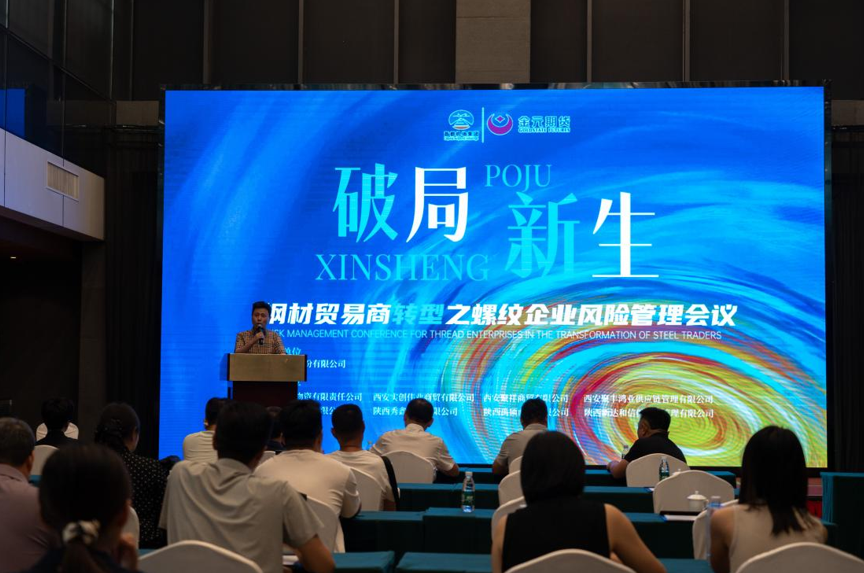
钢材贸易商转型赋能 金元期货西安举办螺纹企业风险管理会议
Qi Huo Ri Bao Wang· 2025-05-22 13:15
Core Viewpoint - The conference focused on the transformation of steel traders and risk management strategies in the rebar industry, highlighting the need for adaptation to market changes and the use of financial tools for risk management [1][3][18] Group 1: Industry Transformation - The steel trading industry is undergoing significant changes, shifting from traditional operations to refined and digital management, and expanding from a single trading model to comprehensive service across the industry chain [3][18] - Rebar, as a core category of construction steel, presents challenges in price volatility and supply-demand dynamics, necessitating enhanced risk management capabilities for companies [3][18] Group 2: Expert Insights - Expert Lei Long discussed the macroeconomic situation in China, emphasizing the historical reliance on exports for GDP growth and the current challenges posed by U.S. economic issues, including debt and liquidity risks [6][18] - Yang Huabin shared insights on how traditional steel traders can seize opportunities for transformation, emphasizing the importance of understanding market dynamics and maintaining a clear analytical approach [9][10] - Liu Bo presented his unique trading philosophy and risk management strategies, stressing the need for a solid understanding of market realities and the establishment of sound trading principles [14][18] Group 3: Interactive Discussions - A roundtable discussion featured industry leaders addressing pain points faced by steel traders during their transformation, fostering an interactive environment for sharing experiences and strategies [15][18] - Participants raised questions regarding the real demand for rebar in construction projects, with insights provided on the current state of construction and steel demand in Shaanxi province [16][18] Group 4: Conference Outcomes - The conference covered topics such as macroeconomic analysis, options derivatives, and practical case studies of steel trader transformations, aiming to enhance companies' risk management systems [18] - Attendees reported valuable takeaways from the conference, indicating a commitment to optimizing their risk management frameworks in response to industry changes [18]

南华期货碳酸锂企业风险管理日报-20250522
Nan Hua Qi Huo· 2025-05-22 11:58
南华期货碳酸锂企业风险管理日报 2025年5月22日 戴鸿绪(投资咨询证书:Z0021819 ) 余维函 (期货从业证号:F03144703) 投资咨询业务资格:证监许可【2011】1290号 期货价格区间预测 | 品种 | 价格区间预测 | 当前波动率(20日滚动) | 当前波动率历史百分位(3年) | | --- | --- | --- | --- | | 碳酸锂主力合约 | 压力位65000 | 25.2% | 30.0% | source: 南华研究 据Mysteel消息,某锂盐厂预计停产检修4个月,预计每月影响锂盐月产量约1500吨。 解读:市场库存依然高位,此厂停产对市场供给过剩格局影响不大。 【利多解读】 【利空解读】 碳酸锂企业风险管理策略建议 | 行为导向 | 情景分析 | 策略推荐 | 套保工具 | 买卖方向 | | 套保比例 策略等级 (满分5) | | --- | --- | --- | --- | --- | --- | --- | | 库存管理 | 公司产品库存偏 高,库存有减值风 | 为了防止库存减值,可以根据企业的库存情况, 做空碳酸锂期货来锁定利润,弥补企业的生产成 本 | ...

南华期货硅产业链企业风险管理日报-20250522
Nan Hua Qi Huo· 2025-05-22 11:58
Report Overview - The report is the "Silicon Industry Chain Enterprise Risk Management Daily Report" by Nanhua Futures, dated May 22, 2025, with analysts Dai Hongxu and Yu Weihan [1] Investment Ratings - No investment ratings for the industry are provided in the report Core Views - Industrial silicon is in the cycle of eliminating backward production capacity, with persistent supply over - capacity pressure. The approaching of the wet season in the Southwest will increase production and inventory, while demand remains weak. Polycrystalline silicon is in a state of alternating fundamentals and delivery logic, with high - inventory pressure and weakening downstream demand [3] Price Forecast and Volatility Industrial Silicon - The price of the industrial silicon main contract faces strong resistance at 8,500 yuan/ton, with a current 20 - day rolling volatility of 24.6% and a historical percentile (3 - year) of 75.4% [2] Polycrystalline Silicon - The polycrystalline silicon main contract is expected to oscillate widely between 34,000 - 38,000 yuan/ton, with a current 20 - day rolling volatility of 29.91% and a historical percentile (3 - year) of 89% [2] Risk Management Strategies Inventory Management - To prevent inventory impairment, sell industrial silicon/polycrystalline silicon futures (SI2507/PS2507) with a 60% hedging ratio, rated 3 out of 5. For high - inventory and impairment risks, sell call options with an 80% hedging ratio (rated 4) and buy out - of - the - money put options (rated 3) [2] Procurement Management - To prevent future raw material price increases, buy industrial silicon/polycrystalline silicon forward contracts according to the production plan, with the hedging ratio based on the plan (rated 1). Also, sell put options (rated 2) and buy out - of - the - money call options (rated 1) [2] Core Contradictions Industrial Silicon - Supply over - capacity persists due to the approaching wet season and expected production increases in the Southwest. Demand is weak, with downstream reduction and production cut expectations [3] Polycrystalline Silicon - The market alternates between fundamentals and delivery logic. High - inventory pressure exists on the supply side, and downstream demand weakens after the photovoltaic installation rush. There may be a contradiction between the main contract's open interest and the number of warehouse receipts [3] 利多/Positive Factors Industrial Silicon - Positive domestic macro - policies may stimulate power demand. Cost reduction space is limited, providing strong cost support [4] Polycrystalline Silicon - Potential capacity integration and clearance plans or agreements may improve the industry situation. Low willingness for enterprise delivery may lead to a delivery - based market [4] 利空/Negative Factors Industrial Silicon - The approaching wet season will increase production in the Southwest. Downstream polycrystalline silicon enterprises' joint production cuts will further weaken demand. Inventory continues to accumulate [4] Polycrystalline Silicon - Failure of enterprise capacity integration and clearance, and continuous inventory accumulation with weak demand [4] Price and Volume Data Industrial Silicon - The main contract's latest price is 7,880 yuan/ton, with a daily increase of 15 yuan, a weekly decrease of 530 yuan (- 6.30%), and a yearly decrease of 36.14%. The trading volume is 208,397 lots, and the open interest is 183,690 lots [6] Polycrystalline Silicon - The main contract's latest price is 35,860 yuan/ton, with a daily increase of 235 yuan, a weekly decrease of 2,560 yuan (- 6.66%). The trading volume is 157,225 lots, and the open interest is 73,488 lots [6] Spot Price Data Industrial Silicon - Spot prices of different grades and regions show declines. For example, the average price of East China 553 is 8,700 yuan/ton, down 100 yuan (- 1.14%) [11] Inventory Data - The total number of industrial silicon warehouse receipts is 65,298 lots, down 355 lots (- 1.85%). Inventory in various delivery warehouses shows different changes, with some decreasing [19]