
北上资金

Search documents
天风策略 谁在卖?
2025-05-14 15:19
Summary of Key Points from Conference Call Records Industry Overview - The records primarily discuss the performance of the public fund market, private equity funds, and various financial instruments in the Chinese market for 2025, with a focus on equity funds and capital flows. Core Insights and Arguments - In April 2025, new equity fund subscriptions reached 74 billion units, with a total net subscription of 1,551 billion units since March, indicating strong investor interest in equity markets [1][2] - The net subscription for stock ETFs in April was 197.3 billion yuan, showing an increase of over 230 billion yuan from the previous month, with major inflows into broad-based ETFs like CSI 300 and CSI 1000 [1][2] - As of March 2025, the scale of private equity funds exceeded 50 trillion yuan, although there was a slight decrease in their positions [3] - The margin trading balance as of the end of April was 1.78 trillion yuan, down 6.9% month-over-month, with a net outflow of 131.5 billion yuan in April [6] - The average daily trading volume of northbound capital in April was over 155 billion yuan, a decrease from over 180 billion yuan in the previous month, but the proportion of total equity trading increased to 12.32% [5] Important but Overlooked Content - The insurance sector saw a net decrease of over 8 billion yuan in asset holdings in Q4 2024, but a cumulative net increase of 630 billion yuan for the entire year, with potential for increased investment due to policy changes in May 2025 [7] - The issuance of bank wealth management products in April approached 6,000, a decrease of 3.36% from the previous month, while the proportion of newly issued equity wealth management products rose to 0.52%, an increase of 0.44% [8] - Industrial capital showed a net decrease of 370 million yuan in April, with a forecasted unlock scale of 110 billion yuan and 247.5 billion yuan for May and June respectively, indicating significant pressure in the electronics and machinery sectors [4][10] - Overall, the market sentiment appears cautious, with a decrease in leveraged funds and a healthy development of public funds, bank wealth management, and private equity products, suggesting a potential shift from small-cap to value styles in the market [11]
民生策略:北上与两融共同成为市场的阶段主要买入力量,而ETF的撤离则仍在继续
Sou Hu Cai Jing· 2025-05-12 12:39
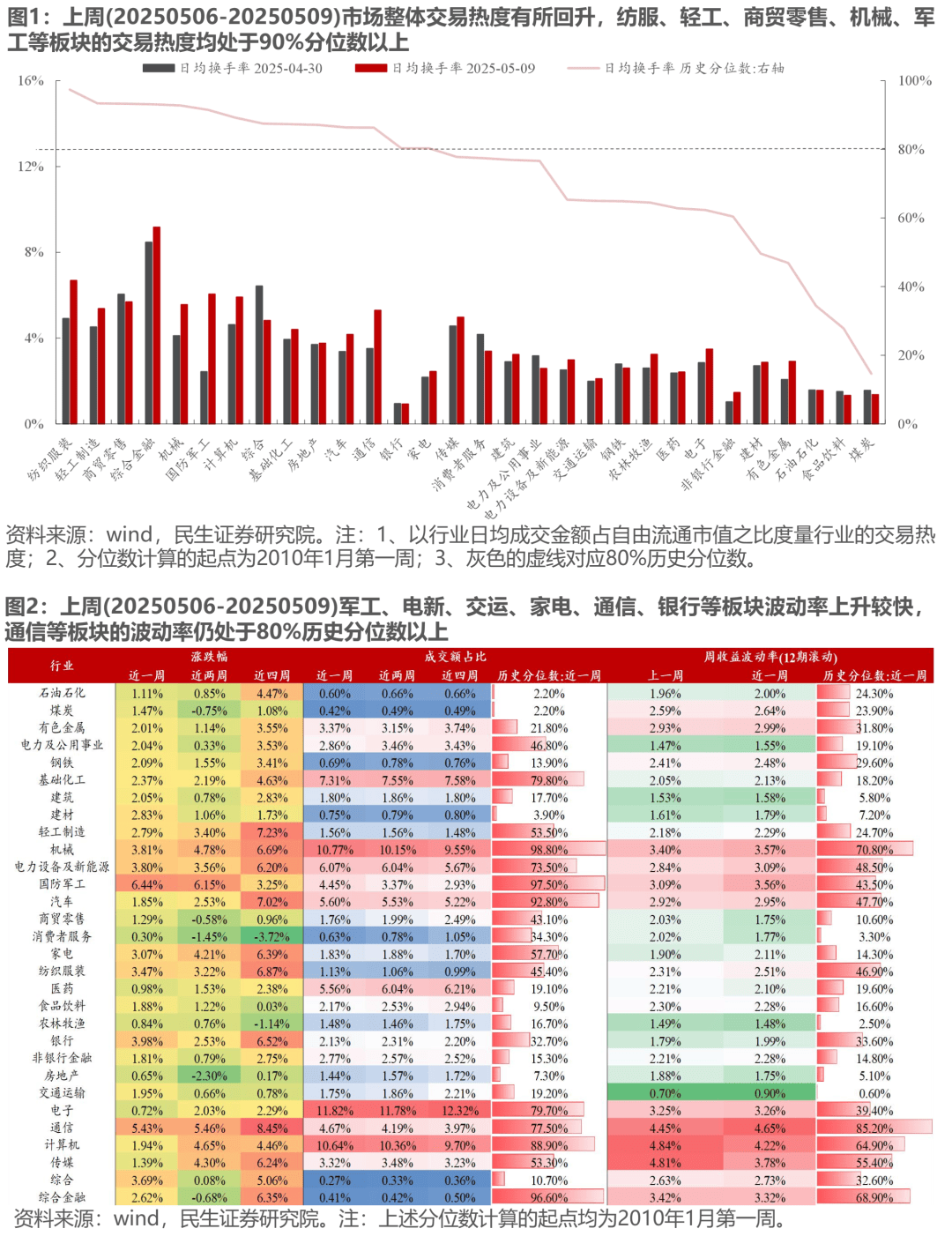
Core Conclusion - Northbound capital and margin trading have become the main buying forces in the market, while ETF withdrawals continue. Future attention should be on the recovery of margin trading and the sustainability of individual investor consensus [1] Trading Activity & Volatility - Market trading activity has rebounded, and volatility has decreased. Sectors such as textiles, light industry, retail, machinery, and military are all above the 90th percentile in trading activity, while the communication sector remains above the 80th percentile in volatility [2] - The volatility of sectors like military, electric new energy, transportation, home appliances, communication, and banking has increased significantly [5] Northbound Capital Activity - Northbound capital activity has increased, with net buying primarily in sectors like communication, electronics, electric utilities, machinery, and electric new energy, while net selling occurred in pharmaceuticals, computers, and media [15] Margin Trading Activity - Margin trading activity has risen to its highest point since late March 2025, with net buying mainly in TMT, machinery, military, pharmaceuticals, and automotive sectors, while net selling was observed in banking, transportation, food and beverage, electric new energy, and textiles [17] ETF Activity - ETFs continue to experience net redemptions, with significant inflows into the STAR 50, CSI 1000, and CSI 2000 ETFs, while outflows were noted in the CSI 300, ChiNext, dividend, and CSI A500 ETFs. The net buying was concentrated in electronics, computers, and machinery, with net selling in electric new energy, financial real estate, pharmaceuticals, food and beverage, communication, and transportation [33][41]

北上回流,ETF流出,个人活跃度呈现低位回升迹象
Minsheng Securities· 2025-04-28 07:39
Group 1: Macroeconomic Overview - The US dollar index has rebounded, and the degree of "inversion" in the China-US interest rate spread has narrowed, with inflation expectations rising [1][13][21] - Offshore dollar liquidity has marginally eased, while domestic interbank liquidity remains overall loose, with the term spread (10Y-1Y) continuing to narrow [1][21][25] Group 2: Market Trading Activity - Overall market trading activity has increased, with trading heat in sectors such as retail, consumer services, real estate, textiles, chemicals, light industry, and machinery above the 80th percentile [2][28][29] - The volatility of major indices, except for the Shanghai Composite Index, has continued to decline, while sectors like computers, communications, and media remain above the 80th historical percentile in volatility [2][28][34] Group 3: Sector Research Activity - Research activity is high in sectors such as electronics, computers, pharmaceuticals, home appliances, food and beverages, and banking, with an upward trend in research heat for agriculture, food and beverages, non-ferrous metals, home appliances, petrochemicals, and electronics [3][43][44] Group 4: Profit Forecast Adjustments - Analysts have continued to lower net profit forecasts for the entire A-share market for 2025/2026, while sectors like agriculture, finance, electronics, and automobiles have seen upward adjustments in their profit forecasts [2][51] - The proportion of upward adjustments in net profit forecasts for the entire A-share market has decreased, while the proportion of downward adjustments has increased [2][51] Group 5: Northbound Capital Activity - Northbound trading activity has continued to decline, with overall net buying of A-shares, particularly in sectors like power and utilities, chemicals, non-ferrous metals, electric new energy, pharmaceuticals, and machinery [3][5] - The average daily trading volume of northbound capital has decreased, and its proportion of total A-share trading volume has also declined [3][5] Group 6: Margin Financing Activity - Margin financing activity has slightly rebounded but remains at a low level since September 24, 2024, with net selling in sectors like non-bank financials, electric new energy, electronics, military industry, steel, and retail [3][6] - The proportion of margin financing in sectors such as finance, coal, communications, light industry, and computers has increased [3][6] Group 7: Fund Positioning - Actively managed equity funds have seen a continued decrease in positions, with net redemptions from investors, particularly in sectors like TMT, automobiles, non-ferrous metals, home appliances, finance, and consumer services [5][8] - New equity fund formations have increased, with a rise in the scale of newly established passive equity funds [5][8]
晚点财经丨“聪明钱” 隐身了;不赌电动车,日本三大车企利润新高;被追逐的公用事业公司
晚点LatePost· 2024-05-14 12:11
"聪明钱" 隐身了 不赌电动车,日本三大车企利润新高 被追逐的公用事业公司 关注《晚点财经》并设为星标,第一时间获取每日商业精华。 "聪明钱" 隐身了 对于一些每天都要交易那么几次的股市投机者来说,一个曾经重要的信号被藏起了。 5 月 13 日起,港交所不再披露北上资金实时成交额和实时可用余额。余额低于 30% 时实时公布可用 余额、否则显示 "可用"。当时成交额会在收盘后公布。 十年前,沪港通(全称 "沪港股票市场交易互联互通机制")开通。那两年后,深港通启动。"通" 就 像 "通道",意味着在不打破中国资本管制的情况下,外资能投资中国的东西了、中国的资本也可以 买港股了。 通过沪港通和深港通流入中国内地股市的资金叫做 "北上资金",它一度被称为 "聪明钱" —— 因为港 资和其他外资市场的成熟度往往高于 A 股市场,交易员认为北上资金对市场有一定领先性,散户、 机构资金也会跟踪北向动向 —— 跟踪的方式是观测北上资金的实时交易、余额和持仓。 这些资金包括欧美资金、港资,以及中资机构的境外资金。这一机制让资金更方便地投资 A 股,不 需要像 QFII (合格境外投资者)一样是金融机构或者持有数百万人民币的个 ...


