
两融

Search documents
负债行为跟踪:两融略有回升,ETF流出放缓
ZHONGTAI SECURITIES· 2026-03-15 09:42
Report Industry Investment Rating - No information provided in the report Core Viewpoints - This week, margin trading activity and balances improved on a week - long basis, with the proportion of margin trading turnover in A - share turnover rising from 9.2% to 9.5%, and most industries' leverage ratios rebounding [3][4]. - ETF fund outflows slowed down or even showed net inflows, with representative broad - based ETFs such as CSI 300, SSE 50, ChiNext, CSI 500, and CSI 1000 showing slower outflows than last week, and SSE Composite Index and STAR 50 ETFs having net inflows [5]. - The outflow of main funds slowed down significantly. Although the main funds of CSI 300, ChiNext, and STAR Market still had net outflows, the speed slowed down. Some industries still had large outflows but also showed a slow - down trend compared to last week, while the basic chemical industry had a large net inflow [6]. - Northbound funds continued to have net inflows. Although their activity decreased slightly, the proportion of their turnover in A - share turnover remained above 12%. The performance of the top 50 Northbound heavy - holding stocks continued to improve, outperforming the market [7]. Summary by Relevant Catalogs Margin Trading - Activity and balance: The proportion of margin trading turnover in A - share turnover rose from 9.2% to 9.5%, and the balance increased from Monday to Thursday. The margin trading of broad - based indexes returned to net inflows, and the outflows of SSE 50 and STAR 50 decreased [4]. - Industry dimension: Most industries' leverage ratios rebounded. Construction decoration, public utilities, and environmental protection industries had a large proportion of net margin purchases in turnover, while comprehensive, beauty care, and non - ferrous metals industries had a large degree of de - leveraging [4]. - Individual stock dimension: Small - and medium - cap stocks shifted from de - leveraging to leveraging, and the de - leveraging of large - cap stocks (over 500 billion yuan) decreased. The top 35 popular stocks mainly increased leverage, and the median proportion of net margin purchases in turnover from Monday to Friday was 0.48%, 1.58%, 1.69%, 0.87%, and 0.34% respectively, a significant increase compared to last week [4]. ETF - Representative broad - based ETFs such as CSI 300 (510300.SH), SSE 50 (510050.SH), ChiNext (159915.SZ), CSI 500 (510500.SH), and CSI 1000 (512100.SH) had slower outflows than last week, and SSE Composite Index (510210.SH) and STAR 50 (588000.SH) ETFs had net inflows [5]. Main Funds - The main funds of CSI 300, ChiNext, and STAR Market still had net outflows, but the speed slowed down significantly. In terms of industries, the outflows from electronics, non - ferrous metals, power equipment, media, and computer industries were still large but had slowed down compared to last week. The basic chemical industry had a large net inflow, while the outflows from machinery and equipment, national defense and military industry, and communication industries accelerated slightly [6]. Northbound Funds - This week, the activity of Northbound funds decreased slightly, and the proportion of their turnover in A - share turnover decreased slightly but remained above 12%. The weekly performance of the top 50 Northbound heavy - holding stocks continued to improve, with the SSE Connect 50 rising 0.75% this week, outperforming the CSI 300 (0.19%). The median weekly increase and decrease of the top 20 most actively traded Northbound stocks was 0.72%, also outperforming large - cap stocks, indicating possible continuous net inflows of Northbound funds [7]. - Since Q4 last year, Northbound funds have continued to have net inflows. In Q4 2025, the net foreign exchange settlement peak occurred, with the securities investment foreign exchange settlement and sales difference reaching 16.6 billion US dollars. Since late December, the trading activity of Northbound funds has significantly rebounded, reaching a phased high on February 24. Since the end of February, the performance of Northbound heavy - holding stocks has gradually improved [8].
两融重新净流出,ETF、北上净卖出放缓
SINOLINK SECURITIES· 2026-03-09 12:31
Macro Liquidity - The US dollar index has rebounded, and the degree of inversion in the China-US interest rate differential has deepened, with inflation expectations also rising [2][14]. - Offshore dollar liquidity has marginally tightened, while the domestic interbank funding situation remains balanced and relatively loose [2][21]. Market Trading Activity, Volatility, and Liquidity - Market trading activity continues to rise, with trading heat in sectors such as oil and petrochemicals, military industry, public utilities, and steel exceeding the 90th percentile [3][27]. - The volatility of major indices has increased, with sectors like steel, military, oil and petrochemicals, and non-ferrous metals showing volatility above the 80th percentile [3][33]. - Market liquidity indicators have improved, although all sectors remain below the 70th historical percentile [3][37]. Institutional Research - The banking, electronics, computing, electric new energy, and pharmaceutical sectors are leading in research activity, with construction materials, computing, media, pharmaceuticals, and textiles showing a month-on-month increase in research heat [4][44]. Analyst Forecasts - The net profit forecasts for the entire A-share market for 2026/2027 have been downgraded, with the proportion of stocks with upward revisions decreasing [5][19]. - Specific sectors such as computing, transportation, machinery, electricity, and public utilities have seen upward revisions in their 2026/2027 net profit forecasts [5][21]. - The net profit forecasts for the CSI 500 and ChiNext indices for 2026/2027 have been increased, while the forecasts for the CSI 300 and SSE 50 have been decreased [5][23]. - Mid-cap/small-cap growth and large/mid/small-cap value sectors have seen upward revisions in their 2026/2027 net profit forecasts [5][25]. Northbound Trading Activity - Northbound trading activity has increased slightly, continuing to show a net sell-off in A-shares [6][31]. - In the top 10 active stocks, the buy-sell ratio for sectors like telecommunications, electric new energy, and automobiles has risen, while it has decreased in non-bank financials, non-ferrous metals, and electronics [6][32]. - For stocks with northbound holdings below 30 million shares, there has been a net buying in electronics, electric new energy, and media sectors, while net selling occurred in computing, military, and coal sectors [6][33]. Margin Financing Activity - Margin financing activity has rapidly declined to the lowest point since mid-July 2025, with a net sell-off of 24.172 billion yuan last week [6][35]. - The main net buying occurred in oil and petrochemicals, transportation, and non-ferrous sectors, while net selling was seen in TMT, electric new energy, and banking sectors [6][36]. - Only the financing buying ratio for agriculture, forestry, animal husbandry, and fishing, textiles, and transportation sectors has increased [6][38]. Long-Short Trading Activity - The trading heat in the long-short list has decreased, with the total trading amount falling and its proportion of total A-share trading also declining [7][41]. - Sectors like oil and petrochemicals and agriculture have a relatively high and still rising proportion of trading amounts in the long-short list [7][44]. Active Equity Fund Positions - The positions of actively managed equity funds have continued to decline, while ETFs have seen a net redemption, although the pace has noticeably slowed [8][45]. - After excluding the impact of price changes, actively managed equity funds have mainly increased positions in oil and petrochemicals, military, and media sectors, while reducing positions in electronics, telecommunications, and chemicals [8][47]. - The correlation between actively managed equity funds and small-cap growth/value has increased, while the correlation with large/mid-cap growth/value has decreased [8][48]. - The scale of newly established equity funds has rebounded, with both actively and passively managed funds seeing an increase in establishment scale [8][50].
资金跟踪系列之三十五:两融重新净流出,ETF、北上净卖出放缓
SINOLINK SECURITIES· 2026-03-09 09:47
Macro Liquidity - The US dollar index has rebounded, and the degree of inversion in the China-US interest rate differential has deepened, with inflation expectations also rising [2][14] - Offshore dollar liquidity has marginally tightened, while the domestic interbank funding environment remains balanced and relatively loose [2][20] Market Trading Activity, Volatility, and Liquidity - Market trading activity continues to rise, with trading heat in sectors such as oil and petrochemicals, military industry, public utilities, and steel exceeding the 90th percentile [3][27] - Volatility has increased across major indices, with sectors like steel, military, oil and petrochemicals, and non-ferrous metals showing volatility above the 80th percentile [3][33] - Market liquidity indicators have improved, although all sectors remain below the 70th historical percentile [3][37] Institutional Research - The banking, electronics, computing, electric new energy, and pharmaceutical sectors are leading in research activity, with construction materials, computing, media, pharmaceuticals, and textiles showing a month-on-month increase in research heat [4][43] Analyst Forecasts - Analysts have simultaneously downgraded net profit forecasts for the entire A-share market for 2026/2027 [5][51] - The proportion of stocks with upgraded net profit forecasts for 2026/2027 has decreased across the A-share market [5][51] - Sectors such as computing, transportation, machinery, electricity, and public utilities have seen their net profit forecasts for 2026/2027 upgraded [5][4] - The net profit forecasts for the CSI 500 and ChiNext indices for 2026/2027 have been upgraded [5][23] - Mid-cap/small-cap growth and large/mid/small-cap value sectors have also seen their net profit forecasts for 2026/2027 upgraded [5][25] Northbound Trading Activity - Northbound trading activity has rebounded slightly, continuing to show a small net sell-off in A-shares [6][31] - In the top 10 active stocks, the buy-sell ratio for Northbound trading in sectors like telecommunications, electric new energy, and automobiles has increased, while it has decreased in non-bank financials, non-ferrous metals, and electronics [6][32] - Northbound trading has mainly net bought in sectors such as electronics, electric new energy, and media, while net selling occurred in computing, military, and coal sectors [6][33] Margin Financing Activity - Margin financing activity has rapidly declined to the lowest point since mid-July 2025 [6][35] - The main net purchases in margin financing have been in oil and petrochemicals, transportation, and non-ferrous metals, while net selling occurred in TMT, electric new energy, and banking sectors [6][39] - Only sectors like agriculture, textiles, and transportation have seen an increase in the proportion of financing purchases [6][38] Trading Heat on the Dragon and Tiger List - The trading heat on the Dragon and Tiger list has decreased, with the total trading amount falling [7][41] - Sectors like oil and petrochemicals and agriculture have a relatively high trading amount on the Dragon and Tiger list, which is still on the rise [7][44] Active Equity Fund Positions - Active equity funds have continued to reduce their positions, while ETFs have seen a net redemption, although the pace has noticeably slowed [8][45] - After excluding price fluctuation factors, active equity funds have mainly increased positions in oil and petrochemicals, military, and media sectors, while reducing positions in electronics, telecommunications, and chemicals [8][47] - The correlation between active equity funds and small-cap growth/value has increased, while the correlation with large/mid-cap growth/value has decreased [8][48] - The scale of newly established equity funds has rebounded, with both active and passive new establishment scales increasing [8][50] - ETFs related to the CSI 500, CSI 300, and CSI 1000 have seen significant net redemptions, while ETFs tracking sectors like brokerages have been net subscribed [8][52]
负债行为跟踪:两融先降后升,ETF流出可控
ZHONGTAI SECURITIES· 2026-03-08 09:02
1. Report Industry Investment Rating - Not provided in the content 2. Core View of the Report - This week, the global risk - averse sentiment has increased, and global risk assets have declined in resonance. The A - share market has also fallen but shows stronger resilience. The short - term decline does not mean the end of the bull market, and the "Spring Rally" is currently in the third stage [4][13] 3. Summary by Relevant Catalogs 3.1 Market Overview - **Global Market**: Affected by the US - Iran conflict, global stock markets generally declined this week, with South Korean and European stock markets experiencing significant drops. US, Japanese, and German government bond yields rose significantly, while Chinese bond yields slightly declined by 0.7bp. Global commodities saw precious metals fall, and crude oil and natural gas prices rise significantly. The US dollar index rose, and most other currencies depreciated [16] - **A - share Market**: Except for the dividend index, most broad - based indices fell this week, with the Science and Technology Innovation 50 leading the decline at - 4.9%. The trading volume of broad - based indices decreased, with the daily average trading volume of Wande A - share dropping from over 3 trillion on Monday and Tuesday to below 2.5 trillion from Wednesday to Friday. The weekly average trading volume of Wande A - share increased from 2.4 trillion to 2.6 trillion [22][25] 3.2 Industry Performance - **Industry Trends**: This week, the media sector led the decline at - 6.38%, while the top five rising industries were petroleum and petrochemicals (9.06%), coal (7.11%), public utilities (5.77%), agriculture, forestry, animal husbandry and fishery (4.23%), and banks (1.64%) [32] - **Technology Sector**: Since February, sectors such as optical communication, high - frequency PCB, high - speed copper connection, solid - state batteries, and liquid cooling have had excess returns. Since March, only optical modules, optical communication, and controllable nuclear fusion have had certain excess returns. From Wednesday to Friday, sectors such as storage, robots, and commercial aerospace rose with reduced trading volume [33][36] 3.3 Fund Flows - **ETF Funds**: The outflow speed of representative broad - based ETFs has changed little. From January 14th to the end of January, the average daily net outflow of CSI 300 ETF was over 14 billion, and since February, it has slowed to about 1 billion. Since February, the average daily net outflow of SSE 50 ETF has been less than 1 billion, compared with over 5 billion previously. The outflows of SSE Composite, Science and Technology Innovation 50, and CSI 1000 ETFs have slowed down compared with last week, while those of CSI 300, SSE 50, and CSI 500 ETFs have slightly accelerated [40][43] - **Leveraged Funds**: The proportion of margin trading turnover has decreased from 10.08% to 9.23%, and the margin trading balance has decreased from 2.67 trillion to 2.65 trillion. However, there were improvement signals on Thursday. Most industries have de - leveraged, but transportation, petroleum and petrochemicals, coal, food and beverages, textile and apparel, and non - ferrous metals have increased leverage. Stocks of all market - cap gradients have de - leveraged, with large - cap stocks having a larger de - leveraging amplitude. Hot stocks in transportation, petroleum and petrochemicals, non - ferrous metals, and storage have mostly increased leverage [44][52][56] - **Quantitative Funds**: Since March, the excess return of CSI 500 quantitative index enhancement has continued to rise, with a median of 1.5%, while that of CSI 1000 quantitative index enhancement has fallen to - 0.01% [67] - **Main Funds**: From Monday to Wednesday, the main funds in CSI 300, ChiNext, and the Science and Technology Innovation Board had net outflows, with a large outflow on Tuesday. On Thursday, the main funds turned into net inflows, and on Friday, there was a slight net outflow. Overall, the sentiment of the main funds improved after Thursday [74][78] - **North - bound Funds**: This week, the total trading volume of north - bound funds has increased, with the average daily trading volume rising from 323.8 billion to 344.3 billion, and the proportion of A - share trading volume dropping from 13.3% to 13.0%, but still remaining at a relatively high level above 13%. The median of the weekly performance of the top 50 heavy - holding stocks of north - bound funds has risen from - 0.35% to 0.79%, indicating a possible net inflow of north - bound funds [12][82][86] - **South - bound Funds**: This week, the average daily trading volume of south - bound funds has increased from 224.4 billion to 230.6 billion, and the proportion has risen from 47.8% to 52.8%. The average daily net purchase amount has decreased from 460 million to - 140 million. The inflow of south - bound funds into the electronics, communication, computer, medicine, and commerce and retail industries has decreased, while the inflow into the banking, media, and non - bank sectors has increased [90][92][93]
资金跟踪系列之三十四:两融明显回补,北上再度流出
SINOLINK SECURITIES· 2026-03-02 11:57
Group 1 - The macro liquidity environment shows a recent decline in the US dollar index, with the degree of inversion in the China-US interest rate spread continuing to narrow. Both nominal and real yields on 10-year US Treasuries have decreased, indicating a drop in inflation expectations [2][15][22]. - Offshore dollar liquidity has tightened marginally, while the domestic interbank funding environment remains balanced and relatively loose, with the term spread (10Y-1Y) narrowing [2][22]. Group 2 - Market trading activity has increased, with trading heat in sectors such as building materials, steel, chemicals, media, and oil & petrochemicals exceeding the 90th percentile. The volatility of major indices has also decreased [3][27][33]. - The volatility of the steel and military sectors remains above the 80th percentile, indicating heightened market activity in these areas [3][33]. Group 3 - Research activity is concentrated in sectors such as banking, electronics, electric new energy, computing, and military, with a notable increase in research heat in the home appliance sector [4][44]. - The research intensity in the top 100 holdings of actively managed equity funds, as well as in the ChiNext Index, CSI 500, and CSI 300, has shown a decline [4][44][50]. Group 4 - Analysts have adjusted net profit forecasts for the entire A-share market for 2026 and 2027, with increases noted in sectors such as oil & petrochemicals, transportation, textiles, machinery, and utilities [5][21][24]. - The proportion of stocks with upward revisions in net profit forecasts for 2026 and 2027 has continued to rise, while the forecasts for the CSI 500 and SSE 50 have been downgraded [5][21][24]. Group 5 - Northbound trading activity has rebounded, with a net sell-off of A-shares observed. The trading volume ratio in sectors like telecommunications, non-ferrous metals, and food & beverages has increased, while net buying has been concentrated in utilities, electronics, and construction [6][31][33]. - The net buying activity in coal, food & beverages, and media sectors contrasts with net selling in electric new energy and chemicals [6][31][33]. Group 6 - The margin financing activity has reached its highest point since late January 2026, with significant net buying in sectors such as electronics, non-ferrous metals, and electric new energy, while net selling occurred in oil & petrochemicals and agriculture [7][35]. - The trading volume on the "Dragon and Tiger List" has increased, particularly in the chemical, light industry, and steel sectors, indicating a resurgence in speculative trading [7][41]. Group 7 - Actively managed equity funds have seen a decrease in positions, with notable increases in allocations to oil & petrochemicals, building materials, and consumer services, while reducing positions in electronics, non-ferrous metals, and computing [8][45]. - The correlation of actively managed equity funds with large/mid/small-cap value stocks has increased, while the correlation with growth stocks has decreased [8][45].
中金公司2月26日获融资买入1.18亿元,融资余额29.67亿元
Xin Lang Cai Jing· 2026-02-27 05:47
Group 1 - CICC's stock price decreased by 0.83% on February 26, with a trading volume of 638 million yuan. The net financing purchase was 32.27 million yuan, with a total financing balance of 2.97 billion yuan as of the same date [1] - The financing balance of CICC is at a high level, accounting for 2.93% of the circulating market value, exceeding the 80th percentile of the past year [1] - CICC's short selling data shows a repayment of 900 shares and a sale of 4,500 shares, with a short selling amount of 156,000 yuan, indicating a high short selling balance of 4.13 million yuan [1] Group 2 - CICC, established on July 31, 1995, operates in investment banking, equity sales and trading, fixed income, commodities, wealth management, and investment management, with revenue contributions from wealth management (32.58%), equity business (25.78%), and others [2] - As of September 30, CICC had 118,900 shareholders, with an average of 24,662 circulating shares per person. The company reported a revenue of 20.76 billion yuan and a net profit of 6.57 billion yuan for the first nine months of 2025, reflecting a year-on-year growth of 54.36% and 129.75% respectively [3] - CICC has distributed a total of 5.36 billion yuan in dividends since its A-share listing, with 3.04 billion yuan in the last three years [4]

山金国际股价创新高,融资客抢先加仓
Sou Hu Cai Jing· 2026-01-29 01:57
Core Viewpoint - The stock price of Shanjin International has reached a historical high, showing a continuous upward trend with 12 trading days of record highs in the past month [1] Company Performance - As of 09:31, the stock is up 7.50%, priced at 41.59 yuan, with a trading volume of 9.12 million shares and a transaction amount of 376 million yuan, resulting in a turnover rate of 0.36% [1] - The latest total market capitalization of the company is 115.48 billion yuan, with a circulating market value of 105.12 billion yuan [1] - The company reported a revenue of 14.996 billion yuan for the first three quarters, representing a year-on-year growth of 24.23%, and a net profit of 2.460 billion yuan, up 42.39% year-on-year, with basic earnings per share of 0.8860 yuan and a weighted average return on equity of 17.87% [1] Industry Overview - The non-ferrous metals industry, to which Shanjin International belongs, has an overall increase of 2.74%, with 75 stocks rising and 4 stocks hitting the daily limit [1] - Conversely, 64 stocks have declined, with the largest drops seen in Yongshan Lithium Industry, Western Materials, and Shengxin Lithium Energy, with declines of 5.96%, 5.54%, and 4.14% respectively [1] Margin Trading Data - As of January 28, the latest margin trading balance for the stock is 1.067 billion yuan, with a financing balance of 1.051 billion yuan, reflecting an increase of 83.30 million yuan over the past 10 days, a growth of 8.61% [1]

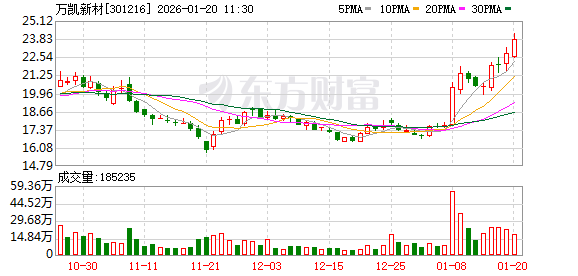
万凯新材创历史新高,融资客减仓
Zheng Quan Shi Bao Wang· 2026-01-20 03:34
Group 1 - The stock price of Wankai New Materials reached a historical high, increasing by 4.34% to 23.78 yuan, with a trading volume of 13.38 million shares and a transaction amount of 313 million yuan, resulting in a turnover rate of 2.44% [2] - The latest total market capitalization of the company in A-shares is 13.797 billion yuan, while the circulating market capitalization is 13.039 billion yuan [2] - In the basic chemical industry, the overall decline is 0.43%, with 165 stocks rising and 10 stocks hitting the daily limit, while 261 stocks are declining, with the largest declines from Shenjian Co., Bofei Electric, and Dongcai Technology at 9.99%, 9.92%, and 8.43% respectively [2] Group 2 - The latest margin trading data shows that the margin balance for Wankai New Materials is 616 million yuan, with a financing balance of 615 million yuan, which has decreased by 47.37 million yuan over the past 10 days, a decline of 7.15% [2] - The company's Q3 report indicates that it achieved an operating income of 12.436 billion yuan, a year-on-year decrease of 5.43%, while net profit reached 77.5944 million yuan, a year-on-year increase of 183.45%, with basic earnings per share at 0.1500 yuan and a weighted average return on equity of 1.45% [2] - On January 16, the company released a performance forecast for 2025, expecting a net profit between 156 million yuan and 203 million yuan, with a year-on-year change range of 152.10% to 167.67% [2]

A股,两融降温!结束10连增
证券时报· 2026-01-20 03:13
Core Viewpoint - The implementation of new margin requirements has led to a decline in the margin trading balance and trading volume in the A-share market, indicating a cooling off in the margin trading environment [2][4][5]. Group 1: Margin Trading Regulations - On January 19, 2026, the minimum margin requirement for investors financing the purchase of securities was raised from 80% to 100% [5]. - This adjustment applies only to new financing contracts, while existing contracts will continue under previous regulations [5]. Group 2: Market Impact - On the first day of the new regulations, the margin trading balance decreased to approximately 27,232 billion yuan, a reduction of about 84 billion yuan from the previous trading day, ending a streak of 10 consecutive increases [4]. - The financing balance on January 19 was about 27,059 billion yuan, down by approximately 85 billion yuan, also marking the end of a 10-day growth trend [4]. - The total margin trading volume on January 19 was around 2,684 billion yuan, the first time it fell below 3,000 billion yuan since January 6, and the lowest single-day figure for 2026 [4]. - The proportion of margin trading volume to total A-share trading volume decreased to 9.82%, the first time it has been below 10% since December 16, 2025, down from 11.01% on January 16 [4]. Group 3: High Margin Balances in Selected Stocks - Despite the overall decline in margin trading balances, many stocks still maintain high margin balances, with 17 stocks having balances exceeding 10 billion yuan as of January 19 [7]. - Notably, stocks such as China Ping An, Dongfang Wealth, and Ningde Times have margin balances exceeding 20 billion yuan [7].

资金跟踪系列之二十九:两融与北上继续回流,机构ETF明显净流出
SINOLINK SECURITIES· 2026-01-19 14:36
Macro Liquidity - The US dollar index continued to rise, and the degree of "inversion" in the China-US interest rate differential deepened. The nominal and real interest rates of 10Y US Treasuries both increased, indicating a rise in inflation expectations [1][16]. - Offshore dollar liquidity showed marginal easing, while the domestic interbank funding situation remained balanced, initially tightening and then loosening. The yield spread between 10Y and 1Y bonds widened [1][23]. Market Trading Activity, Volatility, and Liquidity - Market trading activity continued to rise, with the volatility of the CSI 1000, STAR 50, and ChiNext Index all increasing. Sectors such as military, media, computing, retail, and consumer services had trading activity above the 80th percentile [2][28]. - The volatility of the CSI 1000, STAR 50, and ChiNext Index increased, while the volatility of various sectors remained below the 80th historical percentile [2][35]. - Market liquidity indicators improved, but all sectors remained below the 50th historical percentile [2][40]. Institutional Research - The electronic, pharmaceutical, computing, non-ferrous metals, and machinery sectors had the highest research activity, while banking, real estate, transportation, petroleum and petrochemicals, and retail sectors saw a month-on-month increase in research activity [3][47]. Analyst Forecasts - The net profit forecasts for the entire A-share market for 2026/2027 were adjusted, with increases in sectors such as pharmaceuticals, chemicals, light industry, electronics, and real estate [4][21]. - The net profit forecasts for the ChiNext Index and CSI 500 for 2026/2027 were raised, while the forecasts for the Shanghai 50 and CSI 300 were adjusted up and down, respectively [4][23]. - Mid-cap and small-cap growth sectors saw upward adjustments in their net profit forecasts for 2026/2027, while mid-cap and small-cap value sectors were adjusted down [4][27]. Northbound Trading Activity - Northbound trading activity rebounded, continuing to net buy A-shares. The trading volume ratio in sectors such as computing, home appliances, and non-bank financials increased, while it decreased in communication, electronics, and electric new energy sectors [5][32]. - For stocks with northbound holdings of less than 30 million shares, the main net purchases were in TMT, machinery, and military sectors, while net sales occurred in electric new energy, construction, and agriculture sectors [5][33]. Margin Financing Activity - Margin financing activity slightly declined but remained at a relatively high level since November 2025. The net purchases were mainly in TMT, non-bank financials, and electric new energy sectors, while net sales occurred in building materials and petroleum and petrochemicals [6][35]. - The proportion of financing purchases in the pharmaceutical, construction, and coal sectors increased month-on-month [6][38]. Hot Stocks on the Dragon and Tiger List - The trading activity on the Dragon and Tiger list continued to rise, with the total trading volume and its proportion of total A-share trading both increasing. The military, media, and automotive sectors had relatively high and rising trading volumes on this list [7][41]. Active Equity Fund Positions and ETF Trends - Active equity funds significantly reduced their positions, while ETFs experienced substantial net redemptions. Active equity funds mainly increased positions in petroleum and petrochemicals, real estate, and coal sectors, while reducing positions in TMT, military, and machinery sectors [8][46]. - The correlation of active equity funds with small-cap growth and large/small-cap value increased, while the correlation with large/mid-cap growth and mid-cap value decreased [8][48]. - New equity fund establishment scales increased, with both active and passive funds seeing a rise in establishment [8][50]. - ETFs tracking indices such as the Shanghai 300, STAR 50, and Shanghai 50 saw major net redemptions, while those tracking computing, non-ferrous metals, and media sectors saw major net purchases [8][52].